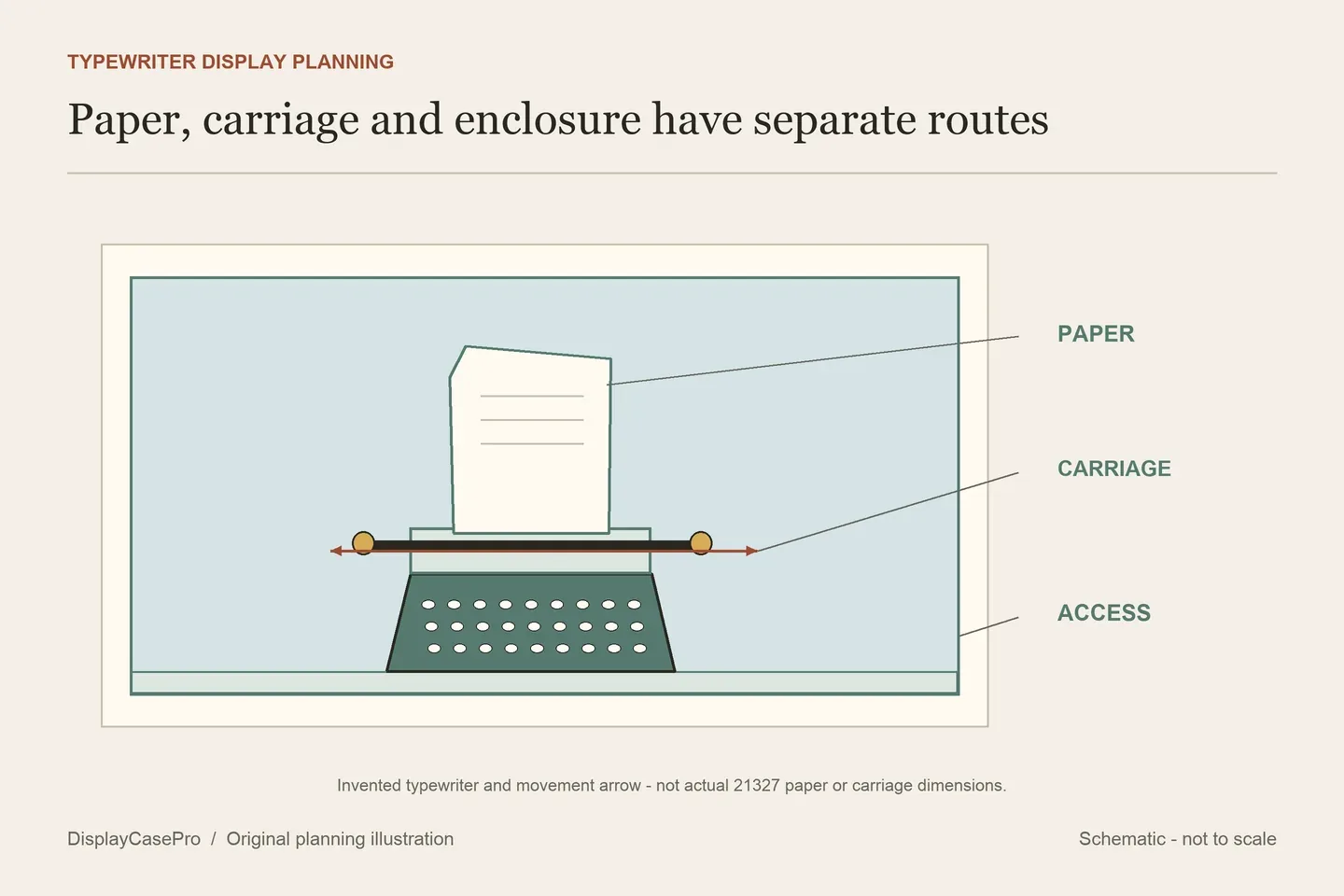
A LEGO Typewriter display case needs to accommodate more than the body of set 21327. Decide which sheet of paper you will show, where the carriage will rest and whether you want to demonstrate the keys. A compact closed display, a lift-off cover and a hinged enclosure can answer different access needs even when their size labels look similar.
The model's body height is not the displayed paper height
LEGO's 21327 description gives a model reference of over H11 × W27 × D26 cm. It describes a center typebar that rises with the keys, a carriage moving from right to left and a platen roller that accepts real paper. The included letter is another display choice.
Keep that descriptive metric reference separate from the page's rounded inch widget. It does not specify the maximum height of every inserted sheet, the carriage's entire travel or the space a hand needs to reach the keys.
Choose the actual sheet and how it sits in the roller before measuring the scene. Its top, rearward curve and side edges can project beyond the body. Include the readable portion you want visible rather than folding the paper against a panel to fit a favorite cover.
Record the carriage's resting position as well. A photograph with the carriage near the middle does not establish the width occupied at either end of its movement. If you intend to demonstrate the mechanism, examine its intended travel under the model instructions before asking whether the case provides room for that task.
Decide what remains accessible after enclosure
| Intended use | Complete outline to record | Opening question |
|---|---|---|
| A fixed model without paper | Body, carriage position, knobs and other side projections. | How is the model placed and retrieved? |
| A letter displayed in the roller | Full sheet height and curve, with its readable area facing the chosen view. | Must the cover come off to change the sheet? |
| Demonstrating key movement | The intended typebar and carriage movement, not only their resting outlines. | Can the keys and carriage be reached as intended, or only after opening? |
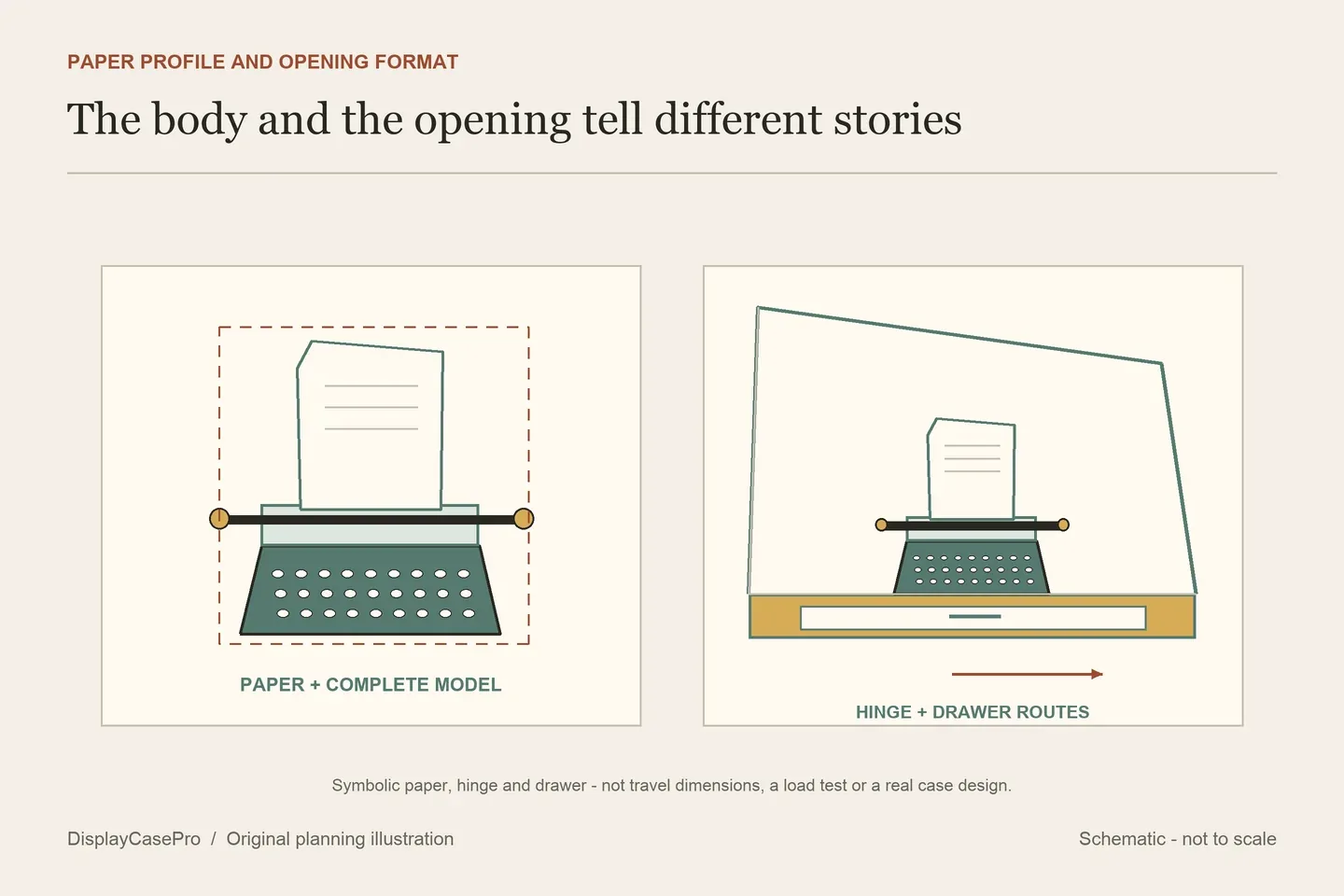
| A hinged case with storage | The closed display plus the cover's opening route and drawer movement. | What needs room above, behind and in front of the case? |
A case's internal height minus the official body height is not a universal paper allowance. The quoted numbers may have different resting surfaces, and the paper's curve is part of the arrangement. Ask for clear space above the supported model in the selected base position.
Keep the paper display separate from the simulated typing action. A sheet that looks good in a fixed photograph does not prove it can remain there throughout the movement you want to show. Resolve that combination before ordering, rather than using the case front to restrain a moving part.
An internal cavity and a product dimension are different specifications
These maker descriptions were read on 17 October 2026. The table preserves their original measurement definitions. It is a comparison of published information, not a ranking or an installation test.
| Case | Published dimensions | Format and unresolved detail |
|---|---|---|
| Wicked Brick 21327, LDS325.1.7 | External W35 × D35 × H19.3 cm. | Lift-off cover, locating studs and magnetic two-tier base. Request clear interior and the intended paper configuration. |
| Kingdom Brick Supply 21327 | Approximate internal L32.8 × W32.8 × H20.0 cm; external L34.3 × W34.3 × H20.6 cm. | 40 × 40-stud area is separately listed. It does not establish clearance for a letter or carriage travel. |
| iDisplayit 21327 | Internal L32 × W32 × H20 cm; external L34 × W34 × H21 cm. | The product text does not specify an operating aperture for the keys. Confirm routine access. |
| Brick In It 21327 | W33 × D30 × H18 cm, labelled product dimensions. | 3 mm clear panels, 5 mm black base and metal corner cubes are described; inside/outside boundary is not stated. |
| J.WOO Design 21327 | W31 × D30 × H20 cm sequence. | Pine base, hidden drawer and hinged acrylic cover. The sequence does not define usable interior or open-cover space. |
The two products giving a 20 cm internal height still publish different floor dimensions. Neither description establishes the maximum paper profile or working envelope of every chosen carriage position. Keep the complete scene and intended access attached to the exact case enquiry.
For the two unlabelled product-size lines, request both the clear receiving cavity and complete exterior. Do not subtract panel thickness from the advertised size or assume the drawer is outside the quoted height. A named set is useful identification, but it does not answer those measurement questions.
A hinged cover changes the access route
J.WOO's description introduces a different format: a flip-top acrylic cover with metal hinges and a drawer within the pine base. Ask which part moves, where it rests when open and what clearance the hinge needs at your location. The maker's broad angle-holding statement is not our test of a particular open position.
Include the drawer's opening route in front of the base if you intend to use it. Its presence does not specify a usable drawer cavity or guarantee that a particular sheet, accessory or stationery item fits. Keep those storage dimensions as a separate question.
For Wicked Brick's lift-off design, the whole clear cover must be raised from its grooves. Leave a suitable route past the paper and somewhere to put the cover down. A neighboring enclosure or low shelf above can affect the routine even though the closed exterior fits.
Wicked Brick also describes a specific stacking arrangement involving removal of the lid and another case with the same base size. That is not a general approval to stack arbitrary boxes. If considering the exact arrangement, confirm its current instructions and how the layer above affects ordinary access.
Record the sheet, not only the set number
Choose the usual viewing position so that the letter, keys and carriage are understandable together. A background can emphasize the writing scene; a clear back can provide another view. Neither choice is evidence of additional operating room.
Use the blank Typewriter paper and access worksheet to record sheet identity, full outline, carriage position, internal dimensions and opening method. Keep a photograph of the chosen scene with the record so that a later paper change is checked again.
The LEGO shelf case guide covers placing the complete exterior on furniture. This guide adds the Typewriter's paper and movement questions; it does not verify dust exclusion, UV performance or a supplier's universal fit claim.
Common questions
Does the official 11 cm height include any letter I insert?
It is a model reference, not a maximum for an unspecified sheet. Measure your displayed paper and its curve with the actual model.
Can I use the keys without removing the case?
Establish the opening and full intended movement for the exact case. A clear front or set-specific product title does not prove access.
Does a hinged cover need less room than a lift-off case?
It needs a different route. Compare the actual hinge movement and resting position with the lift-off route at your shelf; the closed heights alone cannot decide that.
Comments
Share a display tip or ask a question.