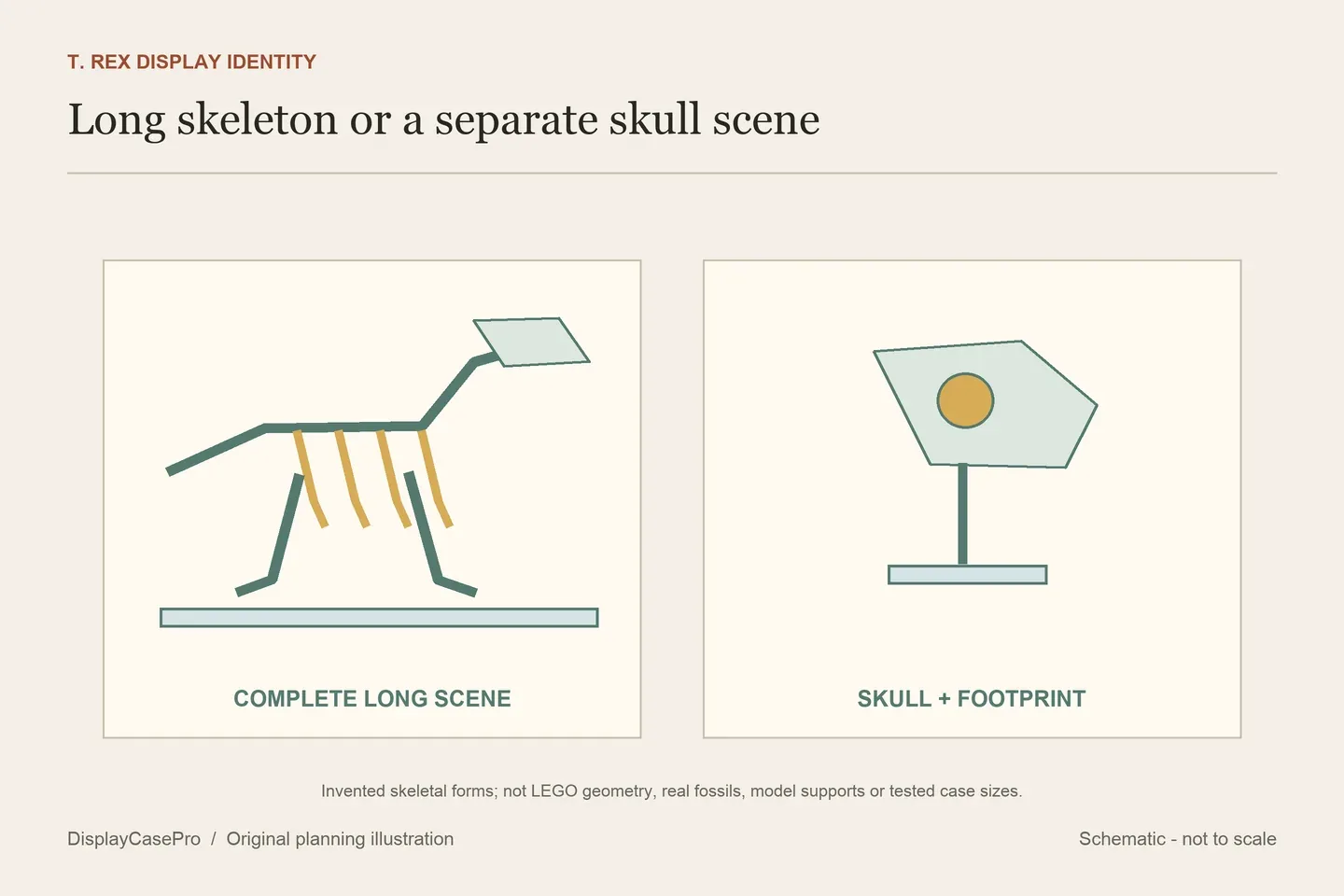
Choose a LEGO T. rex skeleton display case by confirming whether you own the complete 76968 skeleton or the separate 76964 skull-and-footprint set. Search results can mix both. For the long skeleton, record the actual head, jaw and tail pose before comparing the case’s inside and outside dimensions.
76968 is the skeleton; 76964 is the skull display
LEGO’s Dinosaur Fossils: Tyrannosaurus rex 76968 describes an articulated skeleton with movable head and jaw, posable arms and tail, a display stand, information plaque and two minifigures. Its descriptive height reference is over 33 cm.
Dinosaur Fossils: T. rex Skull 76964 instead includes a skull with an opening jaw, a stand and plaque, a footprint and an amber detail. Its skull-with-stand reference is over H21 × W18 × D16 cm. The footprint can be arranged separately, so that reference is not a full measurement of every combined scene.
| Set | Reference in LEGO’s description | Not established by that reference |
|---|---|---|
| 76968 skeleton | Over 33 cm high. | Full length, depth and every head or tail pose. |
| 76964 skull with stand | Over H21 × W18 × D16 cm. | Whole scene with separately positioned footprint and amber detail. |
The Flying Box product in the sampled results names 76964. Its case line is L9.75 × W6.5 × H9.2 inches, with a separate 10.25 × 7-inch base. Keep the larger base in placement checks and obtain the clear inside boundary. Those figures belong to the skull product, not the full 76968 skeleton.
Treat the tail and head as part of the receiving outline
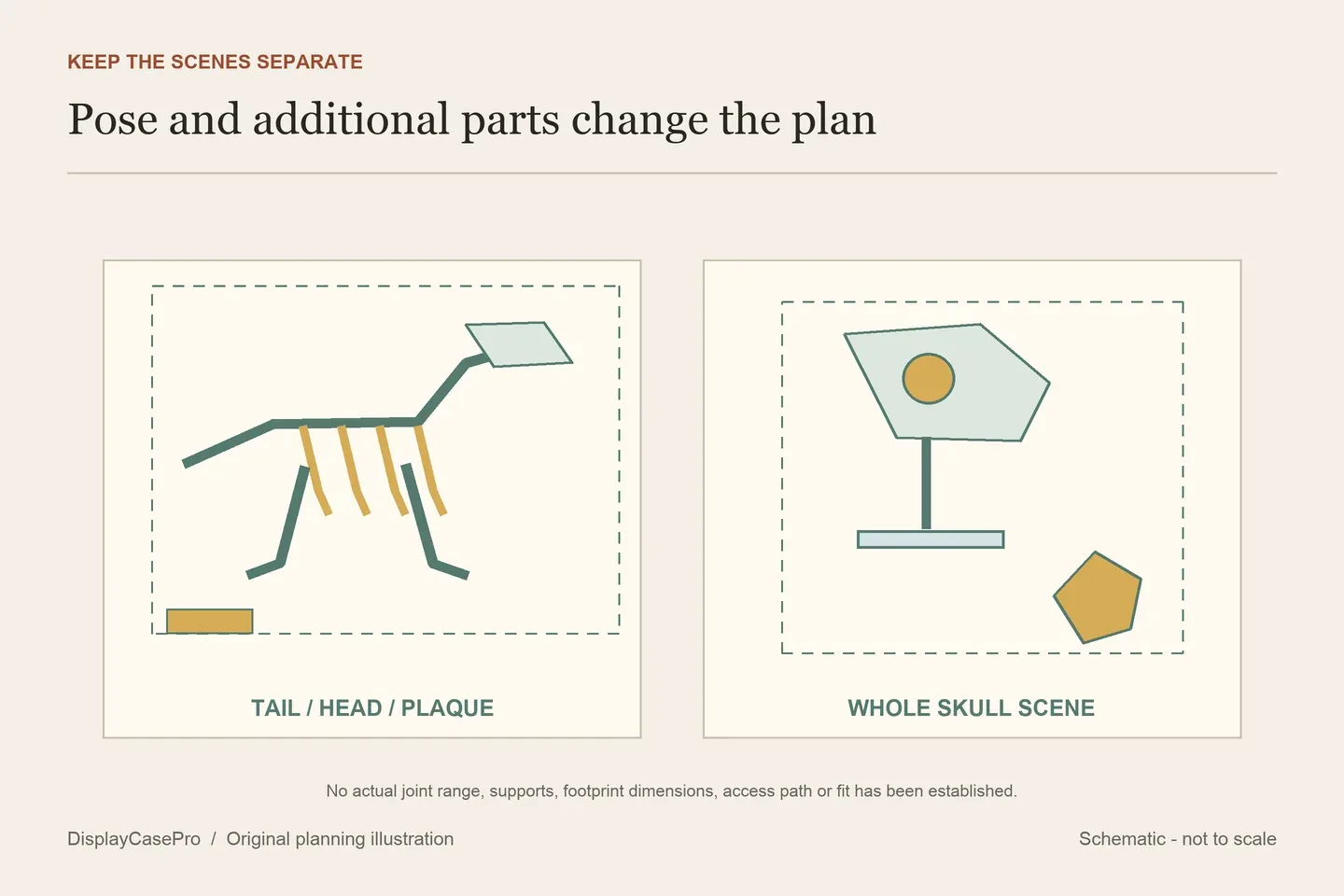
For 76968, choose the intended model pose following its actual instructions. Include the complete stand, the furthest tail point, skull and open jaw if retained. A long horizontal projection can be the limiting feature even when the main skeleton stands comfortably below the case top.
Make a side record for the long outline and an overhead record for sideways head or tail projections. Keep the actual footprint of all supports in that plan. The silhouette seen from the front of a product photograph does not supply the deepest part behind the body.
The over-33 cm height reference is not an exact cavity requirement or a full official length and depth. Do not borrow a smaller skull dimension to complete it. The model’s articulated features also do not imply that every pose is supported or intended inside each set-specific case.
Preserve the boundaries and unresolved axis sequences
These supplier descriptions were read on 18 October 2026. The figures below are published specifications, not our measurements, pose trials or long-shelf load tests.
| Product | Published size | Definition still needed |
|---|---|---|
| Wicked Brick, 76968 | W100 × D28.5 × H38.3 cm. | Boundary unlabelled; actual usable interior and pose. |
| Blacked Brick, 76968 | External W110 × D25 × H39 cm. | Clear receiving depth and complete intended tail scene. |
| Kingdom Brick Supply, 76968 | Inside L109.6 × W26.4 × H39.2 cm; outside L111.1 × W27.9 × H40.1 cm. | Approximate figures; actual pose and opening. |
| Brickcessories, 76968 | Inside 1094 × 294 × 400 mm; outside 1106 × 406 × 407.5 mm. | Axis labels and current complete base drawing. |
| Flying Box, 76964 skull | Case L9.75 × W6.5 × H9.2 in; base 10.25 × 7 in. | Different set; case inside/outside boundary unlabelled. |
Blacked Brick explicitly labels its sequence external. The 25 cm depth therefore cannot be treated as 25 cm of usable floor, and it should not be compared directly with another maker’s inside width without mapping the viewing orientation.
Kingdom Brick Supply distinguishes the inside and outside of its long case. Keep those rows separate when deciding whether the scene enters the enclosure and whether the finished enclosure sits at the intended location. A nominal stud area is another description, not a substitute for the stated clear dimensions.
Brickcessories supplies inside and outside sequences but does not label the individual axes in those lines. The middle values differ by 112 mm. Do not silently change 406 mm, assume a typo or invent a base overhang to explain it. Obtain a current axis-labelled drawing showing the selected case and complete base.
The Wicked Brick description gives a different three-axis sequence without labelling its measurement boundary. Keep that uncertainty explicit. Its set-specific title does not establish every tail position, and subtracting sheet thickness would not define all joints or usable surfaces.
Plan the plaque and figures along the long front view
Choose the normal viewing side and give the plaque and minifigures actual positions. A long skeleton can leave apparently open floor below its body while a tail or front support still blocks a figure’s sightline or access route.
Blacked Brick describes front minifigure studs and an information plaque. Confirm which positions are supplied and whether they suit the exact scene you want. Do not add figures behind inaccessible supports merely because a case title lists the correct set number.
Compare a clear rear with the selected printed background from the intended room view. Bone-coloured elements can read differently against different artwork and reflections. That is a viewing decision, not evidence that the printed version has another cavity or measured UV-filtering performance.
For 76964, make a separate plan for the skull, footprint and amber detail. Do not spread those components according to the whole skeleton’s long layout. Keep the skull’s own stand, plaque and intended jaw position with that smaller scene.
Plan the cover route before choosing the furniture
Ask the maker how the completed scene enters and which part is intended to open for routine access. With a long display, confirm where the removed cover or panel rests and whether it can follow its intended route past the skull and tail. Assembly brackets do not themselves identify a repeated-access door.
Kingdom Brick Supply says the case is not designed to be relocated with the set inside. Choose the final location and intended handling sequence before treating the populated enclosure as a movable unit. No listed dimensions here establish furniture load capacity.
Use the T. rex model and case worksheet to retain set identity, pose, plaque, dimension boundaries and the unresolved axis sequence. The collection measurement guide covers complete profiles, and the LEGO shelf case guide covers the finished enclosure’s placement.
Common questions
Will a T. rex skull case hold the full skeleton?
The sampled skull case names 76964. Select an actual 76968 enclosure and confirm the full supported scene.
Can a case’s external depth be used as clear tail space?
Obtain the actual interior and intended pose. The outside describes the enclosure’s occupied footprint.
Comments
Share a display tip or ask a question.