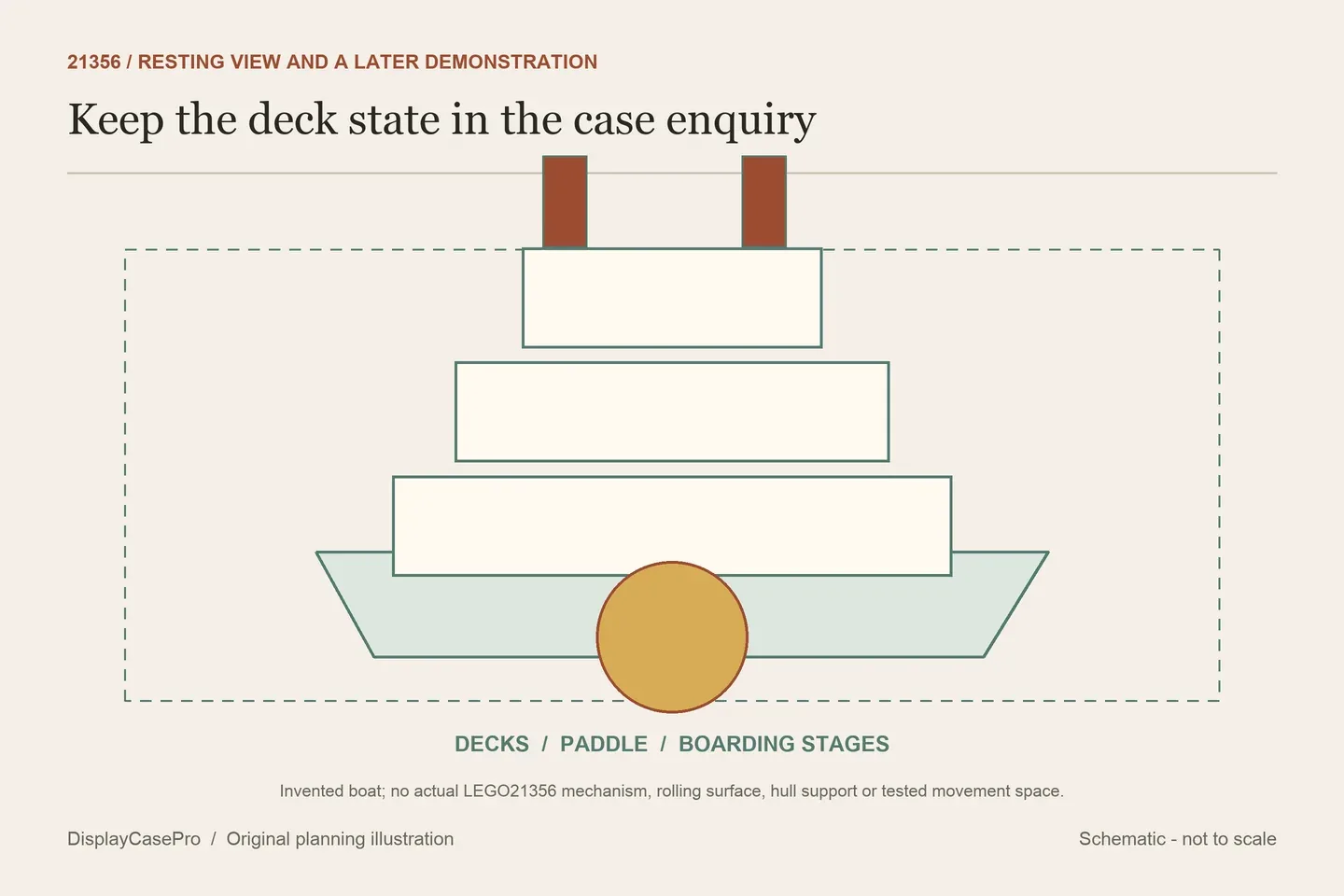
Choose a LEGO River Steamboat 21356 display case for its deck arrangement, paddle and boarding stages, then decide whether a separate ticket booth belongs beside it. This boat’s moving features are a different task from enclosing a settled model. A wood base and a closed case height also need a clearly identified receiving floor.
Record the decks and projections you intend to show
LEGO’s official River Steamboat description gives a reference of over H40 × L69 × W15 cm. It describes a removable pilothouse, texas deck and main deck, with interior spaces including the steam-engine museum. That is a model reference, without a case or a separately arranged booth.
Choose the normal presentation before comparing enclosures. Will all decks stay in place, or will one removed section be displayed separately? Record the boarding stages, anchor and rudder in their intended resting states, including any projection beyond the hull.
Keep a photograph of that complete arrangement with its set number. The name River Steamboat 21356 should stay attached to every case quotation; another sailing ship’s stand, rigging envelope or optional base does not define this boat’s receiving layout.
A working paddle does not establish a working space inside the case
| Task | Model feature | Case question |
|---|---|---|
| View interior decks | Removable pilothouse, texas deck and main deck. | What opens first, and where will each removed section rest? |
| Demonstrate the mechanism | Moving the boat on a surface activates the paddle and connected engine. | Where can the intended operation take place under the model’s instructions? |
| Change a resting feature | Boarding stages, anchor or steering/rudder state. | How is the model reached after the enclosure opens? |
The official description links paddle activation to moving the boat on a surface. A case advertised to receive the resting model has not demonstrated the space or suitable arrangement for that movement inside it. Plan the operation as its own task rather than subtracting hull length from a case line and calling the remainder travel.
Choose the side view that shows the paddle and the deck details you value. A printed water scene may complement that view, but it remains artwork. It does not provide a working surface, more width beside a boarding stage or a different physical support.
Retain the case boundary and the base footprint
These descriptions were read on 18 October 2026. They are source specifications, without physical fit, movement, finish compatibility or protection tests for this guide.
| Exact example | Published dimensions | Question to retain |
|---|---|---|
| Wicked Brick Limited Edition | W76 × D30 × H42.3 cm. | Inside/outside is unlabelled; identify the selected edition. |
| Flying Box | Case L28.25 × W7.25 × H16.5 in; base 28.75 × 7.75 in. | Unlabelled case boundary and separate larger base. |
| Blacked Brick oak version | External W73 × D20 × H42 cm; 3 cm oak base. | Clear height above the actual receiving floor. |
| Brickcessories | Inside 734 × 196 × 430 mm; outside 746 × 206 × 437.5 mm. | Boundaries are labelled, but axes are not. |
| iDisplayit | Inside L78 × W26 × H43 cm; outside L80 × W28 × H44 cm. | Actual boat-and-booth arrangement and access. |
Brickcessories distinguishes inside and outside without naming the tuple’s axes. Request a drawing before mapping those values to the chosen orientation. Its lake-inspired printed rear is a background option, without adding brick-built scenery.
Flying Box’s larger base belongs in the furniture plan. The narrower case sequence is a separate reference whose clear receiving boundary still needs confirmation. Linked instructions for general wall-mounted or minifigure cases do not establish this boat enclosure’s opening routine.
An added ticket booth needs an identified place
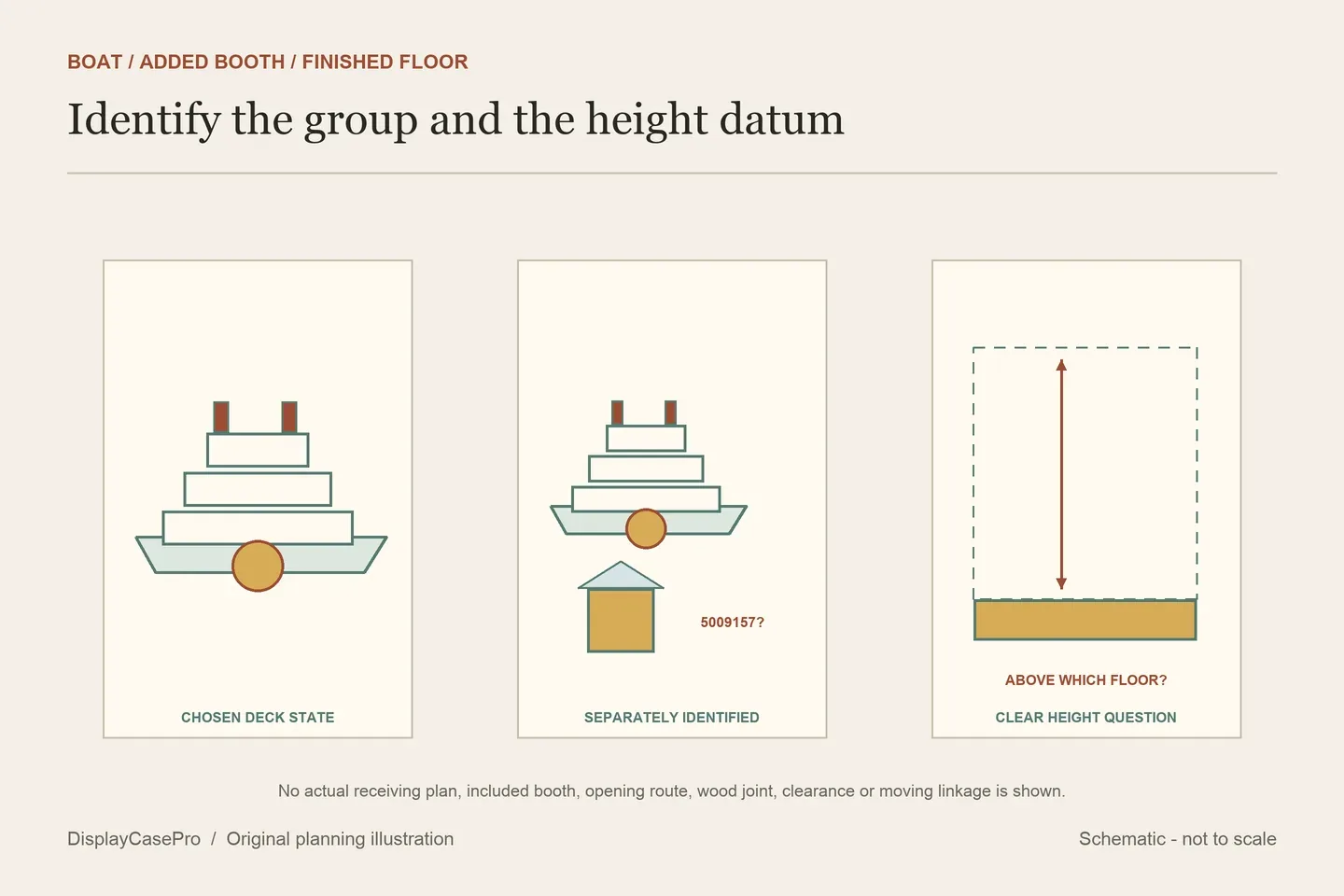
iDisplayit’s description expressly says its case has space for the LEGO GWP 5009157 Amelia Ticket Booth. That is a capacity statement about this case, rather than evidence that the booth is supplied or that every 21356 enclosure receives it.
If the booth belongs in your scene, record it separately from the boat. Ask for the intended layout showing both complete models, any plaque and the visible approach to each. A nominal 97 × 32-stud area is not a finished position map.
If you want the boat alone, retain that choice too. A wide case can serve a different composition from a narrow solo-boat enclosure, but the published number alone does not determine the best view. Compare the actual scene and receiving drawing before selecting the smaller exterior.
Ask where the inside height begins
Blacked Brick’s oak version specifies a 3 cm wood base and 42 cm external height. Those figures and the model’s over-40 cm reference do not establish two centimetres of usable headroom. Obtain the cavity above the finished floor, without assuming how the published exterior includes the base.
Wicked Brick’s Limited Edition describes a 5 mm matte-black base and separate set-information and edition-number plaques. Keep those pieces with this exact case record. An edition name or connector hardware does not supply a routine opening sequence or a current availability claim.
iDisplayit describes joining the sides and top with eighteen fittings, with the top secured to the surround. Confirm the surround’s release and resting place before planning deck removal. Its page says the case is not designed for relocation with the model inside.
Use the steamboat decks, paddle and booth worksheet and the LEGO shelf case guide to keep the closed scene, finished floor, whole base and later access routine together.
Common questions
Can the boat’s paddle be demonstrated inside a fitted case?
Static fit does not establish the rolling operation. Confirm the intended location and model operation separately.
Is the named 5009157 booth included with the case?
The cited page describes space for it. Obtain the selected package’s contents and receiving plan before assuming inclusion.
Comments
Share a display tip or ask a question.