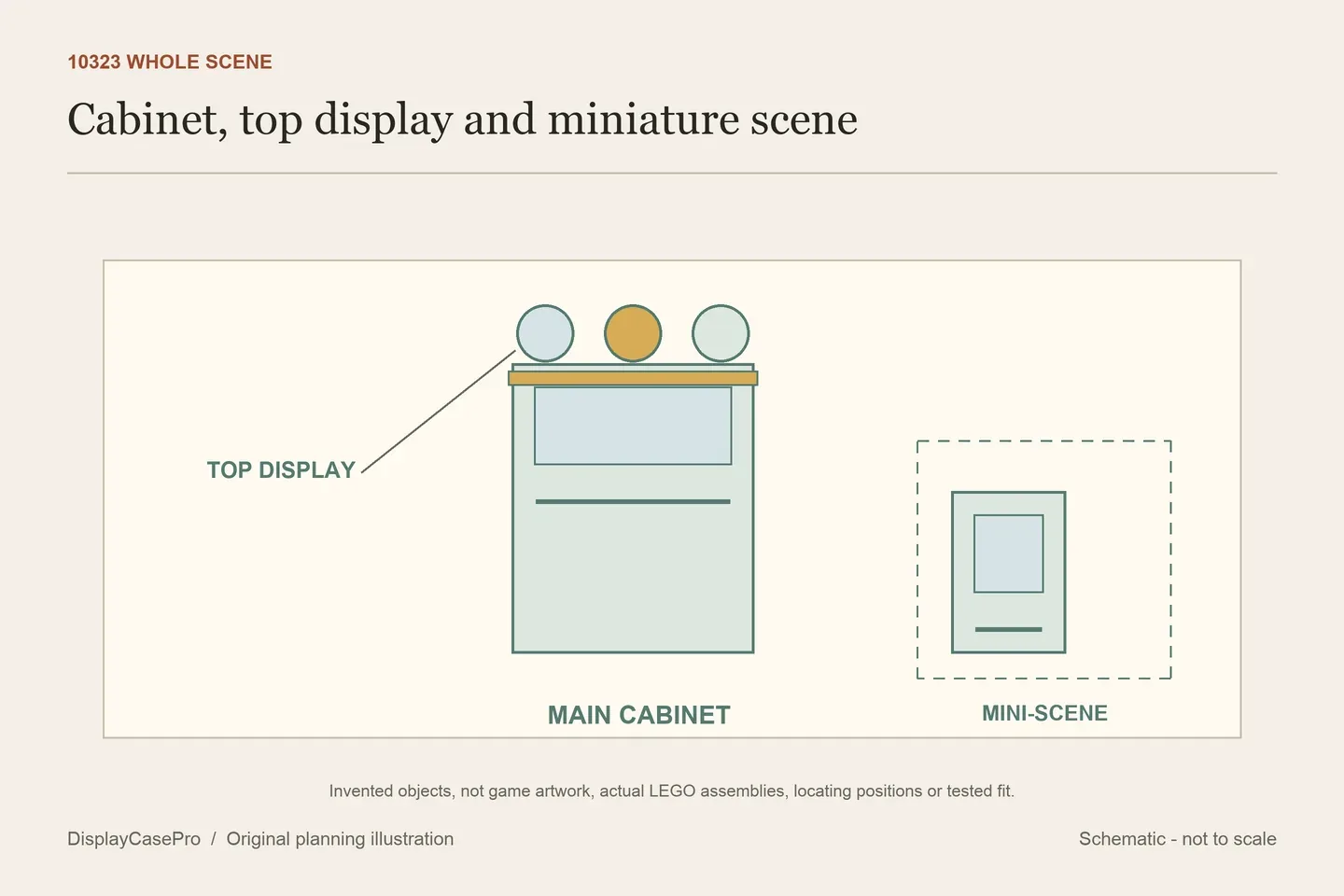
A LEGO PAC-MAN Arcade display case needs a plan for more than the cabinet in set 10323. Include the rotatable character display and decide whether the miniature arcade scene stays inside the cabinet or sits beside it. Then distinguish crank access from reaching the rear panel, coin-slot light and other features.
A side flap can answer one specific access task. A lift-off surround offers a different routine. Compare the complete scene and intended operation before treating two case-size lines as equivalent.
The cabinet reference is not the entire displayed group
LEGO's official 10323 page describes a non-functional game replica with a handle-driven mechanical maze, an illuminating coin slot, a removable rear panel, rotatable character figures and a miniature arcade scene. Its cabinet reference is over H32 × W25 × D17 cm.
Keep that reference attached to the cabinet. Record the complete arrangement with the character display and whichever position you choose for the miniature scene. It does not define every possible grouping or a hand's operating space.
The official description also calls the buildable character presentation a display case. That is a component of the LEGO set, distinct from the surrounding acrylic enclosure compared here. Keep both items named in the scene record so the word case does not hide one of the objects you intend to display.
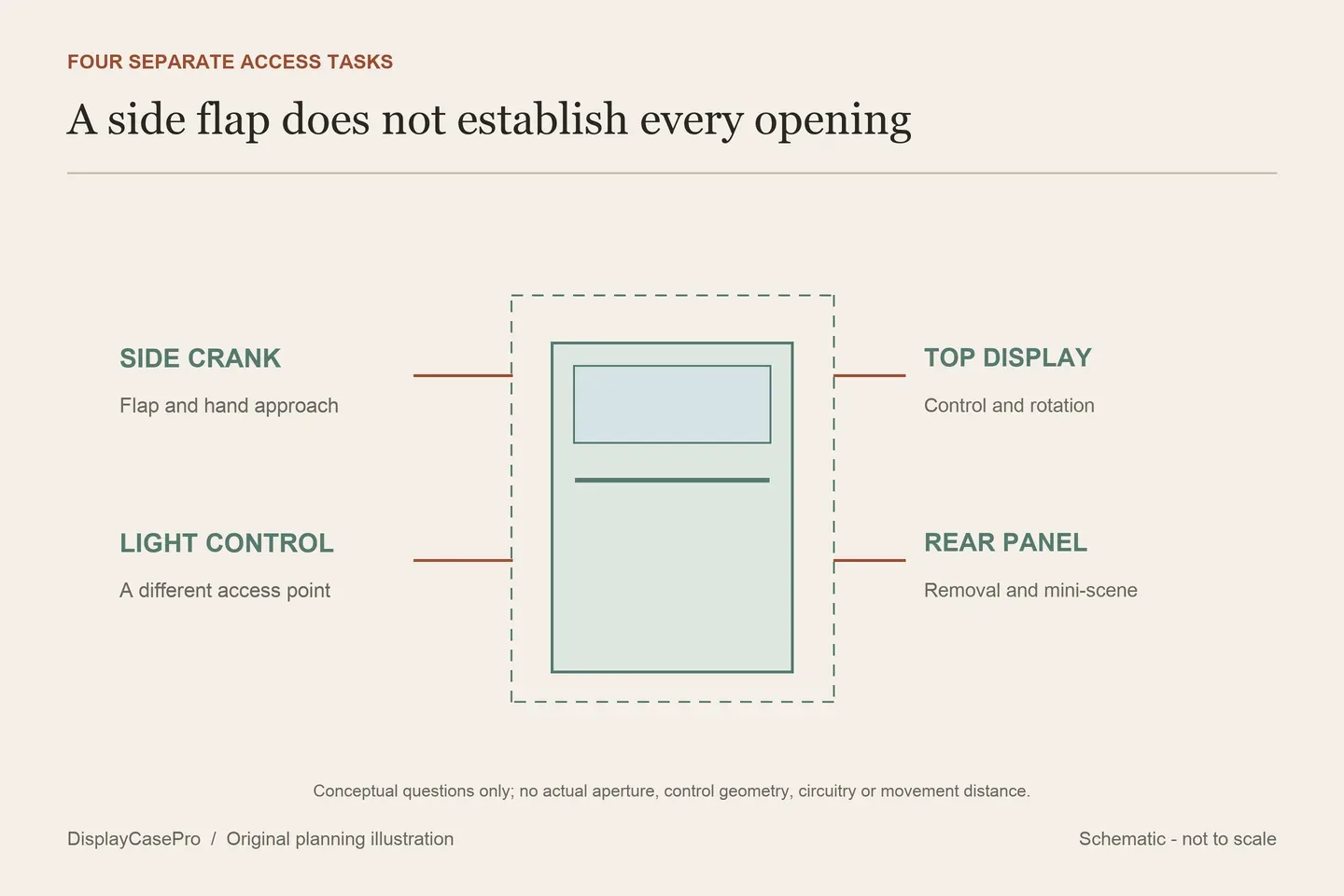
One opening does not answer every access question
| Task | What to identify | Receiving question |
|---|---|---|
| Turn the maze crank | The handle's actual location, movement and hand approach. | Does the case provide the intended side flap, or must the surround be removed? |
| Reach the coin-slot light | The actual light-brick control and model instructions. | Can that control be reached in the chosen layout? Crank access does not establish this. |
| Open the rear panel | The panel route and the miniature scene's retained position. | Where does panel removal happen, and where will the removed part rest? |
| Change the character display | The top assembly and its intended control or rotation. | What must be opened before the chosen change can be made? |
Choose the tasks you actually want to perform between display visits. A fixed viewing arrangement can have a simpler routine than a model demonstrated frequently. Neither choice follows from the transparency of the panels.
Keep the hand-powered maze and the light brick distinct. A merchant's phrase about power functions should not become a claim that this case supplies a motor or an aftermarket lighting kit. Identify any separately added equipment before asking about its occupied space and controls.
Compare the dimensions with their stated boundaries
These supplier descriptions were read in October 2026. They are published specifications, not our measurements, opening tests or verified performance ratings.
| Exact case | Published figures | Access or layout detail |
|---|---|---|
| Wicked Brick 10323 | W35 × D23 × H42.3 cm; inside/outside is unlabelled. | Cabinet cutout, miniature-scene studs, information plaque and lift-off surround described. |
| iDisplayit 10323 | Inside L32 × W26 × H43 cm; outside L34 × W28 × H44 cm. | Side flap expressly intended for the maze crank; space beside the cabinet for the miniature scene. |
| Flying Box 10323 | Case L11.25 × W8.25 × H16.5 in; separate base 11.75 × 8.75 in. | Case inside/outside is unlabelled. Obtain the intended arrangement and routine opening. |
| Kingdom Brick Supply 10323 | Approximate inside L29.6 × W23.2 × H42.4 cm; outside L31.1 × W24.7 × H43 cm. | 36 × 28-stud area and twelve screws are listed. A crank flap is not specified in the main description read. |
| Songlection 10323 | Inside W30 × D20 × H43 cm; also given as 11.7 × 7.8 × 16.8 in. | 10 mm black PVC base and five acrylic panels. Confirm the actual opening and scene layout. |
Do not subtract LEGO's cabinet height from an unclassified case height to declare spare room for the top assembly or a hand. Record the complete displayed group and establish clear interior above the selected base.
Retain material and footprint distinctions too. Songlection's base is PVC, while Flying Box separately lists a larger base than its case plan dimensions. Neither a rounded inch conversion nor the outside base rectangle supplies a missing receiving cavity.
A crank flap needs a clear approach beside the case
iDisplayit's side flap is a specific purchase feature: the description identifies access to the mechanism that moves the maze. Request the opening dimensions and intended cabinet position. Its stated purpose is useful evidence, but this guide has not tested a person's hand clearance through it.
Keep the adjoining furniture in that enquiry. Another case or a room wall immediately beside the flap may obstruct its movement or the approach to the crank. Closed boxes fitting side by side do not establish a usable operating arrangement.
The same listing says the lid rests on top, with twelve fittings used in the case assembly. Confirm the opening routine for other tasks rather than borrowing a secured-top description from a different iDisplayit product. It also states that this case is not designed to be relocated with LEGO inside.
Choose whether the smaller scene stays inside or beside the cabinet
The official set provides a miniature scene that can be stored inside the arcade cabinet. Displaying it beside the larger build changes the grouping you want enclosed. Record that choice before comparing floor dimensions.
Wicked Brick describes a specific cabinet cutout and embedded studs for the smaller scene and figure, with the information plaque in front. Follow that intended layout when asking for fit confirmation. The located objects should not be moved to arbitrary positions because an empty corner appears available in a photograph.
Its clear surround lifts from grooves in the base. Reserve the route past the complete top display and somewhere to place the surround before reaching the rear. A rear panel inside the model and a side flap in the enclosure are separate openings.
Use the PAC-MAN scene and access worksheet to record the individual tasks. The LEGO shelf case guide covers placement once the complete exterior and access routes are confirmed.
Common questions
Is the model a working electronic arcade game?
LEGO describes a non-functional gaming replica with a mechanical maze and a light brick. Keep those features separate from a playable electronic machine.
Does the crank flap provide rear-panel access?
Its stated purpose concerns the crank. Confirm the rear-panel and miniature-scene routine separately.
Should the small arcade scene always sit beside the cabinet?
Choose the actual presentation and confirm the selected case's locating arrangement. The official storage position and a maker's side-by-side scene are different layouts.
Comments
Share a display tip or ask a question.