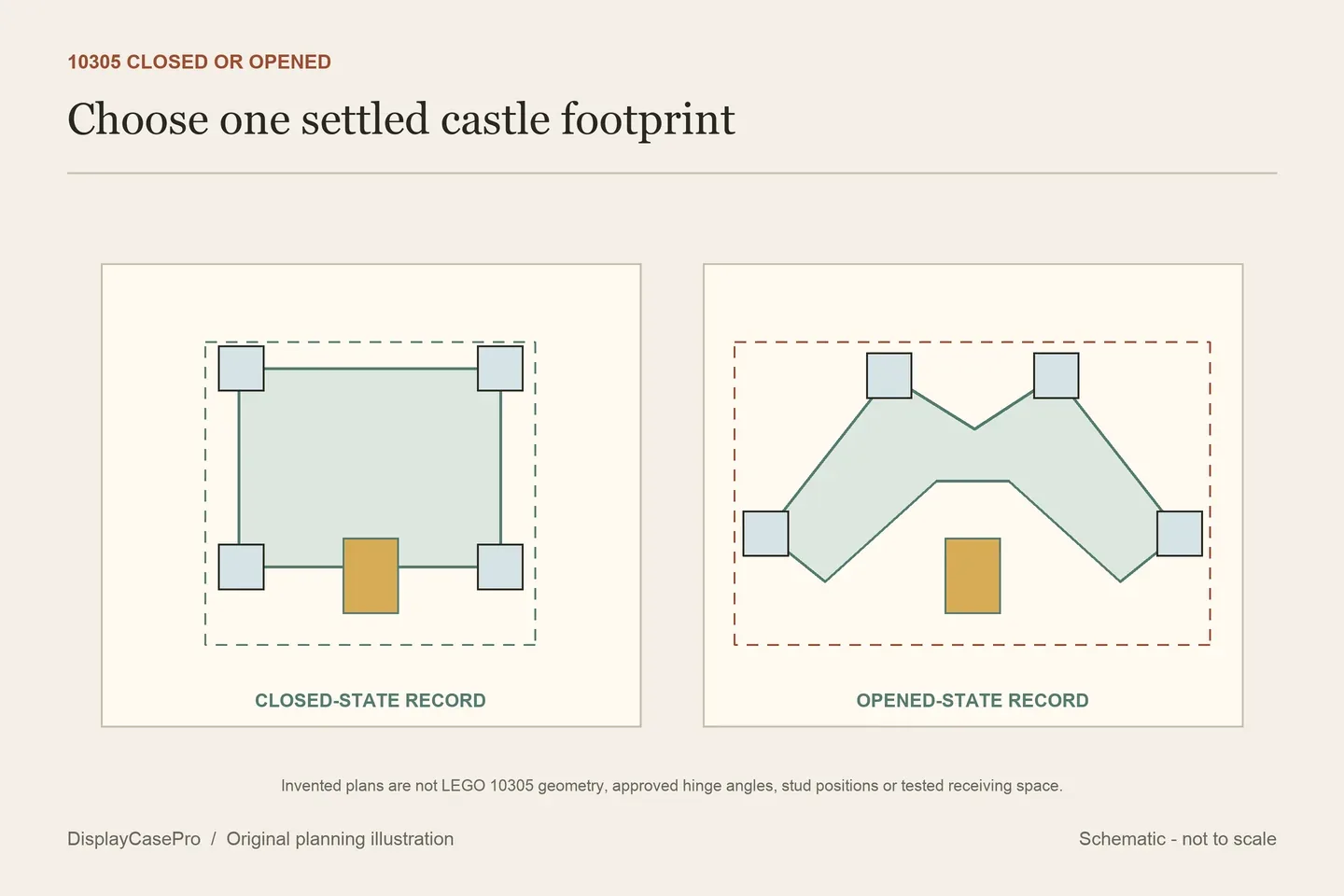
Choose a LEGO Lion Knights' Castle display case for set 10305 in a defined closed or open layout. The official dimensions describe the closed castle, while some case makers explicitly design for an opened presentation. Keep the intended hinge position, drawbridge, figures and base fittings together; space for two resting states does not automatically mean the castle can move between them inside a secured display.
The official reference is explicitly for the closed castle
The LEGO 10305 specification gives the closed model as over H38 × W44 × D33 cm. It describes opening the castle to explore the interior, movable walls, an operating drawbridge and portcullis, a waterwheel, and 22 minifigures.
Keep “when closed” with those dimensions. The 44 cm width is not an official width for every opened angle. If the interior rooms are your main view, record the actual expanded plan rather than doubling a closed dimension or copying an unlabelled photograph.
| Decision | Outline or state to record | Question to resolve |
|---|---|---|
| Closed castle | Complete closed walls, towers, flags and retained scenery. | Does the case's intended base arrangement match that orientation? |
| Opened castle | The actual connected sections and chosen hinge position. | Which expanded layout does the maker's fit statement cover? |
| Drawbridge and entrance | Bridge raised or lowered, with figures and approach clear. | Does the chosen static entrance scene stay inside the receiving space? |
| Feature operation | Opening sections, moving the portcullis or turning the waterwheel. | What access and handling must happen before the feature moves? |
Do not let “open” describe two different things in the order record. An open-position castle case can still be a covered enclosure. The word may identify the model arrangement, not the absence of a front or top panel.
Room for open and closed states is not a moving base
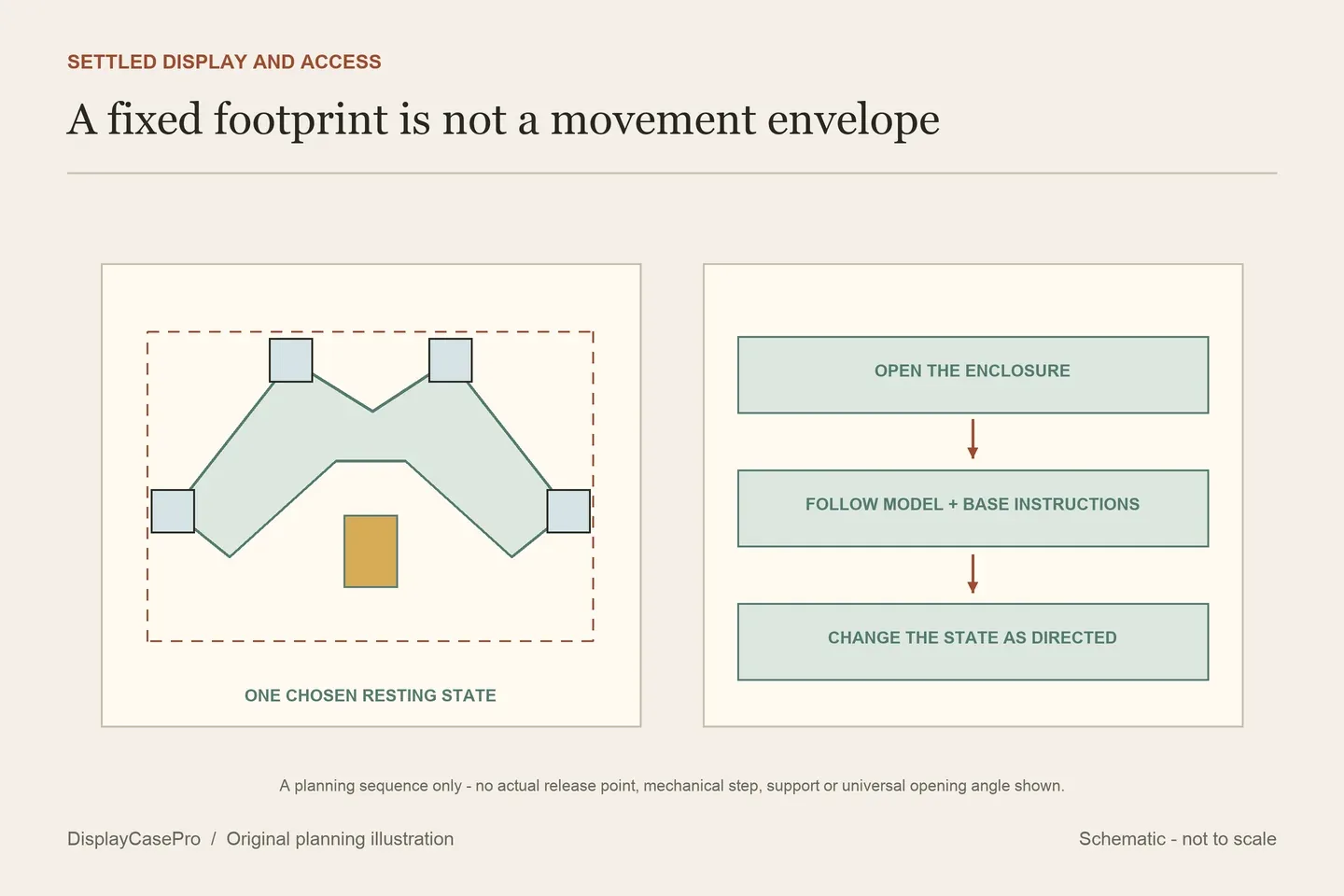
Wicked Brick's 10305 description says its case is wide enough for the castle opened or closed, but recommends choosing one position and then securing the set to the base. Keep both parts of that instruction.
For that product, the useful selection task is a settled scene with the intended locating positions. Do not assume you can swing the sections continuously while they remain secured. Ask how the base receives each documented state and what has to be released before changing it.
Another maker's wider rectangle is not evidence of the same base interface. A fixed stud layout, a flat floor and removable figure sliders give different placement options. Obtain the exact intended castle plan rather than moving studs or adding an improvised support.
Compare the stated castle configuration and size boundary
These descriptions were read on 17 October 2026. Inside dimensions, outside dimensions and unlabelled case lines remain separate. They are published specifications, not fit tests or a ranking.
| Case | Published size | State or question to retain |
|---|---|---|
| Wicked Brick 10305 | External W76 × D39 × H40.3 cm; tiered magnetic base and set/figure studs. | Open or closed resting state, chosen before securing the castle. Clear interior still needed. |
| Kingdom Brick Supply Open | Approximate inside L74.4 × W36 × H39.2 cm; outside L75.9 × W37.5 × H40.1 cm. | The intended opened plan, not every hinge angle or added landscape. |
| Blacked Brick 10305 | External W50 × D50 × H40 cm; front minifigure studs and plaque. | Open-state compatibility is not specified in the description read; obtain the actual receiving layout. |
| Flying Box 10305 | Case L21 × W15.5 × H16 inches; base L21.5 × W16 inches. Case boundary unlabelled; six clear figure sliders described. | Actual castle state, usable cavity and slider arrangement. |
| iDisplayit XL | Inside L78 × W39 × H39 cm; outside L80 × W41 × H40 cm. | Maker describes open or closed presentation; confirm your expanded plan and entry route. |
iDisplayit's 39 cm interior height does not promise a one-centimetre allowance above a castle described as “over 38 cm” when closed. Check the actual highest retained detail and the finished supporting surface. It is also not a measurement of working space for a raised hand or moving section.
Kingdom Brick Supply's product is named Open and gives an approximate L74.4 × W36 cm interior plan. Ask for the intended hinge arrangement and positions of the entrance, waterwheel and figures. Its separate 92 × 44-stud statement does not define every projecting part of the scene.
Blacked Brick's 50 × 50 × 40 cm line is explicitly external and does not identify an opened state. Do not rotate the closed-model reference or subtract guessed panel thicknesses to declare an expanded layout compatible. Leave that question with the maker until the receiving plan is supplied.
Reserve the drawbridge, figures and approach as part of the scene
Choose the bridge position for the view you want. A lowered bridge occupies a different part of the floor from a raised one. Include the actual approach, figures and retained accessories without assuming that the front strip of a case is unused.
Identify the portcullis and waterwheel state separately. A static scene can show those details without providing room for handling their mechanisms. If demonstrations are important, plan the access operation rather than treating a case's static dimensions as a motion envelope.
Flying Box describes six clear minifigure sliders. That is a package detail, not a complete arrangement for all 22 figures. Decide where the actual figures will stand and how they relate to the bridge, plaque and chosen castle view.
iDisplayit's XL description names a smaller compact alternative for a closed-only presentation. The two products should remain distinct in an enquiry. An XL title is not permission to use every expanded angle; a compact title is not a published open-castle fit statement.
Check the cover route before filling the display
Wicked Brick describes lifting the clear case from its base and returning it to the grooves. iDisplayit says its clear surround can be removed from the base. At the intended location, check the route past flags, towers and expanded sections and keep a place for the surround to rest.
Follow the actual model and case instructions before changing the castle's state. Access to a minifigure is a different task from releasing a secured section or moving the drawbridge. A convenient opening for one does not establish the other.
Use the whole exterior for the furniture plan. Flying Box's larger 21.5 × 16-inch base footprint and iDisplayit's L80 × W41 cm exterior belong in that check. The inside floor is not the entire rectangle the finished case occupies.
Both Kingdom Brick Supply and iDisplayit say their cases are not designed to be moved with the model inside. Choose the final location before filling them and keep that restriction with the product record.
Use the Lion Knights' Castle state worksheet to retain the chosen hinge layout, entrance scene and size definitions. The LEGO shelf case guide covers the general location check. Printed backgrounds and magnetic base construction do not establish tested UV performance, stack loads or a carrying system.
Common questions
Are LEGO's published dimensions for the opened castle?
The cited specification explicitly says “when closed.” Measure or obtain a drawing for the actual expanded arrangement.
Can I change between open and closed while it is secured?
Do not assume so. Wicked Brick specifically recommends choosing one position before securing the model; follow the selected product's actual instructions.
Does an Open case have no cover?
The name can refer to the castle's intended pose. Confirm enclosure construction separately.
Comments
Share a display tip or ask a question.