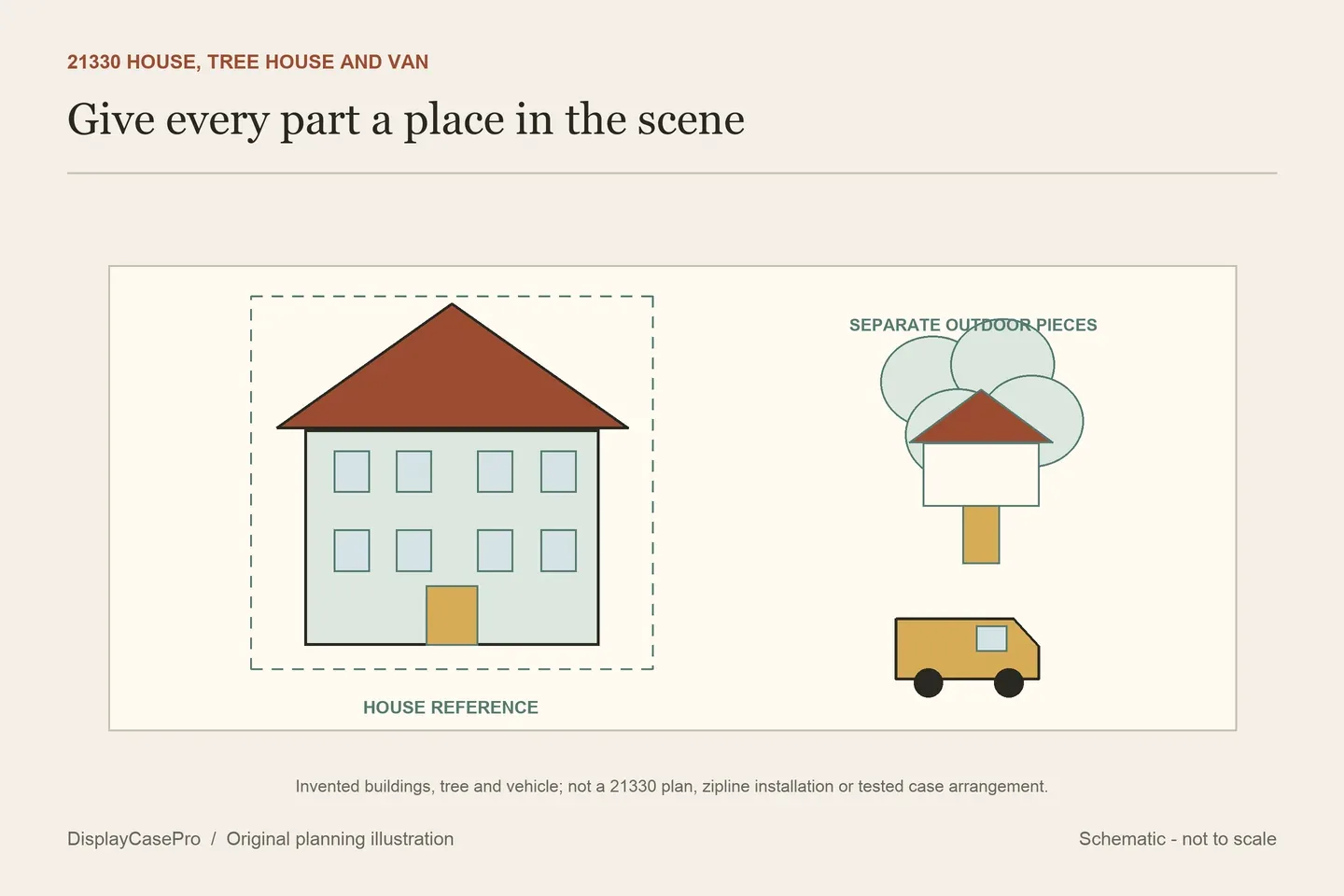
Choose a LEGO Home Alone display case for set 21330 with the house, tree house, van and access routine planned together. The house's published dimensions do not describe every outdoor scene or an opened building. Decide what stays inside, how the walls and roof will be reached, and where the case cover can rest before comparing enclosure sizes.
The official dimensions describe the house
The LEGO 21330 description gives the house as over H27 × W34 × D37 cm. The set also includes a separate tree house and the crooks' van. It describes detachable house levels, opening walls and roof, plus features including the escape zipline.
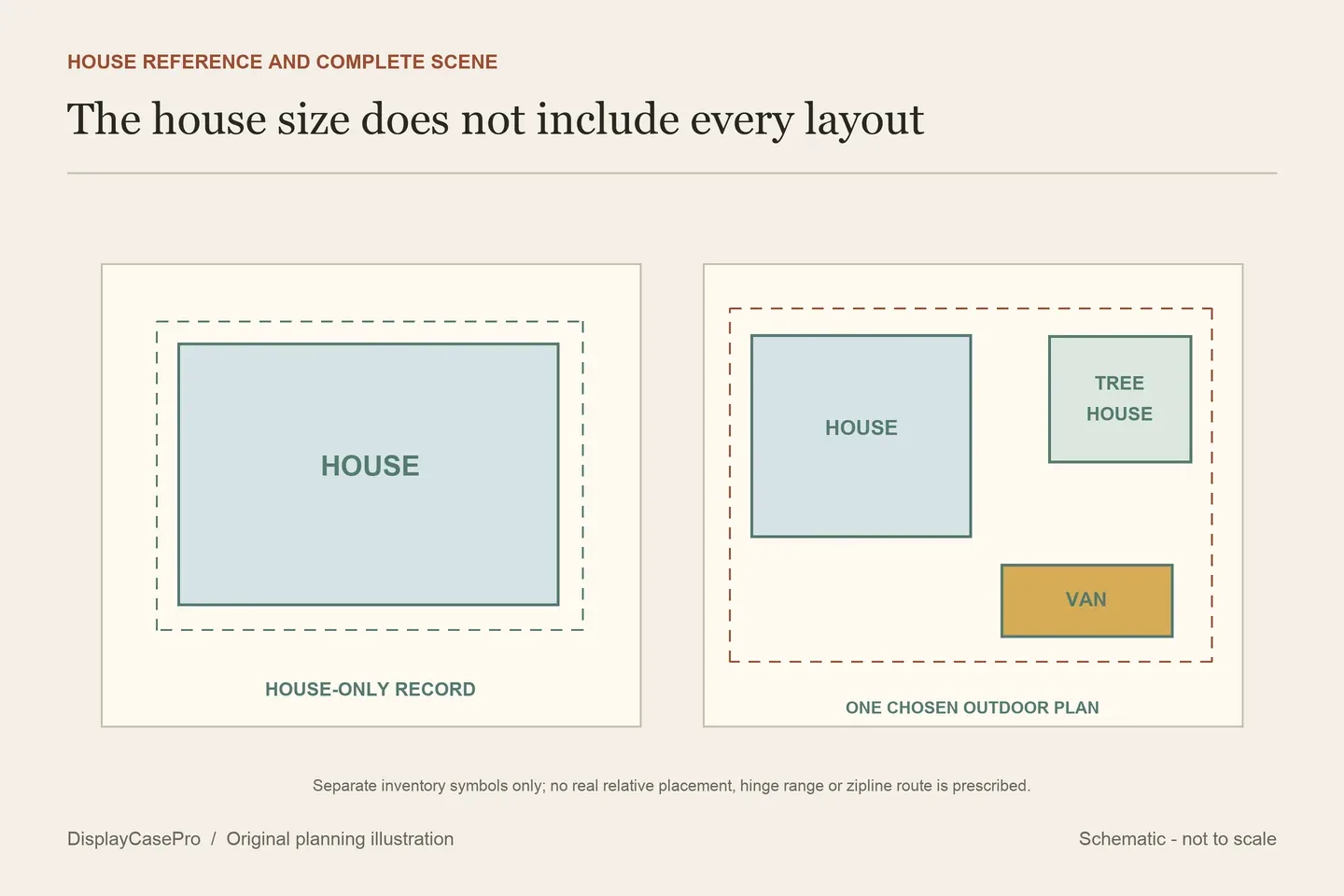
Keep the house reference attached to the house. It is not a bounding box for the building, van and tree house arranged in every possible relationship. A scene that stretches the zipline or puts the van across the front needs its own overall width and depth.
Draw a plan with the three main objects separately identified. Add figures and the information plaque, then choose the room-facing view. That makes it easier to tell a maker what “the complete set” means in your intended display.
| State | Outline to record | Access question |
|---|---|---|
| Settled exterior scene | House, tree house, van, figures and plaque in their final positions. | How does the cover pass the roof and outdoor pieces? |
| House opened for viewing | The actual wall and roof positions, plus any removed level placed separately. | Does the selected enclosure receive that precise layout? |
| A feature demonstration | Hands and moving parts for the intended sled, paint-can or zipline operation. | What must be opened or removed before operating the feature? |
A case that receives a settled exterior scene has not established room for moving walls or running the zipline inside it. If access is frequent, describe that requirement before ordering instead of choosing only by the closed footprint.
An opened house needs its own receiving plan
Choose whether the front exterior, interior rooms or an outdoor film scene is the main view. Opening a wall or lifting a roof changes the object you are presenting. A removed section also needs a place to rest; it does not disappear from the practical display routine.
Do not assume an extra strip beside the house is spare space. A fixed stud position, plaque or tree-house base can occupy it. Ask for the maker's intended placement of all the components you want to retain.
Keep set identity explicit. The current Wicked Brick product read for this guide identifies 21330 even though its URL ends in 21331. Brickcessories' URL contains 213330 while its description identifies 21330. The compatibility statement and actual product contents matter more than interpreting those address strings as different sets.
Case size and whole-base size answer different questions
These product descriptions were read on 17 October 2026. They are first-party specifications with different boundaries, not our measurements or proof of every opened-house arrangement.
| Case | Published dimensions | Question to retain |
|---|---|---|
| Wicked Brick 21330 | W62 × D41 × H30.3 cm; line not labelled inside/outside. Tiered magnetic base and set/figure studs described. | Usable interior above the finished base and intended house/tree/van arrangement. |
| Brickcessories 21330 | Assembled 460 × 400 × 300 mm; axes and inside/outside not identified. White base described. | Labelled receiving axes and the complete scene assumed by the fit statement. |
| Blacked Brick 21330 | Explicitly external W49 × D43 × H30 cm. Embedded set studs and information plaque. | Interior, fixed component positions and clearance for the chosen scene. |
| Flying Box 21330 | Case L21.5 × W15.5 × H12 inches; separate base L22 × W16 inches. Case boundary unlabelled. | Usable interior and complete outside height, in addition to the larger base footprint. |
Wicked Brick's 30.3 cm height is not labelled as clear interior height in the description read. It cannot establish a 3.3 cm operating allowance above LEGO's “over 27 cm” house reference. The base, actual roof detail and opening route still need to be identified.
Blacked Brick's 30 cm figure is explicitly external. Do not use it as the receiving height or derive an interior by subtracting a guessed base thickness. Its set studs also identify a placement system, not permission to move the house freely around the floor.
Flying Box's 22 × 16-inch base belongs in the furniture check. The smaller case footprint does not represent the whole support area. Keep the house, van and tree house within the actual receiving plan rather than using the outside base rectangle as available model space.
Confirm how the selected backdrop is supplied
A moonlit or printed rear changes the view through the case. Decide whether the rear of the house will be important from the room and whether the display will sit against a wall or be seen from several sides.
An owner's Home Alone case account on Between Naps on the Porch reports applying a large background sticker and finding that the finished display crowded a lamp and mirror. This is that owner's experience with their product, not our assembly test or a statement about every current version.
The useful purchase questions are specific: is the background printed directly, pre-applied or supplied for the buyer to apply, and what does its reverse look like? Ask for the current selected configuration rather than transferring an older account's installation method to today's order.
The same distinction applies to the reported furniture problem. Copying another owner's dimensions or placement does not establish your fit. Measure the complete selected case and consider the view of nearby objects, not just the empty tabletop rectangle.
A lift-off cover needs somewhere to go
Wicked Brick describes lifting its clear case off the base and returning it to the grooves. Check the complete path past the roof, tree house and any raised figure. Keep a suitable resting place for the cover before reaching into the model.
Next establish the intended model operation. Removing a level, opening a wall and reaching a feature are different tasks. Follow the set instructions and decide where the removed parts will be placed. Do not let a narrow gap between a panel and roof become an assumed working route.
For another construction, obtain its own routine opening method. Flat-pack panels, aluminum brackets or connector cubes describe assembly, but do not automatically identify a door or a panel intended for repeated removal.
Record lighting separately. LEGO's description mentions a furnace light brick; that does not establish an aftermarket illuminated case. If you add a light kit, include its actual leads and components in the scene and obtain the relevant case routing information.
Use the Home Alone scene and access worksheet to retain the house state, outdoor positions, backdrop version and unresolved size definitions. The LEGO shelf display guide covers the receiving furniture. This comparison does not verify stack loads, complete dust isolation or fading prevention.
Common questions
Do the official house dimensions include every outdoor piece?
The cited size describes the house. Record the tree house, van, figures and chosen arrangement separately.
Can I open the house while the case is closed?
Do not infer working clearance from static fit. Confirm the enclosure's intended opening and your model-access routine.
Will a printed-back version be visible from every side?
The rear treatment changes sightlines. Check the selected background and its reverse at your intended location.
Comments
Share a display tip or ask a question.