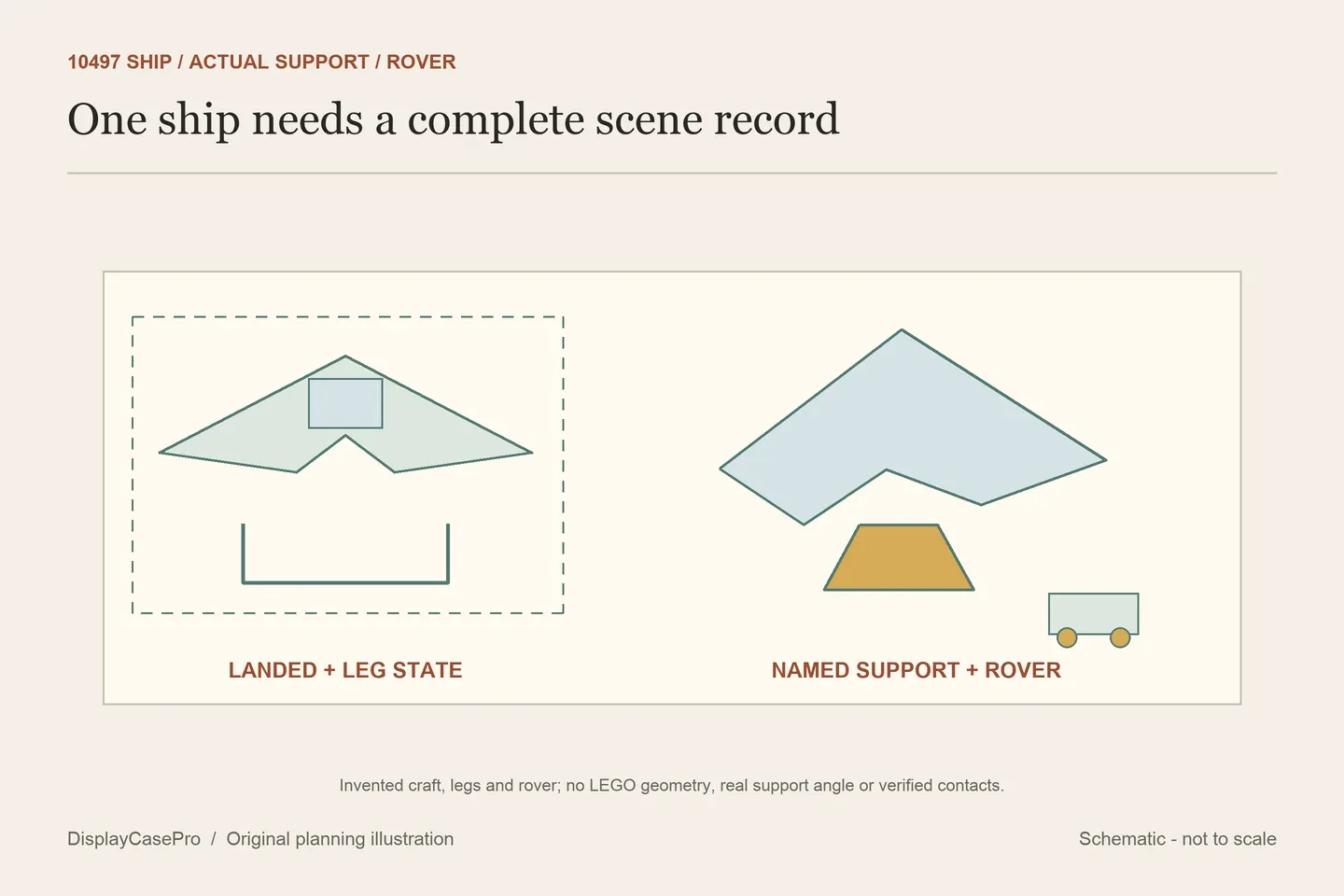
Choose a LEGO Galaxy Explorer display case for spaceship 10497 in its actual landed or supported position. Keep the rear ramp, surface rover, four astronauts and robot in the same plan. A case with a dedicated angled stand and a case whose pictured support is sold separately are different purchases.
Start with the landing legs or a named aftermarket support
LEGO’s official 10497 description identifies three retractable landing legs, an opening cockpit, rear doors and a retractable ramp for the rover. Its model reference is over H13 × L52 × W32 cm. Four astronauts and a robot helper accompany the ship.
The set is a larger anniversary tribute to the classic 497 Galaxy Explorer. That connection does not establish that a 10497 enclosure receives an original 497 or 928. Keep the exact number and complete supported arrangement with the quote.
For a landed display, record the actual leg state and whole ship. For an aftermarket support, identify its maker, version and intended contacts. The published model reference cannot simply be combined with a nominal stand height to calculate an angled display.
Choose whether the rover stays aboard or joins the foreground
| Resting scene | Include in the outline | Separate question |
|---|---|---|
| Landed with rear closed | Whole ship, legs, figures, robot and any separate plaque. | Case opening before demonstrating a feature. |
| Prepared rover scene | Chosen rear-door and ramp positions plus the rover’s actual place. | Whether the intended case receives that complete arrangement. |
| Angled presentation | Exact support, ship and retained foreground pieces. | Included stand, supported envelope and intended rover receiver. |
Decide what should be visible from the room. A raised ship may reveal its upper surface while hiding a small astronaut beneath a wing. A rover displayed outside the ship needs a real floor position; room inside the cargo area is not that separate scene’s footprint.
A settled open ramp is also different from deploying the rover while the cover remains in place. Record the view you intend to retain, then ask where the feature can be used under the actual model and case instructions.
Four spaceship cases and one wall-art mismatch appear in the references
The following original search references were read on 18 October 2026. Flying Box’s result identifies Milky Way artwork 31212, so it is retained as a model mismatch rather than counted as another spaceship case. The figures are supplier descriptions, without physical fitting or support testing here.
| Source | Published scope | Keep with the enquiry |
|---|---|---|
| Wicked Brick 10497 | External W57 × D29 × H29.3 cm; 45-degree support described. | Exact supported scene, rover cutouts and clear cavity. |
| iDisplayit 10497 | Inside L58 × W32 × H20 cm; outside L60 × W34 × H21 cm. | Pictured clear stand expressly sold separately. |
| Blacked Brick 10497 | External W57 × D29 × H27 cm; angled bow support. | Actual angle unstated; request its own receiving drawing. |
| Songlection 10497 | Inside W57 × D35 × H15 cm; 10 mm WPC base. | Whole intended ship state above the finished receiving floor. |
| Flying Box 31212 | Wall enclosure for Milky Way artwork. | Different set and display format; no 10497 fit follows. |
Map the source axes to the viewing direction before comparing numbers. A banked or tilted ship need not align its original model width with the enclosure’s named depth. Comparing 29 cm external depth with 32 cm model width alone does not establish a fit outcome.
Separate the ship support, figure positions and base material
Wicked Brick describes a 45-degree stand, ten sets of studs and four wheel cutouts for the surface rover. Ten stud positions are not ten included astronauts. Its optional printed rear evokes the original box artwork; that artwork does not change the named compatible set.
Blacked Brick’s angled bow has no numerical angle in the read description. Do not transfer Wicked Brick’s 45 degrees to it. Obtain the actual supported outline and intended foreground positions for the product being quoted.
iDisplayit explicitly excludes the pictured clear stand from the case purchase. Its observed choices include white with printed background and floor, plus black or white without printing. Confirm the selected combination and support separately.
Songlection’s box list identifies five acrylic panels, a WPC baseboard, accessories, instructions and a transfer sticker. It does not identify an elevated ship stand. Keep its labelled interior and stated WPC material rather than silently substituting an acrylic floor or another supplier’s support.
Establish the opening route before reaching the cockpit or rear doors
Ask which part of the case opens routinely and where it rests. Then follow the model and support instructions for reaching the cockpit or deploying the ramp. A completed scene that fits the closed display does not measure the hand space or intermediate movement.
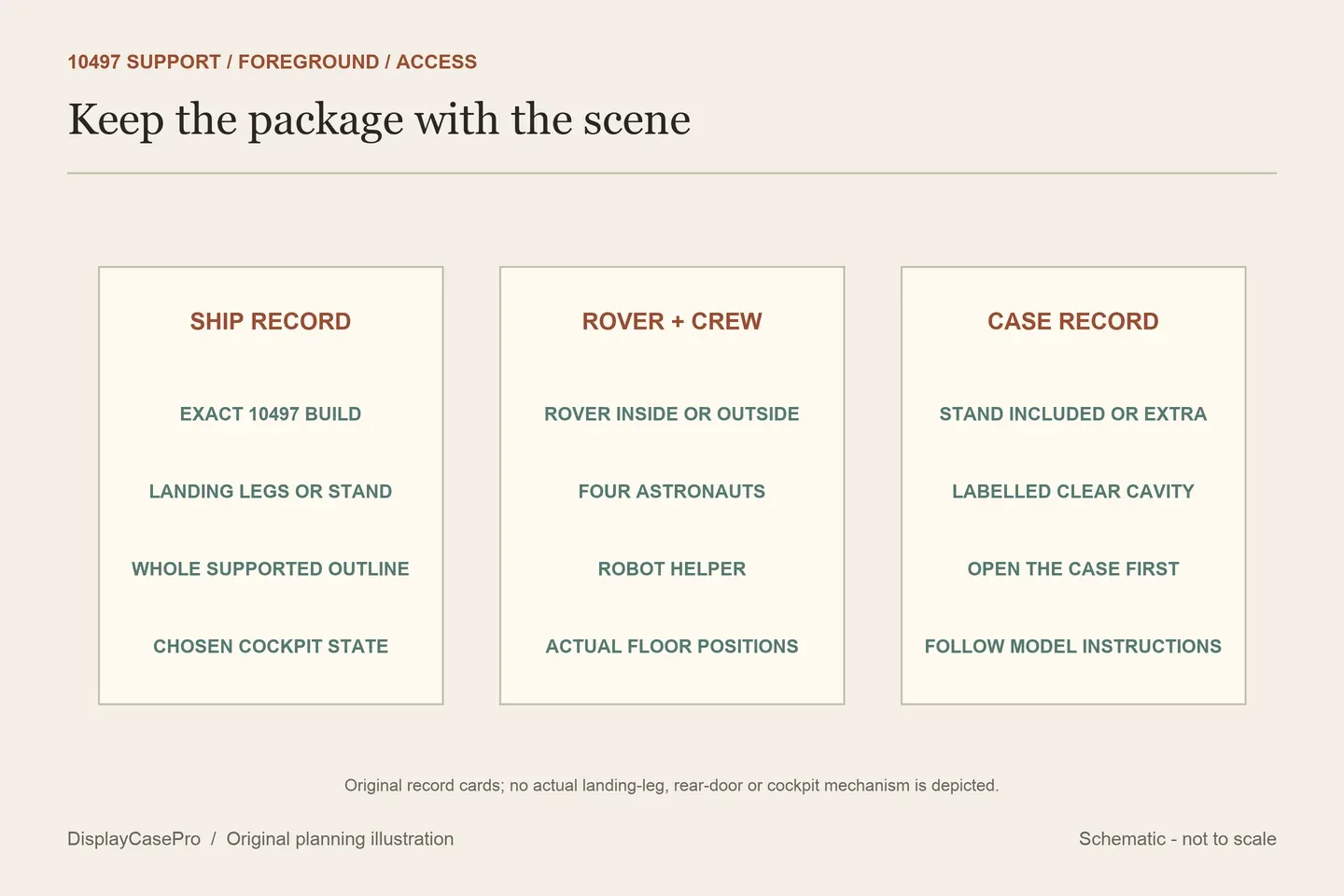
Use the Galaxy Explorer scene and package worksheet with the LEGO shelf-case guide and measurement guide.
Common questions
Does the case photograph establish that a stand is included?
Read the selected package. The cited iDisplayit page expressly says the pictured clear stand is sold separately.
Is a Galaxy wall-art case another Galaxy Explorer option?
Check the set number. The sampled Flying Box result is for 31212 artwork, with a different wall-display task.
Comments
Share a display tip or ask a question.