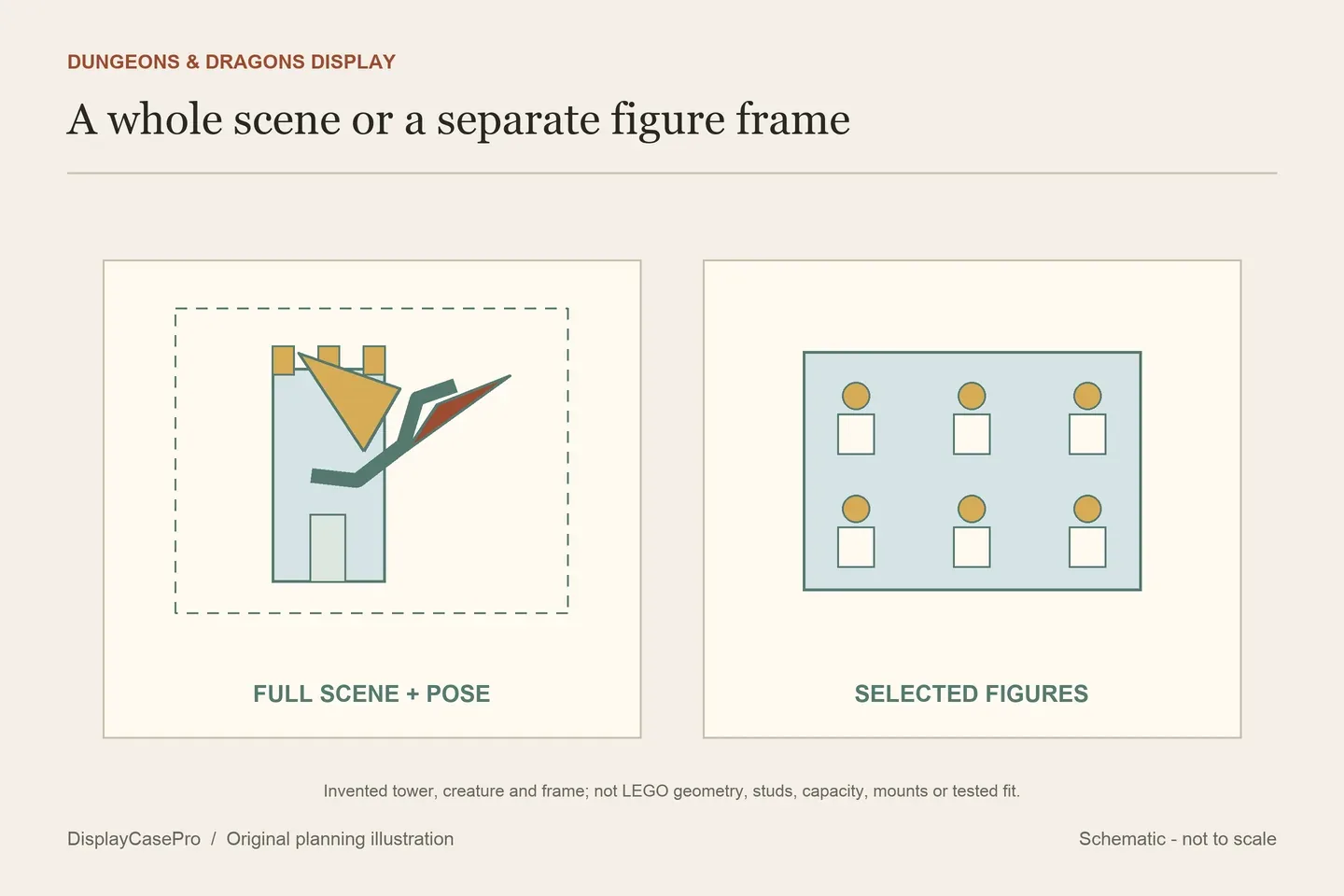
For LEGO Dungeons & Dragons, choose between an enclosure for the complete Red Dragon’s Tale 21348 scene and a separate minifigure display. A tall tower-and-dragon case and a shallow figure frame solve different tasks. Decide which collection you are presenting before comparing their published sizes.
A full 21348 scene and a figure frame are different formats
LEGO’s official 21348 description identifies a tavern with removable roof and upper level, a dungeon and tower, and posable Cinderhowl the Red Dragon, which can wrap around the tower. It also identifies six minifigures and additional monster figures. Keep all retained components in the display inventory.
The descriptive size of over H48 × W37 × D30 cm is assigned to the tower, tavern and dungeon build. It is not a measurement of every separately posed dragon, extended wing or added character arrangement. Use the actual complete scene for the enclosure enquiry.
| Format | Object entering the display | Evidence still needed |
|---|---|---|
| Whole 21348 enclosure | Terrain, buildings, chosen dragon pose, monsters and retained figures. | Complete supported scene and usable case dimensions. |
| Separate minifigure frame | Selected figures with their own bases and accessories. | Actual compartment or row depth, spacing and release method. |
| Whole scene with extra figures | The existing scene plus separately identified additions. | Receiving positions that do not collide with the dragon or obscure the buildings. |
Do not use the full set’s six-minifigure count as a capacity claim for a separately sold frame. Nor should a D&D-themed frame be assumed to receive the tower and dragon. The theme links the products aesthetically; their physical receiving tasks remain distinct.
Record the dragon as displayed, with its widest projections
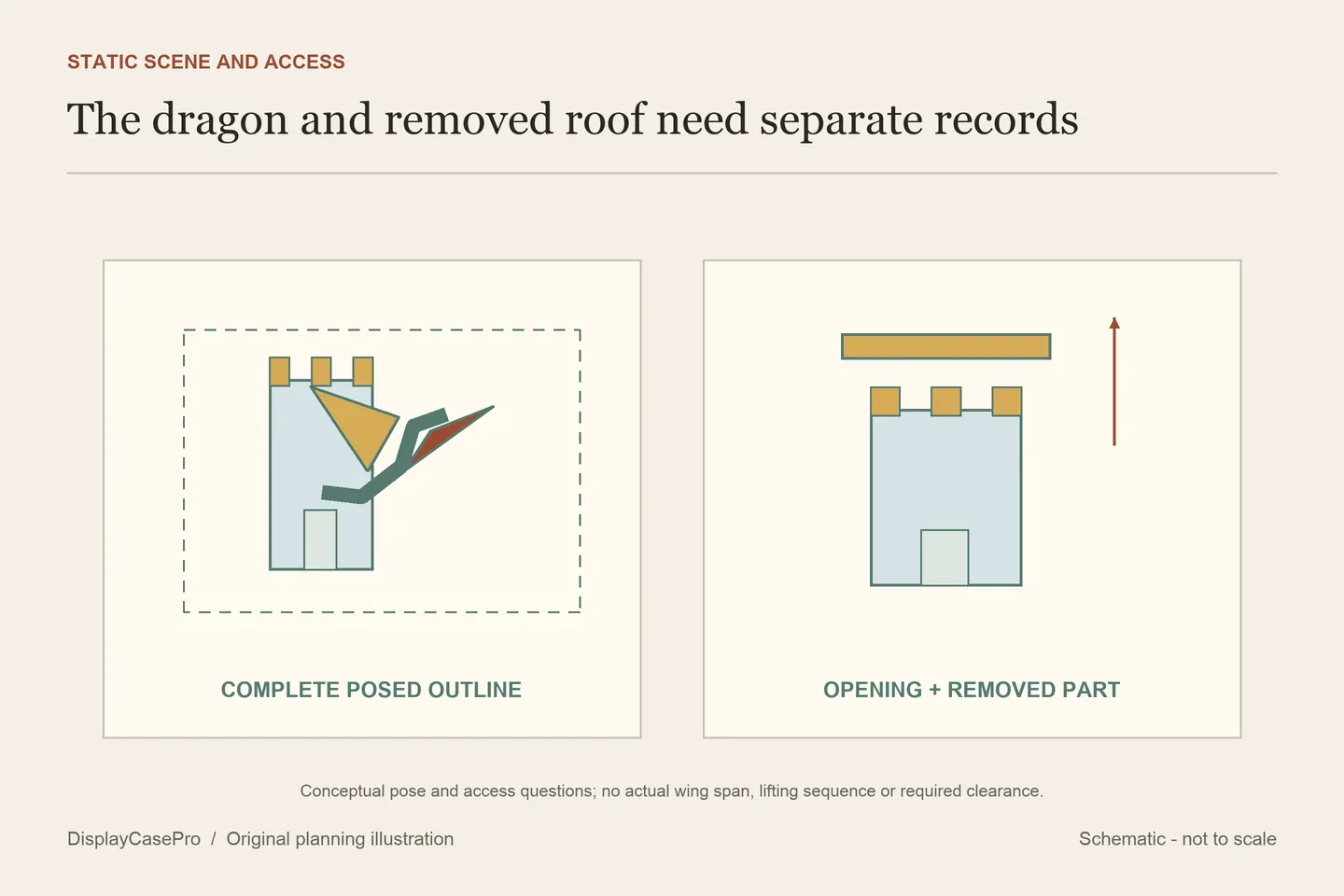
Choose the actual permitted dragon pose and relationship to the tower before comparing a case. Include the highest retained detail, both wings, tail and any support required by the model instructions. A front photograph can hide the depth of a wing or a tail passing behind the building.
Keep a wrapped display and a separately presented dragon as different layout records if both interest you. Do not combine the building’s reference width with a guessed dragon height to create a supposedly official full-scene size. The complete pose needs its own front, side and overhead outline.
Do not use the acrylic wall to restrain a wing or alter the dragon merely to meet a listed dimension. If the chosen configuration differs from the maker’s intended scene, request confirmation of that exact layout rather than extending a set-number compatibility statement to every pose.
Compare the labelled boundaries without filling missing fields
The following supplier descriptions were read on 18 October 2026. These are attributed specifications and questions, not products tested or ranked by this site.
| Source | Published figures or format | Resolve before ordering |
|---|---|---|
| Wicked Brick, 21348 | W50 × D36 × H51.3 cm; boundary unlabelled. | Actual interior and intended whole-scene arrangement. |
| ElevenMark, D&D minifigures | 32.5 × 44.8 cm or 27 × 27 cm face-size sequences; boundaries and axes unlabelled. | Usable depth, figure positions, exact version and accessories. |
| Blacked Brick, 21348 | External W47 × D38 × H49 cm. | Clear interior above the base and complete posed dragon. |
| BrickShell, 21348 | H20¼ × W18⅜ × D14⅜ in; boundary unlabelled. | Receiving cavity and actual opening for the scene. |
| Brickcessories, 21348 | Assembled 500 × 500 × 500 mm; axes and inside/outside unlabelled. | Labelled cavity, rear option and intended routine access. |
Blacked Brick’s 49 cm external height does not establish one centimetre of usable room above a building described as over 48 cm high. The case construction and actual dragon pose remain part of the comparison. Do not subtract base thickness to manufacture the missing interior.
BrickShell describes pressure-fit construction and 5 mm acrylic. Those details do not specify a removable magnetic front or the clear receiving boundary. A feature described for another BrickShell product should not be transferred to this one.
ElevenMark’s figure display describes included studs, wood construction, a themed or mirror-effect rear, and wall or desktop presentation. The two published face-size sequences do not supply front-to-back clearance. Ask for the exact figure layout and complete accessory depth rather than deriving a compartment from outside face dimensions.
Choose front figures and the rear appearance together
Blacked Brick describes embedded studs for figures in front of the set and an information plaque. Give those positions actual figures in the plan. A front figure can hide a doorway or collide visually with the dragon’s foreground outline even when its feet fit on a stud.
Brickcessories offers clear, black or printed rear treatments. Decide whether you want a view of the scene from behind before choosing one. A printed backdrop changes the view; it does not establish different wing clearance or an access door.
Wicked Brick describes a plaque and selectable rear treatments. Confirm the actual supplied version and locating arrangement. UV-printing and broad protection wording do not establish independently measured UV filtering or preservation performance.
Treat roof removal and campaign use as separate operations
The model’s removable tavern roof and upper level create access questions beyond its static height. Decide where those sections will be lifted and placed, which figures must first be moved, and whether the dragon remains in its display position. Follow the actual model instructions for handling.
Ask the case maker which part is intended to open for routine access and its removal route. Screw brackets or pressure-fit panels describe construction, not necessarily a convenient repeated-access panel. An enclosure that receives the completed display has not demonstrated room to play a campaign inside it.
LEGO supplies a campaign-download route with the set, but this comparison does not reproduce the campaign or prescribe gameplay. If regular play is intended, plan an appropriate opening and model-removal routine rather than treating the cover as a gaming surface.
Use the D&D scene and frame worksheet to keep the chosen format, complete pose, figures and access together. The collection measurement guide covers the supported outline, and the LEGO shelf case guide covers the confirmed complete enclosure’s location.
Common questions
Will a D&D minifigure case receive the Red Dragon’s Tale build?
The sampled ElevenMark product describes a separate figure display. Obtain a whole-scene enclosure for the actual 21348 arrangement.
Does a case named 21348 accept every dragon pose?
The title alone does not establish that. Confirm the chosen pose, supports, clear cavity and opening route.
Comments
Share a display tip or ask a question.