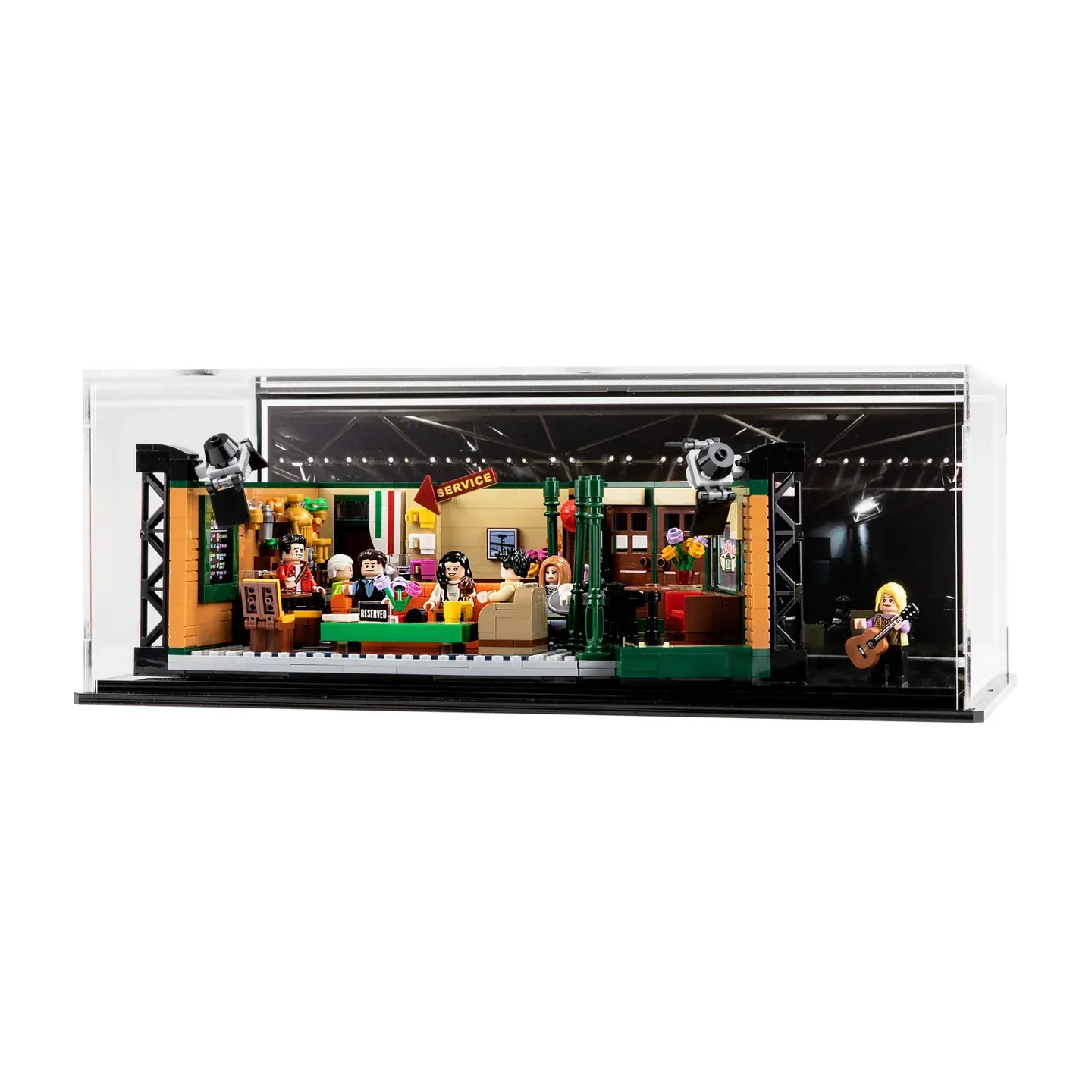
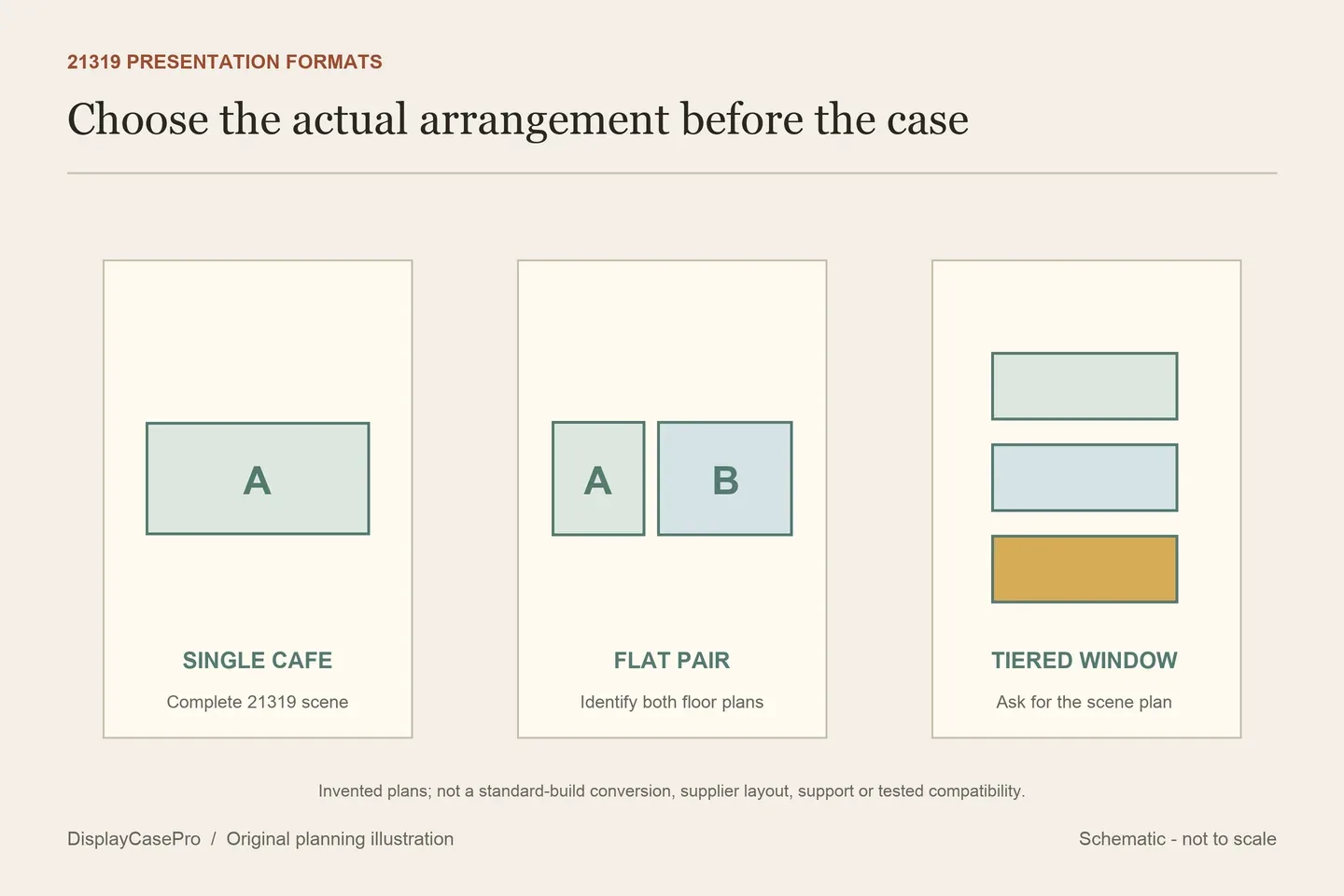
A LEGO Central Perk display case can present the complete 21319 café alone, pair it with The Friends Apartments 10292, or create a tiered window-style scene. Those are different arrangements. Choose the actual builds and layout before comparing a compact cover with a case over a metre long.
A product naming both sets does not establish that their original floor plans fit a three-tier format without changes. Keep the standard build, any proposed rebuild and the supplied display accessories clearly identified in the enquiry.
Keep the café and apartments as named components
LEGO's official 21319 description identifies the café's removable seating area, seven minifigures and brick-built studio light rigs. Its model reference is over H11 × W29 × D22 cm. Retain the light rigs and their actual positions when recording the completed scene.
The official 10292 description identifies two apartments and an adjoining hallway, with a model reference over H10 × W64 × D31 cm. It also describes lift-out carpets that form smaller displays.
Those references identify the original sets. Adding the two published widths does not produce a verified combined case footprint: the chosen relationship, depth, supports, figures and projections still need a complete plan. A small carpet scene is another presentation, not the whole apartment floor plan compressed into less space.
Choose the presentation before the enclosure shape
For the café alone, decide which view matters: the main seating area, front window, service counter or stage. Keep the retained figures and light rigs in the outline. A case that looks shallow from the front still needs to receive the complete studio set.
For a flat paired display, mark 21319 and 10292 separately in a top view. Identify the connecting hallway and the figures or accessories you want visible between or in front of the scenes. Do not assign the same floor area to both builds.
A tiered window presentation needs a different drawing. Ask the supplier to identify the intended scene on each level, the clear height and depth per level, and any required changes to the standard builds. Confirm whether instructions, supports and any extra parts for that arrangement are actually included.
The DIA listing describes stacked interior scenes and a window-grid design, but its overall dimensions do not supply a locating plan for the original two sets. Treat the proposed arrangement as something to confirm before ordering, rather than a ready-made conversion instruction.
Single-set covers and long paired cases have different footprints
These supplier descriptions were read in October 2026. They are attributed specifications, not our measurements or proof of every scene arrangement. Axis labels and stated boundaries remain attached to each source.
| Exact format | Published figures | Receiving question |
|---|---|---|
| Wicked Brick, 21319 alone | External W39.3 × D24.2 × H14.5 cm. | Studded base, plaque and lift-off surround. Request usable interior above the finished base. |
| Flying Box, 21319 alone | Case L13.5 × W11 × H5.5 in; separate base 14 × 11.5 in. | Case inside/outside is unlabelled. Include the larger base in the furniture plan. |
| DIA, three-tier window style | Overall W47 × H41 × D30 cm. | Overall size is not per-tier clear space. Confirm the actual build arrangement and conversion requirements. |
| Kingdom Brick Supply, 21319 and 10292 | Approximate inside L100.0 × W32.8 × H13.6 cm; outside L101.5 × W34.3 × H14.5 cm. | 124 × 40-stud area and fourteen screws are listed. Confirm the complete flat scene and rig positions. |
| iDisplayit, 21319 and 10292 | Inside L103 × W32 × H16 cm; outside L105 × W34 × H17 cm. | 128 × 40-stud area, fourteen fittings and a top attached to the lift-off surround. |
The long paired cases describe another purchase from the small single-café covers. A shared set number in their titles does not make the footprints interchangeable. Keep the case's full exterior beside the intended furniture dimensions.
For the tiered format, ask for every occupied level rather than dividing 41 cm by three. Floor thicknesses, the base, top fittings and scene projections are not established by that arithmetic. The useful information is a labelled receiving drawing for the supplied configuration.
Check the current rear treatment, not only the photograph
Wicked Brick expressly says its product imagery shows an older vinyl background sticker, while the current display has an upgraded UV-printed rear panel with the same design. Confirm the selected version and its assembly routine rather than assuming the illustrated sticker is what you will receive.
A printed rear also changes how the studio scene reads from behind. Decide whether the display will sit against a wall or be viewed from several sides. Keep the reverse appearance in the enquiry if the back of the café is part of your intended view.
DIA identifies the case as non-lighted in its description and FAQ. Generic text elsewhere about USB frame lighting and a separately supplied power bank does not establish lighting in this particular case. Ask for the exact package instead of transferring a feature from another product family.
A long scene needs a practical cover-removal route
iDisplayit describes the top as secured to the surround, which lifts away from the base. That is different from lifting a loose lid while leaving every side in place. Reserve the route and a suitable resting place for the complete long surround.
The café's removable seating area and the apartments' lift-out carpets are model features. Decide which scene changes you expect to make and where the removed elements will rest. Receiving the finished display does not establish room to perform those changes inside the enclosure.
Both iDisplayit and Kingdom Brick Supply state that their cited combined cases are not designed to be relocated with LEGO inside. Keep that restriction with the layout record. Stud-area statements identify a published base format; they do not override the handling instructions.
The cover photo comes from the CubeBuff authorized gallery and shows a printed-background case around 21319 alone. It is not a picture of either paired case or the three-tier conversion. The full retrieved composition is retained, proportionally resized and compressed to WebP; it does not document our assembly test or the purchase contents of another product.
Use the Central Perk scene and case worksheet to retain set identities, layout type, background version and opening questions. The LEGO shelf case guide covers placement of the confirmed complete exterior.
Common questions
Will a case for 21319 also take the apartments?
Confirm the exact product and complete pair. The sampled single-café and combined cases publish substantially different footprints.
Does three-tier mean the original sets fit without rebuilding?
The overall size and title do not establish that. Obtain the intended scene plan, required modifications and actual supplied parts.
Are the model's studio lights an illuminated case?
Brick-built studio rigs and electrical display lighting are separate items. Identify the actual case package and any additional equipment.
Comments
Share a display tip or ask a question.