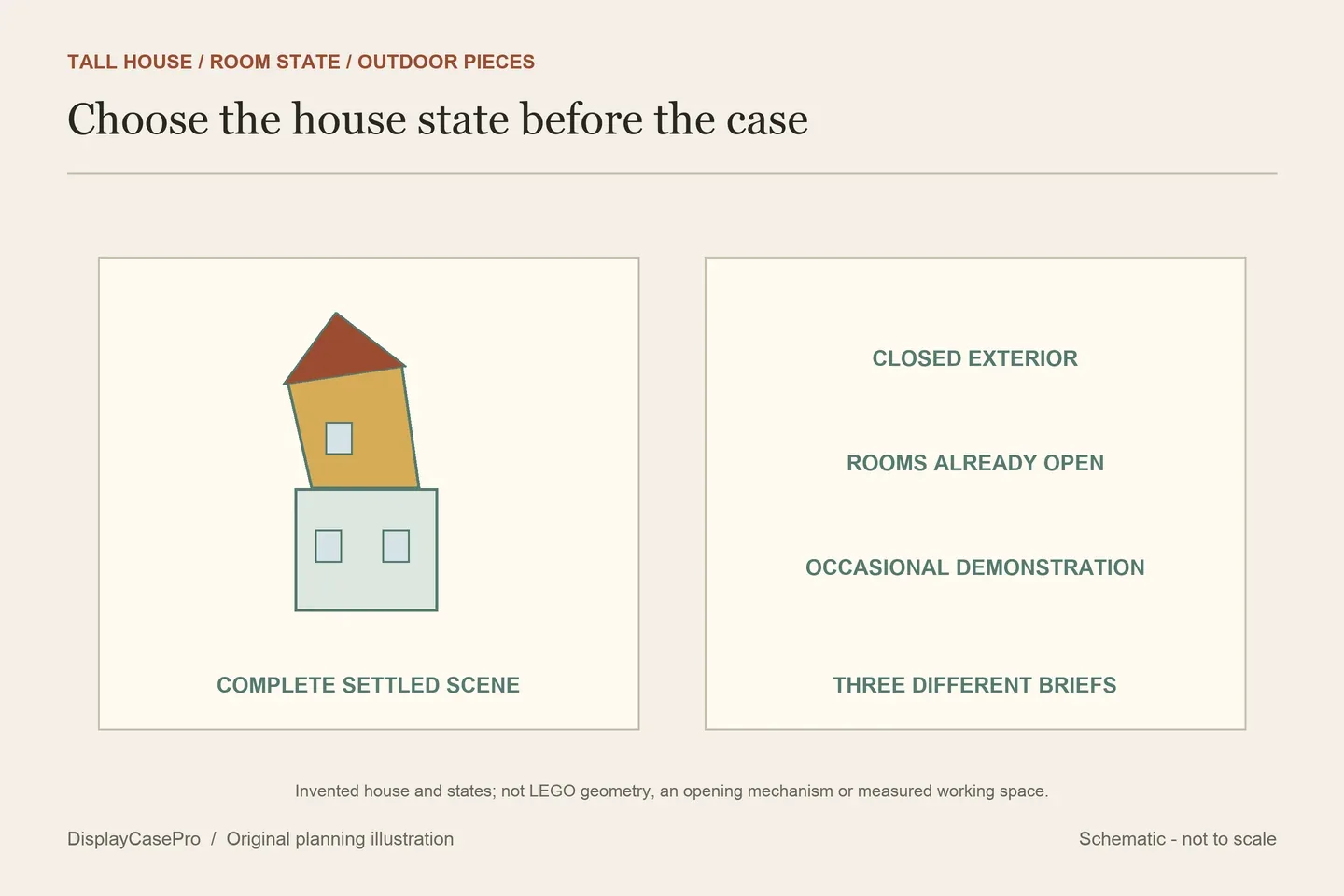
Choose a display case for LEGO The Burrow – Collectors’ Edition 76437 with the tall house, pigsty, animals and figures in a definite scene. Decide whether the house stays closed or presents its rooms already open. A case that receives the settled building does not automatically allow it to open or its features to be operated inside.
The house’s height reference is only one part of the plan
LEGO’s official 76437 description identifies an opening interior, a kitchen dishwashing feature and a Floo Network fireplace function. The scene includes 10 minifigures, Errol the owl and two pig figures with an outdoor pigsty. Keep the animals separate from the minifigure count.
The official prose gives the model as over H46 × W25 × D23 cm, also stated as over H18 × W9.5 × D9 inches. That reference is not a drawing of every opened-room state or every arrangement of the pigsty and figures. The separate rounded dimensions widget does not provide a more precise handling envelope.
Write 76437 Collectors’ Edition in the enquiry. A general “Burrow case” name does not identify every LEGO edition or a modified house. Record the actual roof projections, outdoor pieces and any retained accessories in the display you intend to keep.
Decide which rooms remain visible when the cover is closed
| State | Complete outline to record | Access still required |
|---|---|---|
| Settled exterior | Closed house, roof, pigsty, figures and any plaque. | Route for removing the surrounding case past the tall details. |
| Rooms already opened for display | The exact open-house arrangement and separately positioned pieces. | A cavity that receives that particular final layout. |
| Occasional feature demonstration | The room or control you intend to approach. | What opens first, where the cover rests and how the model is then handled. |
Choose the main view from the actual room. The crooked exterior may be the priority against a wall, while the open rooms can matter more from a side or rear approach. A scenic printed back changes that choice; it should not be treated as transparent simply because the front and sides are clear.
Put the pigsty and characters on the scene plan before adding the information plaque. An apparently empty strip beside the house is not guaranteed outdoor space, particularly if the base has fixed positions or the chosen open state occupies it.
Retain the case, cavity and larger-base definitions
These five descriptions were read on 18 October 2026. They are attributed product specifications, not DisplayCasePro measurements or tests. One pair of listings also has an expressly stated supply relationship, explained below.
| Exact source | Published size | Definition to retain |
|---|---|---|
| Wicked Brick | W36 × D30 × H48.3 cm. | Inside/outside unlabelled; confirm the clear cavity above the finished base. |
| iDisplayit | Inside L26 × W26 × H47 cm; outside L28 × W28 × H48 cm. | Interior and complete exterior are separate. |
| Flying Box | Case L11.5 × W10.25 × H19 in; base 12 × 10.75 in. | Case boundary unlabelled; larger base is a separate footprint. |
| DisplayGeek | Case H19 × W11.5 × D10.25; base W12 × D10.75. | Those numerical lines do not state units or inside/outside. Obtain the selected specification. |
| Songlection | Inside W27 × D27 × H48 cm. | Labelled inside; confirm height datum, complete exterior and intended house state. |
iDisplayit’s 47 cm inside height and LEGO’s “over 46 cm” model reference do not establish a known one-centimetre gap. The latter is qualified, and the actual roof, displayed figures and starting surface still need confirmation. A lift-off route is a separate question from static receiving height.
Wicked Brick’s 48.3 cm height is unclassified in the read specification. Do not use it as a measured interior or subtract guessed base and panel thicknesses to make one. The page describes a 5 mm black base, 3 mm clear panels and a plaque, but those construction details do not replace a labelled receiving drawing.
For Flying Box, retain the 12 × 10.75-inch base in the furniture plan. The smaller case footprint does not describe every outside support edge. For Songlection, retain the stated 10 mm WPC base material; it should not be silently rewritten as PVC because another supplier uses that material.
The DisplayGeek page identifies Flying Box as its supplier
DisplayGeek’s lower product description expressly says the cases are made and shipped by Flying Box. Its matching numerical size sequence therefore should not be presented as a second independent fit test. Keep the retailer and maker roles visible rather than counting two matching listings as two physical verifications.
The actual DisplayGeek package text lists screws, corner blocks, a cleaning wipe and a LEGO piece used as a screwdriver. Its generic instructions also discuss other case families. A magnetic-bottom description for KP Armor is not evidence that this custom 76437 product has that opening method.
Ask which exact product and instruction set applies to the order, along with labelled units, cavity and complete exterior. A broad fitting-guide warning about other boxes does not supply the open-house envelope or permission to transfer a tutorial from a different product family.
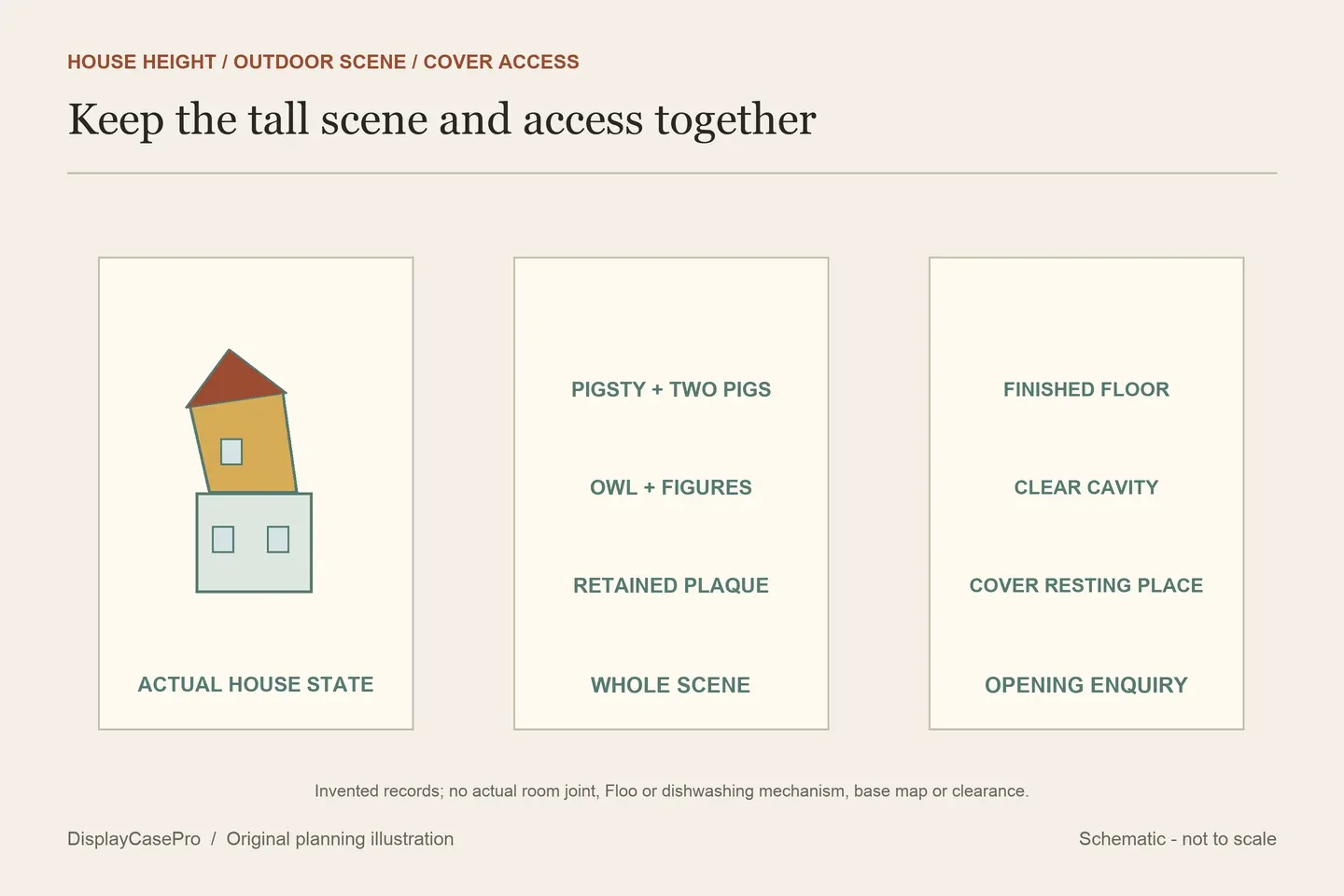
Settle cover removal before planning a feature demonstration
Wicked Brick describes lifting the clear case from the base and returning it to grooves. Establish the complete route past the roof and any raised detail, plus a suitable resting place for the surround. A tall shelf recess may receive the closed case while leaving the opening task unresolved.
For the other products, obtain their own routine opening instructions. Screws, connector cubes and flat-pack panels describe construction; they do not necessarily identify a front door or a part intended for frequent removal. Follow the case and model instructions rather than loosening an arbitrary panel around the house.
Then identify the feature you want to reach: viewing an interior, approaching the kitchen or using the fireplace function. A resting scene’s dimensions do not prove that a hand or moving section can work between the house and acrylic. If the intended display stays open, obtain confirmation of that exact arrangement.
Keep print and lighting choices separate. Wicked Brick offers a printed rear, while Songlection mentions lighting and print options. Optional services are not a confirmed electrical package. Include any actual equipment and cable route in the specification, and obtain loaded stacking information before relying on a stackable label.
The Burrow house-state, supply and access worksheet retains the set number, animal scene, dimension boundaries and unresolved opening questions. Use the LEGO shelf-case guide for placement and the measurement guide for the complete chosen outline. This comparison does not test UV filtering, dust isolation or case loads.
Common questions
Does a 76437 case guarantee that the house opens inside?
A set compatibility statement does not establish working space. Choose a settled open layout or confirm how the case is opened before using the model.
Are the Flying Box and DisplayGeek pages independent fit tests?
DisplayGeek identifies Flying Box as the maker and shipper. Treat the repeated size sequence as related supply information, not two tests.
Does a printed background include working lighting?
Confirm the actual selected package. Background artwork and a lighting option do not establish supplied electrical equipment or measured protection.
Comments
Share a display tip or ask a question.