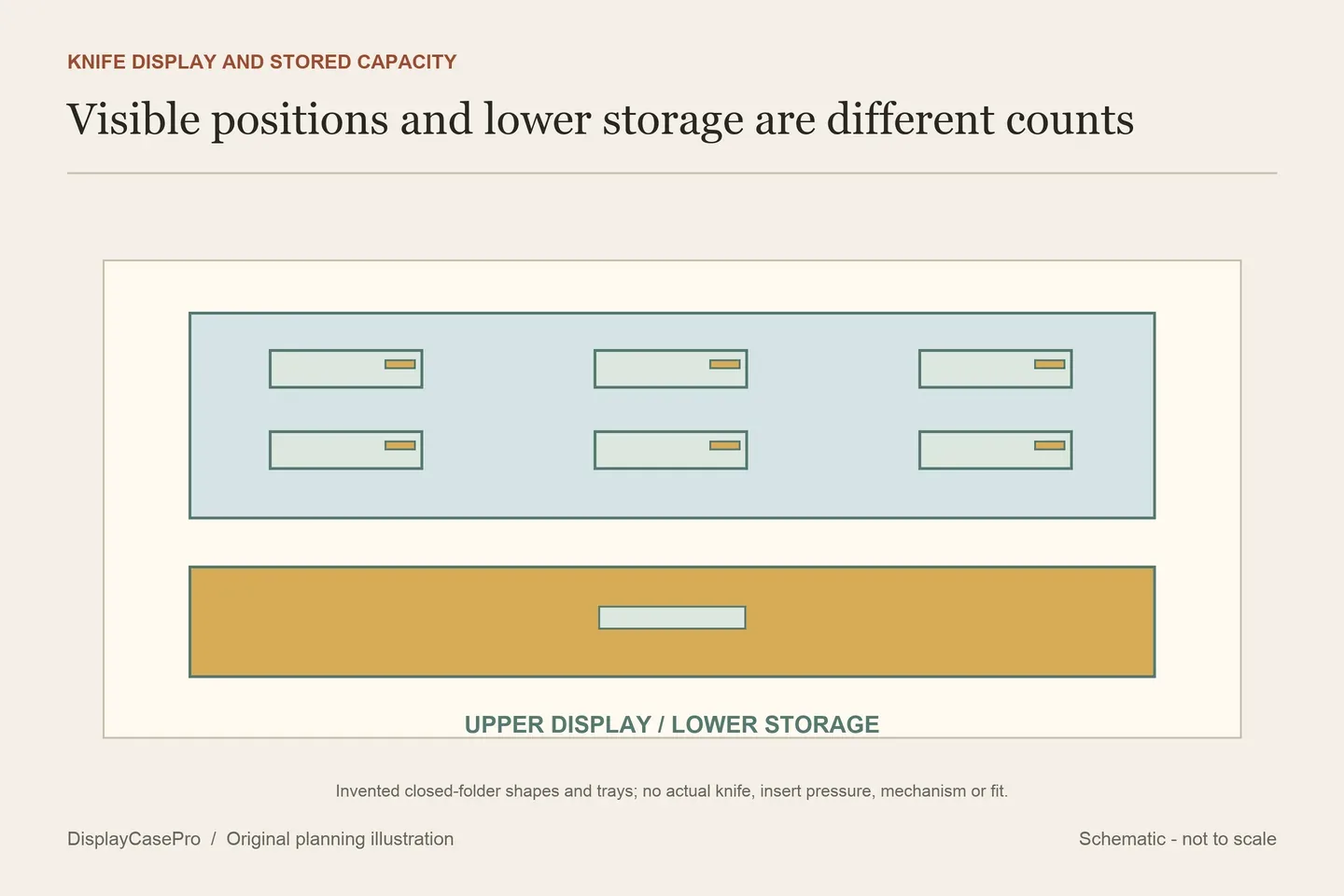
A knife collection can be displayed on individual stands, in fitted upper trays or in a flat glass-top box. The useful distinction is what remains visible and what receives each knife. A case advertised for twelve items may show only its upper group, while a foam-lined box can change its receiving space when the insert changes.
Record folding knives in their intended display state
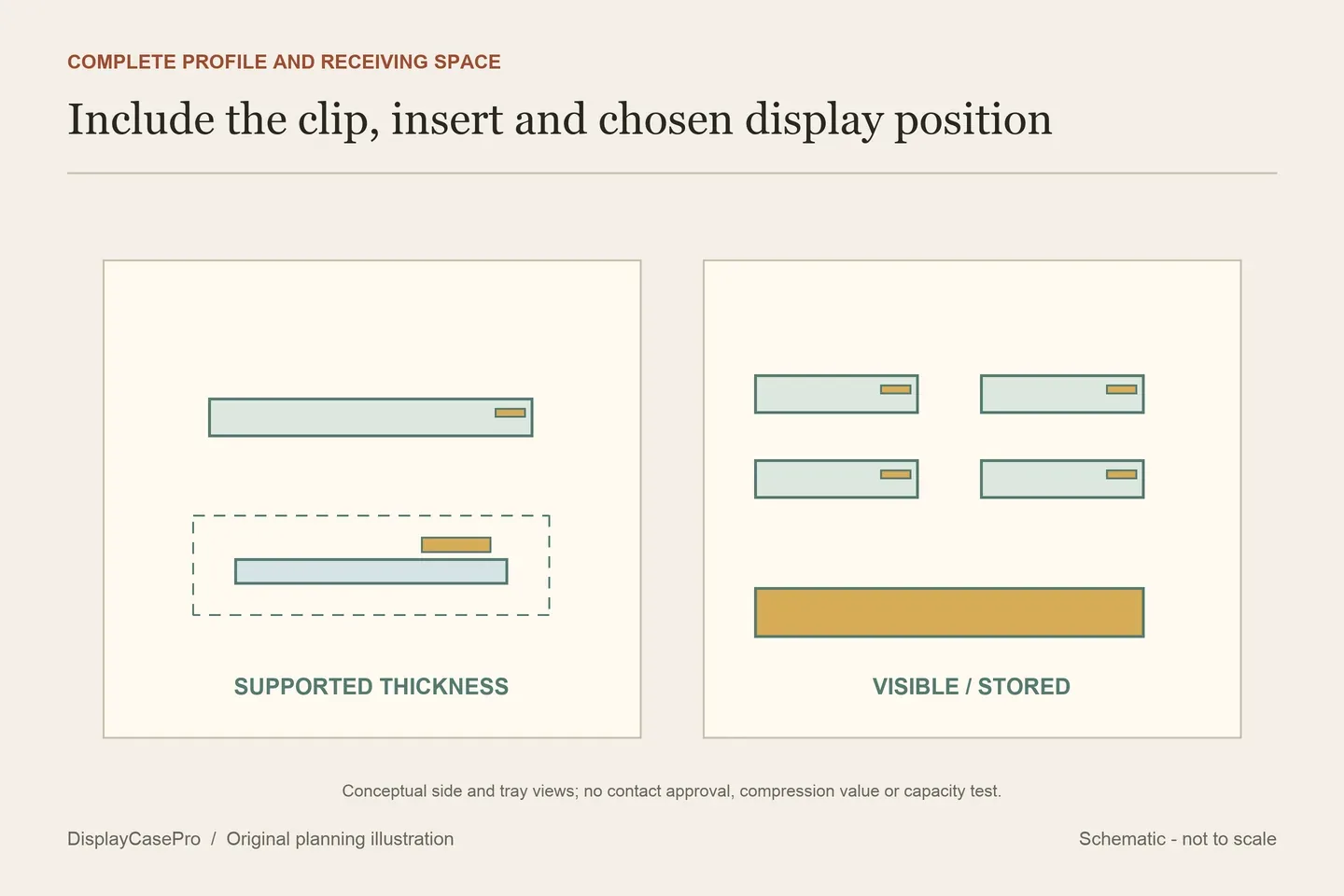
For a closed folding knife, include the handle, pocket clip, projecting fittings and complete thickness. Do not substitute blade length for the outline that will enter the display. Record the exact knife and its intended support so a change of clip or presentation does not silently invalidate the original fit check.
A fixed-blade knife, a closed folder and a knife retained in its sheath occupy different shapes. Decide which of those objects the selected holder is intended to receive. A long box marketed for a large fixed blade is not automatically a useful arrangement for several short closed knives, even when their combined lengths look smaller.
Choose what the display should reveal: handle detail, maker’s mark, the outline of an entire item or a documented group. Keep condition and identification notes separate from the choice of presentation. This guide compares display formats and specifications; it does not prescribe knife operation, sharpening or changes to a mechanism.
Choose a receiving format before choosing a finish
| Source | What the description establishes | Confirm for your collection |
|---|---|---|
| Holme & Hadfield Personalized collection | Selected knife, coin and watch cases can carry names, dates or messages. | Exact knife product, support and receiving dimensions; engraving does not establish fit. |
| William Henry Collector boxes and racks | The range includes covered boxes, open stands and wood racks. | Selected model’s upper/lower positions, compartment size and contents. |
| KnifeCenter Mixed display listing | Wood/glass boxes, stands and wall mounts for several object types. | Actual enclosure, interior definition and knife-specific receiving shape. |
| The Wood Gallery Large Knife Display Box | Outer 6 × 15 × 2.5 in; display area 5 × 13.75 × 1.25 in. Axes unlabelled. | Insert option and dimension conflict in additional information. |
| Chicago Knife Works Display category | Cases, extra-deep frames, easels, tiered stands and plaques. | Which product is covered and how its intended positions receive the actual knives. |
The first Holme & Hadfield result is a personalization collection, rather than a single knife-case specification. Its mixed assortment is useful for discovering formats, but the watch or coin products shown alongside knife boxes do not supply knife compatibility. Keep the selected product identity in the enquiry before discussing engraving or colour.
Likewise, a retailer’s mixed “displays” page can include unrelated mounts. A tiered open stand has no enclosing front merely because it appears in the same category as a glass-top box. Confirm that distinction from the selected product description.
Twelve positions do not necessarily mean twelve visible items
William Henry’s Collector Display Case, COLLECTOR’S BOX 3, lists twelve items, divided into six upper and six lower positions. It describes laminated wood, brass hinges and a beveled glass top. That upper/lower split should remain attached to the capacity statement.
Do not read “twelve” as twelve unobstructed faces visible through the closed top. Ask how the lower positions are accessed, what each compartment receives and whether the intended closed knives clear the tray and glazing. The description read supplies no compartment dimensions, so neither the item count nor the photographs establish fit for your mixture.
Make separate counts for continuous display and nearby storage. If you rotate the upper selection, assign each knife a record and a storage position. If the purpose is to compare every handle at once, choose enough confirmed visible positions instead of relying on a larger combined count.
The insert changes the space beneath the glass
The Wood Gallery’s large box illustrates why the insert must stay in the specification. Its standard foam is described as 0.5 in thick, with knives less than 3/4 in high lying below the glass. A 1.25 in foam option is described as allowing the glass to press the knife into the insert. That is a particular product’s proposed arrangement, not a universal display method.
Ask how the selected insert supports your knife and which surfaces contact it. A top panel used as part of a pressure-retention arrangement needs explicit confirmation for that item; do not copy it into another box. Clip height, projecting fittings and the chosen liner can all affect the complete receiving profile.
The same page labels the outer box 6 × 15 × 2.5 in and the display area 5 × 13.75 × 1.25 in, but its additional-information field gives 12 × 20 × 4 in without explaining the relationship. Do not silently call the larger sequence shipping dimensions or choose whichever fits. Request a current labelled drawing. Its microsuede and felt descriptions also need clarification for the selected lining.
Keep the removal route and collection record together
For a stand, establish the supported outline and how the item is lifted clear without contacting its neighbours. For a fitted tray, ask whether the tray is removable and how lower storage is reached. For a hinged box, check the actual open position at the intended shelf rather than using only its closed outside height.
The Wood Gallery describes two lockable latches and keys. That is a hardware feature, not a certified security rating. Similarly, a soft insert’s material name does not establish long-term compatibility with every finish or component. Retain unresolved contact questions with the exact knife and support, especially for a personally important or historic piece.
Use the collection measurement guide to record complete supported profiles and labelled case boundaries. For a flat presentation, the separate usable-depth guide helps distinguish outside depth from the space above the receiving surface.
Download the knife-display worksheet for the intended state, clip and fittings, stand or insert, visible and stored counts, lining questions, conflicting measurements and retrieval route. Resolve those fields before treating a capacity name or personalized lid as a complete order specification.
Common questions
Will one large box suit several closed pocket knives?
Compare the individual supported profiles and the intended positions. A large outside rectangle does not provide dividers, suitable contacts or independent removal paths by itself.
Can the foam specification be used as a universal knife-height limit?
Keep it with the named product and insert option. Receiving depth, actual compression, glazing contact and the complete knife profile need confirmation together.
Comments
Share a display tip or ask a question.