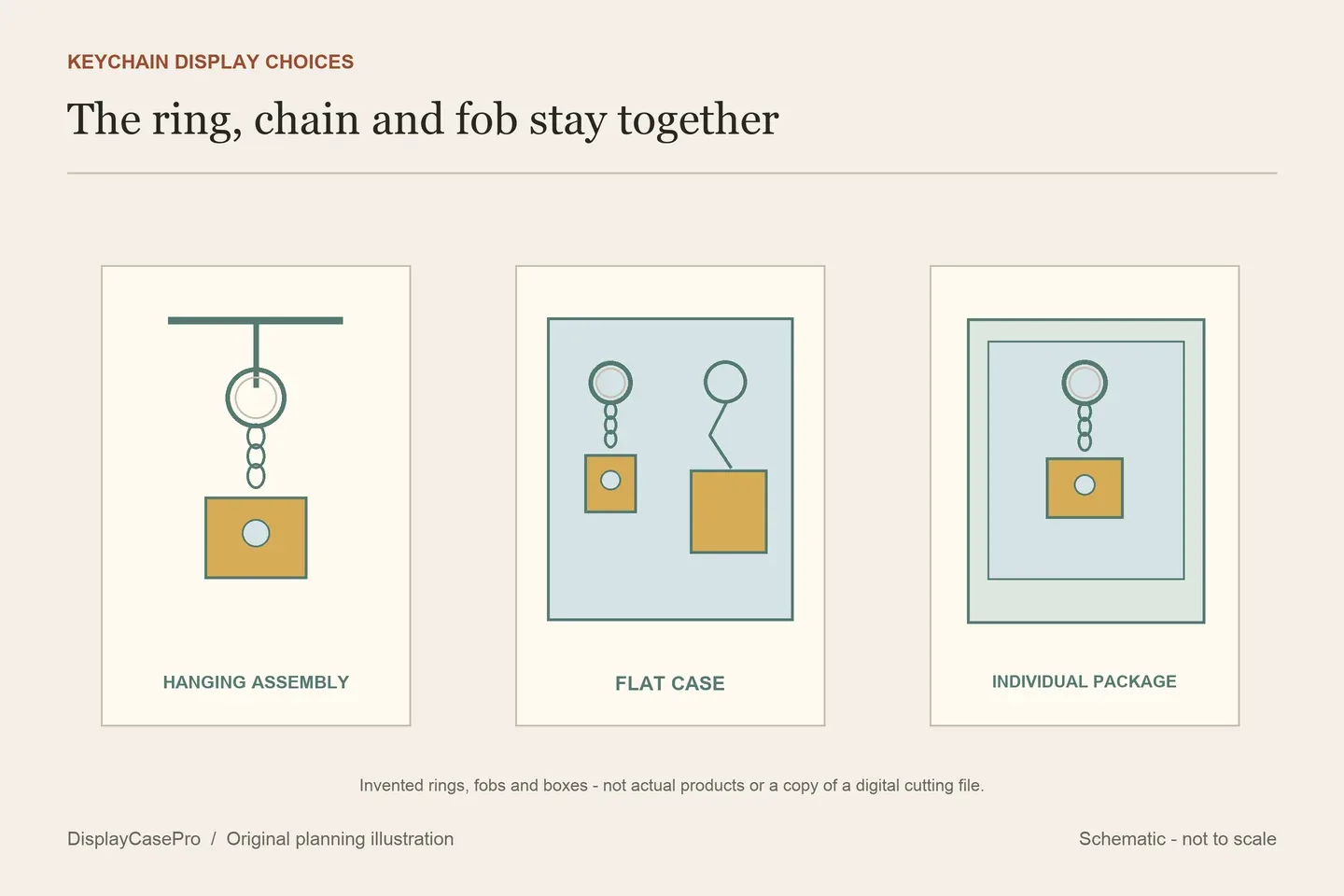
Choose a keychain display case by deciding whether each complete keyring will hang, lie flat or sit in its own presentation box. Measure the ring, chain, fob and attached parts together. The fob's advertised size and the number of hooks alone do not describe the space the collection will occupy.
Measure the ring, chain and fob in the chosen arrangement
A keychain described as two inches wide may still have a ring and chain extending beyond that outline. Include any second charm, swivel, strap or clip that will stay attached. Record the arrangement you want to show, rather than substituting the length of one component for the whole item.
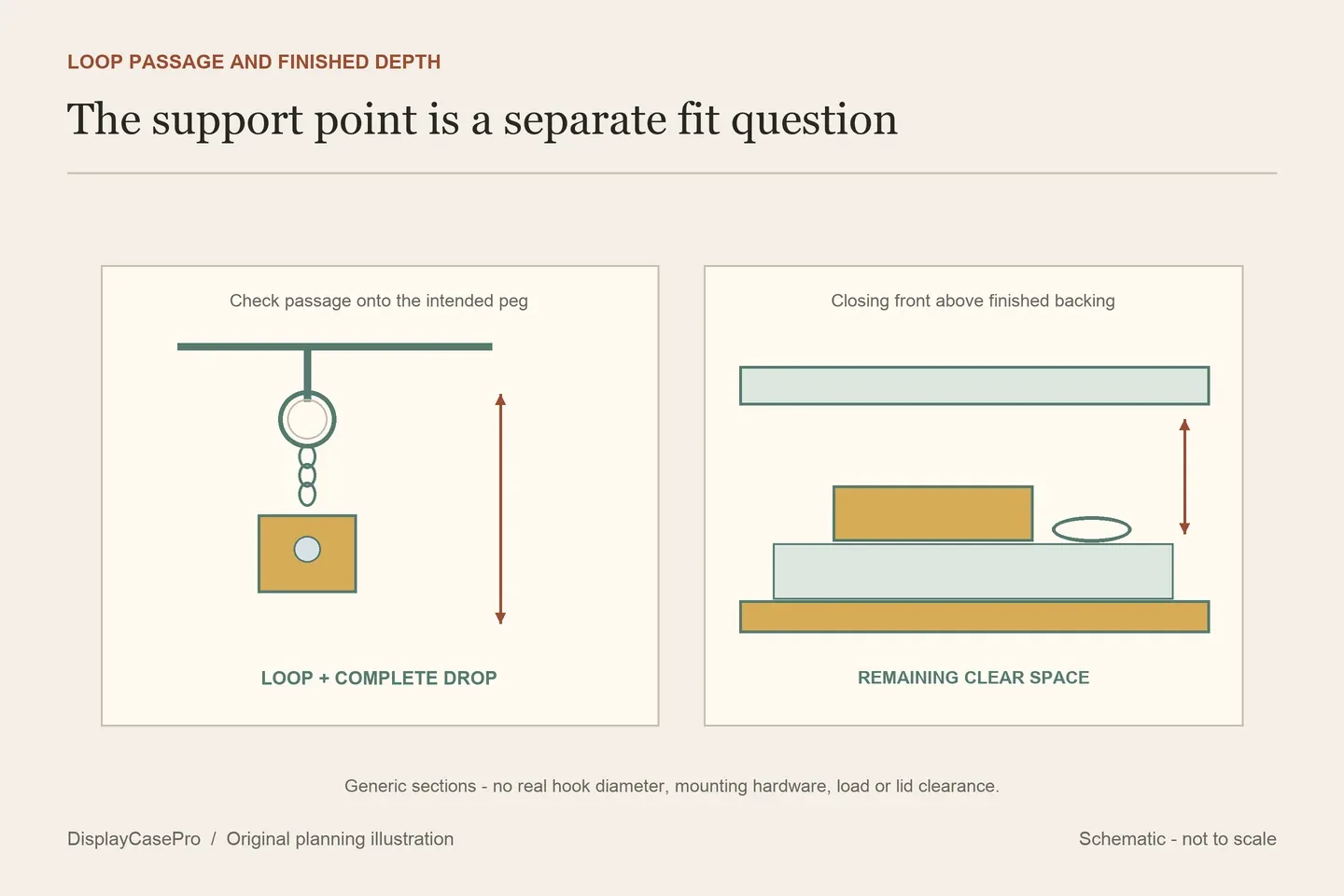
For a hanging display, identify the intended support point. A ring passing over a peg, a clasp opening around an arm and a strap resting on a hook need different receiving geometry. Check that the complete loop can get onto and off the support without forcing a decorative part through the gap.
For a flat case, arrange the ring and chain beside the fob in a position the support can maintain. A chain crossed over the artwork can hide its face even when the assembly fits within the frame. If both sides matter, keep a reverse reference image with the collection record or plan an appropriate way to turn the piece during an open-case viewing.
Choose between enclosure, open access and individual packaging
| Format | What it offers | Fit and access question |
|---|---|---|
| Flat case with a closing front | A front-facing arrangement of complete keyrings behind a cover. | Actual support, projection above the backing and clearance beneath the closed lid. |
| Open pegboard | A visible wall sequence with direct access to the rings. | Loop passage, occupied hanging outlines and whether a shared peg hides pieces behind one another. |
| Rotating hook stand | Several hanging items accessible from different sides. | Clear drop beneath each arm and the sweep of the loaded items during rotation. |
| Individual window box | A small presentation package around one configured keychain. | Whether the listing supplies a physical box or a digital template, and its assembled receiving space. |
The Daiso display-case category includes flat, stepped, arch and cylindrical containers, as well as badge and card cases. That assortment provides possible enclosure shapes, but its category names do not specify a keychain mount. A clear empty box still needs a support appropriate to the complete item and the chosen display orientation.
Keep a seller's pack quantity separate from collection capacity. A carton containing several empty cases does not tell you how many assembled keychains fit in one case or how many can be seen without overlap.
A two-inch case does not provide two inches above the backing
Custom Displays' keychain range uses its two-inch Collectors Edition cases with a one-inch foam-filled interior and velvet backing. The page recommends that two-inch range for items under 3/4 inch thick. Its 6 × 9 × 2-inch model lists an approximate 4 × 7-inch inside face area.
Those are different measurements. The two-inch size is not a stated clear gap above the finished foam, and a 4 × 7-inch face area does not supply usable depth. Compare the complete configured keychain with the actual receiving area and the lid's closed position.
The maker describes using a pin through its foam-backed background. Establish the intended mount for your keyring without piercing a fob, leather strap or printed decoration. A backing that accepts pins is not evidence that a keychain's own surface should be punctured, compressed by the lid or glued into place.
Sketch the whole assembly on the chosen face area before ordering. Allow the ring and connected parts their own positions. Keep captions outside the fob's artwork, and confirm that the support maintains the arrangement in the case's intended wall or tabletop orientation.
Count readable fobs, then check independent removal
The Carmichael Workshop's original pegboard project uses a 24 × 30 × 0.5-inch plywood panel and a grid of 54 holes. Its author describes about 50 collected keychains and the possibility of several pieces on a peg. That is one creator's open display, rather than a closing case or a tested capacity for every collection.
Multiple rings on one peg create an order: the outer ring may need to come off before the inner ring can be removed. Decide whether that suits a settled souvenir collection. For pieces you often take out, give the relevant ring an independent retrieval route and keep a record of its assigned position.
The Plymor rotating stand listed by Michaels is described as H13 × W8 × D8 inches and accommodating up to eight hanging items. The loaded product page identifies Collecting Warehouse as the seller and shipper. It is an open stand, with no enclosing cover specified.
Its overall height does not provide a numeric clear drop beneath an arm. Obtain that clearance for the longest complete keychain, along with the receiving arm's dimensions. A wide fob can also occupy neighboring space as the stand turns, even when eight rings fit onto eight hooks.
Check whether a window-box listing is a digital file
The DIY Craft Tutorials Keychain Display Box SVG listing supplies downloadable SVG, DXF and PDF templates, not a shipped physical box. It describes six window designs and shows a two-inch acrylic keychain with what it calls a standard-length chain.
| Template version | Assembled box size stated | Remaining fit question |
|---|---|---|
| Standard | W3.3 × L5.3 × H0.7 in; the listing also gives 85 × 136 × 18 mm. | Clear interior and the complete ring-chain-fob arrangement, including the selected window. |
| Cricut Joy version | W3 × L5.3 × H0.7 in; the listing also gives 76 × 136 × 18 mm. | The narrower assembled format and the actual item support, rather than assuming the same receiving area. |
Keep the source's inch and metric figures as published approximations. They are assembled box measurements, not a measured cavity. “Standard-length chain” is a description of the sample, not a universal keychain size. Confirm your complete assembly before selecting a template or a finished package.
A packaging window is also a different viewing choice from a clear cabinet front. Place the important artwork where the opening will actually reveal it. Follow the template provider's current instructions and terms if you choose that route; the illustrations and worksheet here do not reproduce its cutting files.
Use the blank keychain assembly and access worksheet to record the whole item, chosen face, support point and removal order. The collection measurement guide covers the occupied outline, while the shadow-box usable-space guide covers clearance above a finished backing.
Common questions
Does a two-inch fob fit a box advertised for two-inch keychains?
Check the complete ring, chain and attached parts against the actual receiving arrangement. A sample fob size does not specify every keychain assembly.
Do 54 peg holes mean 54 visible keychains?
Count the outlines and faces that remain visible in your layout. Wide fobs, long drops and shared pegs can change how many useful positions the board provides.
Can an open stand go inside a separate case?
Check the entire loaded stand, the space needed to reach each ring and any intended rotation. The empty stand's overall size alone does not establish an enclosed working arrangement.
Comments
Share a display tip or ask a question.