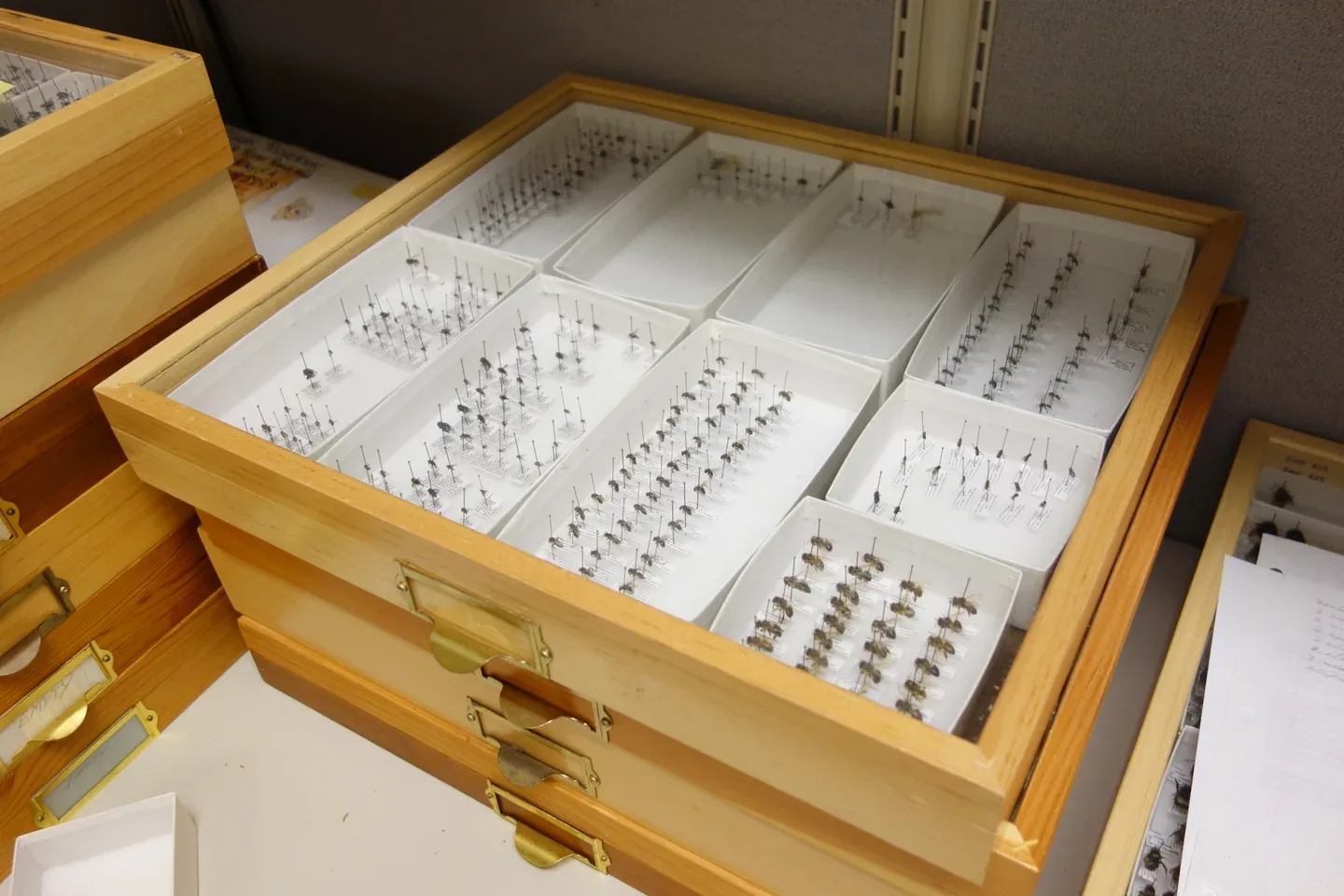
Choose an insect collection display case by distinguishing a small exhibit box, a drawer intended for a cabinet and a particular event’s required box format. A growing collection also needs a specimen-to-position record. The outer drawer size, pinning surface and clear space above prepared specimens are separate measurements.
Start with the prepared specimens and the information already with them
List the collection’s existing identifiers and associated labels before choosing a display layout. Keep the supplied identification, documented collecting information and any uncertainty in separate fields. An attractive row or a similar-looking specimen is not independent identification evidence.
Record the complete already supported profile, including the existing pin or other mount and any label projection. A box’s face area cannot supply its usable specimen height. This guide compares receiving boxes and records; preparation, mounting and treatment need their own appropriate instructions.
Decide whether the group is a fixed exhibit or a collection that will receive additions and re-identification. In a changing collection, a clear position map can make a move traceable. Leave an identifier connected to its original record when changing the visible arrangement.
A box can fit on a table without fitting in a drawer cabinet
| Format | Useful purpose | Receiving information needed |
|---|---|---|
| Individual exhibit box | View a selected prepared group through a front. | Actual lined cavity, lid closure and intended orientation. |
| Collection drawer with unit trays | Keep smaller recorded groups within one drawer. | Exact tray array, clear drawer boundaries and finished specimen heights. |
| Drawer inside a cabinet | Store and retrieve a documented drawer system. | Actual drawer exterior, cabinet receiver, stops and opening instructions. |
Ecology Supplies’ insect display box uses chipboard, a glass viewing lid and a paper-covered foam pinning surface. It publishes a 16.5 × 11.5 in size, without identifying that pair as a clear interior or supplying a height.
The same description refers to Cal Academy unit trays fitting the box’s height. That statement does not specify a complete tray array or make the box a demonstrated fit for every cabinet. Request the actual selected trays and the closed receiving dimensions together.
Keep the outside, inside and board dimensions in different fields
The following descriptions were read on 18 October 2026. They are attributed product or plan figures, without measurements, cabinet-fit or preservation tests by DisplayCasePro.
| Source | Published figures | Boundary to retain |
|---|---|---|
| Ecology Supplies box | 16.5 × 11.5 in. | Inside/outside and height are not specified in that size line. |
| Home Science Tools BE-CASELRG | Inside 12 × 16 × 1.25 in; outside about 12.25 × 16.25 × 2 in. | Published interior versus exterior, with the finished foam datum still to confirm. |
| Carolina case family | Outside depth about 2¼ in; inside depth about 1⅜ in; ⅜-in pinning board. | Selected face size and the clear height above the installed liner remain separate questions. |
| Mississippi State P3832 plan | Outside 19 × 16½ × 3 in; pinning piece ½ × 15 × 17½ in. | Plan exterior and one construction component, rather than a measured finished cavity or cabinet receiver. |
Home Science Tools’ exhibit case has a lift-off telescoping cardboard top, an acrylic panel and four supplied lid-retaining pins. The half-inch foam liner and those closing pins have different jobs. Specimens are excluded, and the stated interior depth should not automatically have the foam thickness subtracted again.
Carolina’s family description names glass tops and a pinning board covered with white Ethafoam. Its depth figures do not provide the face dimensions of every selectable variant. Keep a requested clear height above the finished surface separate from the board’s construction thickness.
Neither a deep-sounding product title nor the largest face in a range supplies an insect count. The existing supported specimens, labels, tray arrangement and access determine which positions can actually be used.
A historical standard does not replace the current event packet
Mississippi State Extension’s P3832 box plan describes a 19 × 16½ × 3 in exterior and says nonstandard sizes are not acceptable for its contest-display context. Keep that statement with the publication, rather than extending it to every event or current state programme.
Bug Collectors’ historical account also describes that exterior, referring to a July 1999 change, but says older 18 × 24 × 3½ in boxes remain acceptable. These statements should not be silently combined into one universal current rule.
If entering an event, obtain its current written requirements before buying or building. Separately obtain the actual cabinet’s drawer interface if the box will be stored there. A shared Cornell or standard label does not demonstrate the receiving fit of a particular manufactured pair.
The published construction lists are not a complete assembly or chemical-care procedure in this guide. Use the relevant current instructions for the intended project; do not infer a finished receiving cavity by adding selected board dimensions.
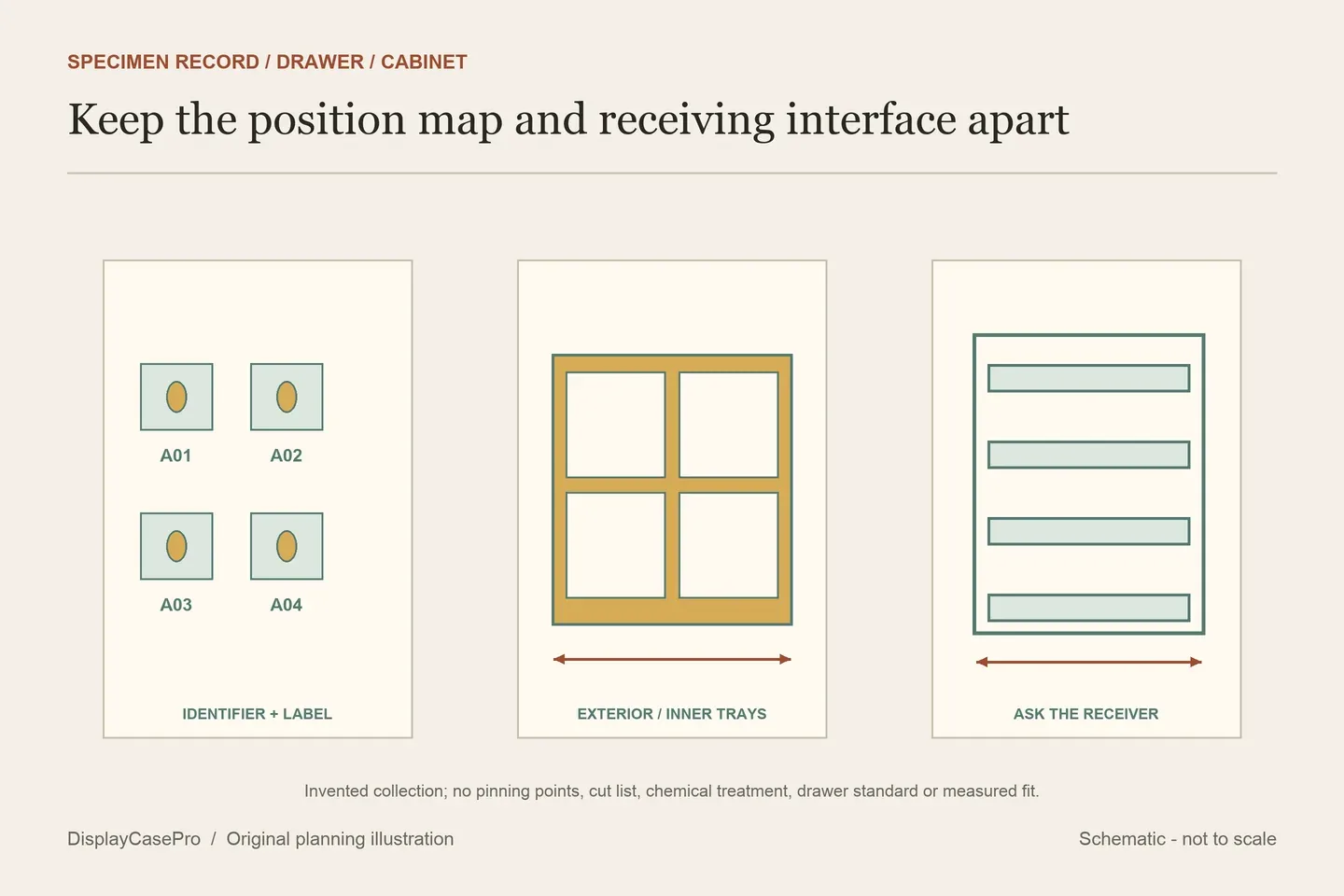
A position change should keep the specimen’s record intact
Use a drawer identifier, a tray identifier where present and a position record linked to each specimen. Keep the original label information and an existing photograph with that record. A new visible caption can be a reference to the record without replacing uncertain information with a guessed species or location.
For growth, record the intended spare positions and which neighboring groups would move. An unused patch of backing is not automatically enough room for the next supported specimen and label. Update the position map after a change so the former location remains traceable.
Confirm which parts open and how a supported tray or drawer is intended to be approached. A viewing lid, drawer pull and specimen mount are different components. Do not treat permission to open the box as an instruction to grasp a specimen or alter its preparation.
The cover photograph shows a Bohart Museum collection drawer. Photo: Daderot, 24 June 2014, CC0 1.0. Whole composition retained, proportionally resized and compressed to WebP. It illustrates trays and associated labels, without proving a commercial drawer’s dimensions, cabinet fit or mounting method.

Use the insect collection, drawer and label worksheet with the usable depth guide to keep the exterior interface and finished receiving space distinct.
Common questions
Will any box called standard fit my cabinet?
Confirm the actual drawer exterior and cabinet receiver. A publication’s format name is not a fit test of your pair.
Do four supplied pins mean a four-specimen capacity?
For the cited Home Science Tools case, the four pins retain the lid. Specimen capacity and suitable preparation are separate questions.
Comments
Share a display tip or ask a question.