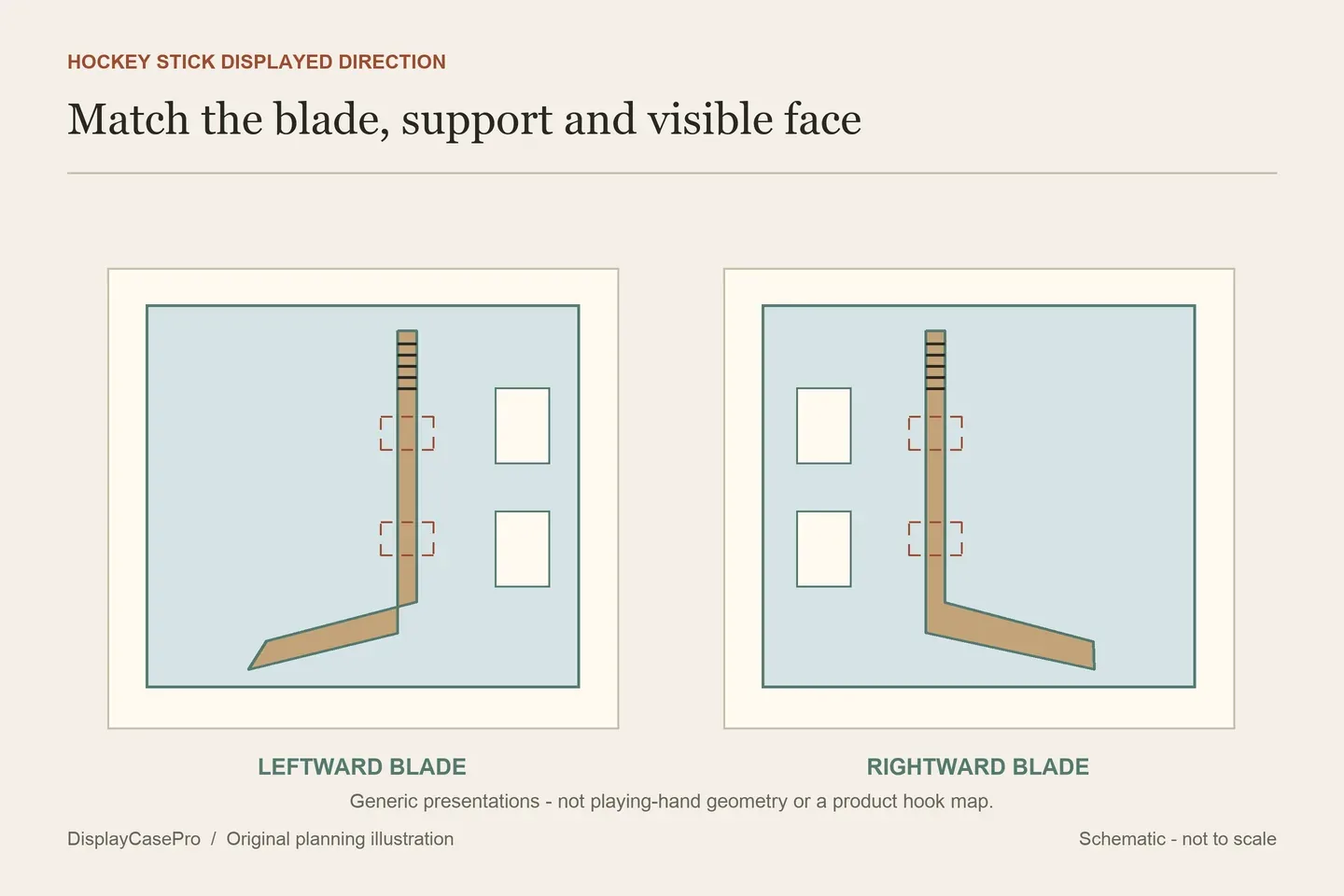
Choose a hockey stick display case around the complete shaft and curved blade in the direction you want to show. Check the intended hooks, the blade's projection toward the glazing and the room used by photos or pucks. A long cabinet dimension alone does not define the supported stick layout.
Record the full stick in its displayed direction
Identify the actual stick type, maker and model before selecting a case. A product naming a hockey stick does not establish that a goalie stick, field-hockey stick, shortened keepsake or other unusual profile fits the same arrangement. Use the complete item rather than a nominal shaft-size label.
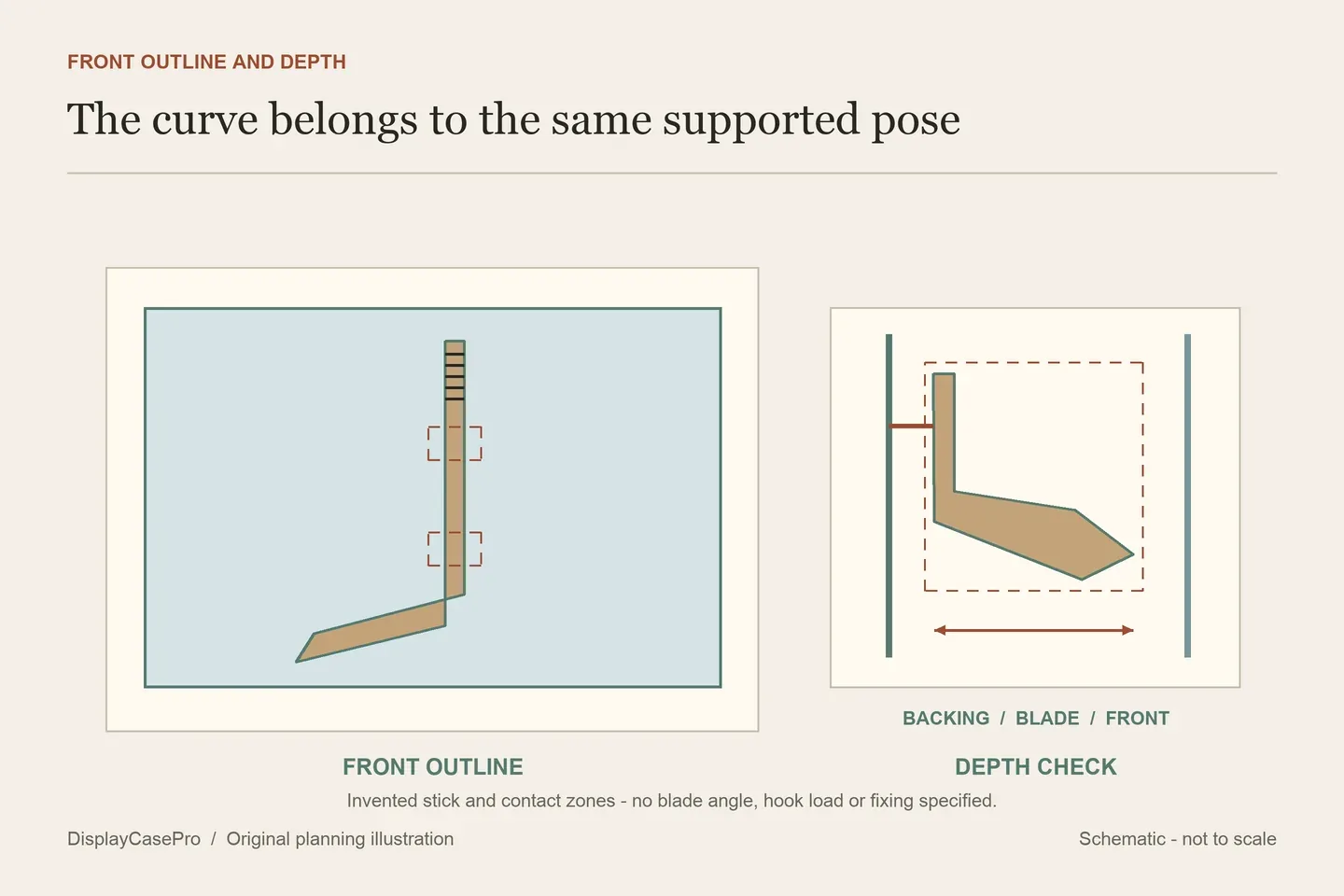
Choose the side you want visible, including any signature or commemorative text. Then record the overall outline with the blade pointing in the intended direction. Mark the shaft end, blade tip, heel and the widest blade area on a simple front-view sketch.
Draw a side view too. A curved blade can project away from the backing toward the front panel even when the front silhouette fits. The relevant depth belongs to the supported stick in that position; rotating the shaft later can change the blade's relationship to the glazing.
Keep the product's left- or right-handed compatibility statement attached to its actual support layout. It is useful information to confirm, rather than a substitute for checking your own blade and the face you want visible. Do not reverse or bend a stick simply to imitate a product photograph.
Three listings provide different kinds of information
These pages were read in October 2026. Figures retain each supplier's axis order and measurement definition. They describe published products; none has been physically tested here with your stick.
| Exact listing | Published size | Support or layout information |
|---|---|---|
| sfDisplay dc5208bBlk cabinet | Inside H70.5 × W15.5 × D3.5 in; outside H72 × W16.5 × D4.25 in. | Two padded metal hooks and both wall orientations described. The stated stick-length limit needs clarification below. |
| Nikco DC5208Blk listing | Inside H70.5 × W15.5 × D3.50 in; outside H72 × W16.5 × D4.25 in. | A padded metal mounting kit is described; obtain the actual placement and opening instructions. |
| PATHER horizontal case 84101 | H12 × D3½ × W72 in. | Inside/outside is not labelled. Hooks and four fold-over frames are listed; left- and right-handed sticks and horizontal mounting are named. |
The 72-inch figures do not mean the same thing across the table. One is a labelled outside height, while the horizontal product supplies an unlabelled width. Obtain a clear interior for the chosen orientation before comparing a supported stick.
The matching sfDisplay and Nikco dimensions are two published listings, rather than two independent physical measurements. Retain the source and exact product code with each set of figures. Similar numbers do not settle an unresolved compatibility statement.
For the PATHER product, request the usable opening, internal depth and hook layout. Its horizontal specification should not be treated as permission to turn the case upright. A different orientation may require a different retention and hanging arrangement.
A 37.5-inch statement conflicts with a much taller cavity
The sfDisplay description says its intended adult stick is approximately up to 37.5 inches, while the specification table gives a 70.5-inch internal height. The two statements need a current explanation from the supplier.
Do not silently correct the smaller number, choose the larger number as the supported-stick maximum or invent a diagonal placement. The case's empty rectangle and the intended hook positions answer different questions, and the published wording does not resolve their relationship.
Send your stick's actual full outline and ask for a labelled arrangement drawing: “Your description gives an approximately 37.5-inch stick limit, while the interior height is listed as 70.5 inches. What is the supported limit for this exact stick and orientation, and where should the supplied hooks contact it?”
The answer should cover the complete blade as well as the shaft. Keep the written clarification with the product record. A review showing another object inside the cabinet, or a familiar product image, cannot supply that missing stick-specific specification.
Hooks and photo frames belong on the same plan
Mark the intended hook contact zones before adding other memorabilia. Ask how the supplied hooks receive the shaft and whether their position avoids the important inscription. A general padded-hook description does not identify a suitable contact point for every finish or signature.
Do not assume that a broad empty area beside the shaft is freely usable. The blade, hook projection, door fittings or a companion object can occupy that space. If including a puck, give it its own documented support rather than placing it against the stick.
The PATHER listing includes four fold-over frames but does not supply their usable picture dimensions in the text read. Ask which picture format they receive and how they are positioned in the intended scene. Four frames in the package do not establish room for four arbitrary photographs or additional deep frames.
Make the stick the reference for the whole composition. A photo should be readable without covering the blade or requiring a hook to move into an unconfirmed position. Record every object intended to remain inside before comparing the final usable width and depth.
Check how the stick enters and the case opens
A closed interior can be long enough while the intended opening remains awkward. Ask which panel or door moves, the direction of movement and how the complete blade passes through. The stick should not have to be flexed against a frame edge to enter.
For a hinged front, check the door swing and access to both hooks. For another construction, obtain that product's opening instructions rather than assuming a side, end or front panel is routinely removable. An assembly method is not automatically the everyday access method.
Plan the entire outside outline on the wall, together with the intended opening. Nearby frames, a corner or furniture can interfere even when the closed case fits. The collection wall planning guide helps arrange the verified outline among other displays.
Follow the case's actual installation documentation for its orientation, complete contents and wall construction. Included screws, hooks, latches or an empty-case weight do not establish the correct wall fixing for every installation. This guide supplies no universal anchor spacing or load rating.
Use the blank stick, blade and support worksheet to retain the two views, displayed direction, hook zones, companion items and source conflict. Resolve those fields before choosing a finish, print or lighting accessory.
Common questions
Does a 72-inch case hold a 72-inch stick?
Not from that number alone. Establish the usable interior, full blade profile, intended support locations and opening, with any conflicting length statement resolved.
Can the same case show either blade direction?
Confirm the exact product's intended handed-stick layout. The PATHER horizontal listing names both, but that does not define every curved blade or another maker's hook arrangement.
Can a stick cabinet also hold photos and pucks?
Only according to the complete intended layout. Each companion piece needs its own occupied space and support; a capacity illustration is not a free area for arbitrary additions.
Comments
Share a display tip or ask a question.