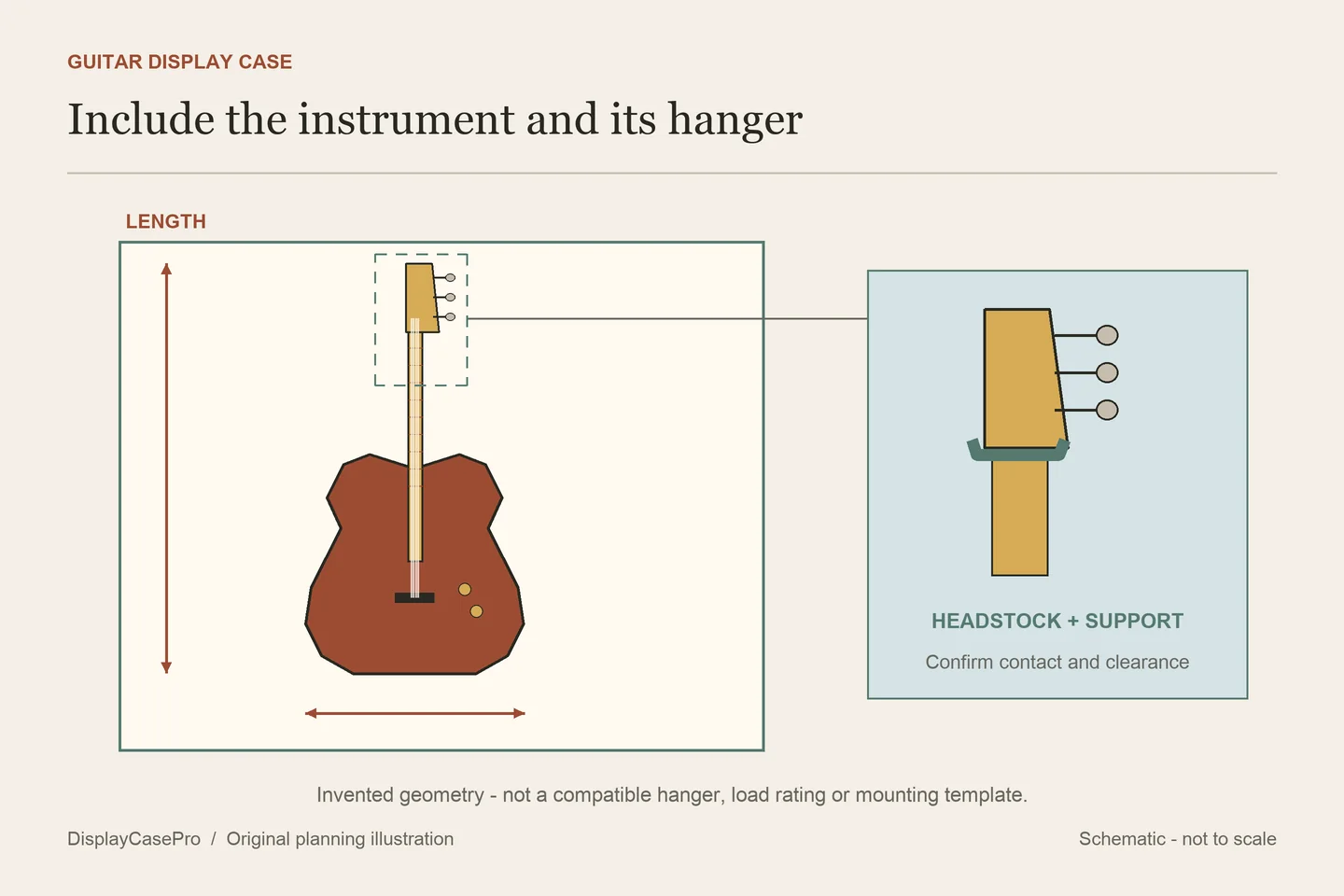
Size a guitar display case around the instrument in its intended support, including the headstock, tuning machines, body and any projecting parts. Then check the door opening and usable depth. A case’s inside height is not necessarily the maximum guitar length once its hanger is installed.
Record the guitar as it will be displayed
Identify the exact instrument and display state. A body style, brand name or “electric/acoustic” label is not a complete dimensional specification. Keep documented maker dimensions and any suitable measurements of your own instrument in separate fields.
| Direction | Include | Question for the selected case |
|---|---|---|
| Full length | The complete instrument from its lowest projection to the highest headstock or tuning-machine point. | What length is accepted with the intended hanger and mounting position? |
| Width | The widest part of the body or any sideways projection in the chosen orientation. | Are the opening, hanger region and usable interior wide enough? |
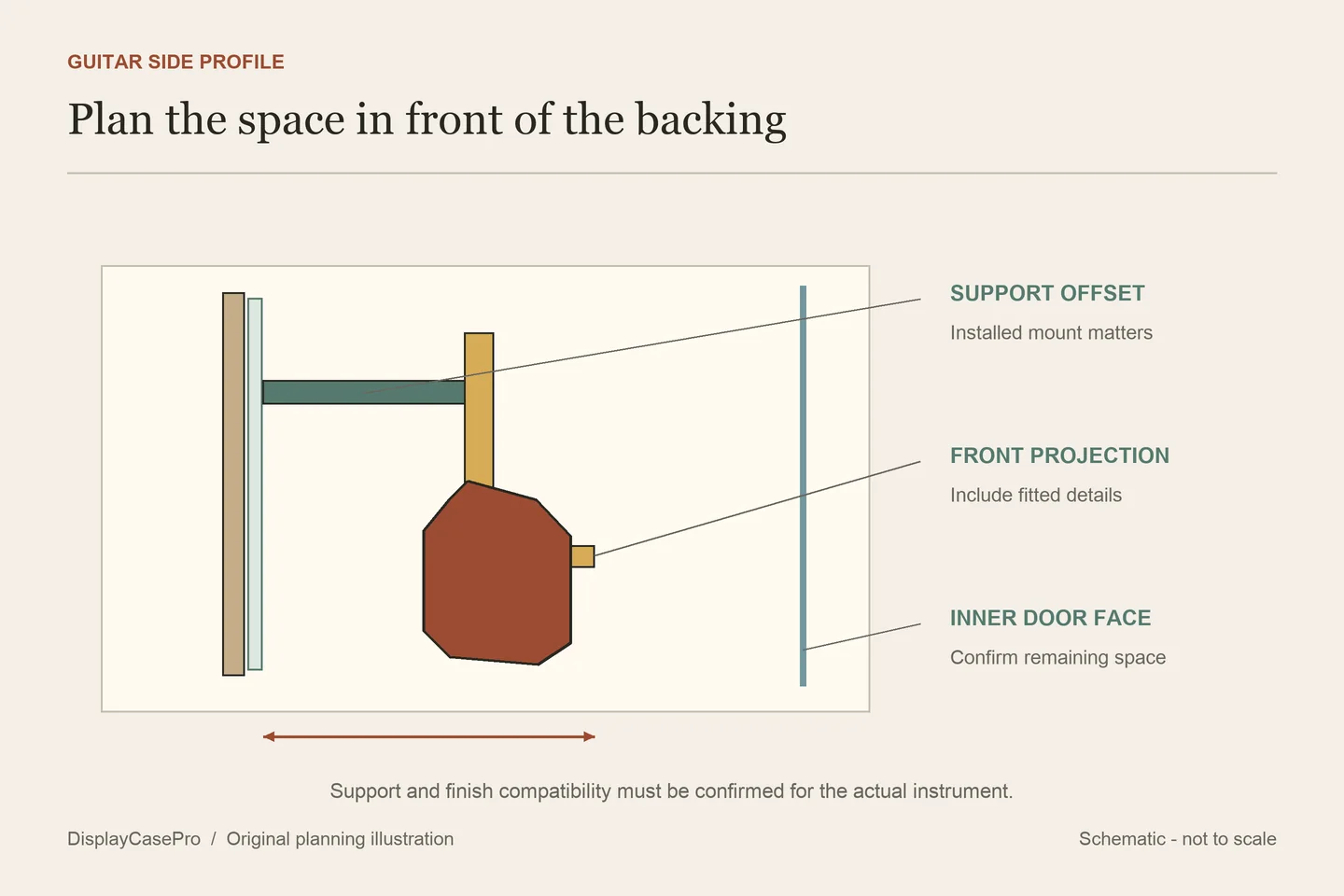
| Depth | The body, controls, bridge or other projections, plus the support’s offset from the backing. | What remains between the installed support and the inside of the closed door? |
Include a strap, fitted accessory or display base only if it will remain in that configuration and the instrument instructions permit it. Do not press a control, bend a projection or move the neck to reduce the outline. If direct measurement risks contacting a delicate finish or component, obtain suitable dimensions from the instrument maker or a qualified instrument specialist.
For the general object/case/room distinction, use the collection measurement guide. The extra guitar-specific fields are the support position, headstock clearance and projection from the backing.
Compare two current listings without mixing their axes
The following figures are published specifications for the named products. Keep the axis order with the numbers; neither case has been fitted or measured by DisplayCasePro.
| Case and original axis order | Inside | Outside | Important scope |
|---|---|---|---|
| Fender Guitar Display Cases, L × W × D | 43.75 × 16 × 3.625 | 46.63 × 17.5 × 4.5 | Listed as a vertical electric-guitar display case. A mounting template is provided; wall mounting hardware is not included. |
| sfDisplay Clear Viewing Guitar Cabinet, W × H × D | 18 × 44.5 × 5.5 | 19.5 × 45.5 × 6.5 | A padded neck mount is included and fitted at the chosen position. The description states a guitar length up to 44 in. |
The second example makes the distinction explicit: 44.5 inches of listed inside height does not mean a 44.5-inch guitar is accepted. Retain the separate 44-inch instrument limit. Do not turn the difference into a universal half-inch hanger allowance; it belongs to this maker’s product description.
Likewise, the Fender case’s dimensions do not establish fit for an arbitrary acoustic guitar, bass or unusual headstock. The actual supported profile and the maker’s compatibility information still control the choice. Outside depth is useful for placement on the wall; inside depth serves a different job.
Check the headstock and hanger together
A guitar can fit within a rectangle while its intended support does not. Ask whether the hanger is fixed or fitted later, what instrument shapes it is intended to receive and where its contact areas will sit. Record the tuning-machine positions and any asymmetric part of the headstock near the support.
Resolve the support arrangement using both the instrument and hanger/case instructions. A similar neck width is not proof of compatibility. A padded surface is also not a loaded-capacity or finish-compatibility specification. Obtain those confirmations for the actual instrument and mount.
Keep the mount’s attachment location in the order brief. It affects the space above the headstock, below the body and in front of the backing. If a maker supplies a stated maximum instrument length, preserve it alongside the inside dimensions rather than replacing it with a calculation.
Vertical and horizontal display require different confirmation
Do not assume a vertical case becomes a horizontal display by turning it sideways. The instrument support, door, attachment points and intended loading direction need to suit that orientation. Pennzoni’s acoustic-case page, for example, tells customers to request additional hardware for horizontal display. That requirement belongs with the chosen configuration.
If several guitars will share a cabinet, ask for the actual rest arrangement and usable opening for the proposed collection. A nominal capacity does not describe every combination of body widths, neck/headstock shapes and accessible removal routes. Keep that multi-instrument specification separate from a one-guitar wall case.
Resolve the finish-contact question
Fender links a stand disclaimer about instrument finish reactions from its display-case page. The one-page document advises caution with vintage instruments and nitrocellulose finishes because environmental contaminants can contribute to reactions between a finish and stand components. This is a reason to confirm the actual contact arrangement, rather than infer universal compatibility from a soft lining.
Record what is known about the instrument’s finish, including any uncertainty about refinishing. Ask the instrument and support makers about the proposed materials and contact locations. Do not add a homemade barrier layer and assume it settles the question; it also changes the contact material and geometry.
If the instrument has environmental-care requirements, put those in a separate part of the brief. Confirm whether the proposed display is simply an enclosure or provides a specified environmental system. An attractive closed case does not itself document those capabilities. This sizing guide does not set humidity targets or prescribe instrument treatments.
Prepare a complete guitar-case specification
- Identify the instrument. Record model, finish information and the intended display state without substituting a generic body category.
- Describe the support. Give the exact hanger model, orientation, contact questions and proposed attachment position.
- State the supported dimensions. Include headstock/tuning machines, widest body point and projection from the backing.
- Ask for usable limits. Obtain inside dimensions, any separate mounted-instrument limit and the clear opening for the finished arrangement.
- Check placement and access. Confirm the case’s outside footprint, door movement, prescribed installation and removal task at the intended location.
Use the blank guitar display specification worksheet to keep those answers together. Leave an unconfirmed limit visible as a question. Do not fill it by subtracting guessed lining or frame thickness from an exterior size.
Check the case opening with its maker’s instructions before adding the instrument. The retrieval route should permit appropriate support without pulling on tuning machines or reaching through another guitar. Installation and loading must follow the selected case’s requirements for the actual location; this article provides no wall-anchor design.
Once the support and dimensions are resolved, plan reflections, fittings and maintenance access with the display cabinet lighting guide. Include any fittings in the finished space specification.
Common guitar-case questions
Can I use the inside height as the guitar-length limit?
Use a maker’s separate mounted limit where provided, and confirm the installed hanger arrangement. The sfDisplay example above shows why the two figures must remain distinct.
Will an electric-guitar case hold an acoustic guitar?
Check the exact product’s stated scope and the actual supported instrument. The body depth, headstock/support region and opening all matter.
Does a plush or padded interior settle finish compatibility?
Obtain compatibility information for the actual finish and contact components. The material description alone is not a universal approval.
About this guide: This is a dimensional and support-planning reference based on named maker pages and the linked primary disclaimer. It does not report a guitar fit, hanger-load, installation or preservation test.
Comments
Share a display tip or ask a question.