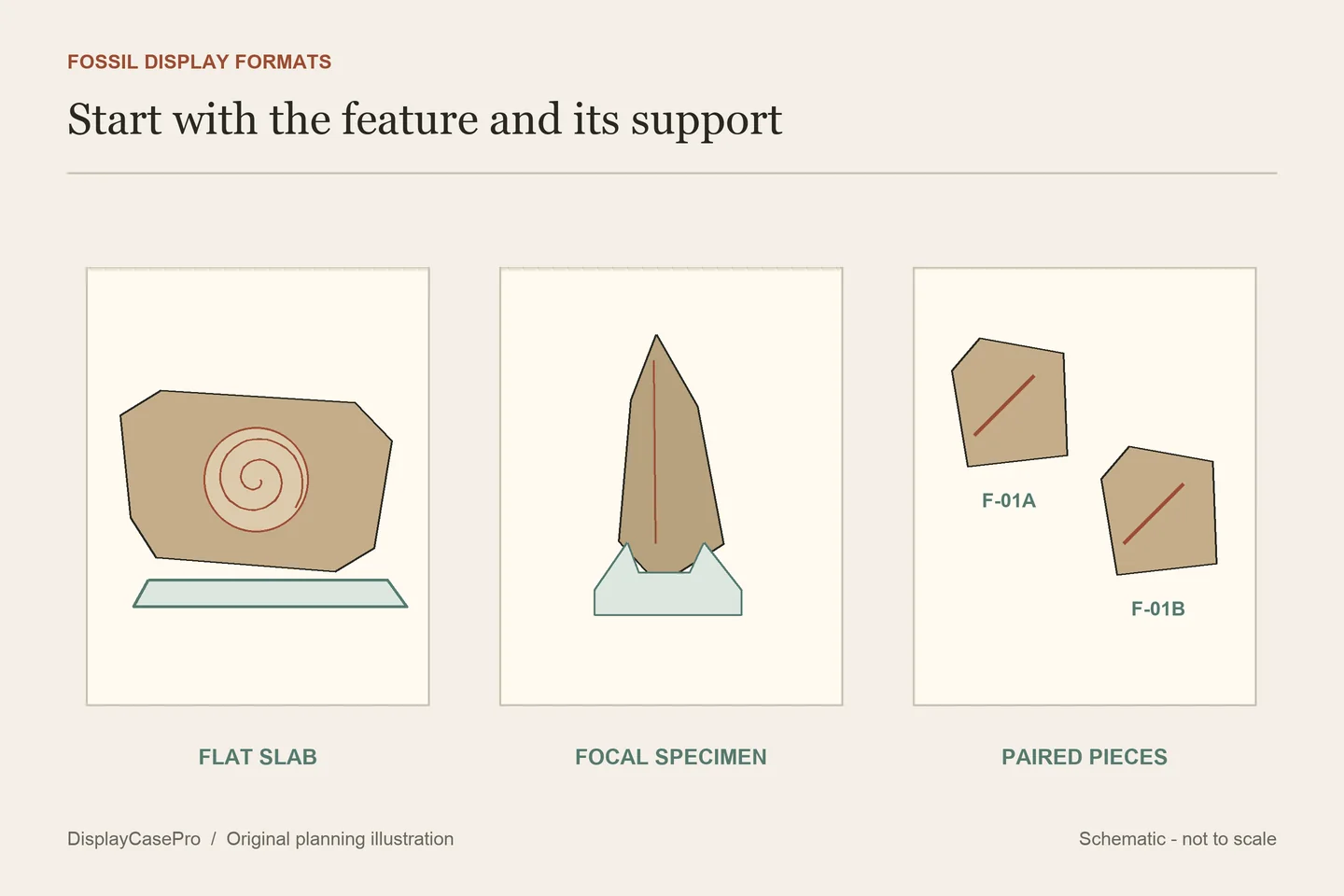
Choose a fossil display around the feature you want to see and the support the whole specimen needs. A broad slab, a loose tooth and a delicate feature projecting from matrix are different display tasks. A clear box supplies an enclosure; the support and contact arrangement still need to suit the particular fossil.
Start with what the display should reveal
Write one viewing goal for each specimen: the impression across a slab, a tooth’s profile, a surface detail or the relationship between two documented counterparts. Then identify what belongs to the physical object: the exposed feature, surrounding matrix, an existing mount and any associated part. Plan for that complete assembly.
A fossil’s appearance can hide the support it needs. The National Park Service’s 2005 paleontological collections handbook discusses fossils that cannot support their own weight, matrix that provides support and fragile features needing tailored exhibit mounts. Its exhibit guidance considers both flat and upright arrangements and reserves adhesive solutions for experienced specialists. Preparation and repair records also inform later care. These principles make an existing support and preparation history important starting information; they do not provide a universal home mounting recipe.
If the support history is unknown, write down the question before choosing a display that changes the angle or contact points. A clear view is useful only if it can be achieved with an appropriate support arrangement. An enclosure alone does not resolve that question.
Four fossil display case ideas
| Composition | What it reveals | Planning question |
|---|---|---|
| Flat slab under a cover | A broad impression or arrangement across a matrix surface, viewed from above. | Can the complete slab remain suitably supported with its edges and relevant surface visible? |
| One supported specimen | A chosen profile or focal feature with a separate record card. | What carries the specimen, and where must contact or pressure be avoided? |
| A small cabinet study group | Differences between individually recorded specimens without combining their identities. | Can each support and label be reached without moving a neighboring fossil? |
| Documented paired pieces | The relationship between counterparts or associated pieces, each with its own position. | Is the relationship recorded, and can the pieces be displayed separately without rejoining them? |
Flat slab with room to read the surface
A low covered presentation can make a broad feature easier to study than a crowded vertical arrangement. Plan the intended viewing direction using an existing photograph or a paper outline. Keep the caption outside the feature area and record which orientation makes the specimen’s details legible.
Check the table or cabinet location from the viewer’s position. A cover edge, frame or deep label block may conceal part of the surface. Resolve that in the layout before changing the object’s orientation. Keep the chosen support’s full footprint in the case plan.
One supported specimen as a focal piece
A single enclosure gives a small fossil space for its identity and context. Choose the main view, then ask for a support designed for that object and angle. The support may occupy more width or depth than the fossil’s most obvious outline. Include its base, rear restraint and any inaccessible area in the specification.
Place the record card where it can be read without looking through the specimen or its support. A separate card holder also lets the caption change when better documentation becomes available.
A cabinet group with individual places
Use one clear comparison question: different recorded forms, a documented locality or a collecting history. Give each item its own position code and preserve the distinction between a verified description, a supplier’s label and an uncertain identification. A neat row should not turn an uncertain group into a claimed scientific series.
Mixed profiles often need different support heights and viewing angles. Plan each supported item separately, then check the combined arrangement from the intended view. A cabinet shelf is a location for the supports, not a reason to use the same mount for every specimen.
Paired pieces with a shared record
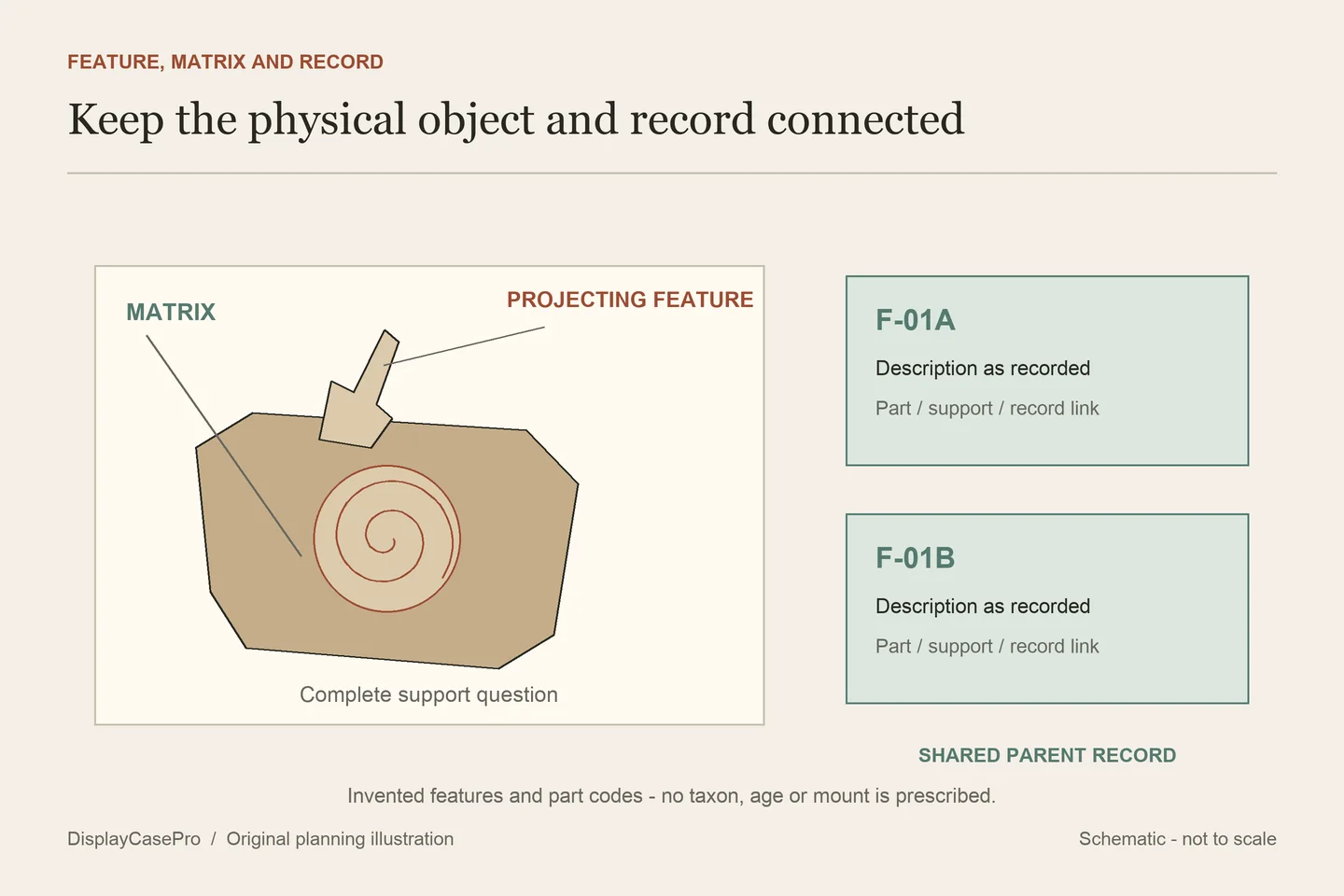
For documented counterparts, show the relationship through adjacent positions and a shared label reference. Use separate part codes such as F-01A and F-01B, with the parent record F-01. Keep the original description of their relationship. Do not infer a match from similar appearance or bring the pieces into contact to complete a decorative pattern.
Choose the support before the enclosure
Describe the proposed contact arrangement in plain language. Does the specimen rest on a shaped support? Is it already fixed to a base? Will a flexible membrane touch it? Does a proposed upright view require a new retaining mount? These are more useful questions than whether the case looks museum-like.
Separate the supporting and enclosing tasks in your notes. One line describes the object and its support; another describes the clear case around them. This prevents a case’s nominal width or a seller’s photograph from becoming an assumed mounting solution.
- Matrix: include the complete piece in the outline and ask which areas carry its weight.
- Projections: mark the features that extend beyond the main body and the clearance they need.
- Existing base: record whether it remains part of the display and what is known about its attachment.
- Retrieval: identify how the supported assembly leaves the enclosure without reaching through another specimen.
Use the collection measurement guide to record the complete supported outline. If a new upright mount, uncertain repair or fragile projection is involved, resolve the object-specific question with an appropriate collections specialist before using the proposed layout.
A floating frame’s outside size is not its display area
A small membrane frame can look like a convenient ready-made answer. Read the definitions carefully. FossilEra’s black P-116 floating frame lists a 4.4 × 4.4 in total size and a 3.7 × 3.7 in display area. Its description says items about 0.75 in thick can be accommodated, using flexible plastic membranes, with stands for horizontal or diagonal presentation.
Those numbers describe the named product. They do not establish suitable contact pressure for a particular fossil, especially one with a thin projection, friable surface or previous repair. The approximate thickness statement is not a preservation rating. Record both the visible-area question and the membrane-contact question before considering fit.
Compare that route with an enclosure around an independently supported specimen. The latter needs room for the support as well as the fossil, but its enclosure need not supply the retaining contact. Ask for the complete proposed package rather than comparing headline frame sizes alone. For a deep frame, the usable-space guide explains which internal faces define available depth.
Keep the displayed specimen connected to its records
Use a short display caption and a fuller record. The caption can carry the specimen code, a description with its uncertainty intact and the documented collecting context. The record can retain original label images, acquisition information and known preparation or repair references. Do not replace an older label because its wording is inconvenient for a decorative theme.
A position map links those records to the actual case. For each shelf or tray position, list the specimen code, part code, support reference and record location. Use existing documentation images where available; obtain further views only through appropriate handling. Keep a display reproduction or cast clearly identified so it is not confused with an original.
The blank fossil display worksheet includes matrix, exposed feature, desired view, preparation record, support/contact route and counterpart fields. Leave unknown details as questions. A blank field is more useful than an invented species, locality or age.
Common display questions
Can a slab stand upright?
That depends on the individual slab and a suitable retaining support. A stable-looking photograph does not establish the support requirements. Plan the upright view only after those requirements are resolved; a flat presentation may be a useful alternative.
Should all fossils use the same case?
A consistent exterior can tie a collection together, but the interior support and usable space still follow each specimen. Compare the complete supported profiles before committing to one case size.
Can I remove matrix to make the fossil fit?
Keep preparation outside the display-sizing task. Choose the enclosure around the documented object and its support. A smaller case is not a reason to alter the fossil.
About this guide: This is a layout and specification guide. The dated museum source provides bounded support and record principles; the product page provides attributed dimensions. Neither is presented as a tested home preservation system.
Comments
Share a display tip or ask a question.