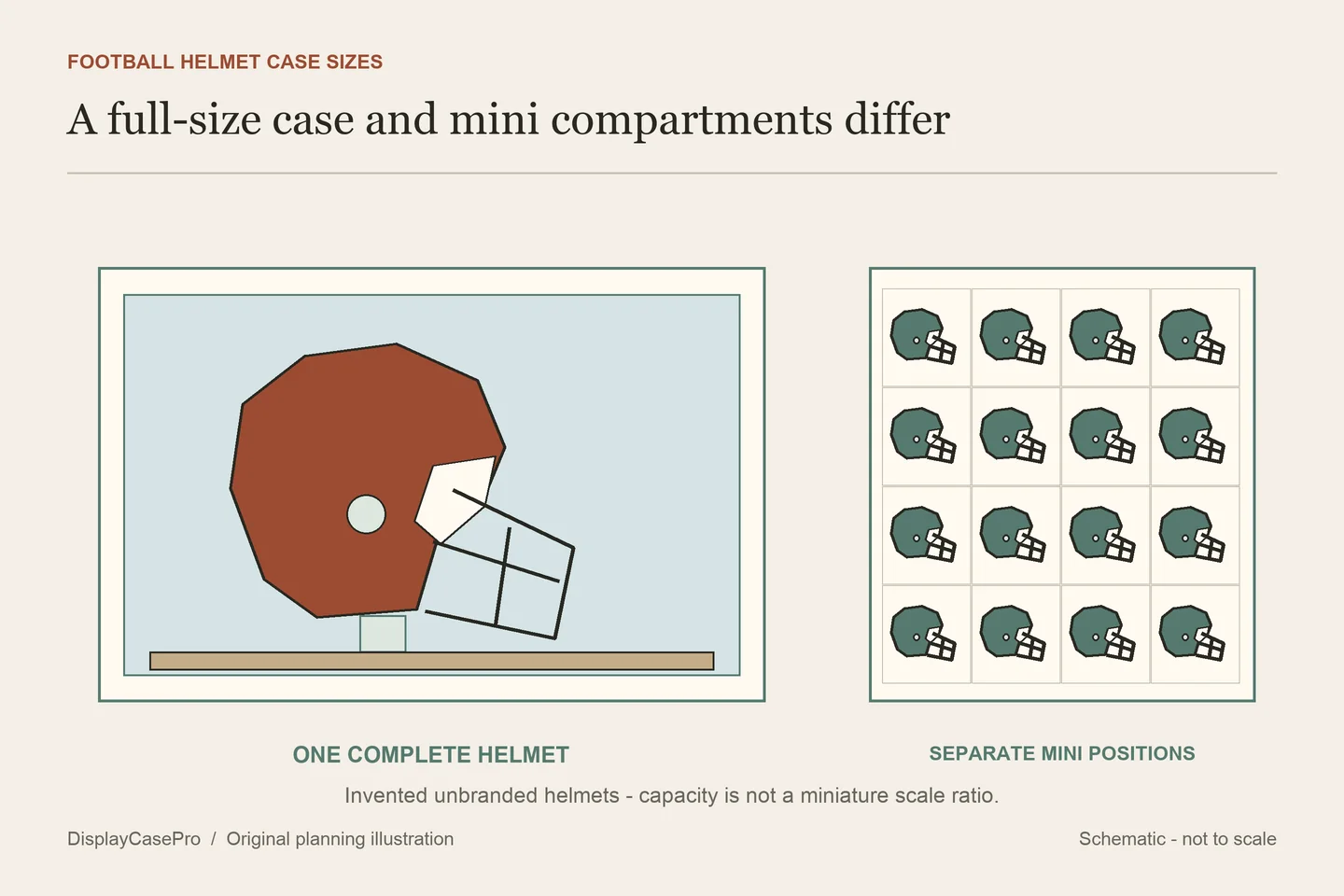
Choose an American-football helmet display case using the complete helmet, facemask and intended support. Match that profile to usable inside space, measured above the correct base or platform. A full-size case, a divided mini-helmet cabinet and the exterior dimensions of either are different specifications.
Start with the actual collectible helmet
Record the helmet model and whether it is described as full-size or mini. Keep the exact facemask, visor and other fitted components with that record. A shared team name or generic helmet category does not define the physical outline.
Choose the intended viewing orientation. Include the complete facemask, any projecting strap or attachment, and the actual support or stand. An important signed panel may need a different view from the one used in a seller’s product photograph.
- Length: include the forward and rearward extremes of the chosen arrangement.
- Width or depth: retain the maker’s axis labels and account for sideways projections and support footprint.
- Height: measure the supported arrangement from the surface on which that support will rest.
- Access: identify the path for the cover, door and supported helmet before filling the enclosure.
Use the collection measurement guide for the general envelope method. Keep your helmet record separate from published case dimensions, and leave an uncertain projection or support requirement unresolved until confirmed.
The measuring floor changes the available height
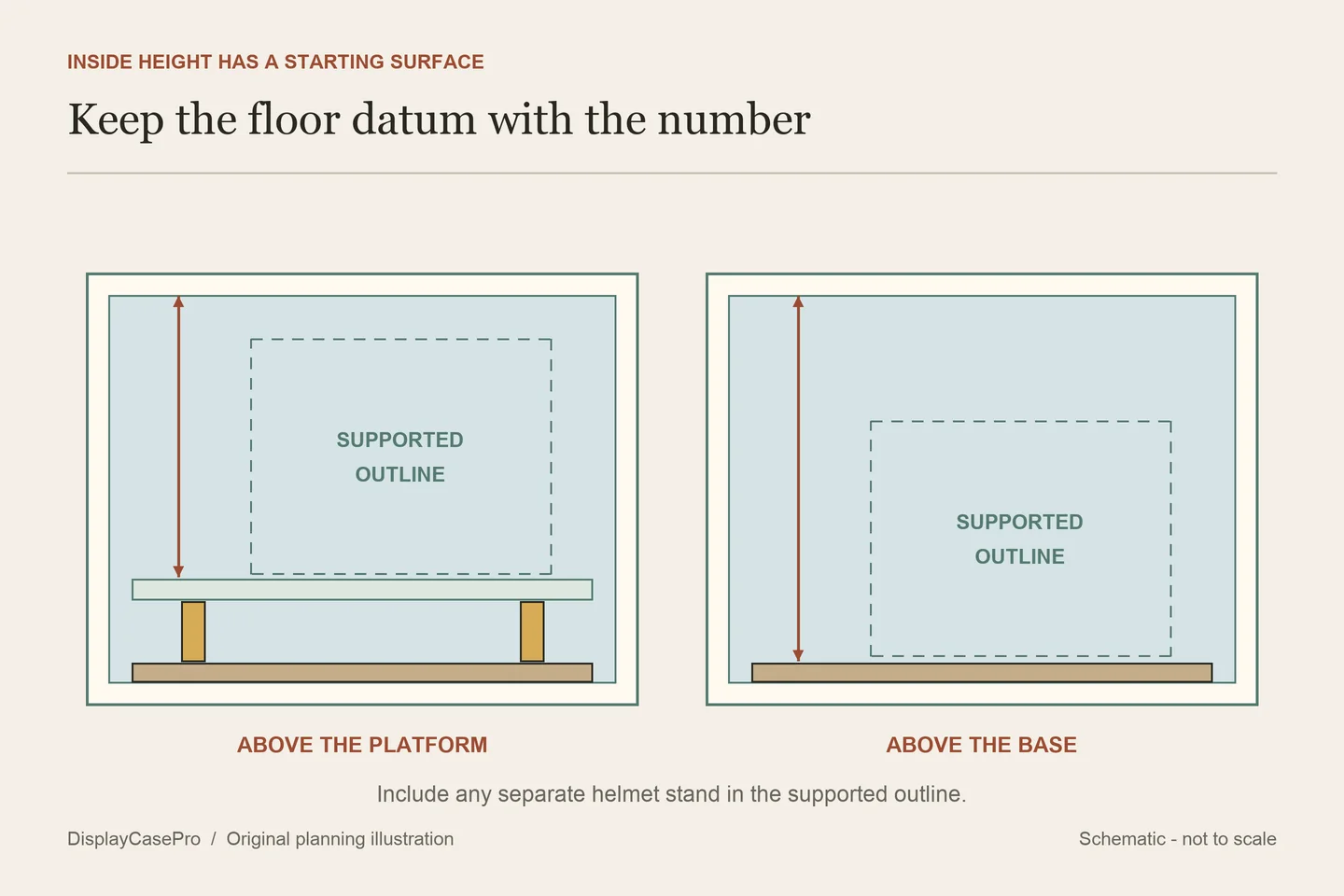
A case’s raised platform uses part of its vertical space. It is also a different component from a stand that holds the helmet. Identify both so that you neither omit an added stand nor subtract the platform twice.
Better Display Cases A002/V44 publishes the following figures in L × D × H order:
| Dimension definition | Length | Depth | Height |
|---|---|---|---|
| Outside | 14.5 | 11 | 12 |
| Inside, with risers | 14.25 | 10.75 | 10.5 |
| Inside, without risers | 14.25 | 10.75 | 11.75 |
The maker defines the 10.5-inch height between platform and case top, and the 11.75-inch figure above the base. Choose the row for the actual ordered/assembled configuration. If a separate helmet stand will sit on that surface, include it in the supported helmet’s height. Confirm any configuration change with the case maker.
These are product-specific published dimensions, not a fit test. The 12-inch exterior height does not supply either internal limit, and the two inside heights should not be combined into a larger usable space.
Preserve another seller’s axis order
Hobby Lobby’s helmet case, SKU 2486405, uses H × W × D: 12 × 15 × 11 in outside and 11 × 14.63 × 10.75 in inside. Its description identifies a flat-base format. Keep those labels with the SKU when comparing it with a listing that uses L × D × H.
A wider-looking number may simply describe another axis. Map the supported helmet’s intended orientation explicitly rather than silently reordering the seller’s numbers. The pictured helmet is not evidence that your facemask, support or model fits.
For a mini-helmet cabinet, use one compartment’s space
A multi-helmet cabinet has an overall footprint and smaller receiving areas. Its capacity describes how the maker organizes those areas; it does not describe the size of one full-size helmet.
Carney Plastics 16MFH explicitly lists a capacity of sixteen mini football helmets. Its overall size is 23.75 H × 28.75 W × 5.25 D in. When ordered with dividers, each compartment is listed as 7 W × 5.75 H × 5.125 D in. The maker offers divided and undivided shelves.
Compare a supported mini helmet with the chosen compartment and its opening. Do not apply the divided-compartment width to an undivided configuration, and do not interpret the product’s sixteen-item capacity as a miniature scale ratio. The cabinet’s whole width is not one helmet’s receiving space.
Plan the display view within each position. A support that angles the helmet can change the profile, and a divider may obstruct the side you want to see. Record the actual helmet/support combination for each position rather than treating every mini as identical.
Leave conflicting figures open for confirmation
Some listings need clarification before they can support a purchase decision. The Pennzoni full-size helmet case page contains these two exterior lines:
| Location on the page | Stated outside dimensions, inches |
|---|---|
| Main description | 14 1/8 W × 11 5/8 H × 10.75 D |
| Dimension section | 10 3/4 W × 14 L × 12 H |
The height values differ as well as the axis descriptions. Do not choose whichever line suits the shelf, average the figures or assume that rotation resolves the discrepancy. Ask for a current labeled drawing or written confirmation for the exact configuration.
Use the same approach when a listing supplies only exterior dimensions, a photo or a “fits full-size helmets” statement. Ask for the actual inside space, the floor datum and the intended opening method. Keep the reply with the case model and date of the specification.
Prepare a complete helmet-case brief
- Identify the item. Record the exact helmet, full-size/mini description, facemask, visor and intended orientation.
- Identify the supporting surface. State whether a separate stand rests on the case platform or base. Use the relevant inside-height definition.
- Record the complete profile. Include projections and all support components that rise above that surface.
- Confirm the receiving space. Use the clear interior for a single case or the applicable compartment for a divided cabinet.
- Check the opening task. Ask how the cover or door moves, where it rests during access and how the supported helmet leaves.
- Check placement. Use verified exterior dimensions and the maker’s installation/loading requirements for the actual shelf or wall.
The blank football helmet case worksheet separates those fields, including a place for conflicting or missing specifications. A mock-up of the intended outline can help discuss access with a maker; it does not test the actual support or case capacity.
Reserve a clear view of the chosen panel and a separate location for any added caption. A mirror may provide another view, but check whether the frame, support or reflection obscures the detail. Use the display cabinet lighting guide for the view and reflections after the physical arrangement is resolved.
Keep the case’s care instructions separate from the collectible. Advice for cleaning acrylic does not establish a suitable treatment for a signature, painted shell, decal or other helmet component. This article does not prescribe such treatments.
Common helmet-case questions
Is there one standard full-size helmet case dimension?
The listings above use different interiors, axes and base arrangements. Choose from the actual supported helmet and exact case configuration rather than a universal box size.
Can I use a case’s outside height to check fit?
Obtain the clear inside height above the surface the supported helmet will use. Exterior height describes the package, not that clearance.
Does a sixteen-mini cabinet fit every mini helmet?
Check the applicable compartment, opening and individual supported profile. Capacity alone does not establish every model or presentation angle.
About this guide: These are attributed supplier specifications and original planning tools. No helmet or case was fitted, load-tested or evaluated for playing safety, autograph authenticity or long-term preservation.
Comments
Share a display tip or ask a question.