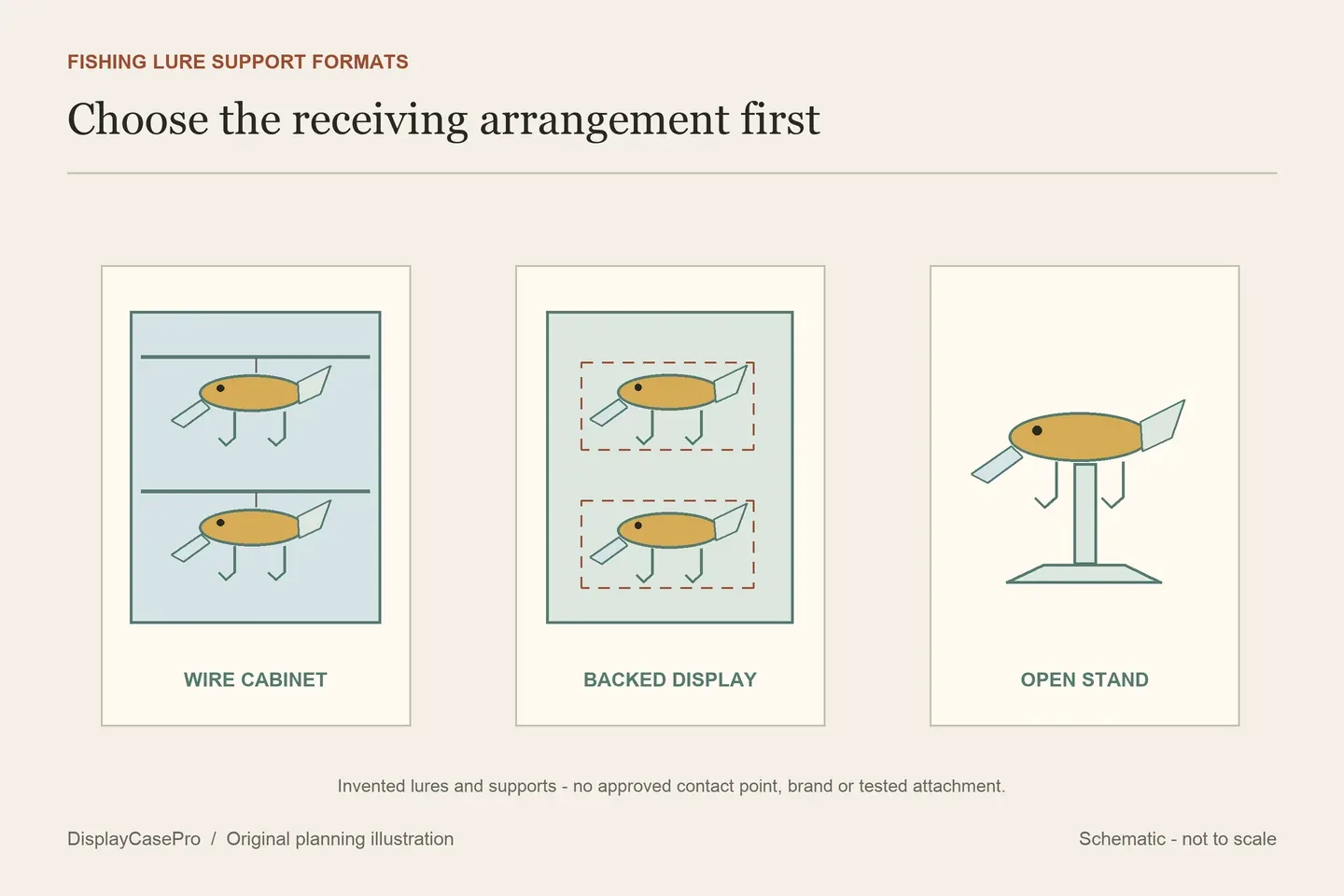
Choose a fishing lure display case for the complete lure, including its hooks, diving lip, skirt and intended support. A cabinet with hanging wires, a foam-backed pin-up case and a small clear packaging box provide different receiving arrangements. Decide which part will support the lure before comparing case dimensions or counting positions.
Include more than the painted body
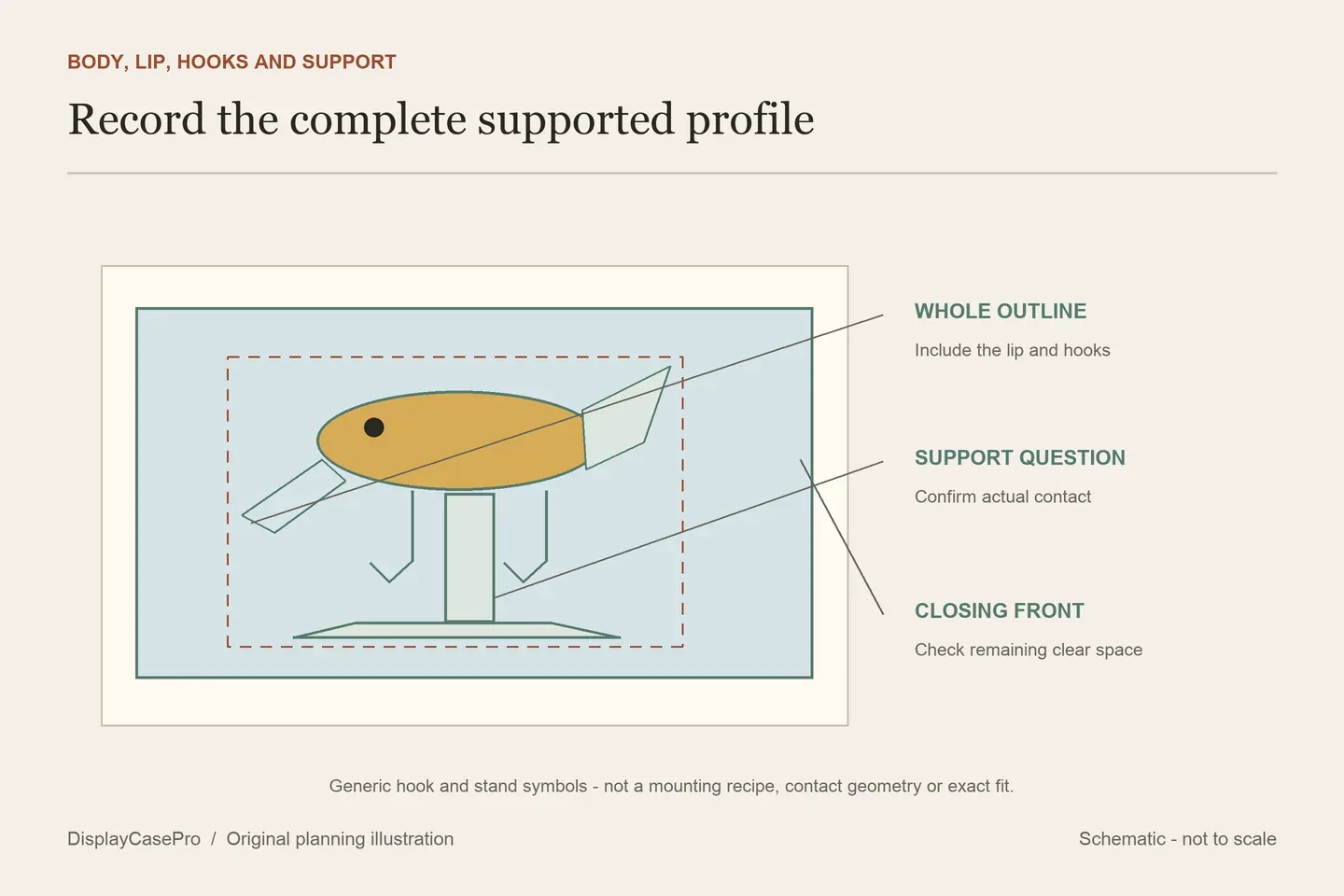
Record the lure's full outline in its intended display position. Include a projecting lip, trailing material, hook assemblies and any retained packaging. The body length printed on a fishing-product listing is not necessarily the length or depth of the assembled display.
Identify what you want to see: the painted side, a maker's mark, a documented color variant or the complete packaged release. Keep an uncertain identification separate from the fit record. A display position should not require a story about a lure's maker or age that the collection record cannot support.
Plan the support independently from the sharp or projecting parts. Do not assume a hook, split ring or decorative attachment is an approved hanging point for a particular case. Obtain the holder's instructions for the actual lure and keep the complete supported outline in the record.
Choose the receiving arrangement first
| Format | Useful presentation | Question to resolve |
|---|---|---|
| Cabinet with hanging wires | A group of lures arranged across repeated horizontal supports. | Approved attachment, occupied space in front of and behind the wires, and independent removal. |
| Foam-backed pin-up case | A composed front view with separate captions. | Actual pins or mounts, contact with the lure and clear space above the finished backing. |
| Individual open stand | A selected hardbait displayed at a defined angle. | Receiving points, supported profile and whether a separate enclosure is needed. |
| Small clear box | One lure or a specified package kept in an individual container. | Clear interior, hook and lip clearance, and how the lure is supported inside. |
The sfDisplay lure category leads to a dedicated hanging-wire cabinet. By contrast, the Carolina Sportsman Outfitters lure-kit category mixes fishing kits with individual Megabass stands. A category called a display kit does not establish a supplied closing front or a collector cabinet.
Fine Home Displays' fishing category includes a custom case named 13½ × 17½ inches with 2¼- and 3¼-inch depth options. That category text does not define clear space above its finished lining. Confirm the actual selected construction rather than comparing the depth-option names as usable cavities.
Compare interior space, backing and product size separately
These descriptions were read on 17 October 2026. They are attributed specifications, not our measurements, mounting tests or a ranking.
| Product | Published information | Remaining receiving question |
|---|---|---|
| sfDisplay cabinet, dc6065b | Outside H18 × W14 × D2.75 in; inside H17 × W13 × D2 in. Four adjustable interior wires and a front door opening from right to left. | Wire position, approved lure attachment and the remaining front and rear clearance of the hung arrangement. |
| Custom Displays PINUP | 18 × 24 × 3-inch case; approximate inside face 16 × 22 in. One-inch foam backing; maker describes items one inch thick or less. Pins excluded. | Actual mount, total supported projection and clear space above the finished backing. The 3-inch case size is not that gap. |
| Jann's Netcraft 371111, Size 3 | Listed L4¾ × W1⅞ × H1 in, with a hang tab. The size line does not label inside or outside. | Clear cavity, opening and a suitable arrangement for the complete hooks and lip. |
| Jann's Netcraft 371111, Size 4 | Listed L5⅞ × W1⅞ × H¾ in, also in the same clear-box range. | The longer box is shallower in the listed height; it is not a larger receiving space on every axis. |
For the wire cabinet, four wires are supplied supports, not a stated four-lure capacity. A broad or deep lure can use more space than a narrow one. Assign complete outlines before deciding how many pieces will remain visible and independently reachable.
For the PINUP case, the maker's thickness recommendation belongs to that model and its backing system. It does not specify the force, load or contact points of an unidentified pin mount. Establish a suitable support without piercing the lure, forcing its parts into the foam or using the closing front to hold it in position.
Jann's boxes are listed as a ten-pack. Keep that order quantity separate from the number of lures accepted by one box. A clear lid and hang tab provide a packaging format; they do not define a fitted support inside or a universal wall-mounting method.
A 50 or 76 mm stand length is not the supported height
The observed Megabass JDM Lure Stand 50 Silver and Stand 76 Silver pages describe 50 and 76 mm stand lengths respectively. They identify acrylic stands for hardbaits but do not supply a complete receiving-point diagram, base footprint or loaded height.
Do not turn those lengths into maximum lure lengths or a clearance allowance. Confirm the intended contact arrangement for the specific hardbait, then record the supported lure's full height, width and depth. If it will sit under a separate cover, include the stand as part of the assembly.
Choose the angle for the detail you want visible while staying within the stand maker's intended use. A dramatic tilt in a product photograph does not establish that every lure can rest at that angle or that its hook assemblies clear the base.
Leave a retrieval route between the complete outlines
Place the largest projecting pieces on a paper layout first. Check a side view as well as the front: a hook behind the body or a lip pointing toward the door can be hidden in a front photograph. Leave those parts clear of neighboring lures and the enclosure.
For a hanging group, establish which parts move when one lure is retrieved. For a composed backing, keep the mount and label identifiable without using the lure's finish as a writing surface. Group by documented maker, pattern or acquisition story where useful, while leaving uncertain information marked as uncertain.
Check the actual opening route at the proposed location. A right-to-left door needs its intended swing, while an individual box or lift-off cover needs a receiving place for the removed part. Follow the selected case and mount instructions rather than adapting an unrelated collector's fixing method.
The blank lure profile and support worksheet records the attachment, full outline and unresolved receiving dimensions. Use the collection measurement guide for the assembled profile and the usable-depth guide for clearance above a finished backing.
Common questions
Can I choose a case from the lure's body length?
Include the complete hooks, lip, other attachments and intended support. Body length alone does not provide the assembled width, height or depth.
Does a three-inch pin-up case have three inches of clear depth?
Obtain the gap above the finished backing and mount. Overall depth and backing thickness describe different boundaries.
Do four wires mean four display positions?
They describe the supplied supports. The useful positions depend on the actual lures, their approved attachments, their complete outlines and access between them.
Comments
Share a display tip or ask a question.