Choose a fishing fly display case by deciding whether you want fixed wall artwork, a small covered exhibit, a drawer collection or a working fly box. The finished fly, its existing support and its readable label determine the receiving space. A box’s face size or number of sections does not establish that complete arrangement.
Describe the tied object before choosing its frame
Record the fly’s documented pattern, tyer or acquisition information, retaining uncertainty where the original record is incomplete. A resemblance to a named pattern does not establish its maker, tying date or fishing history.
Include the full dressed outline: any wing, hackle, tail, body and retained hook. A hook-size number is not the total width or depth of the finished display. Keep an existing mount, tag or backing with that outline instead of assuming the dressing can be flattened to enter a shallow frame.
Decide which side or angle should be visible. A streamer’s side profile and a bulky bass bug’s front may tell different stories. Choose the useful view from the normal viewing position, then resolve an appropriate support for that actual object.
Wall art and a working fly box serve different routines
| Format | Useful purpose | Receiving question |
|---|---|---|
| Small covered exhibit | One selected fly or a composed group. | Clear depth above its finished support and the actual closing front. |
| Framed wall composition | A stable view with pattern captions. | Complete dressed profiles, mount and independent removal. |
| Drawer/module collection | Recorded groups in repeatable compartments. | Drawer interface, cell boundaries and the supported fly height. |
| Working fly box | Organisation for the box’s intended fishing routine. | Exact compartments and instructions; not an assumed wall-art mount. |
Wild Water’s six-section clear box is a plastic working-box example. Its description lists W8 × D4 × H1 inches without identifying an inside boundary. Six sections do not mean six flies, and the whole height does not describe a finished art mount beneath a front.
A fixed display can be useful without being a field container. Keep the intended opening and retrieval routine explicit rather than expecting one purchase to demonstrate both roles.
A module, compartment and glass-covered box need different fields
The following source descriptions were read on 18 October 2026. Published sizes retain their definitions; they are not our measurements or mounting tests.
| Source | Published information | Unresolved receiving detail |
|---|---|---|
| Alaska Fly Fishing Goods | Glass-covered Medium 3 × 4 in and Large 6 × 8 in. | Inside/outside, usable height and actual supported arrangement. |
| Caddis Fly Shop | Fly Display Box; selector reads 3x4-DISP. | Units, axes, clear depth and opening. |
| Pontillo L.L. Bean portfolio | Module W24 × D16 × H9 in; compartments described as 2½ in square and 2 in deep. | Exact module/drawer array and clear space with the intended mounts. |
| Wild Water six-section box | Product W8 × D4 × H1 in. | Selected interior, compartment boundaries and working-box use. |
Alaska’s product calls the larger size suitable for multiple flies, without assigning a count or a mount. Keep the glass cover and the nominal face separate from clear depth above the supported fly.
Caddis Fly Shop’s page describes a cover against unwanted handling. Its selector does not label units or an interior height. Do not transfer Alaska’s inch definition merely because the two names contain similar numbers.
The Pontillo portfolio describes walnut modules made for L.L. Bean stores, with two drawers, forty compartments and removable tempered glass in the top module. The wording does not justify forty flies or forty compartments per drawer. Confirm the exact array and current receiving construction; an expandable-system description is not a loaded stacking specification.
The dressing and support occupy depth together
In his 2010 California Fly Fisher article, Richard Alden Bean explains why bulky bass bugs did not suit the shallow frames he had considered. His personal project used a twelve-by-sixteen-inch curio with seventeen compartments, a hinged glass front and a stated one-and-a-half-inch depth.
That account is an example of selecting a cabinet around particular flies. Its dimensions are not a universal minimum for bass bugs, and its adhesive and craft-mount choices are not a treatment prescription for another collection.
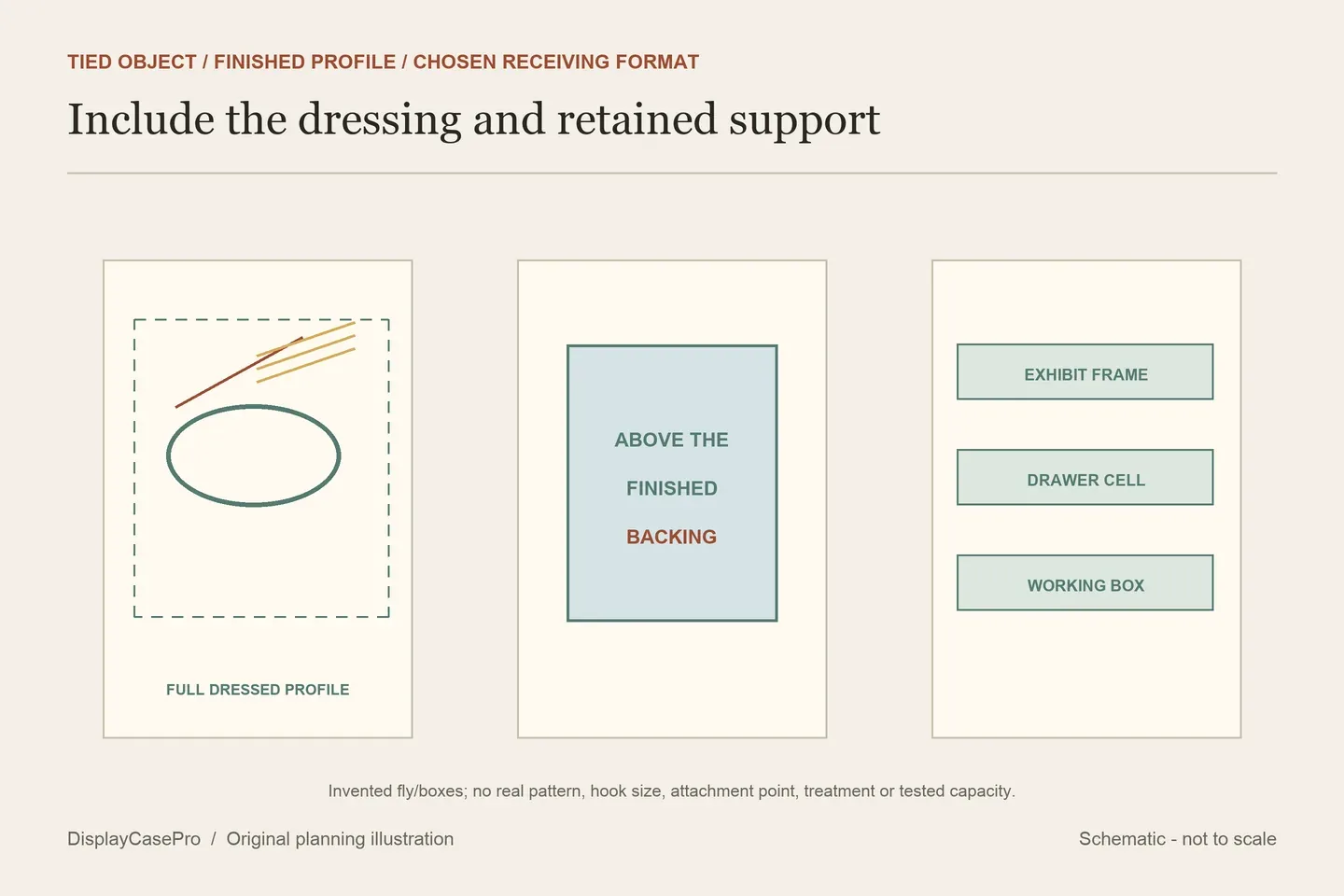
For your display, obtain clear space above the finished backing and intended support. Include the fly’s furthest projection in the chosen view. An overall frame depth, an empty compartment or a photograph of a suspended fly does not establish that finished gap.
Keep the caption and fly connected when one position changes
Give each display position a short identifier linked to the original pattern and source record. Keep a photograph of the retained arrangement where useful. A new caption can reference the record without adding an unsupported date, species imitation or maker attribution.
Plan retrieval of one supported item without passing it through neighboring wings, tails or hooks. A large group may need fewer occupied positions than the number of available compartments. Keep the actual closure and the resting place for a removed cover in that plan.
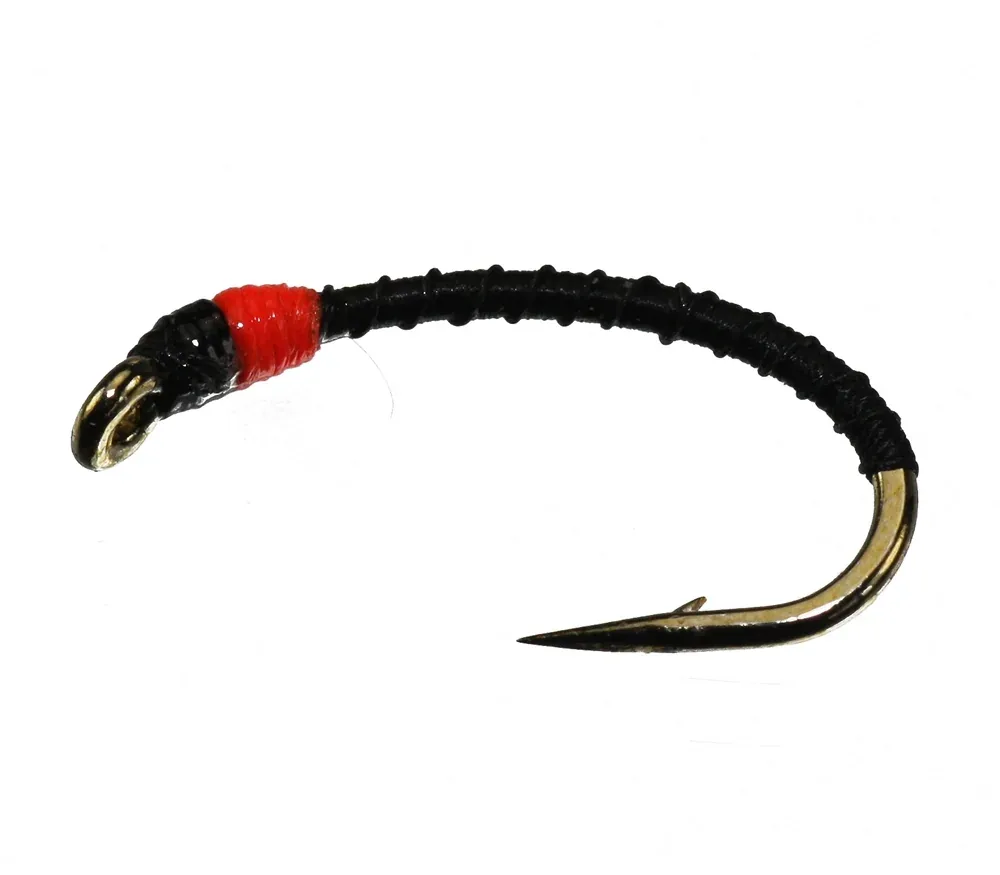
Cover photo: Trout buzzer artificial fly by Theessentialfly, CC BY 3.0. Whole composition converted and compressed to WebP, with smaller responsive versions. It shows no measured scale, approved support or compared case.

Use the fly, support and display-position worksheet with the usable depth guide and collection measurement guide. Retain the object, support and enclosure as separate receiving records.
Common questions
Does a 3 × 4-inch box tell me the available fly height?
Obtain the finished cavity and its boundary. That pair alone does not describe supported depth or a clear lid.
Are artificial fishing flies the same display task as insect specimens?
They are tied composite objects. Keep their existing dressing, hooks and documentation with their own support enquiry.
Comments
Share a display tip or ask a question.