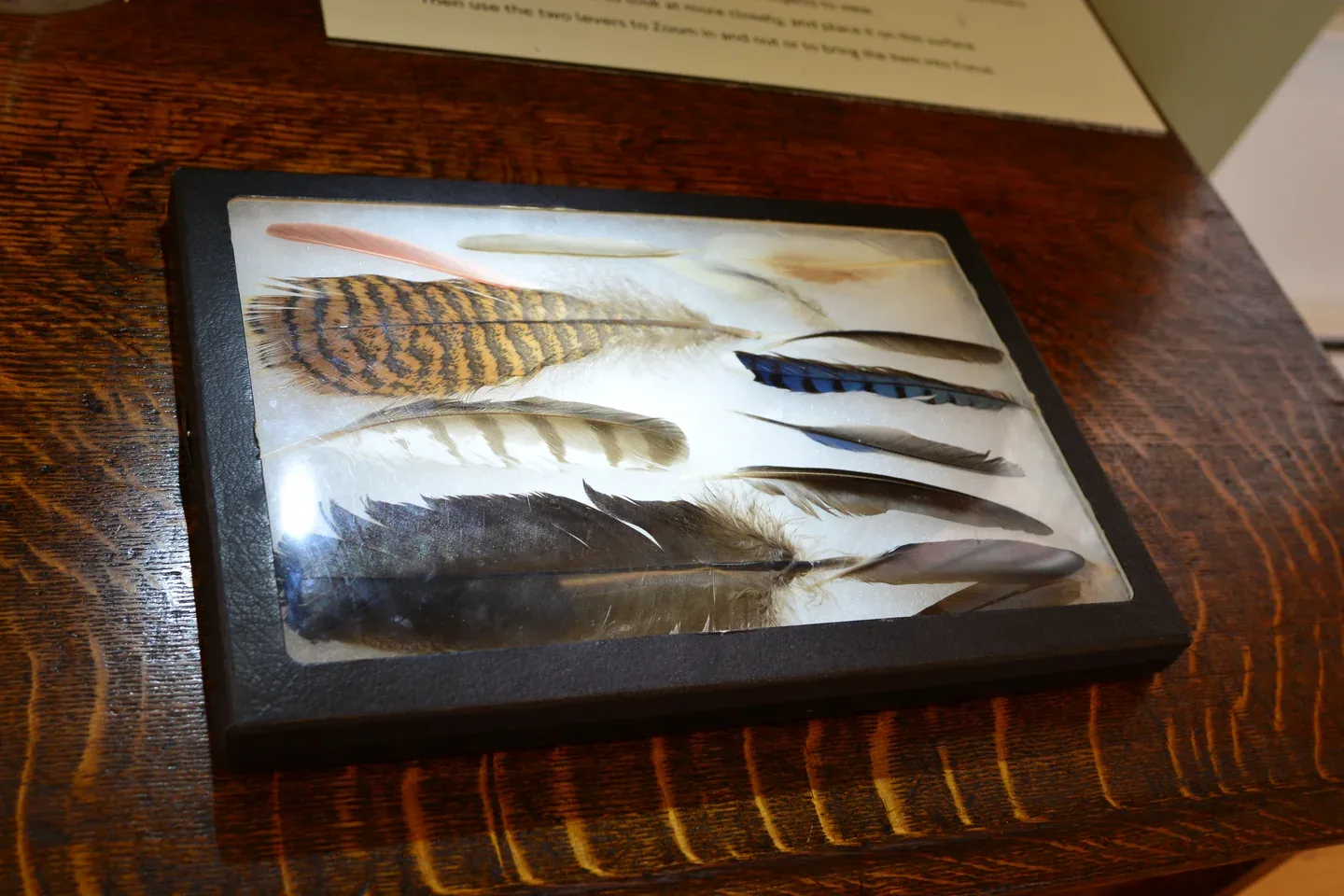
Choose a feather display case by separating three tasks: presenting an existing feather flat behind a front, standing feathers in an open holder, or buying finished feather artwork. A padded fan bag serves another purpose. The complete vane, quill, existing attachments and object record determine which format is useful.
Begin with the whole feather or finished work
For a loose feather, record its complete outline from tip to quill end, its natural curve and any attached tag or existing support. A length alone does not show how far a curved feather projects above a flat backing or how wide its vane appears in the chosen view.
For finished featherwork, record the complete object instead: its backing, handle, bindings, decorative parts and existing mount. A fan is not a group of loose feathers available for rearranging. Choose an enclosure around the retained assembly rather than assuming its components can be separated.
Keep documented source and identification with the record. If a species, maker or date is uncertain, retain that uncertainty. A display-box label, a decorative design or a resemblance to another photograph is not independent identification evidence.
A transparent front, a quill hole and a zipper solve different tasks
| Format | What to establish | Remaining limitation |
|---|---|---|
| Flat receiving enclosure | Whole supported feather, clear space above the backing and a closing front. | The box needs an appropriate object-specific support; empty depth alone is insufficient. |
| Open upright holder | Actual quill-hole diameter and depth, standing outline and independent removal. | It provides no enclosing front, and neighboring vanes may overlap. |
| Finished feather artwork | Exact supplied composition, associated record and maker’s access instructions. | Its photographed arrangement is not proof of an empty reusable cavity. |
| Padded fan or feather bag | Complete retained object, closure and intended transport instructions. | A soft zippered bag is not a glazed viewing case. |
Crazy Crow’s fan and feather category describes semi-rigid, zippered cases with a stiffener and padded velour interior. Its tapered shapes are offered for storage and transport. Do not treat the word “case” as evidence of a transparent viewing front or a museum display environment.
Mission Del Rey’s 29bc181 listing is a named painted-feather display box with a representative picture. Confirm the actual supplied composition and accompanying information. The seller’s artist and cultural attribution fields remain seller-provided information, rather than provenance independently established by this guide.
A holder’s nineteen holes do not describe nineteen unobstructed views
The published examples below were read on 18 October 2026. They illustrate different products and incomplete receiving definitions, without physical fit, transport or preservation testing.
| Product | Published information | Ask before relying on fit |
|---|---|---|
| Mission Del Rey 29bc181 | 10 × 10 in. | No labelled inner face, depth or empty-case specification. |
| Snow Pond feather block | W7 × H2 × D1.5 in; 19 holes of varied sizes. | Individual hole diameter/depth and the full standing feather arrangement. |
| Crazy Crow roach feather case 6520-001-002 | 5¾ × 18 in in the category title. | Clear usable dimensions, thickness and complete retained-object compatibility. |
Snow Pond’s linked stoneware block excludes the feathers. Its overall width and hole count do not specify the size of each opening or the gaps between complete vanes. Request those details for the quills you already have; do not force or trim a quill to make it enter.
The open wooden holder in Songbird’s DIY project uses three rows of drilled holes. That is a decorative craft example, without a numerical hole specification or enclosing cover. Its author’s stain, glue and construction choices are not a tested support or materials prescription for a different collected object.
Sketch the occupied outline using existing reference images or paper shapes before deciding how many positions to use. Count the vanes that remain visible, not simply the number of available holes. A back row can be hidden by a broad foreground feather even when every quill enters the holder.
Keep an existing mount and its purpose in the enquiry
A flat enclosure must receive the already supported profile without using its glazing to press the feather into shape. Establish where the object is carried, which parts contact the support and how the assembly comes out. Avoid turning an attractive craft photograph into an assumed attachment method for a fragile or important piece.
Walter Baumgartner’s museum feather-shield conservation account describes one historic composite object with specialized lighting, climate and transport arrangements. It emphasizes minimal handling and object-specific support. Its numbers and packing construction belong to that case study, rather than providing a universal home-care recipe.
For an important finished work, retain its existing documentation and obtain appropriate advice about the actual object before changing its support. The enclosure decision should follow that arrangement; a smaller box is not a reason to flatten a vane, cut a binding or detach a decorative element.
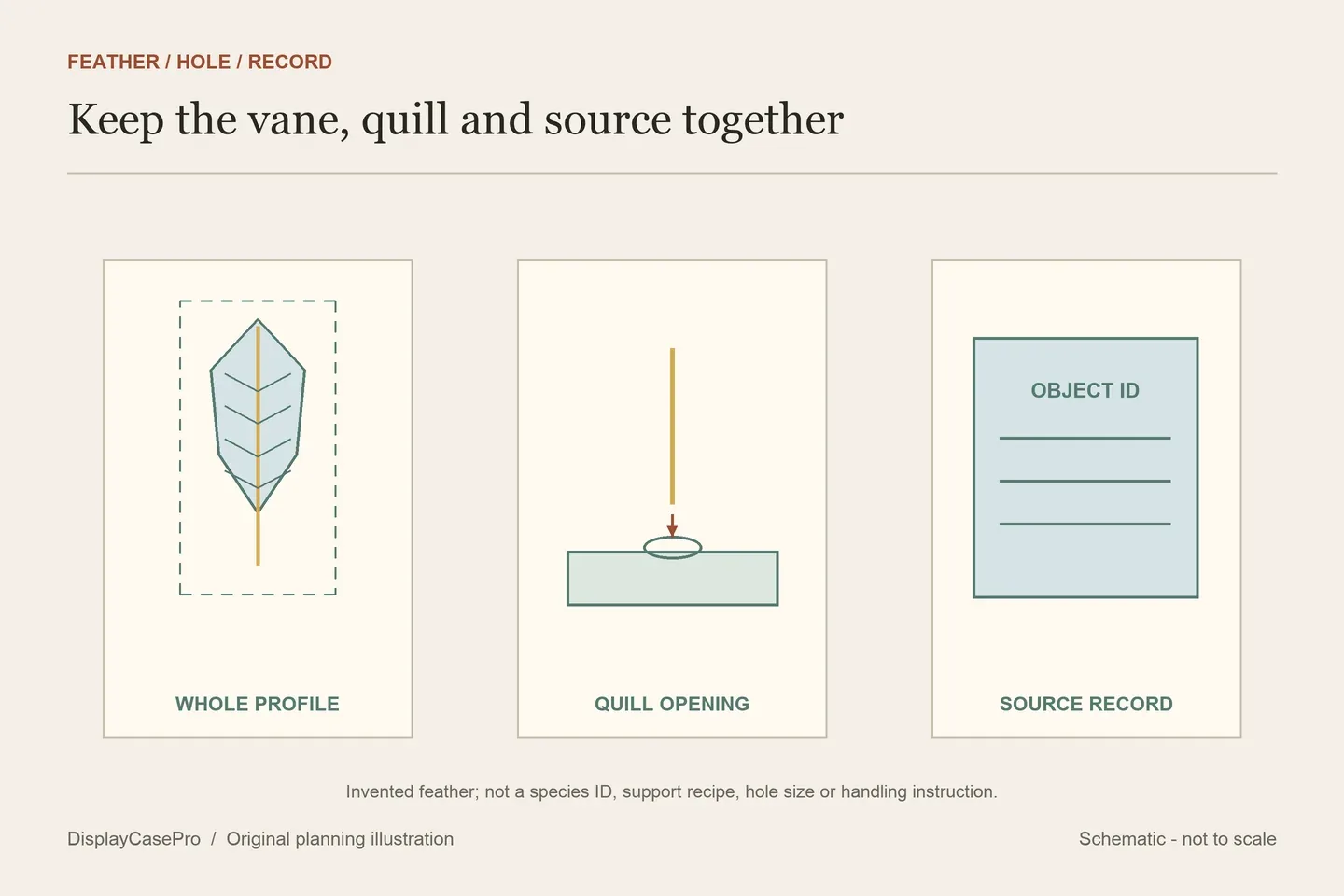
Keep the chosen face visible and the record retrievable
Decide which face matters and keep an existing reverse photograph with the record when needed. Plan a caption outside the feather’s outline. A label can describe a documented source or personal association without adding new writing to the object itself.
For an upright holder, confirm that the selected quill can be removed without catching a neighboring vane. For a flat enclosure, identify which panel opens and how the complete support is lifted clear. Reopening should not require grasping an unsupported tip or sliding the feather against the front.
The cover photograph shows an observation tray at the Staten Island Museum. It provides context for an existing covered arrangement, not a home mounting method or a specification for the products above. Photo: Joe Mabel, 28 May 2026, CC BY-SA 4.0. Whole composition retained, proportionally resized and compressed to WebP; the image derivatives retain that license.

Use the feather format, support and record worksheet. The collection measurement guide covers complete outlines, and the usable depth guide distinguishes the empty box from the space above a finished support.
Common questions
Does a ceramic feather holder include feathers?
The cited Snow Pond product explicitly excludes them. Check each selected product’s contents rather than relying on a styled photograph.
Can I use a fan bag as a display case?
Its stated storage and transport role does not supply a glazed viewing enclosure. Choose the format for the task and confirm the retained object’s receiving arrangement.
Comments
Share a display tip or ask a question.