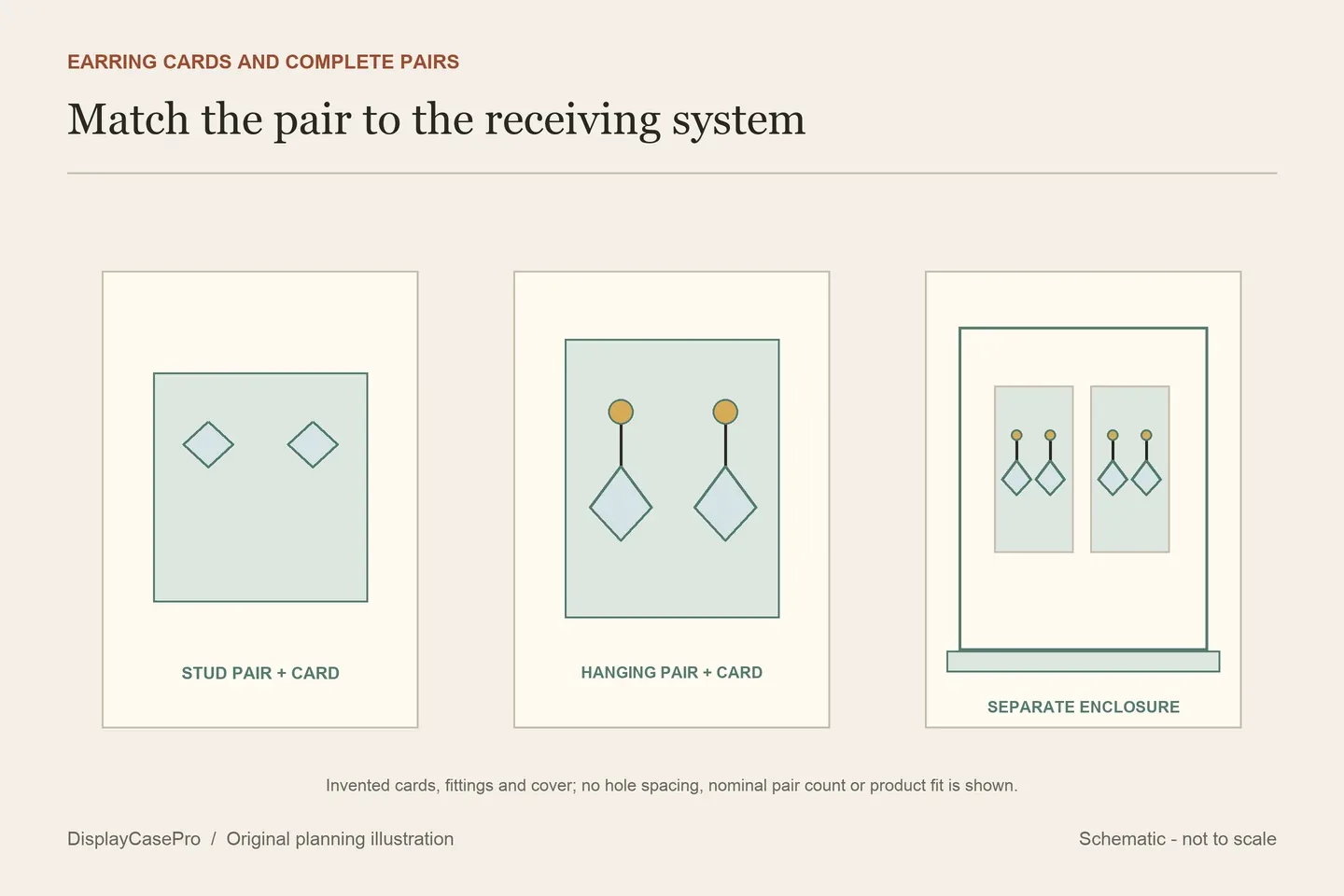
Choose an earring display case around the way the earrings are held: studs through an intended insert, hooks hanging from a bar, or complete pairs on cards. Count cards and pairs separately, include the backs and hanging drop, and check how each pair can be released. A transparent case around a rotating card rack is a different purchase from an open earring stand.
Start with the earring's complete front and back
Make an inventory of complete pairs and any intentionally separate singles. Record studs, hooks, hoops and clips as their actual constructions, rather than assuming that every pair uses two straight posts. Decorative fronts alone cannot identify a compatible support.
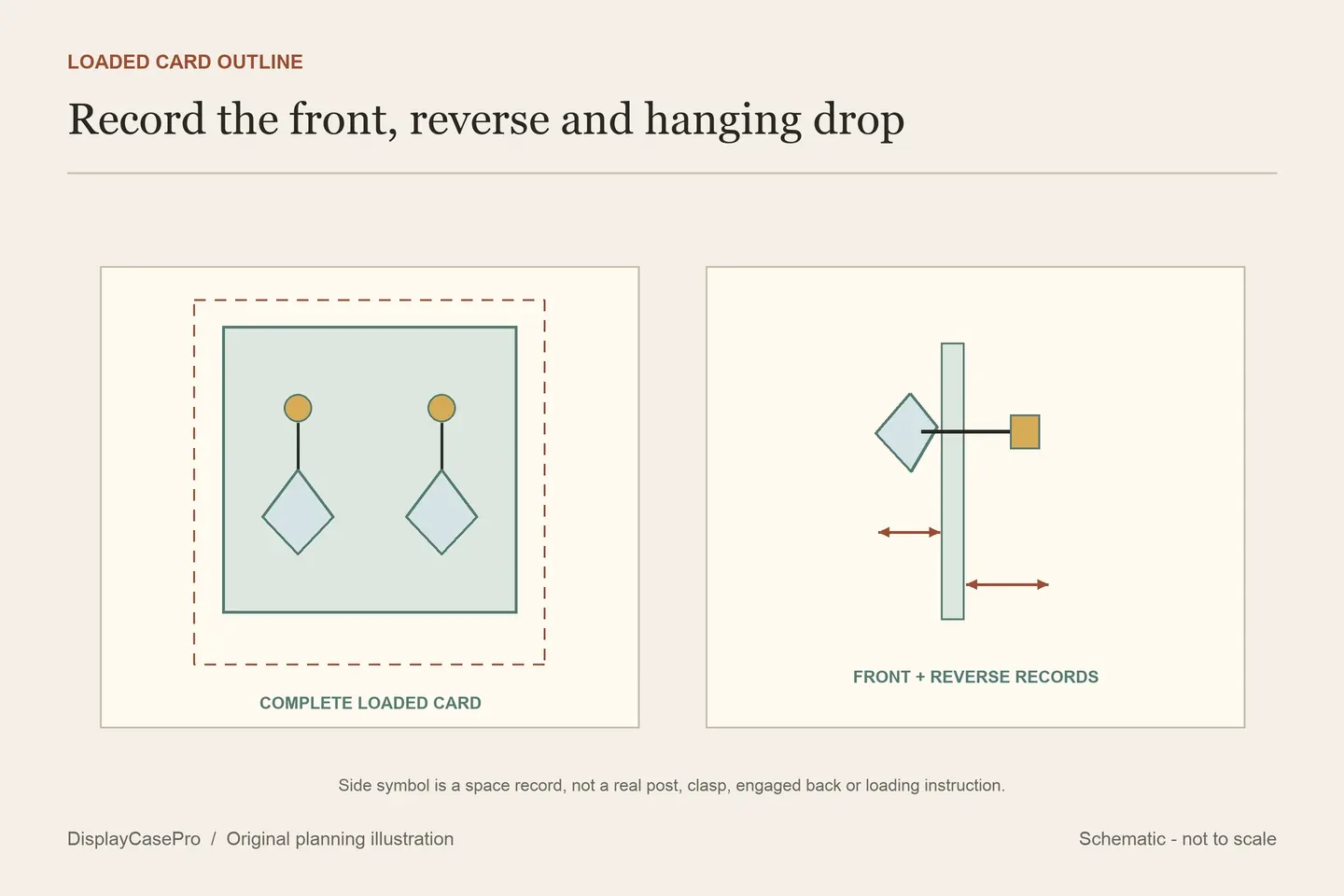
For a stud, include the engaged back and its projection behind the receiving surface. For a hanging design, record the actual drop from its support position, plus any side movement that must be considered. A broad hoop or clip can require another receiving method and a different release route.
| Arrangement | Record | Access to establish |
|---|---|---|
| Studs in an intended insert | Both fronts, post positions, actual backs and rear projection. | How the backs engage and release without pressure from the case back. |
| Hooks or other hanging fittings | Supported drop, widest decoration and neighbouring pieces. | How the fitting enters and leaves the bar, hole or supplied holder. |
| Loaded earring card | Whole card, the pair's front and back, and any jewelry extending beyond the card. | How the card releases and whether the pair stays independently reachable. |
The Jewelry Display earring and pendant category includes stands, ramps, trays and combination displays. A pendant position and an earring position are not interchangeable merely because they appear together in the catalogue.
Measure the loaded card, not only the printed rectangle
Keep the intended card with the pair when measuring. Its width and height describe a starting rectangle; projecting fronts, backs or long drops can extend beyond it. Include any readable maker label you want to retain instead of covering it with the next card.
For a rotating display, map the actual occupied positions around the rack. A large pair may overlap a neighbouring card or hang into the next row. A nominal count does not document clearance for every mixture of earrings.
Card capacity also does not automatically equal a pair count. One card may be intended for a pair, a single, or a different jewelry arrangement. Keep the selected card's actual layout and the display maker's receiving specification together rather than multiplying unverified holes into a collection capacity.
The Michaels display and packaging page separates earring displays, bracelet stands, neck forms and other props. That section map supplies no particular card size or enclosure fit; the exact product still needs its own specification.
Compare a locking card display, a portable case and a stud ramp
These first-party descriptions were read on 17 October 2026. They illustrate different receiving systems, not a ranking or our handling tests. Published measurements without an interior or open-state definition remain unresolved.
| Product | Published information | What still needs checking |
|---|---|---|
| Acme AER/25 | 48 standard 2-inch earring cards, locking clear panels and rotating base. Main description: W8 × D8 × H18.5 in. | The same page has an additional 23 × 13 × 13 in line. Resolve its reference and the receiving/operating space. |
| Ikee WDJ82756OK | Supplied set of 100 cards and advertised capacity up to 100 cards. Overall W31.5 × D14 × H12.5 in. | Card dimensions, actual pair layout and whether the size describes the opened or closed case. |
| JewelrySupply ER200 | White leatherette ramp, explicitly for five pairs of stud earrings. Size sequence 6 1/4 × 1 1/2 × 2 in. | Actual post/back arrangement. This is an open support; the size sequence is not an enclosure cavity. |
The ER200 description specifically says stud earrings. Do not transfer its five-pair capacity to long hanging earrings or use the listed two-inch figure as a documented drop allowance. Its supplied geometry and intended orientation belong with the exact product.
AER/25's 48-card statement is also narrower than a promise to receive every pair. Confirm the actual card dimensions and supported jewelry profile, then check how the selected loaded cards pass the panel during removal. Clear panels and a lock do not establish independent theft-prevention performance.
Keep the two AER/25 dimension lines unresolved
The AER/25 main description gives W8 × D8 × H18.5 inches, while its additional-information table gives 23 × 13 × 13 inches. The latter line is not labelled as packaging or an interior in the returned text. Do not assign it one of those meanings to make the numbers agree.
Ask the seller for a labelled drawing of the current product, including the outside unit, usable card area and intended access. Keep the original discrepancy in your comparison record until it is resolved.
The Ikee case has a different missing definition. Its 31.5 × 14 × 12.5-inch overall line does not state whether the case is opened or closed. It cannot establish both a closed shelf footprint and the working area for an unfolded display. The text also says accessories are not included; confirm the exact contents alongside its explicit supplied-card statement.
Check the panel, rear access and rotating display together
A case can provide front-panel access without providing access to an earring back behind an insert. Determine whether the entire card or insert comes out as intended, or whether the jewelry releases in place. Keep both members of the pair identifiable throughout that operation.
For the AER/25, the maker describes unlocking a panel and removing a card. Establish that exact routine at the planned location. The base dimensions alone do not document the clear space needed by the loaded rotating rack, an open panel and the person using it.
For a portable or folding display, obtain both the closed and working dimensions. A carrying handle or lock does not independently verify transport protection for the actual earrings. Follow the exact case and insert instructions rather than assuming the jewelry should remain in every visible position during movement.
Use the earring pair, card and access worksheet. The usable-space guide explains finished support references. Choose contact materials for the actual jewelry; a leatherette or velvet label is not an anti-tarnish or universal coating-compatibility specification.
Common questions
Do 100 included cards guarantee space for 100 large pairs?
Keep supplied card count, advertised card capacity and the actual loaded-card arrangement separate. Check the intended card and jewelry profile.
Can a stud ramp hold every dangling style?
Use its actual fitting specification. ER200 explicitly describes stud earrings, and its size does not provide a general hanging-drop limit.
Does a clear front panel provide rear-back access?
Confirm the release sequence for the actual card or insert. Front access alone does not describe how an earring back is reached.
Comments
Share a display tip or ask a question.