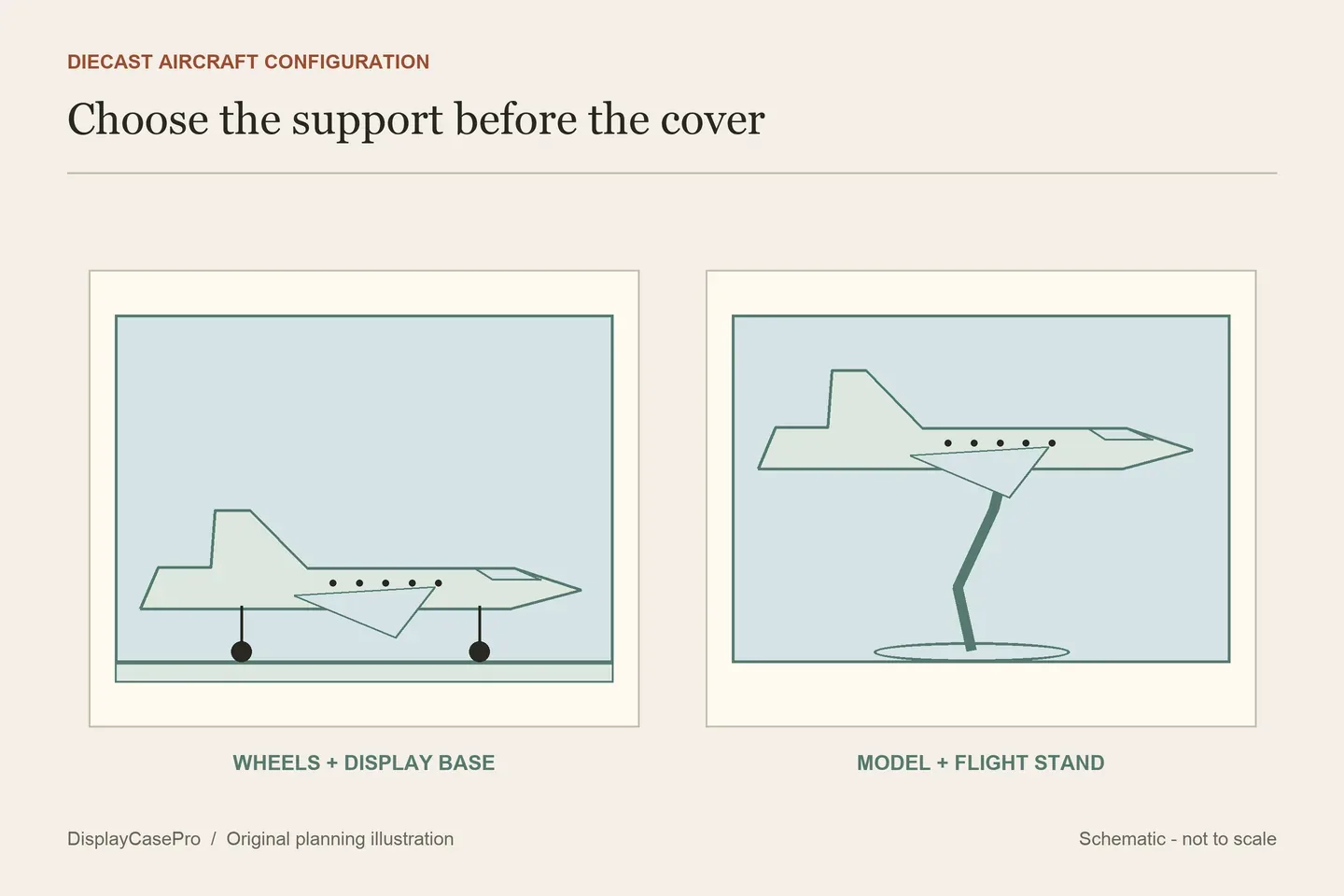
A diecast aircraft on its landing gear and the same aircraft on a flight stand can need different display cases. Choose the intended configuration first. Then match the complete wing, tail, model and support outline to an actual enclosure, rather than ordering from the scale or aircraft name alone.
Check whether the product actually encloses the aircraft
Aircraft display searches often mix three products: a scenic base underneath the model, a stand that holds it in a flight pose, and a transparent cover that encloses the arrangement. You may need more than one, but a photograph of all three does not establish that every part is included.
For example, Aiken's 1:72 accessory category contains airfield and carrier-deck bases, model-specific jet stands and a leather-base display case. “1:72” groups those accessories; it does not describe one standard enclosure footprint.
The distinction continues at the individual listing. Hobby Master HS0004, as listed by Aiken, is an optional stand with adaptors for the maker's 1:72 F-4, F-15E and F-16 models. The aircraft is expressly excluded. That is specific adaptor information, not a universal stand for all diecast jets or proof of compatibility with a particular cover.
Record the aircraft as it will be displayed
Keep the maker and catalogue number with the scale. Two models of the same aircraft can have different stands, optional parts or display positions. If the intended wing or landing-gear configuration is not documented, resolve it before taking it as a space-saving option.
| Configuration | Include in the occupied outline | Resolve before choosing the cover |
|---|---|---|
| Resting on landing gear | Nose-to-tail extent, wing span in the chosen position, top of the tail and any projecting details; the complete base if used. | The intended resting contact and whether any separate scenic base or support changes the height and footprint. |
| Mounted on a flight stand | The model at its intended angle, full stand base, adaptor, wing tips and highest point above the final resting surface. | Exact stand/model compatibility, approved pose, complete assembled dimensions and the cover's route around that pose. |
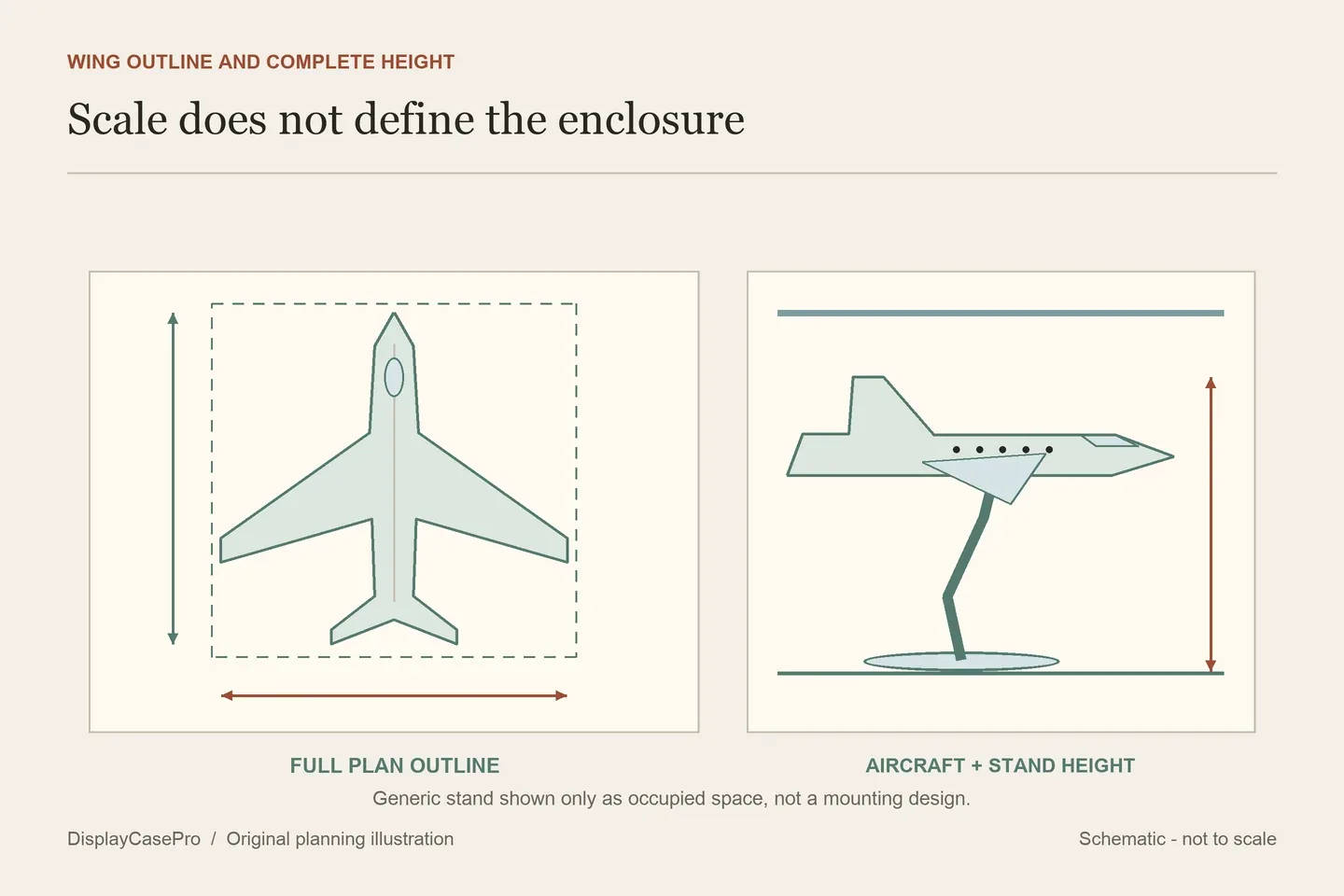
A wingspan figure is useful only with its configuration. Folded wings can reduce lateral spread while increasing height. A banked or climbing pose can change more than one dimension. Use the actual approved arrangement; do not force a wing, antenna or landing-gear part into a different position to meet a case size.
Also include a propeller's displayed outline, projecting pitot tube or other small detail where present. The broad wing may be obvious, while a slender forward projection determines the real length. If handling the model for measurement is unsuitable, work from its maker's dimensioned information or obtain appropriate specialist help.
Compare labelled usable space, not nominal scale
The Better Display Cases multi-size model listing gives both inside and outside dimensions for individual SKUs. The following three examples use its inside dimensions, in inches and L × D × H order.
| Listing | Published dimensions | Selection implication |
|---|---|---|
| Better Display Cases A030B | Inside 11.75 × 11.75 × 3.75 in. | A square interior with the lower height of these three examples. Compare the full aircraft and support, not the fuselage alone. |
| Better Display Cases A030 | Inside 11.75 × 11.75 × 5.75 in. | The same listed footprint as A030B, with more height. Additional height does not increase usable wing span. |
| Better Display Cases A030A | Inside 14.75 × 14.75 × 5.75 in. | A larger listed footprint, with the same height as A030. That still does not establish fit for a named aircraft. |
| Aiken's Hobby Master leather-base case HM-CS24548 | Length 9.5 in and width 9.5 in; the specification does not label those values inside or outside or provide a clear height. | Ask for usable interior and base-to-cover height. The accompanying references to 1:72 and 1:48 models do not supply the missing measurements. |
These examples are not a recommendation to pair HS0004 or any named aircraft with one of the covers. The stand's actual base footprint, assembled pose and height have not been established by its N/A length and width fields. A scale label cannot fill those gaps.
Preserve the supplier's axis order in your record. Map it to the intended display orientation explicitly, then obtain the outside footprint for the shelf. A square cover can simplify a plan view, but neither turning the aircraft diagonally nor comparing the case diagonal alone proves that the wings, nose and tail all fit.
Resolve the support before ordering a cover
Use a stand designated for the actual model and follow its instructions. An adaptor listed for an F-15E should not silently become an adaptor for every F-15 variant. Likewise, a generic clear rod in a decor photograph does not establish a suitable attachment or support for your diecast model.
For a custom enclosure, send the maker a labelled drawing of the complete supported arrangement. Grandpa's Cabinets offers aircraft cases with or without a hardwood base and discusses working around an existing base. Use that as a quotation question: which base remains, what space is usable above it, and how does the cover open? It is not evidence that every existing base is suitable without assessment.
Trace the intended cover operation while the aircraft stays supported. A lift-off top needs a clear upward route beyond the wings and tail, plus somewhere to set it down. A door or removable panel needs its own opening space. Obtain instructions for the selected case rather than transferring an opening method from another size on a multi-product page.
Keep overhead suspension and improvised adhesive mounts out of this enclosure plan. An idea illustrated with a lightweight kit does not establish a support method for a diecast aircraft. The aim here is a documented resting or stand-mounted configuration inside a suitable cover.
Plan a fleet from wing outlines, not row counts
For several aircraft, place complete plan-view outlines on a shelf drawing. Add the stand bases, scenic bases and labels as separate shapes. Wings can overlap in a front photograph while occupying the same space, or hide the route needed to retrieve the model behind them.
Give each aircraft a position and removal sequence that does not require threading it between neighboring wing tips. Group by a documented theme if it helps the view, but do not assume a shared scale makes every aircraft equally wide. A larger single case or separate covers may suit the collection better than a tightly repeated grid.
The blank aircraft case and stand worksheet records catalogue number, wing configuration, stand/adaptor identity and the final envelope. The general measurement guide covers consistent units and interior versus outside size. Once the layout is resolved, use the lighting guide to plan the view without adding fittings into the aircraft's space.
Common questions
Does a 1:72 case fit every 1:72 aircraft?
No. Scale does not give the physical size of each aircraft or its display configuration. Compare the actual supported model with explicitly usable dimensions.
Can a flight stand be added after the case is chosen?
Only if its complete approved arrangement fits and remains accessible. The stand can change the footprint, height and angle, so resolve it before relying on a case specification.
Is a scenic base the same as a display case?
No. A base presents or supports the model underneath; a stand can hold a pose; an enclosure supplies the surrounding cover. Check which components the exact listing includes.
About this guide: Dimensions are attributed examples from the cited listings. No aircraft, adaptor, support or cover has been physically fitted or load-tested for this article.
Comments
Share a display tip or ask a question.