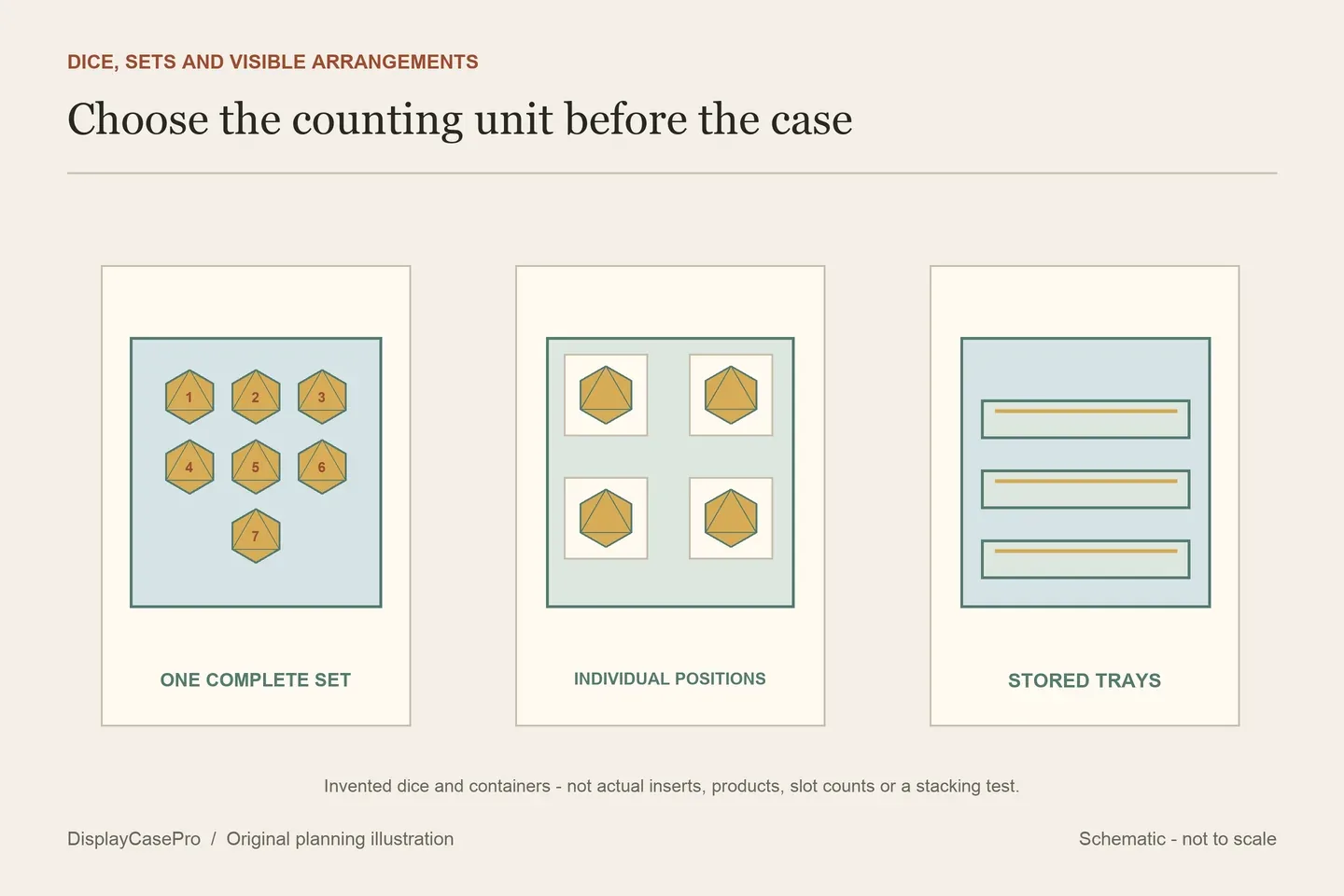
Choose a dice display case by separating three counts: individual dice, complete sets and sets visible at one time. Then check the actual die shapes and the receiving positions. A modular box for one polyhedral set, a cube for a specified packaged format and a case with stacked trays are different display systems.
Record the complete set and each unusual die
A seven-piece polyhedral set and a ten-die group are different counting units. Record which dice belong together and whether you want the entire set continuously visible. A large loose-dice total does not tell you how many complete sets remain together in a display.
Check the actual profiles, not only the number of faces or a nominal size. A long or unusually shaped d4, an oversized d20 and a small cube need different receiving geometry. Record the widest and highest points in the intended resting position, including any existing holder that will remain around the die.
Keep a set identifier with matching pieces, packaging and any separately stored additions. Similar colors do not establish that loose dice were supplied together. For a mixed collection, leave uncertain relationships documented rather than completing an apparent set from appearance alone.
Choose between a featured set and a larger organized collection
| Format | Useful purpose | Check before counting |
|---|---|---|
| One-set modular box | Keep a selected polyhedral set together in a repeated display format. | Accepted shapes, complete receiving space and the maker's stacking conditions. |
| Clear cube or rigid box | House a specified set or packaged dice format. | Exact version, intended dice family and actual internal dimensions. |
| Fitted foam presentation box | Present individual dice in assigned positions. | Every cavity's shape, usable depth and the view through the closed front. |
| Case with removable divided trays | Organize a larger collection and move selected trays into use. | Total storage count, visible tray arrangement and the permitted opening or rolling configuration. |
The Forged Gaming storage category mixes display cases, rolling trays, bags, chests and other formats. Its product names do not all describe continuous enclosed viewing. Likewise, the URWizards box category includes display boxes, engraved wooden boxes and gift packaging with different interiors.
For a featured set, choose the view first: a whole coordinated group, a particular inclusion or the readable numbers. A case can receive every die while its insert, dark lining or front reflections obscure the detail that made you choose the set.
720 dice is a conditional storage total
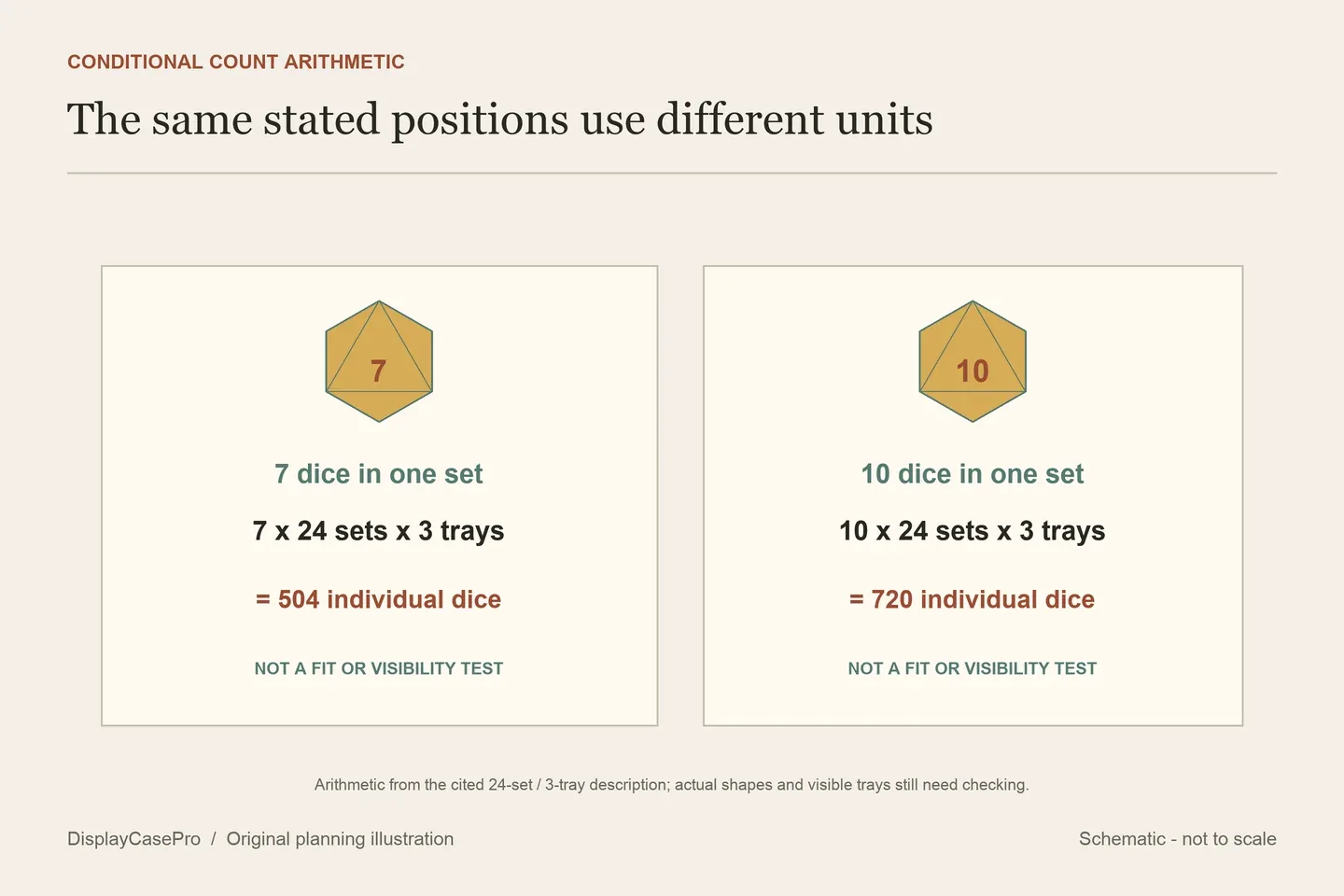
The Game Nerdz Forged Gaming case, SKU FGDICEDISPTRPL, describes three removable divided trays. Each tray is described as accepting up to 24 sets of seven or ten standard dice, with one set per section. Its advertised maximum of 240 dice per tray and 720 per case uses the ten-die count.
At 24 seven-die sets, the arithmetic is 168 dice per tray and 504 across three trays, assuming all those stated positions are usable for the actual sets. That calculation changes the counting unit; it is not our fit test or a guarantee that mixed oversized dice fill every section.
Keep total storage separate from the closed view. Three trays do not automatically mean all of their contents can be seen through one lid at once. Establish the intended loaded arrangement and which sets remain visible before treating the largest total as display capacity.
The listing gives exterior L13.75 × W9.5 × H4.5 inches and an interior footprint L13 × W8.75 inches. It does not provide a complete numeric cavity for each divided section or a separate usable interior height. Do not derive those by dividing the overall footprint by 24 or subtracting a guessed lining thickness.
The described alternative use moves the trays to the lid and uses the inside as a rolling tray. Confirm that exact operating arrangement and a suitable place for the removed components. A display case, storage case and rolling surface are different states of the same product, not a reason to roll dice against a populated insert.
Match the intended die family to the actual case version
These published descriptions were read on 17 October 2026. No dice, stacking arrangement or protection performance was tested for this guide.
| Case | Published intended use | Receiving detail still needed |
|---|---|---|
| Dispel Modular Dice Display Box | One case per box; described for a standard seven-piece polyhedral set with a vertical stacking design. | Numeric cavities and acceptance of the exact shapes or oversized pieces. The maker's broad fit wording is not an independently tested universal standard. |
| Chessex M, SKU 02804 | Short product description says it is used for 12 mm d6 Dice Block. | Actual interior and the complete intended dice or retained package. Do not infer the cavity from the address or M label. |
| Chessex M Tall, SKU 02805 | Short product description says seven-die sets and 16 mm d6 Dice Block. | The selected format's receiving dimensions. M and M Tall are separate versions, not one interchangeable case. |
| URWizards Leather Dice Display Box | PU leather box with inner foam; size sequence 22.5 × 5 × 3 cm; dice excluded. | The sequence does not label axes or inside/outside. Obtain the actual foam cavity shapes and clear space above the configured dice. |
The Chessex storage category also contains cardboard displays described by numbers of sets, sampler containers described by compartments and empty boxes described by size names. Those units should remain attached to their respective products; they are not interchangeable loose-dice capacities.
For foam, check each actual die against its intended position without forcing it into a tight or differently shaped cutout. A general “full set” description does not specify every sculptural variant. Retain a fit question where the maker has not supplied the receiving geometry.
Plan the closed view and the next game separately
For a closed display, check the actual insert with the front in place. Choose a viewing direction that shows the feature you care about, and keep the set label readable without covering a die. A repeated grid can organize the collection while still leaving unusual shapes in separate suitable positions.
For gaming access, identify where the complete set goes when removed and where its empty display returns. Keep the set's components together while an insert or tray is elsewhere. A position map makes a deliberate empty slot different from an unexplained missing die.
Follow the actual case and dice maker's instructions for opening, stacking and contact materials. A transparent lid or padded description does not establish universal compatibility with every resin, stone, coating or metal finish. This guide does not assess dice balance or prescribe polishing, humidity treatment or transport performance.
The blank dice-set and visible-capacity worksheet separates set counts, individual profiles and the loaded tray arrangement. Use the collection measuring guide for the complete supported outline and the usable-space guide for the room left above a finished insert.
Common questions
Does 720 dice mean 720 complete sets?
The cited three-tray description uses up to 24 seven- or ten-die sets per tray. Its 720 maximum counts individual dice when those sections hold ten each.
Does a standard seven-piece box fit every d4 or oversized d20?
Confirm the actual shape and numeric receiving limits. A set count alone does not describe each cavity.
Can the storage total be used as the visible display count?
Check which trays and positions are visible in the closed arrangement. A stack's total capacity and the contents seen through its lid are separate counts.
Comments
Share a display tip or ask a question.