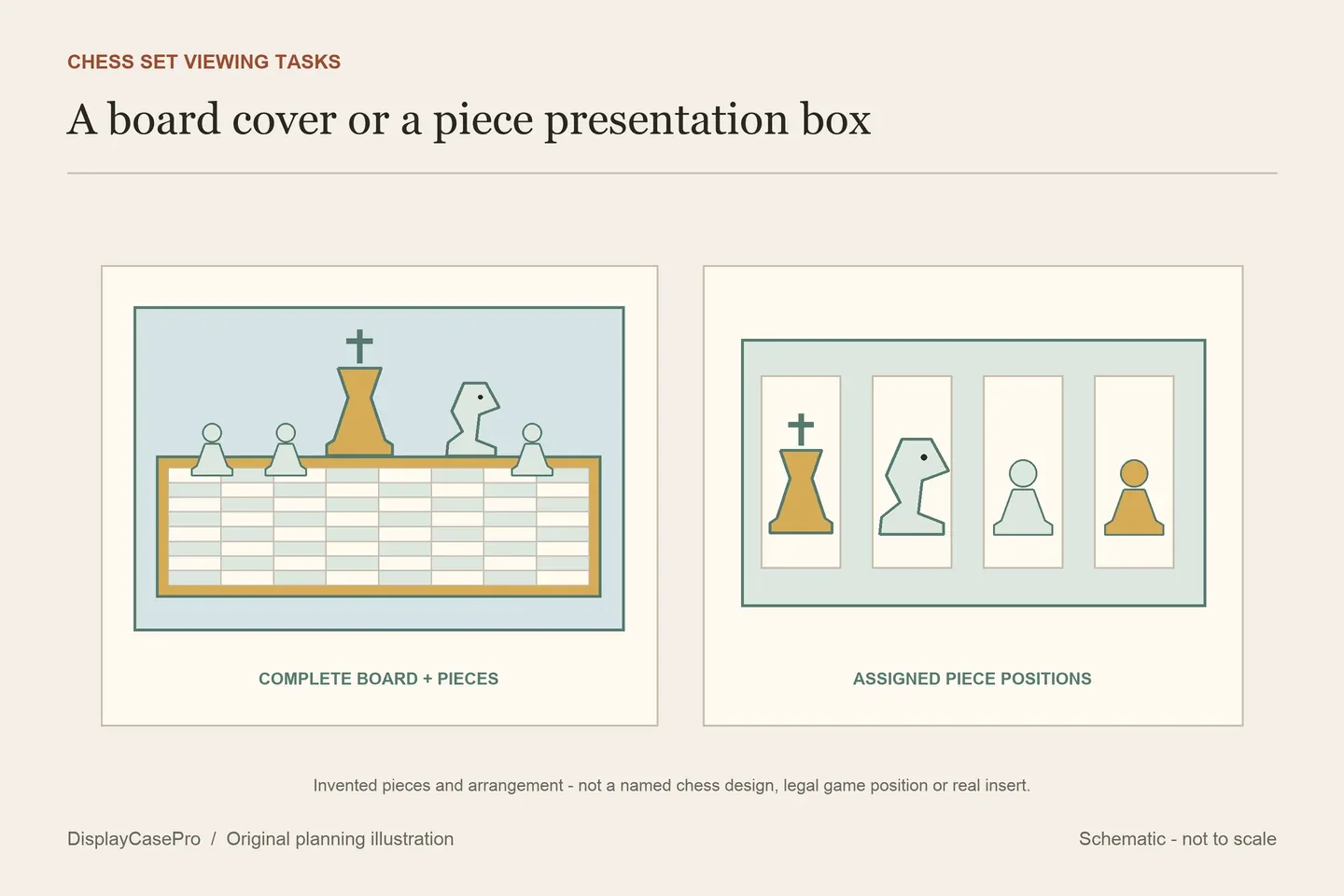
Choose a chess set display case by deciding what stays visible: the complete set on its board, the pieces presented in a fitted coffer, or a few selected pieces while the rest remain stored. A board cover and a piece-storage box have different receiving dimensions. Check the actual board, piece profiles and supplied insert before treating a king-height label as a fit guarantee.
A board display and a piece box do different work
| Arrangement | Format to investigate | Receiving boundary |
|---|---|---|
| All pieces arranged on the board | A cover or enclosing case for the complete board and setup. | Board exterior, any supporting base and the highest occupied position. |
| Each piece presented in an assigned place | A fitted coffer or compartmented presentation box. | Actual slot shapes, piece profiles, insert layers and the open viewing arrangement. |
| A set stored together between uses | A suitable divided or fitted storage box. | Complete piece count, accepted profiles and closure without pressure. |
| A few selected sculptural pieces | Individually suitable supports and a separate enclosure if wanted. | The selected pieces' complete bases and projections, plus a linked location for the rest. |
A solid lid can provide storage while concealing the pieces. A presentation box can show them when opened, without keeping them continuously visible when closed. Decide which view you want rather than using the word display to assume a transparent front.
The Chess USA box category mixes piece boxes with carrying bags for boards and sets. Its introduction specifically says its humidor-style boxes are not intended to be carried. Keep the instructions for the actual product separate from a neighboring carrying-case listing.
For a board cover, include the border and supporting base
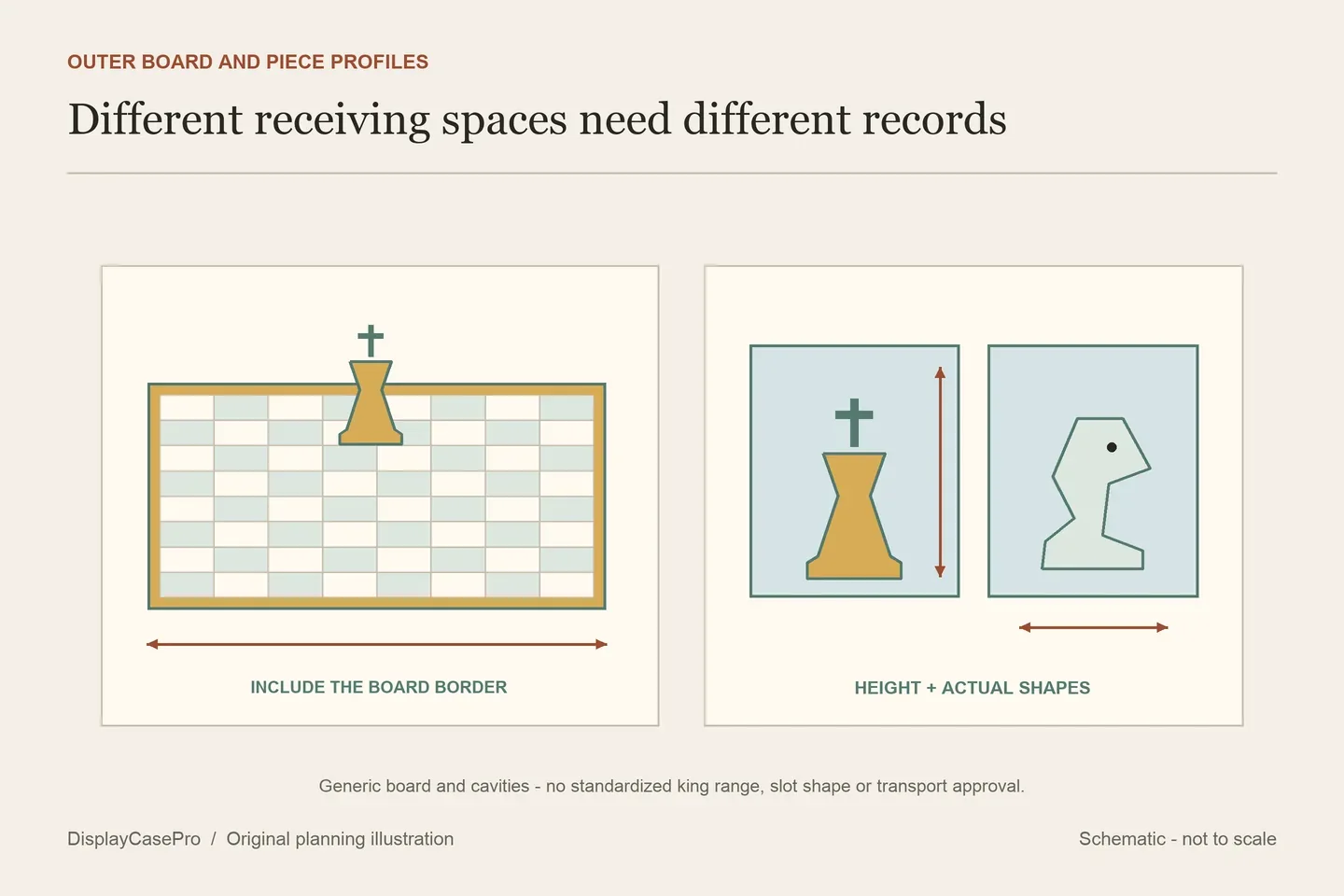
Record the board's complete outside length and width, including its border, feet or added base that will remain under the enclosure. The playing-square area is only part of that footprint. A decorative board edge can be the receiving limit even when every piece fits comfortably on the squares.
Arrange the actual set in the position you want to keep visible. Record the highest point from the bottom of the complete supported assembly. Include a tall finial, a sculpted knight or a themed piece that projects beyond its base, rather than relying solely on the advertised king height.
If you want to preserve an unfinished game, record that position as well as the occupied outline. A cover that fits the initial ranks does not prove convenient access to every later position. Plan how the cover leaves the board without requiring pieces to be moved first.
J Display Case's chess-cover page offers custom clear acrylic covers and locking display cases, with options such as handles, finger cutouts and a custom base. It requests the customer's dimensions and desired options rather than publishing one standard chess-set cavity. Specify the intended opening and resting surface as part of that request.
Compare the actual format before comparing size labels
The following descriptions were read on 17 October 2026. They compare published functions and unanswered fit questions; no chess set or case was physically tested for this guide.
| Source and format | What is stated | What it does not establish |
|---|---|---|
| J Display Case custom board covers | Custom cover or locking-case options, with optional handles, cutouts and base styles. | A standard inside size, a supplied board or a particular set's fit without the chosen specification. |
| Staunton Castle leatherette presentation coffer | 15 × 13 × 6 in size sequence; vinyl, velvet and wood; shaped piece grooves. Title and description say 4.125–4.4 in kings, while a later Fits line says 4.125–4.5 in. | The size line does not label axes or inside/outside. The conflicting upper king-height limits need confirmation, along with every slot profile. |
| Official Staunton slide-lid category | A returned Solid Mahogany slide-lid box and general descriptions of sliding tops and lined interiors. | Clear cavity, a specific set's piece count or a numeric fit limit for that exact box. |
The coffer's title does not resolve its later 4.5-inch Fits line. Keep the discrepancy with the exact product and ask for confirmation before assigning a set near that boundary. Do not silently use the larger maximum or assume the 6-inch box dimension is clear headroom over an insert.
The broader Staunton Castle storage collection includes different king-height ranges, straight-compartment coffers and loose divided storage. Those are distinct interiors. A set that suits one style is not established to fit another because the outer box looks similar.
Check knights, crowns and extra pieces as well as the king
A king-height range helps identify the intended set family, but it does not define every piece's width or contour. Compare the complete base, crown, finial and knight profile with the actual receiving positions. A differently carved knight can raise a different fit question from the king.
Count the pieces supplied with your set, including any extra queens or other retained pieces. Keep those extras in the position plan rather than assuming every fitted insert includes a place for them. Also identify whether the box presents one layer at a time or has a specified way to reveal the whole set.
The World Chess box category distinguishes fitted coffers, divided boxes and decorative caskets. It recommends checking king height and base diameter. For a fitted interior, add the actual shapes and complete count to those measurements instead of treating either dimension as a universal compatibility standard.
Place each piece only in a position intended to receive it. Do not press a crown against the lid or force a broad base into a narrow groove to preserve the planned count. Obtain the supplier's receiving information where the exact piece or insert remains unresolved.
Make the display practical for the way you play
For a board cover, identify where the removed cover will rest while the game is in use. Its handles or cutouts affect how it is reached, but their presence alone does not specify a loaded carrying method. Follow the instructions for the actual cover, base and board.
For a sliding-lid box, allow the lid's full intended travel. For a hinged coffer, check the opening position and any removable insert. A box that fits on a shelf when closed can still be inconvenient to open there.
Keep the set record connected across display and storage. Note the board, piece set, spare-piece positions and any separate packaging. A photograph of the complete arrangement helps explain which pieces belong together without inventing an edition or historical provenance.
Use the blank chess arrangement and insert worksheet to separate board dimensions, piece profiles and unresolved fit limits. The collection measuring guide covers the complete supported outline; the usable-space guide explains the space left above a finished insert or base.
Common questions
Will a box for a 4.4-inch king fit every set with that king height?
Check the other piece profiles, bases, insert shapes and complete count. For the cited coffer, also resolve the conflicting 4.4- and 4.5-inch limits.
Does a piece-storage box enclose the board too?
Confirm the supplied arrangement. A fitted piece box and a cover around a complete board are different products and require different measurements.
Does a presentation box keep the pieces visible when closed?
Check the actual lid and viewing arrangement. Presentation when opened does not establish continuous visibility through a closed front.
Comments
Share a display tip or ask a question.