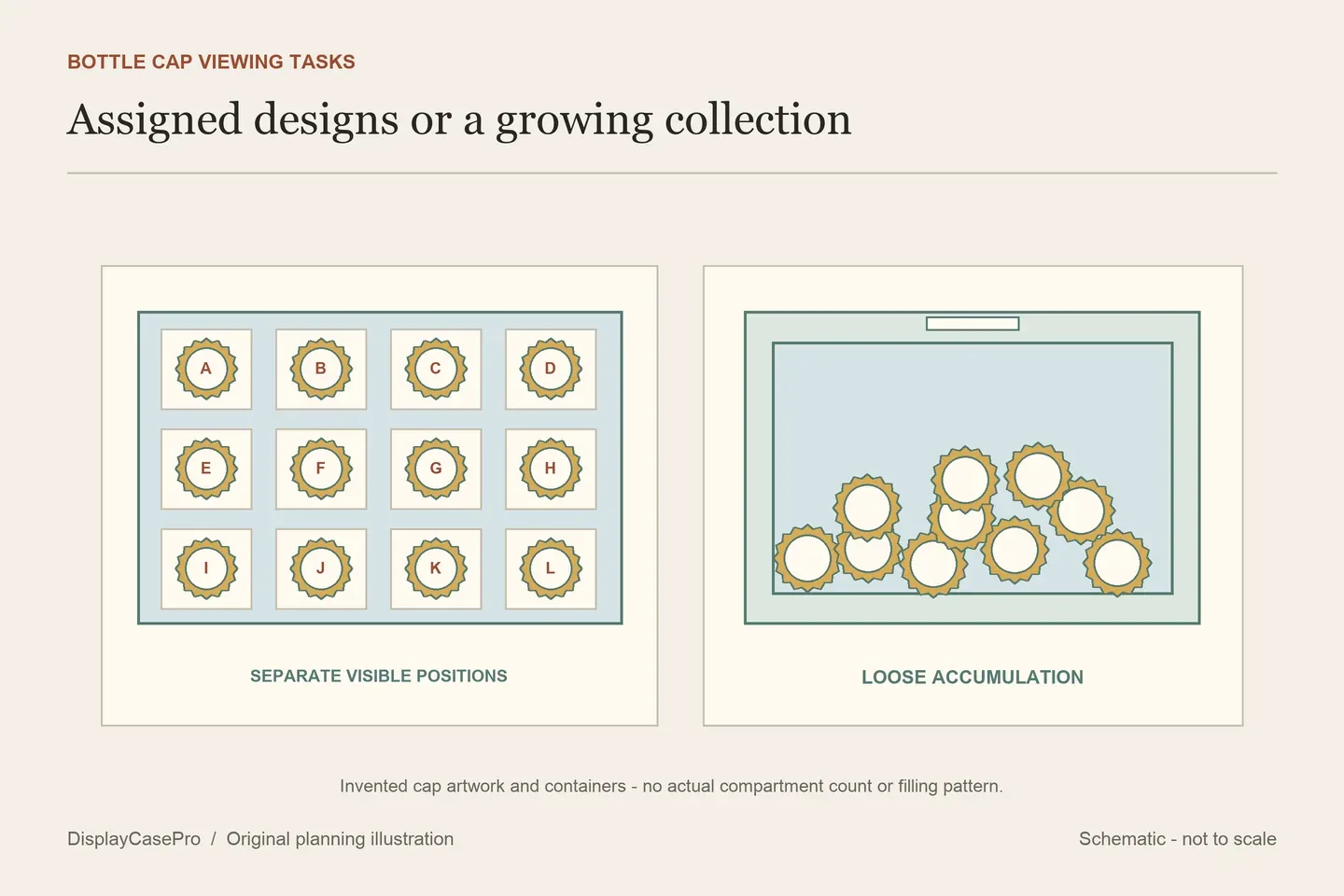
Choose a bottle cap display case by deciding whether you want to see each design in an assigned position or watch a loose collection accumulate behind a window. Fitted trays and drop-in boxes do different jobs. Check the complete cap profile, entry route and retrieval method before comparing their advertised counts or outer sizes.
A visible collection and a visible pile are different views
An assigned position keeps one chosen face visible and connects it with a row or label. An accumulation box records a growing group, but overlapping caps will hide some designs. Neither format is automatically better: choose the viewing task you want from the collection.
| Purpose | Format to investigate | Main limitation to check |
|---|---|---|
| Compare individual printed designs | A fitted tray or case with separately assigned positions. | Receiving size, cap profile and retention in the intended orientation. |
| Keep adding caps to a shared keepsake | A window box with a documented entry and emptying route. | Overlap, entry size and the ability to retrieve a particular cap. |
| Organize a larger reference collection | Suitable album pages or trays, with a selected group on display. | Exact pocket or insert format, hidden backstock and the link to collection records. |
The SAFE bottle-cap category includes albums, refill pages, fitted cases and more general collectible holders. Category membership does not make every insert suitable for every cap. Keep a display tray's receiving shape separate from an album page's pockets or a generic coin holder.
Record the crown profile, not just the printed circle
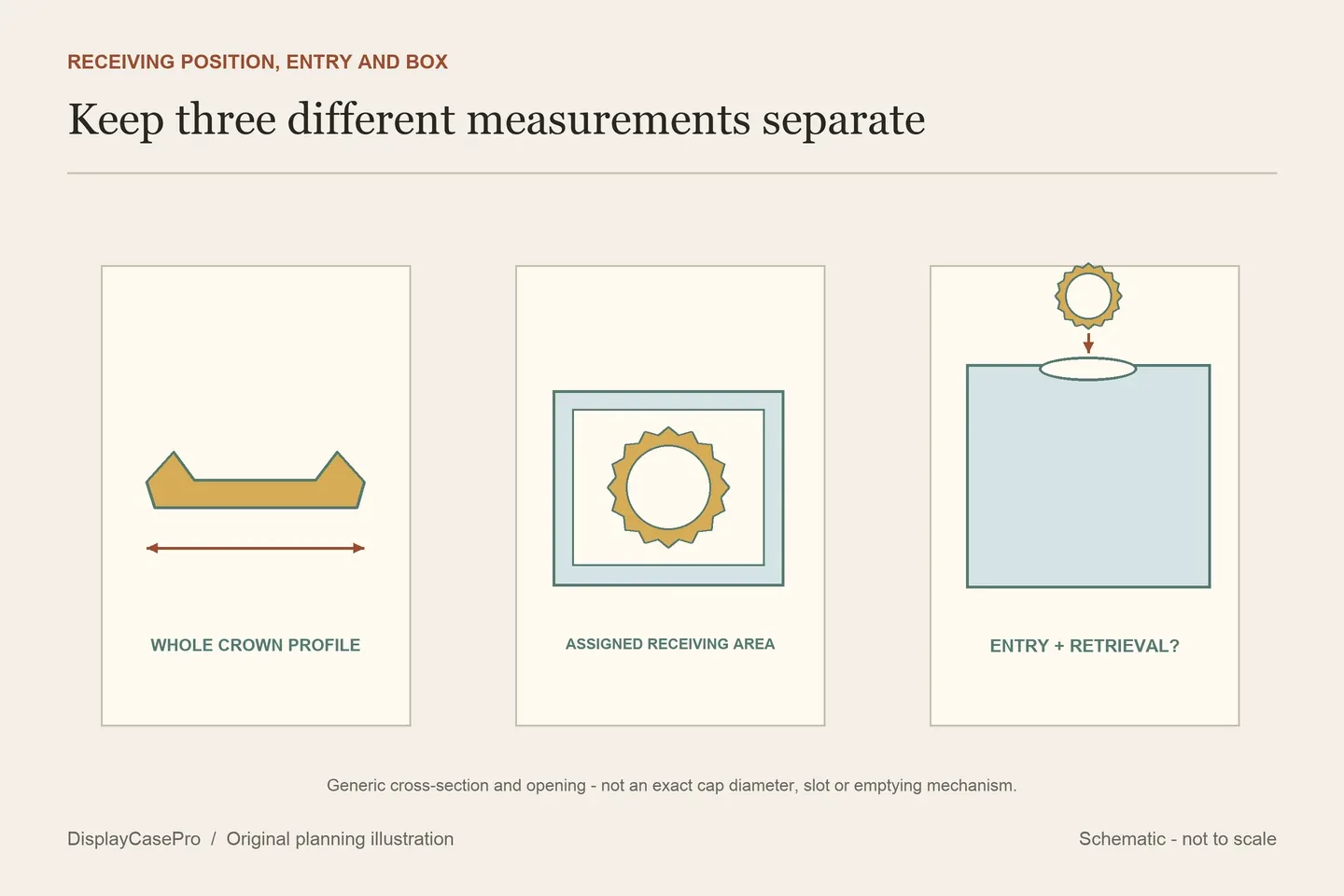
Measure the complete cap as collected, including the widest rim and its depth. Record any liner, retained insert or irregular projection without removing it just to simplify the fit. A hollow crown with a projecting edge does not have the same receiving profile as a flat disc of the same apparent diameter.
Identify which face matters. If the underside carries information you want to retain, photograph it for the associated record before assigning the visible position. A front-facing row does not show both sides, and a mirrored backing should not be assumed to produce a readable underside.
Keep any bent rim or other existing condition in the record. Choose the holder around the object rather than flattening it, bending its edge or pressing the lid closed to match an advertised capacity. This guide compares display arrangements; it does not prescribe cleaning, rust removal or restoration.
Compare 50 and 60 positions with the actual receiving geometry
The following are published product descriptions read on 17 October 2026, not our measurements or retention tests. Their position counts do not provide a common cap-size standard.
| Case | Published features and size | Unresolved fit detail |
|---|---|---|
| Hobbymaster Pride Bottle Cap Collector's Display Case | Up to 50 caps in soft-lined compartments. Overall 14¾ × 8½ × 1⅛ in. Clear plastic front-opening lid with magnetic closure. | Individual compartment receiving dimensions and clear depth are not supplied in the description. |
| SAFE Champagne Cap Display Case, SKU 5925 | Up to 60 champagne caps or bottle caps in a removable blue velvet tray. Case 375 × 260 × 38 mm, with 38 mm described as depth; hinged acrylic top and magnetic closure. | The complete tray cavity and individual receiving sizes are not specified by the overall case dimensions. |
Hobbymaster describes vertical or horizontal wall presentation as well as flat or propped placement. SAFE describes wall fittings and flat tabletop presentation. Verify the exact cap, insert and orientation you intend to use; changing the orientation changes the support task.
Ask for the dimensions of the actual positions, the accepted cap profile and the clearance to the closed front. If your group mixes small and broad caps, assign the unusual pieces first. Ten additional nominal positions do not help if the particular tray cannot receive those profiles.
A removable tray offers a way to handle the arrangement separately from its outer case when the product's instructions permit. Establish how caps remain supported during that operation and where the tray will rest. A magnetic closure describes the lid fastening; it does not establish a lock rating or controlled interior conditions.
Check the entry hole independently from the box size
The Bar Supplies Custom Irish Pub box describes an acrylic window, a metal bottle opener and a round top opening 1.14 inches in diameter. Its size line is 5.25 × 5.25 × 7.8125 inches, without labelled axes or a clear inside/outside definition.
The entry measurement is a separate restriction. Compare the intact cap's full profile with that opening; the larger box dimensions do not make a cap pass through the hole. The product description also does not provide a cap count or explain how an accumulated collection is emptied. Resolve that route before treating the box as a reusable archive.
The Personal Creations Home Bar box lists MDF and acrylic with W10 × H12 × D2.5-inch dimensions. The Gifts.com personalized box gives the same materials and dimensions in a different axis order. Neither description read specifies a usable cavity, entry size, retrieval mechanism or cap capacity.
Matching descriptions across two retail pages are not two independent fit tests. There is also an identity detail to check on the Personal Creations page: its URL ends in 30228286, while the product area displays item 30228283. Confirm the selected product and design rather than silently reconciling the numbers.
A personalized name, location or year can explain the collection, but it does not keep each cap facing forward. If a readable sequence matters, select assigned positions or maintain a separate illustrated record. Do not infer an opening or emptying mechanism solely from a front photograph.
Keep each design connected to its position
For a fitted case, use a simple row-and-position map. Group by a documented brand, place, design series or acquisition sequence, and leave uncertain origins marked as uncertain. A themed row should not turn an undocumented acquisition into a claimed event souvenir.
For an accumulating box, keep a record image before adding a cap if later identification matters. Give important pieces their own assigned positions instead of relying on finding them inside an overlapping group. Keep paper labels separate from loose caps and avoid making adhesive contact with the printed face.
Before hanging a populated case, follow the selected product's mounting and handling instructions. Plan room for the actual front or lid to open, and decide where a removed tray or retrieved cap will go. An overall case-size line does not answer those access questions.
The blank cap-profile and position worksheet separates receiving size, entry and retrieval. The collection measuring guide covers the complete object profile; the usable-depth guide helps distinguish the outer box from the space above its finished insert.
Common questions
Does a 60-cap case fit any 60 bottle caps?
Confirm the actual receiving positions and your cap profiles. A nominal capacity is not a universal diameter or depth allowance for mixed caps.
Will every cap remain visible in a drop-in box?
Loose caps can overlap and change orientation. Choose individual supported positions when every face must remain readable.
Can box dimensions prove a cap fits through the top?
Check the entry opening separately. Also obtain the emptying route; entry and retrieval are different operations.
Comments
Share a display tip or ask a question.