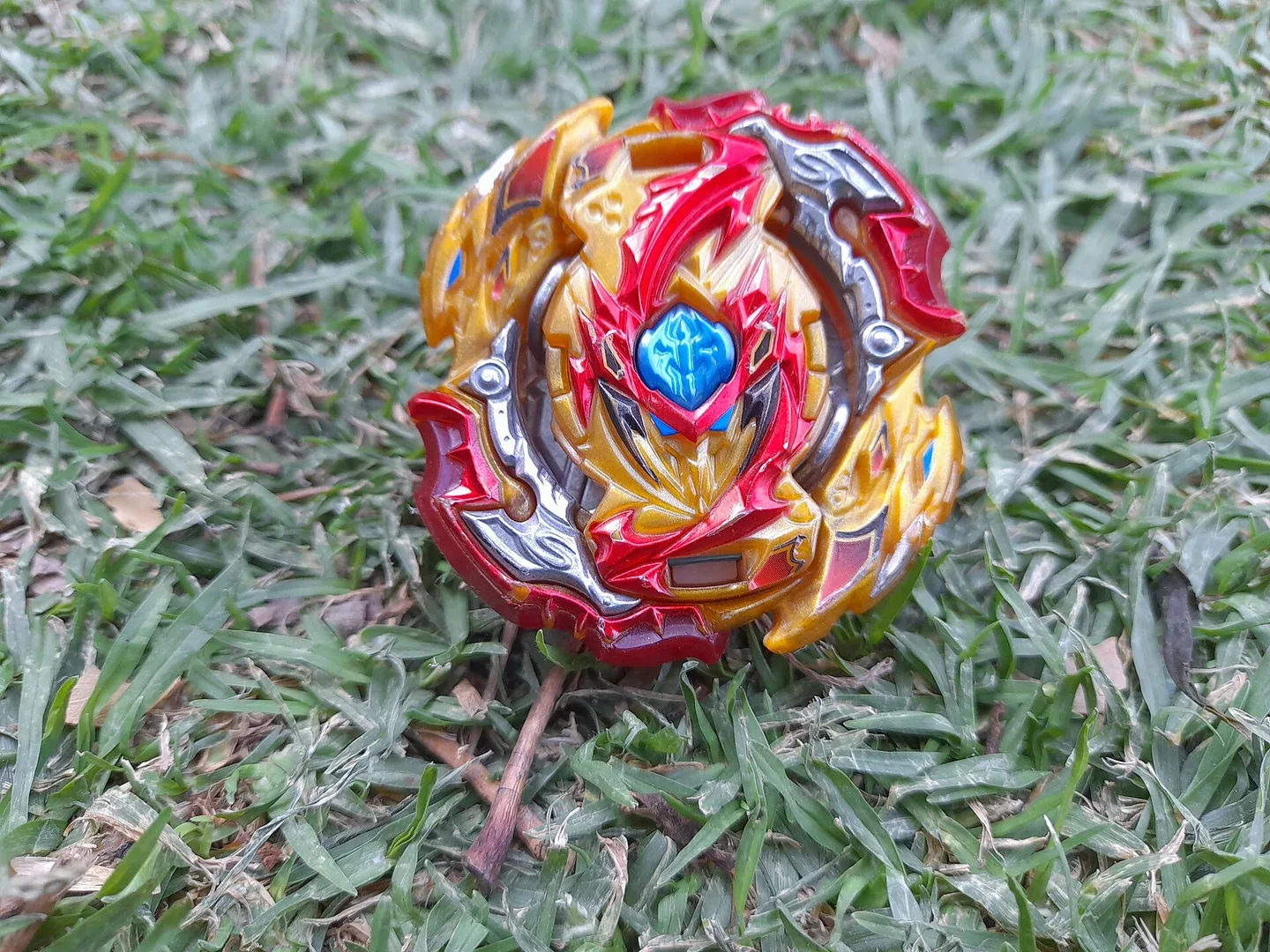
Choose a Beyblade display case around the exact top you want to show, its assembled parts and the way its decorated face will be presented. A carry box, an angled stand, a themed scene and a transparent individual case perform different jobs. Neither a generation name nor a four- or eight-top capacity establishes the receiving space for your particular build.
Choose a visible collection or a packed play kit
Start with a simple question: do you want to see the tops continuously, or organize equipment for taking elsewhere? A closed gear case can keep a selected group together without offering the view you want on a shelf. An exposed stand can present the decorated face without supplying a surrounding cover.
The BeyWarehouse cases, carriers and displays category illustrates this mixture. Its actual cards include gear cases, an adjustable storage organizer, illuminated four- and eight-top displays, a keychain and carrying cases. Those names distinguish formats; their nominal counts do not provide individual cavity dimensions.
Write down which equipment belongs in the display. A favorite complete top on its own is different from a row of selected combinations with spare components. Launchers and grips can occupy another identified area rather than being squeezed into positions advertised for tops.
If you also need a transport arrangement, record that as a separate requirement. Visibility through a panel, a stackable description or a convenient carrying handle does not establish how a loaded display should be moved.
Keep the complete top connected to its parts
Record the generation, exact release and assembled configuration as documented for the item. Photograph the intended presentation. For a changed combination, identify the components actually fitted rather than retaining the original package name as the complete description.
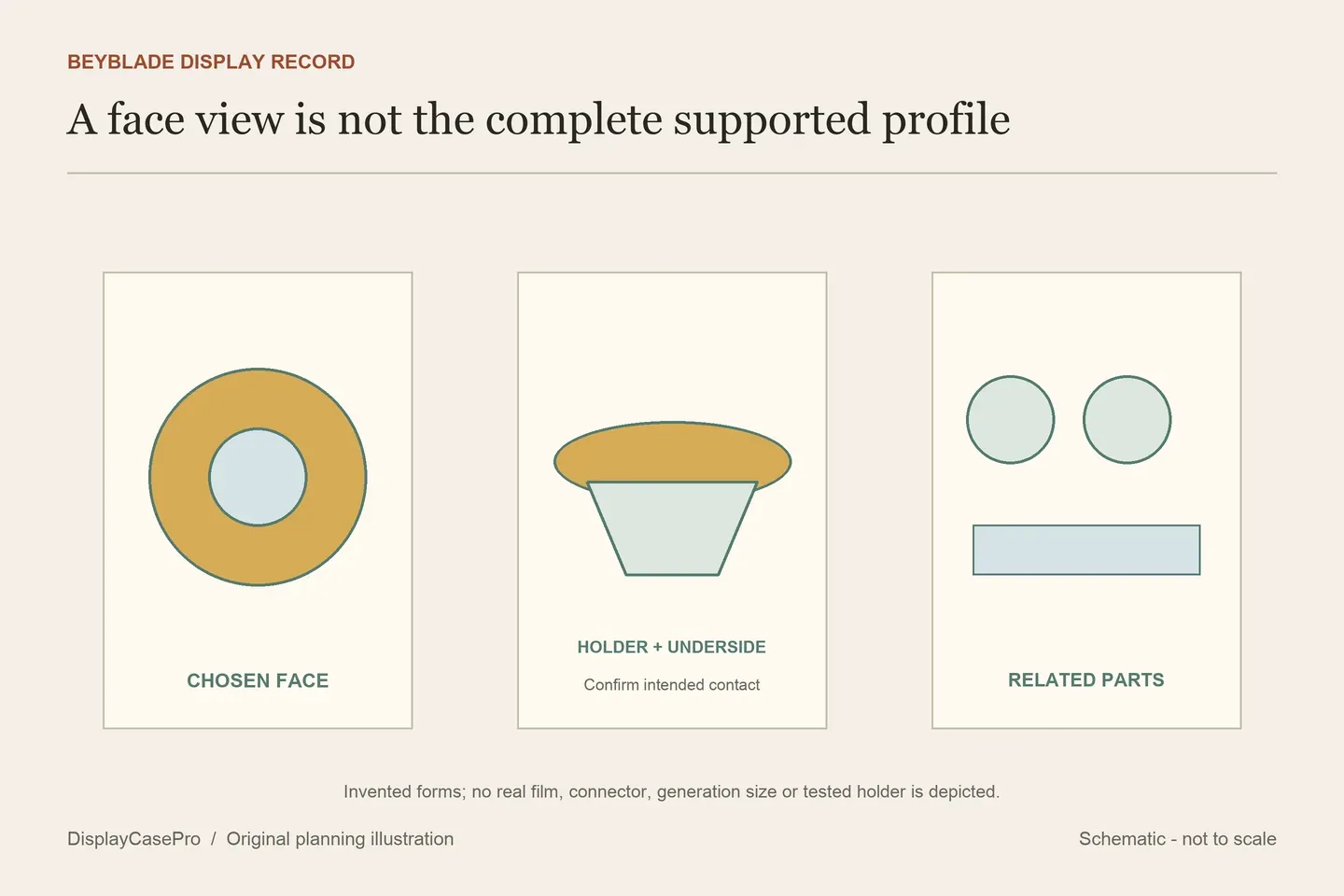
Measure the widest and deepest points in that chosen position, including the underside and the intended holder. Do not replace this profile with the diameter of the decorative upper part. An upright or angled presentation changes which parts project toward the closing panel.
A disassembled arrangement needs its own plan. Keep each component associated with the correct build and position. A small card can identify the displayed combination while the detailed parts record remains in your inventory. Leave uncertain identity marked as uncertain rather than assigning a part from color alone.
Use the collection measurement guide for the general outline method. Here the additional task is to preserve the relationship between the complete top, its chosen face and any separated components.
Read the receiving description behind the capacity
| Source | Published display description | Resolve before assigning a top |
|---|---|---|
| BeysCollector category at BeysAndBricks | Four- and eight-top cases with USB backlights; stackable and all-series wording. | Clear position sizes, actual holding method, permitted stacking arrangement and power route. |
| Beyhaven single display case | A plastic layer holds the top. Most average-size generations are described, with a Dynamite Battle size exception. | Your complete build, receiving profile and permitted contact with the holding layer. |
| ThePortal0 display-tagged category | Dioramas, a rivalry display, packaging stands, a launcher rack and a separate Metal Fusion case. | Which object is supported, whether a cover is supplied and the size of that exact package. |
The Beyhaven exception is useful precisely because it limits the broader generation statement. Do not turn “most” into “all,” or assume that a case accepting one assembled Burst top accepts every larger version. Ask about the actual item you intend to place in it.
ThePortal0's tag also includes a custom plating service. A search result containing “display” is therefore a starting point for identifying the product, not confirmation that every returned item encloses a top. No current availability is inferred from these sampled category pages.
Understand what locates the top
A plastic holding layer, a shaped recess and a stand engaging an underside component are different interfaces. Obtain the selected holder's instructions and accepted profile. Ask where it contacts the top, whether the complete build stays assembled and how it is removed.
The Monkee Mods collection display guide distinguishes gear boxes from aftermarket presentation stands. Its general claims about stand pressure and long-term damage are not adopted here. The useful next step is to establish the actual support's intended contact, rather than assuming that every angled stand harms a part or every flat arrangement is appropriate.
For a film-style holder, ask whether the holding layer is replaceable and how the case opens. The returned Beyhaven description does not answer those questions. A photograph of a top apparently suspended in place does not identify the film material or establish compatibility with every finish and projection.
Keep the decorated face visible and the top reachable
Choose the view before filling a row. A near-vertical face may reveal decoration clearly while concealing the underside. A lower angle can reveal more of the build but also bring the front edge nearer the cover. Compare the complete supported arrangement with the actual clear space in that orientation.
Keep a position map for repeated rows: collection group, build identifier and case location. If you change a combination for use, update the record when it returns. An attractive row is easier to understand when its labels describe the combinations actually present.
Plan retrieval from the center of a populated row. Establish whether a front panel opens, an individual case separates or a complete cover lifts. Include any lead and connector without routing them across the opening. Follow the exact lighting instructions; a USB connection alone does not define the case's light output, heat behavior or protection.
Use the Beyblade build and display-position worksheet to keep these decisions together. For a larger enclosure, the cabinet lighting guide covers the separate room-view task.
Common questions
Does an all-series case accept every Beyblade size?
Confirm the exact complete build and receiving position. A broad series claim does not supply a numeric size range, and the cited single-case listing explicitly mentions an exception.
Is a packaging stand a case for the top?
Identify what it supports and what is included. A stand intended to show packaging can perform a different task from locating an assembled top under a cover.
Can an illuminated display replace a carry case?
Use only the handling and transport arrangements documented for that display. Visibility and an advertised capacity do not establish loaded transport performance.
Photo credit: Cover: Lord spriggan en pasto, Gatotactico16, CC BY-SA 4.0. Resized and converted to WebP under the same license. The outdoor reference photograph shows a top, not a case, tested fit or recommended display surface.

About this guide: Published descriptions and original planning analysis; no top, film, stand, illumination or case was physically tested.
Comments
Share a display tip or ask a question.