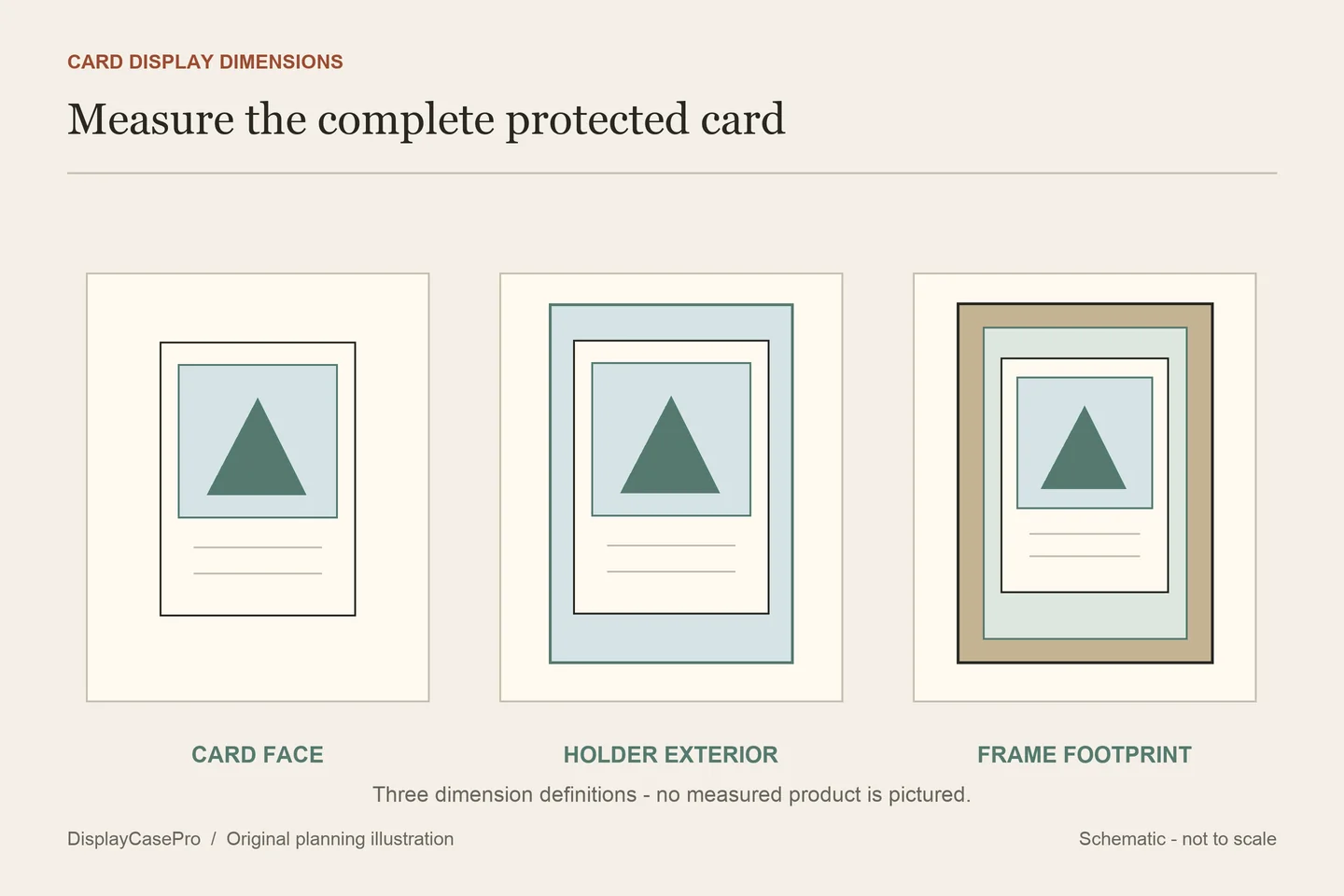
Baseball card display case dimensions need to match the card in its intended protection. Record the sleeve, top loader, snap holder or grading slab, then compare its outside dimensions with the frame's actual recess, track or mounting system. The card's size, the visible window and the case's outside footprint are different measurements.
Five measurements that should have separate labels
| Measurement | What it describes | What it does not establish |
|---|---|---|
| Card face | The paper card's width and height | The outside size of a protective holder |
| Holder exterior | The complete sleeve, top loader, snap holder or slab | Whether the display's retention and access suit it |
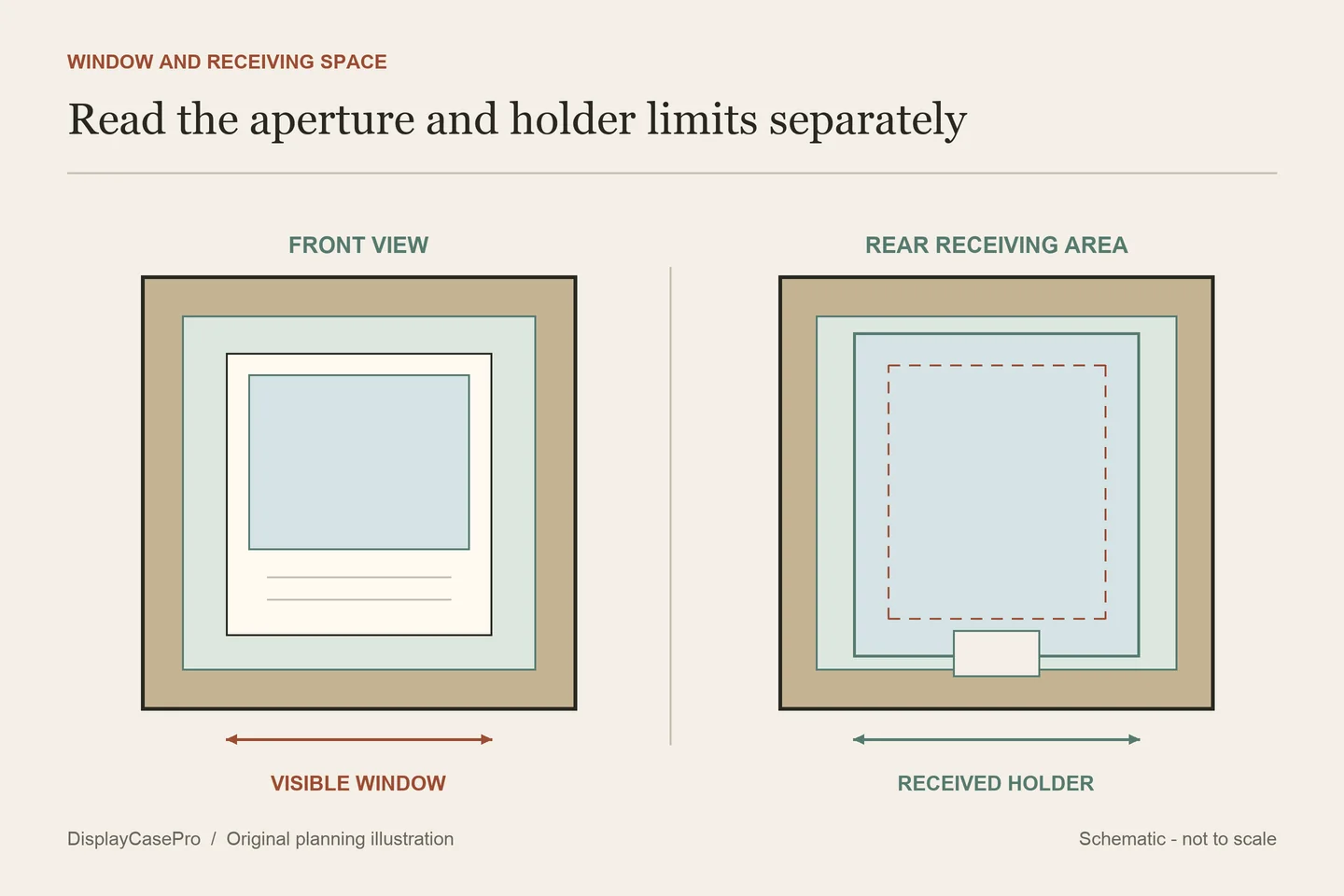
| Visible window | The opening through which the viewer sees the item | The size of the hidden recess behind it |
| Recess, track or mount limits | The dimensions the display accepts and supports | That every nominally similar holder or added sleeve fits |
| Frame or case exterior | The complete wall or shelf footprint | Usable interior area or card capacity |
A familiar 2½ × 3½ inch format appears in many modern trading-card supplies, but the term “baseball card” also covers other formats. Record the actual release and its protection. Vintage, oversized, miniature, die-cut and thick memorabilia cards should not be assigned to one default opening.
Keep portrait and landscape orientation explicit. Rotating a holder may change which edge rests on a support or how it enters a track. A supplier's width-by-height statement should be read in its stated orientation rather than silently swapped to make the numbers match.
A real holder shows why the paper footprint is insufficient
The BCW Mini Snap Card Holder, SKU 1-MS, is specified for a standard 2½ × 3½ inch trading card. Its published outside dimensions are larger. This example separates the maker's three dimension definitions; the figures are not measurements we have taken.
| Definition | Dimensions as listed | Use in display planning |
|---|---|---|
| Intended standard card | 2½ × 3½ | Identify the intended card-face format |
| Holder interior footprint | 2⁹⁄₁₆ × 3⁹⁄₁₆ | Read the holder's own interior specification |
| Holder exterior | 2¹¹⁄₁₆ × 3¹¹⁄₁₆ × ¼ | Check the protected item's outside profile against a display |
The space between a card and a holder is part of that product's design. It is not an allowance to copy into every frame or a reason to compress a thicker card. If a card already has a suitable protective holder, measure that assembly before choosing the display.
A protective sleeve around a slab or top loader adds another layer. Include its edges, flap and seams when checking the admission route. Do not remove protection simply because a frame was selected from the bare-card dimensions.
A visible window is different from the holder the frame accepts
BCW's Interlocking Graded Card Frames, SKU 1-ICF-G-BLK, state accommodation for slabs up to 3⁷⁄₁₆ × 5½ inches. The listed interior window is 2⅞ × 4⅞ inches, and the exterior frame is 5 × 7 × 1 inches. The FAQ also states holder thickness up to ⅝ inch.
Those figures describe different jobs: receiving the slab, revealing its face and occupying wall space. Check the actual label and card view through the aperture as well as physical retention. The maker also says this graded-frame product does not interlock with its separate standard-card frame, SKU 1-ICF-S-BLK. Similar styling does not establish connector compatibility.
For another format, Franklin Sports' Trading Card Display Frame, item 92141X, uses sliding tracks and includes twenty top loaders. Its feature list specifies compatibility with 4 × 3 inch top loaders and a nominal 16 × 19 inch frame. The 4 × 3 statement describes the top-loader format in that bullet, not a universal paper-card size.
A supplied-top-loader track system and a graded-slab frame solve different tasks. Confirm the exact holder and access requirements before substituting one for the other. These examples explain specification reading; they are not a tested compatibility list or a ranking of cases.
Check the protected card in the order it will be displayed
- Identify the exact item. Record the card release, orientation and existing protection. Keep any grading label identifiable.
- Record the outside holder profile. Include total width, height and thickness, with any additional sleeve.
- Obtain the display limits. Ask whether a published number is a recess, window, track opening or exterior dimension.
- Check entry and retention. The holder needs to pass through the opening and rest in the intended support configuration.
- Check what remains visible. Look for a hidden card edge, covered label, glare or a front lip across important information.
- Check release. You should be able to follow the intended removal method without bending the card or levering against the holder.
Carry the original units through the comparison and use one converted set only when needed. Keep the supplier's definitions beside your own figures. A very close numerical match leaves practical access unresolved; there is no universal clearance number supplied by the phrase “standard card.”
The collection measurement guide covers complete supported profiles. For a deeper frame with separate mounts, the usable depth guide explains why the outer frame depth is not the space left in front of the assembly.
Plan capacity from the protected formats you own
Sort a group by holder type and orientation before counting positions. A frame built around identical top loaders does not automatically have the same capacity for mixed slabs. Keep any oversized holder or thick card visible in the inventory instead of treating it as a routine slot.
Make a paper map showing the complete holders and their labels. Use the intended team, season, player or set order only after each position has a plausible fit. Leave an unconfirmed position marked as such. A numerical card count on a sales page is a description of its intended arrangement, not proof that every collection of that many cards fits.
For a baseball-and-card enclosure, include the ball, both supports and their viewing relationship. A base footprint does not define the card-holder opening. Check that the companion object does not hide the card or block removal of its holder.
Download the blank card-and-holder fit worksheet. It separates card format, holder exterior, visible window, mount limits and the finished case. Retain the exact model reference so a later supplier revision or a new protective sleeve can be checked.
Common questions
What size display case fits a standard baseball card?
Start with the actual card in its chosen holder. A 2½ × 3½ inch card can sit inside a larger protected profile, and different display systems receive that profile differently. Obtain the frame's holder or track limits rather than selecting from the paper dimensions alone.
Does an opening smaller than the slab mean it cannot fit?
A front viewing window may be smaller than a rear recess that holds the slab. Check both definitions and the loading route. Even when the slab can be received, verify that the window reveals the card and the label you want to show.
Can I use one frame system for graded and ungraded cards?
Only when that exact system supports the intended holders and connections. Check individual fit, orientation, retention and any interlocking parts. A shared brand or similar appearance does not establish interchangeability.
Comments
Share a display tip or ask a question.