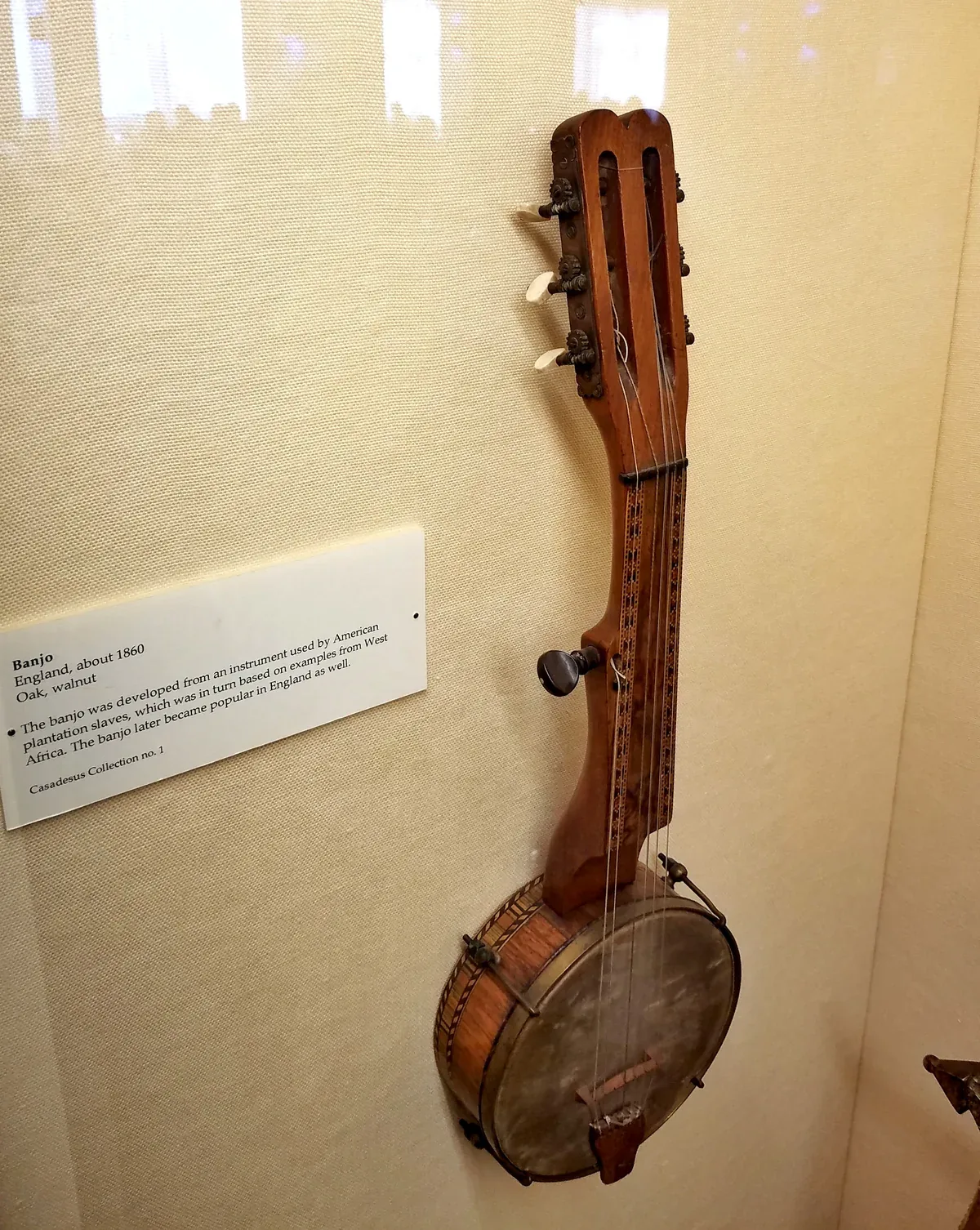
Choose a banjo display case around the actual instrument, its support and how often you will take it out to play. A padded carrying case, an open wall hanger and a glass-front cabinet solve different problems. For an enclosure, the pot’s supported depth and projecting hardware matter alongside the full neck and headstock outline.
Decide what will stay visible between playing sessions
A regularly played banjo needs a practical retrieval routine. A family instrument displayed with a historical label may instead be approached only for inspection. Identify the instrument, its condition and the purpose before choosing furniture or supports. For an old, repaired or valuable instrument, obtain appropriate instrument advice about the proposed display and contact arrangement.
Check that a search result describes a full instrument. Banjo Ben’s current banjo-case results mix instruments sold with cases, transport cases, bags and a miniature gift instrument. A “9-inch mini banjo” gift set with a stand and case is a different object from a playable full-size instrument. The word case alone does not establish a transparent enclosure.
A shaped hard case or gig bag can serve transport and storage under its own instructions. It does not provide a windowed wall cabinet. If you need both transport and visible display, retain them as two requirements instead of expecting one product name to settle both.
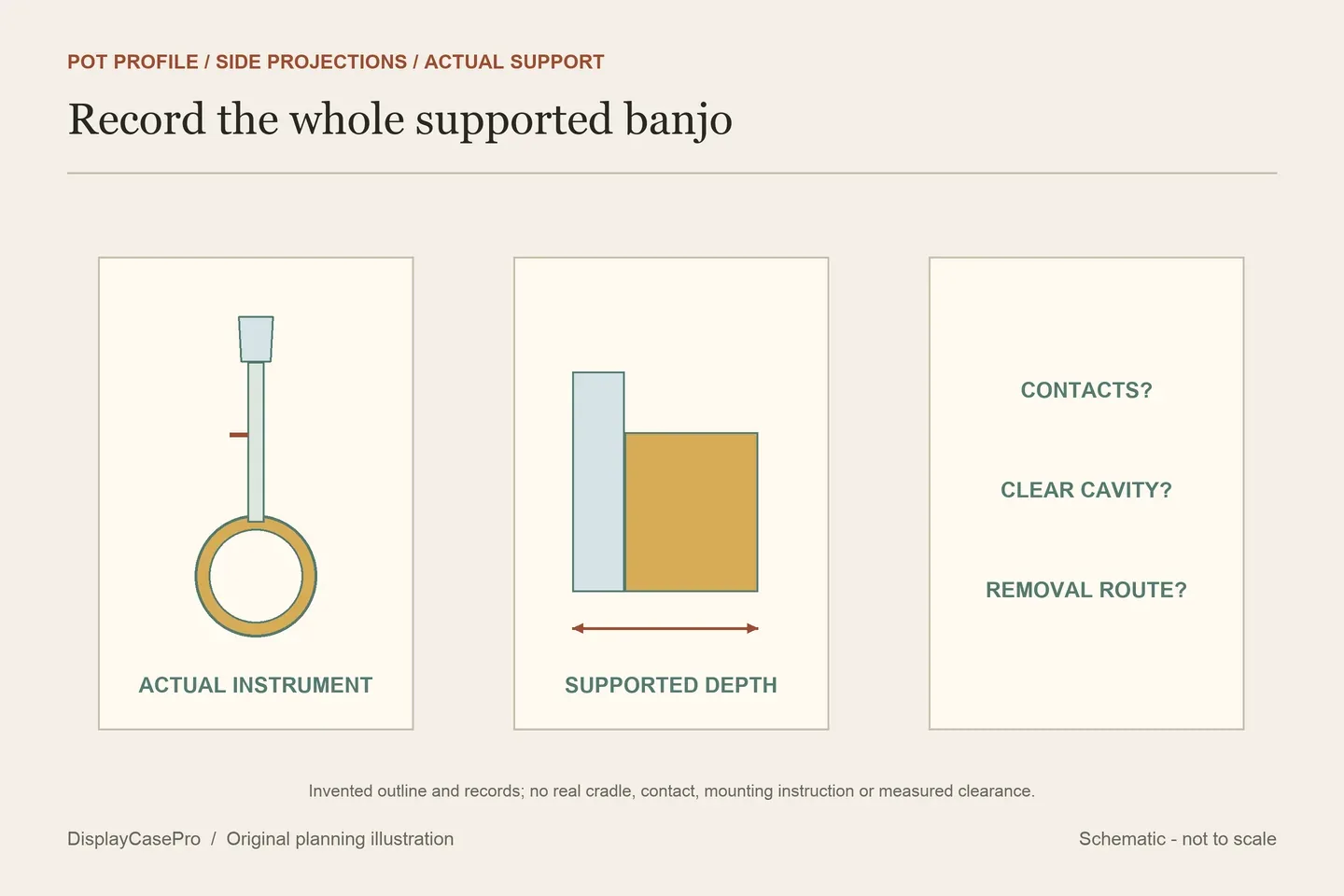
Record the pot, neck and side projections as one supported outline
Write the exact maker and model, and identify the banjo’s actual configuration. Keep an open-back or resonator arrangement as it will be displayed. Do not remove a resonator, strap or other part simply to make an unexplained cabinet dimension look suitable.
| Region | Include in the record | Question to resolve |
|---|---|---|
| Pot and rear profile | The complete rim, brackets, tailpiece and actual open-back or resonator depth. | What is the projection from the backing once the intended support is installed? |
| Neck and headstock | Full length, tuning machines and any side-mounted fifth-string peg on this instrument. | Does the support region and opening avoid those projections? |
| Retained accessories | Any strap or accessory that will remain, in its intended position. | Is that configuration permitted by the instrument and display instructions? |
| Installed support | Exact model, location, contact areas and offset. | Which instrument features are supported, and what finish/contact confirmation is needed? |
Use a front outline and a side record. A round pot can look compact from the front while projecting farther toward a closed door than the neck. A side peg also needs its own position; treating the neck as a straight, featureless line can miss the part nearest a support or case edge.
Keep maker dimensions and any suitable measurements of your own instrument labelled separately. Do not press against a bridge, head or fitting to reduce the outline. If measuring would risk contact with a delicate part or finish, obtain the required dimensions with help from the instrument maker or a qualified specialist. The collection measurement guide separates the object, receiving space and surrounding room.
A guitar cabinet and a banjo hanger need different confirmation
The following descriptions were read on 18 October 2026. They identify formats and missing information; DisplayCasePro has not mounted a banjo or tested the products.
| Source | Read format or specification | What remains unresolved |
|---|---|---|
| Banjo Ben search page | Current page mixes instruments, transport cases/bags and a miniature gift set. | The exact full-instrument display product, rather than a search-match count. |
| ECG Music display category | ClimaCase and ClimaStand products, with general climate/display descriptions. | Banjo-specific cavity, support and current selected product details. |
| Bluegrass Today cabinet report | Historical custom multi-instrument cabinet account, published May 9, 2017. | A current manufacturer specification for your instrument group. |
| Calido ShowCase Deluxe | SCX lists W22.5 × H51 × D9 inches; inside/outside is unlabelled. | Clear receiving dimensions with the actual banjo support installed. |
| MID Displays hanger category | Open banjo hanger names at 2, 3, 4 and 7 inches among other instrument hardware. | What each number measures, exact neck/contact compatibility and installation. |
The ShowCase’s general mention of banjos is useful scope information, but its 9-inch depth line is not labelled as a clear cavity behind the closed door. Ask for that boundary and the intended instrument position. Do not subtract guessed glass, backing or hanger thickness to manufacture an interior.
Likewise, an open merchandising hanger adds no surrounding cover. A product name containing “7 inch” is not evidence of seven inches of receiving space in an unrelated cabinet. Identify the selected hanger and its actual installation rather than combining a category-card number with another maker’s enclosure.
Keep instrument contact and wall attachment separate
String Swing’s BCC11B banjo mount describes a narrow, reinforced, padded cradle on a metal plate. Its banjo-specific installation text recommends a wall stud, distinguishes masonry fixings from the enclosed hardware, and states a limit of 15 pounds or less. Keep those instructions and conditions with that product rather than adopting a larger generic marketing load figure elsewhere on the page.
An instrument cradle and a cabinet’s wall attachment are different components. A cabinet may have its own cleat while the banjo needs a separately confirmed internal support. Ask who supplies each part, where it contacts or attaches, and which installation instructions apply to the complete loaded arrangement.
Padding, a non-rubber gasket or a broad instrument-compatibility claim does not independently establish suitability for a particular finish. Give the maker the actual instrument and known finish information. Do not add a homemade contact layer or substitute a guitar hanger and assume that the support question is settled.
Plan the door and playing routine before arranging the wall
Ask how the chosen cabinet opens and how the instrument is intended to be supported during removal. Record the clear aperture, approach to the cradle and position of nearby furniture. A deep enough interior does not establish that the banjo can pass through the door or be reached comfortably at the intended height.
For several instruments, request the actual neck-rest arrangement and retrieval sequence. The 2017 cabinet report describes custom rests and environmental equipment; it is not a current capacity chart or proof that a standard cabinet controls the conditions your banjo requires. This guide does not prescribe a humidity target or instrument treatment.
Use the banjo, support and playing-access worksheet to retain the pot profile, side projections and unresolved receiving dimensions. The collection wall guide helps plan the surrounding composition after the individual display and installation are resolved.
Common questions
Will a guitar display cabinet receive a banjo?
Confirm the actual supported instrument and labelled cavity with the maker. A general banjo mention does not document every pot, resonator, side peg or support arrangement.
Is a miniature banjo case a useful size reference?
It describes the miniature product. Keep it separate from a full-instrument display and use the actual banjo’s complete outline.
Cover photograph: Daderot, via Wikimedia Commons, CC0 1.0. England, about 1860; Casadesus Collection at Symphony Hall, Boston. Whole photograph retained. It documents that historic exhibit, not a modern mounting instruction or measured case.

Comments
Share a display tip or ask a question.