Plan an antique key display case around the intact keys you own and the information you can document. A new ceremonial key award, a purchased lock-and-key collection and an empty shadow box are different orders. Keep each key’s projecting bit, original tags and any verified lock relationship in the layout before choosing the frame.
A key case may include a new award rather than receive old keys
EAG Awards’ ornate bronze ceremonial-key product supplies an award arrangement with a new nine-inch key and personalization options. Its case description should not be read as a universal empty frame for a historic key collection. Confirm whether the item being ordered is the complete award, an empty case or a custom service.
Relic & Rarity’s Mechanisms of Secrecy listing describes a completed group of eighteen locks and twelve keys in a shadow box. Those counts belong to that particular arrangement. They do not establish the capacity of an empty product or whether your differently shaped keys can occupy the same positions.
The completed group also carries the seller’s descriptions of its history, age and condition. Keep those claims with their source rather than adopting them as independently verified facts. A convincing frame, an old-looking surface or a named collection does not authenticate another key.
Include the bow, projecting bit and retained tags
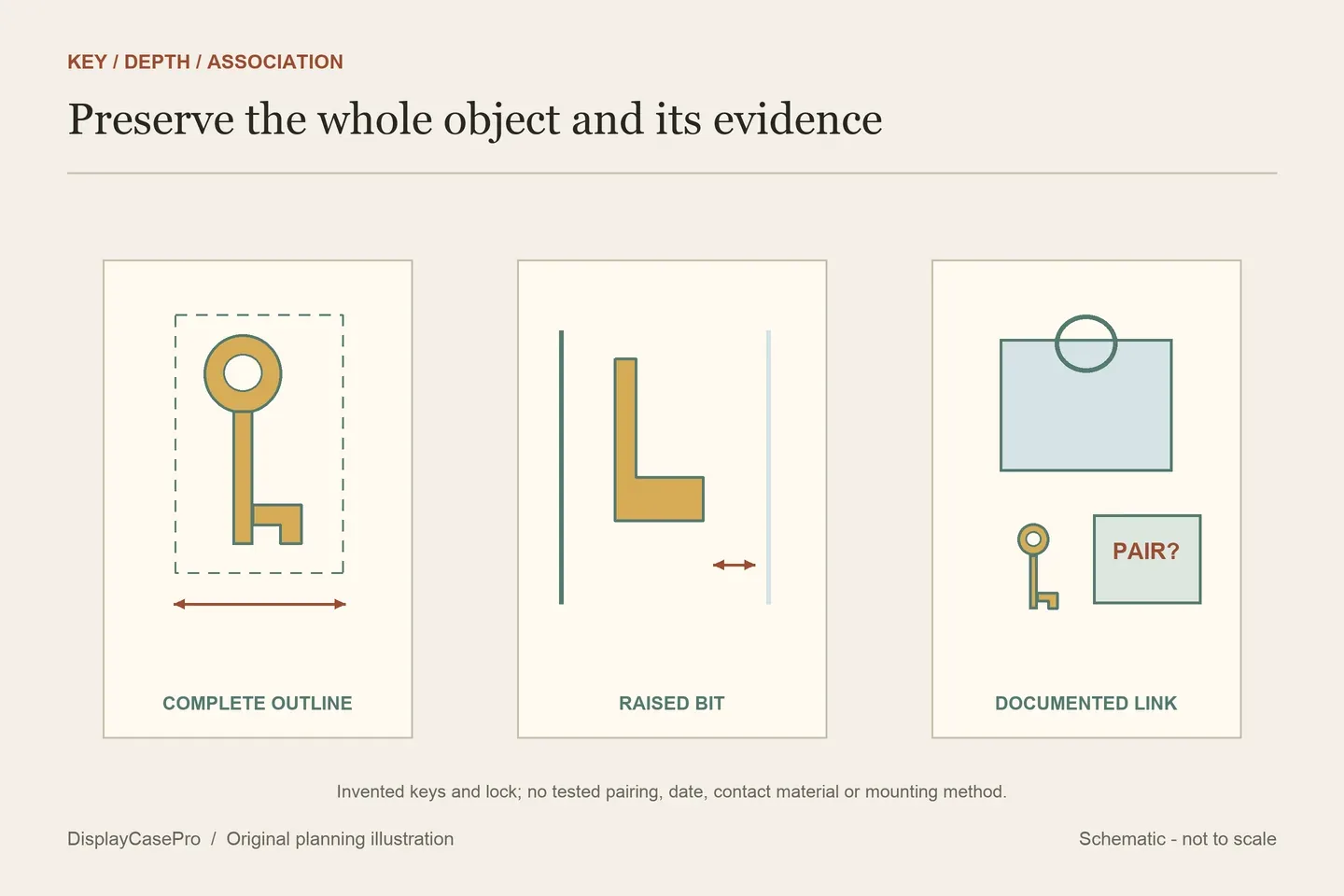
Measure the complete key in its intended display orientation. Include the bow, stem and bit, along with any projection towards the glazing. Record units and the reference surface. A long narrow stem can fit along a frame while its raised or angled bit creates the actual depth question.
If an old tag, tassel or ring remains attached, plan its position too. Do not remove it simply to make the metal outline fit a smaller opening. Keep important lettering or a stamped number visible, and retain an existing reverse image when both sides carry information.
For a documented lock-and-key pair, include the whole lock, shackle, existing support and caption in the arrangement. A paired presentation can need different receiving depth and support from a row of loose keys. Several small keys fitting beside a lock does not establish that any one of them belongs to it.
Compare a completed display with its own specification
The following figures were read on 18 October 2026. They are published descriptions without a physical measurement or mounting test by DisplayCasePro.
| Listing | Published size | Receiving limitation |
|---|---|---|
| EAG ceremonial-key award | 10½ × 13½ × 2½ in display case. | Tuple axes and inside/outside boundary are unstated; includes a specified new key award. |
| Relic & Rarity completed group | Approximate W21.25 × H21.25 × D2.35 in. | Boundary is unstated; finished eighteen-lock/twelve-key arrangement, not empty capacity. |
Neither depth line provides a labelled clear gap above a finished backing. Request that measurement for an empty frame intended for your collection. Do not subtract guessed layers from the case depth, particularly when the mount or backing has not been specified.
Use a separate paper layout for the actual visible opening, full object outlines and captions. Keep a key’s bit or original label out of the area hidden beneath a mat. The external frame can be larger than its visible opening, so an outside width alone does not settle the composition.
Choose whether the object must remain independently removable
Dans le Lakehouse’s skeleton-key project suspends a small group with ribbon and pins. Life on Kaydeross Creek’s framed-key project uses nails, hot glue and an added cardboard spacing arrangement. These are two authors’ decorative projects, without a tested load, materials or removal specification for your keys.
Decide whether you are making permanent decoration or retaining a collected object for later inspection. When the latter matters, request a support plan that explains the contacts, attachment and release. Gluing an unidentified surface into a craft composition can make a different long-term commitment from placing an intact key on a removable support.
| Question | Record | Ask the frame maker |
|---|---|---|
| Which surfaces matter? | Marks, old tags, finish and the chosen face. | Where does the support contact the key, and which parts stay visible? |
| Will a lock remain with it? | Documented pair or explicitly unknown association. | How are the two objects separately supported without obscuring the record? |
| Will it be removed? | Inspection and label-reading routine. | How does the support release without using the front to retain or compress the key? |
A material name alone does not establish suitability for an unknown surface. Keep the actual support and contact questions with the object record. This guide does not prescribe cleaning, polishing, corrosion removal or testing an old key in a lock.
Keep documented pairs distinct from decorative neighbors
Miss Mustard Seed’s furniture-key post distinguishes a key that fits a keyhole from one that operates its latch. Its tassel arrangements are furniture decoration, not proof of an original key-and-lock relationship. Preserve an unknown association as unknown in a display caption.
Assign each key an identifier tied to its own source notes and reference image. If a group is known to have come from one building or collection, record the evidence for that group separately from the identity of each key. Avoid converting visual similarity into a date, original use or matching pair.
Check the front-opening and support-removal route before fixing a dense arrangement. A wide bow or projecting bit can obstruct a neighboring item’s removal even when the row fits behind the glass. Plan a place for the opened front and complete support, rather than relying on the keys to remain loose while the box is tilted.
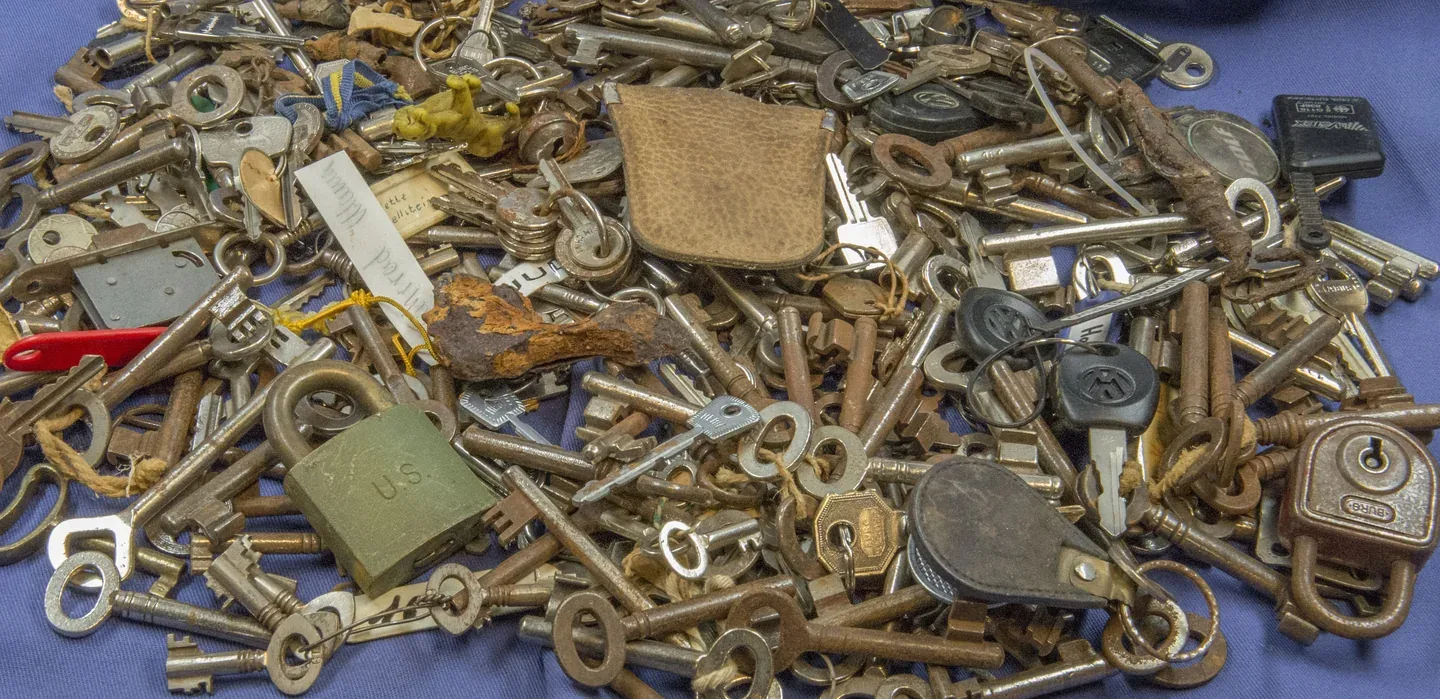
The cover photograph shows a mixed, unsorted key collection with rings and tags. It illustrates varied complete profiles, not an all-antique identification or recommended storage arrangement. Photo: Hannes Grobe, 7 May 2015, CC BY-SA 4.0. Whole composition retained, proportionally resized and compressed to WebP; image derivatives retain the same license.

Use the antique key, lock-association and case worksheet. The collection measurement guide explains complete profiles and units; the usable depth guide explains the space above an installed backing.
Common questions
Does a twelve-key display accept any twelve skeleton keys?
No capacity follows from the cited completed collection. Compare the actual supported outlines and clear receiving area of the selected empty enclosure.
Should every displayed key be labelled as a lock pair?
Only record the relationship you can support. A nearby lock, compatible-looking bow or decorative fit is not evidence of original ownership or operation.
Comments
Share a display tip or ask a question.