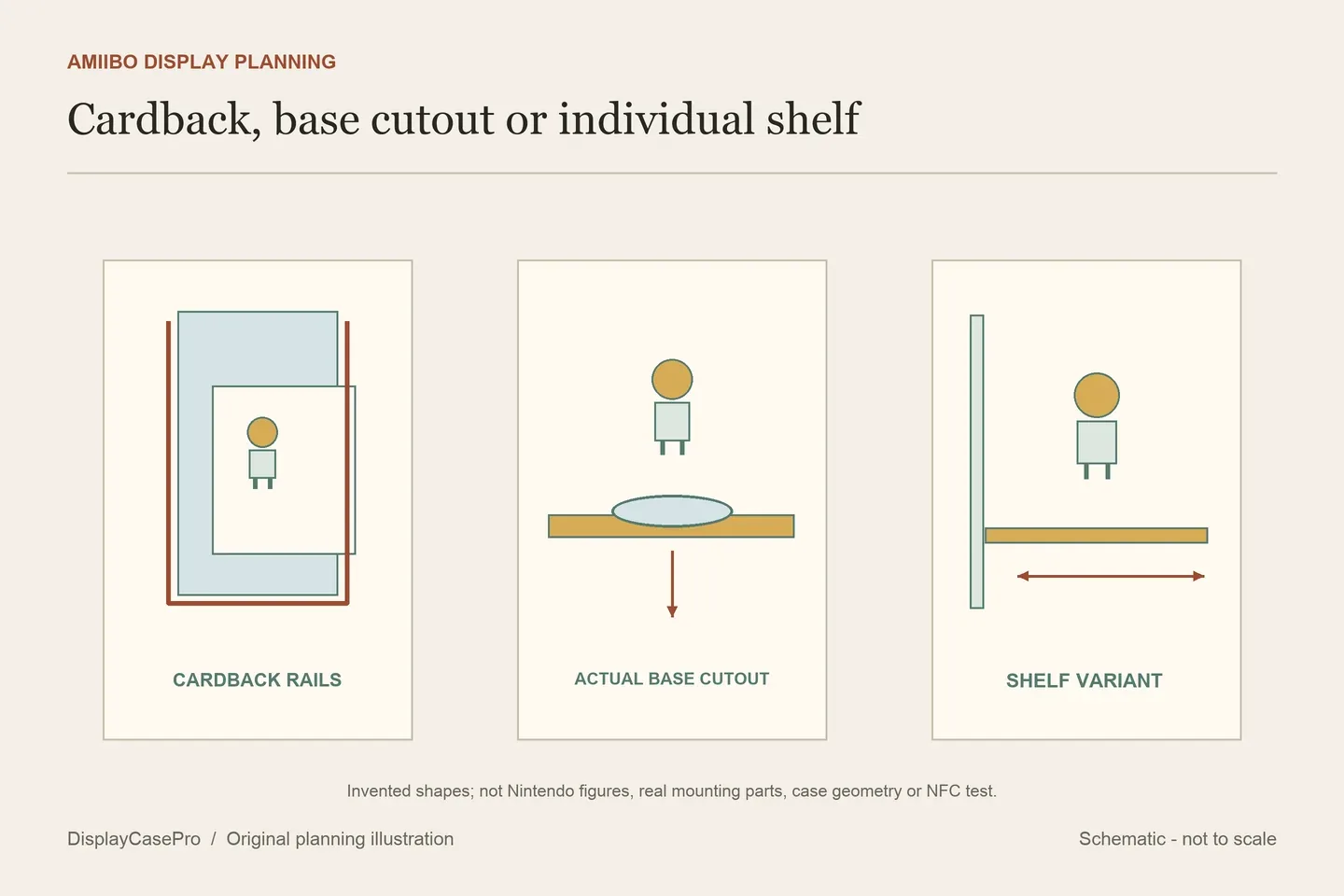
Choose an amiibo display case by deciding whether the figure stays on its original card or will sit loose in a receiving position. For loose figures, check the actual base and projecting pose against a tier cutout or shelf. If you use the amiibo in games, include its removal and return routine in the choice.
A cardback rail, a circular base cutout and a small wall shelf support different parts of the collectible. They cannot be compared using a single figure-height number or a nominal collection count.
Start with the part the display receives
For a carded figure, the object entering the overcase is the complete retained package, including the cardback and blister. For a loose figure, it is the figure with its base and projecting features. An outer protector, if retained, creates another distinct outline.
Record the exact release and physical form. A catalogue compatibility list that also mentions amiibo cards or other accessories is not a dimensional specification for every figure. Likewise, knowing that two figures belong to one game series does not establish that their bases and poses share a receiving shape.
| Format | Receiving task | Check before assigning an item |
|---|---|---|
| Carded-figure overcase | Hold the intact package using the prescribed opening and cardback support. | Complete card and blister profile, rail spacing and clear insertion route. |
| Tiered enclosure with cutouts | Place a loose figure’s intended base in a designated position. | Accepted base shape, cutout size, local headroom and neighbouring props. |
| Individual wall shelf | Support one loose figure at a stated distance from the wall. | Exact shelf variant, complete projection, supplied fixing and release route. |
The intended view also matters. A card’s artwork may be central to one collection, while a loose figure’s side-facing weapon or large rear feature may matter more in another. Decide which details should remain visible before filling every available position.
CGA’s two size blocks need a receiving definition
CGA’s amiibo carded-figure case describes a sliding bottom and interior rails for the cardback. Its first size block states W5.31 × H7.75 × D4.13 in. An additional-information block gives a different W5 × H7½ × D3⅝ tuple.
The returned descriptions do not clearly label one block as the receiving cavity and the other as the exterior. Do not silently make that assignment. Ask for the clear interior, rail geometry and opening for the exact carded release you own.
Also identify whether another protector remains around the original package. Extra layers can affect admission and closure even when the bare card appears suitable. A generic clearance statement cannot replace the selected case’s labelled drawing.
Keep the original package in its chosen state during this check. There is no need to fold a card tab or press a blister against a panel to test an uncertain listing. Resolve the dimensions before trying to load the collectible.

Twelve positions do not define twelve interchangeable figures
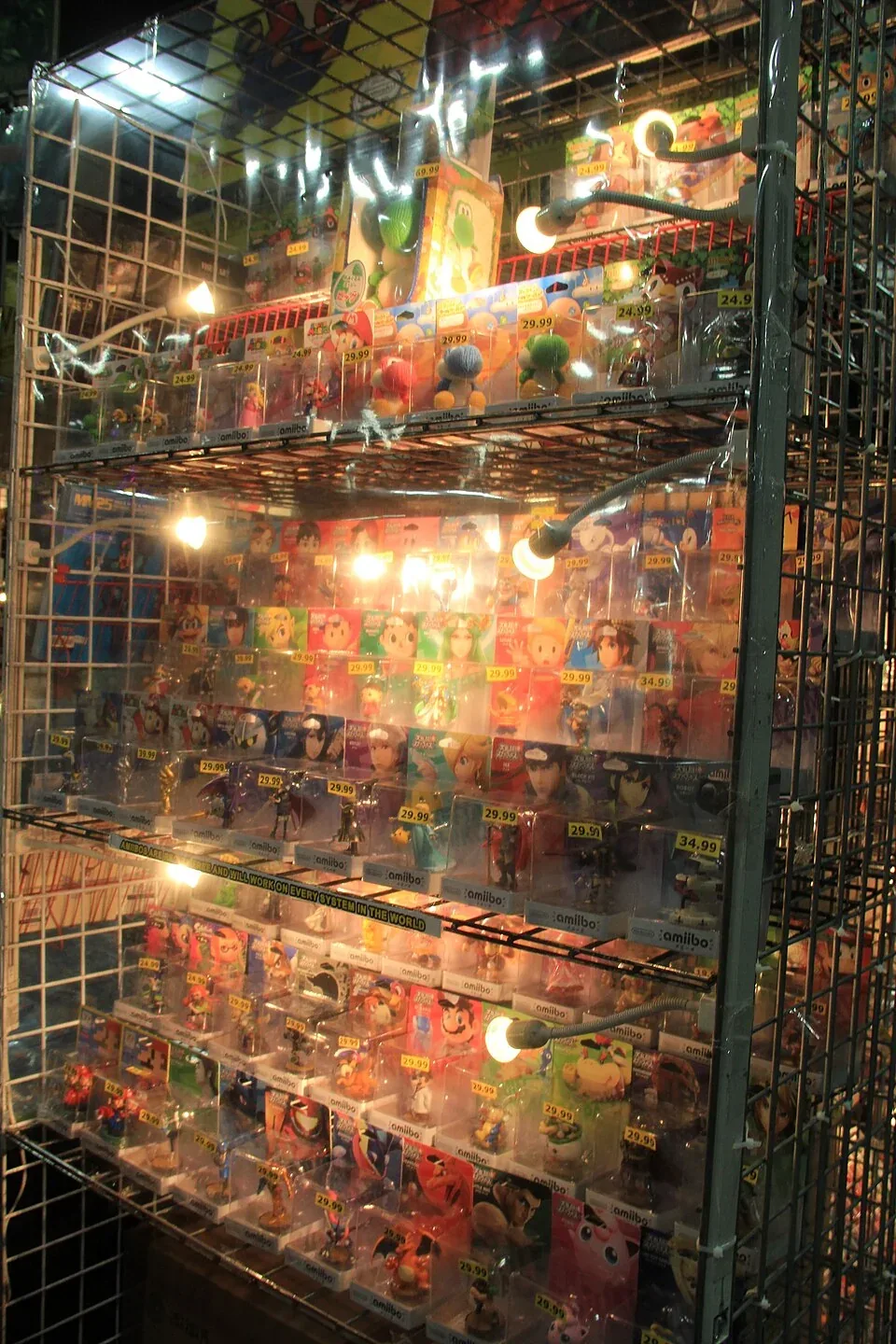
The iDisplayit 12-figure case describes three tiers with circular cutouts. It lists internal L32 × W21 × H16 cm and external L34 × W23 × H17 cm.
The main description does not give the accepted base diameter, cutout dimensions or clear height above each tier. The 16 cm whole-interior height therefore cannot be assigned to every figure on the raised levels. Request the position geometry for your actual selection.
Map each figure to a position with its full pose included. Check a projecting sword, wing, hair shape or other feature against both the cover and its neighbours. A base entering a cutout answers only part of the fit question.
Check the viewing order before treating an occupied rear position as useful capacity. A figure that fits physically can still lose its main detail behind a front-row pose. Leave a position empty or change the group when the intended view and retrieval route cannot both be maintained.
Guardian and regular shelves have different descriptions
SuperheroDIY’s individual shelves distinguish regular, Bigger – 1 inch out and Guardian – 3 inches out variants. The regular shelf is listed as W2 × L2.25 × H2 in. These are support dimensions, not a stated universal receiving-circle size.
The Guardian wording also describes about 2 inches from the wall to the back edge of the base. That is a different reference from the variant’s “3 inches out” label. Ask how each distance is measured rather than converting either phrase into clearance behind every figure.
The page describes an included Command strip for the regular arrangement, while the Guardian version ships with a mounting screw. Keep that distinction in the order and installation record. Do not assume every variant has the same fixing or that an adhesive description promises damage-free removal from your wall.
Before arranging several shelves, confirm the complete projection and prescribed fixing for each selected support. Use the collection wall planning guide for the separate task of arranging their finished footprints.
Give a frequently used figure a repeatable route
Nintendo’s Super Mario Odyssey instructions describe touching a compatible amiibo to the controller’s NFC touchpoint. That provides a practical reason to plan access; it does not establish that an arbitrary case, package or fitted shelf permits scanning through it.
For a figure you use, follow the instructions for your actual game and controller. Choose a display whose prescribed removal sequence suits that use, and keep a clear place for the figure to return. Avoid a layout that requires moving several unrelated figures whenever one is needed.
For a collection retained carded, keep that preference explicit. Display planning should not require opening the package to satisfy a gameplay assumption. A display-only group and a regularly used loose group can have separate positions and records.
Use the blank amiibo receiving and access worksheet to keep cardback rails, cutout geometry, shelf variant, fixing and game reference together. The collection measurement guide covers recording the complete supported outline.
Common questions
Will a circular base fit any circular cutout?
Check the exact base and receiving dimensions, then the full figure above it. Shape, projection, local headroom and removal still matter.
Can I scan a figure without taking it out?
This guide has not tested through-case scanning. Use the relevant Nintendo instructions and plan suitable removal rather than relying on an enclosure’s transparent appearance.
Are the published dimensions physical test results?
They are attributed product descriptions with their stated limits. No case fit, fixing performance or NFC behaviour was tested by DisplayCasePro.
Comments
Share a display tip or ask a question.