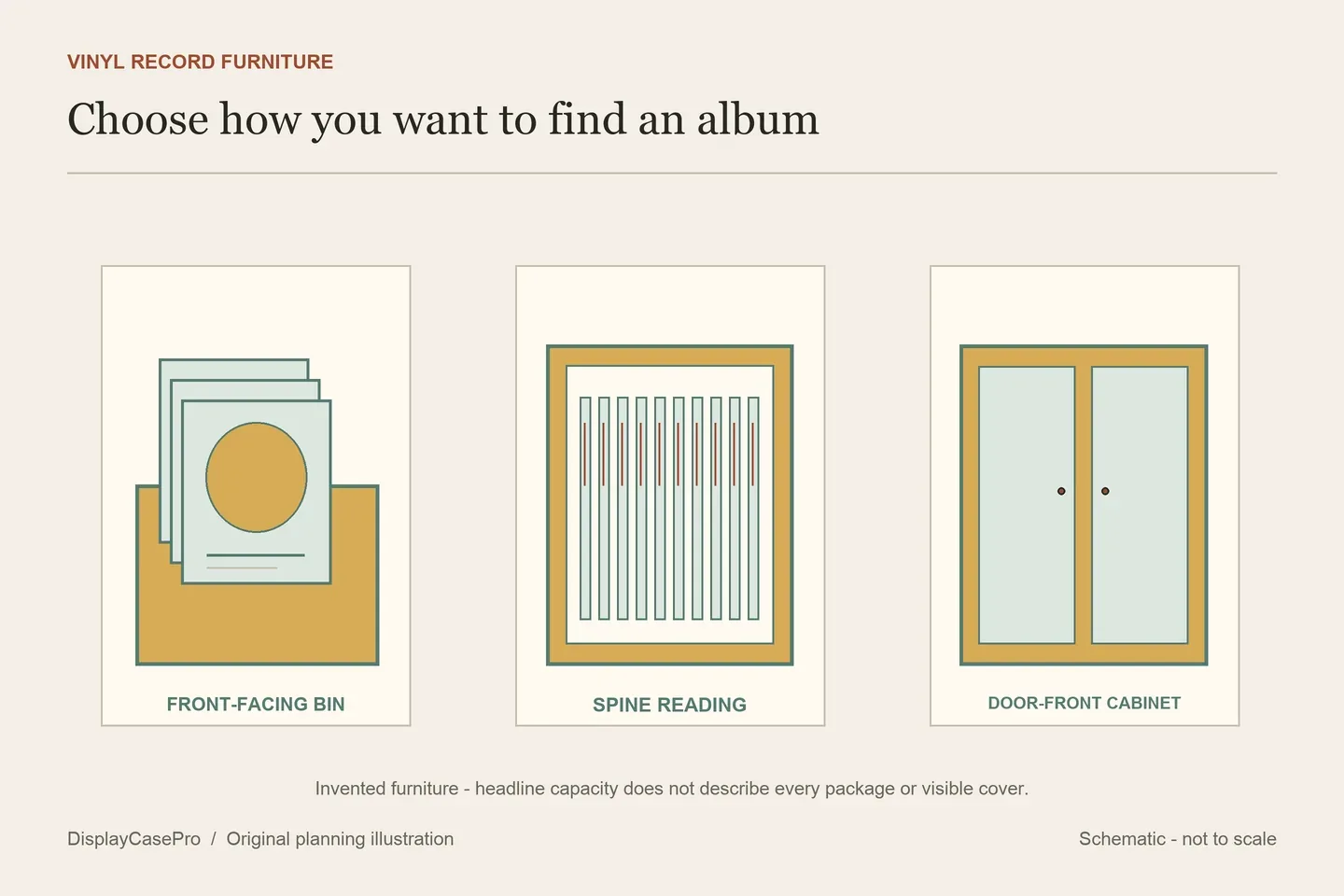
Choose a vinyl record display cabinet by deciding how you want to find an album: browse front-facing covers, read spines in upright rows or open a cabinet or drawer. Then check the complete jacket package, each storage area's dimensions and its own load limit. A headline LP count does not describe every edition or how many covers remain visible.
Choose front-facing browsing or spine reading deliberately
| Format | What you see | Access to check |
|---|---|---|
| Front-facing flip bins | The foremost covers and any selected cover-art display, with more records behind. | Room to browse and lift complete jackets past the bin front and dividers. |
| Upright shelf rows | Mostly spines, with covers revealed when an album is removed. | Full package height and depth, suitable support and space to retrieve one album. |
| Pull-out drawers | The furniture front when closed and the collection when opened. | Full drawer travel, assigned loading limits and the intended retrieval position. |
| Door-front media cabinet | The doors or selected open areas, with records accessible inside. | Door swing, usable compartments, dividers and any equipment or cable space. |
The Crosley Media Stands category includes cabinets, cube arrangements and record-player stands. Their shared category does not establish identical interiors, doors or shelf ratings. Choose a particular model before assigning your collection to its compartments.
Sidetracked Workshop's catalogue likewise includes flip-bin consoles, tiered units and a drawer cabinet. A drawer capacity and an open display count describe different ways to reach the collection. Choose the browsing routine you want before a finish or furniture silhouette.
Measure sleeves, gatefolds and box sets as complete packages
Keep an outer sleeve in the measurement if it will remain on the album. Separate ordinary single jackets, thicker gatefolds and box sets rather than assigning each release one identical slot. Record the shelf length occupied by the actual packages and their combined weight.
A count based on standard single records cannot establish the same capacity for bulky editions. A box set can also change the required height or depth. Keep unusual packages assigned to an identified bay instead of assuming every compartment can receive them.
The Emily Henderson storage roundup by Caitlin Higgins organizes furniture into small, medium and large collection options. Its personal experience and average size/weight estimates provide context for that article, not a load assessment of your collection. Use the actual cabinet ratings and your complete packages rather than copying those averages into a packing plan.
For upright shelf rows, decide which spines must be readable and how records stay supported as the row becomes less full. For front-facing bins, keep the cover chosen for the front linked to the records behind it. A bin containing many albums shows only a limited selection of complete faces at once.
Four products supply different kinds of capacity information
These examples were read on 17 October 2026. They retain the makers' dimension definitions and nominal capacities. They are not physical tests, structural certifications or a ranking.
| Furniture | Published description | Question before assigning records |
|---|---|---|
| LPBIN2 base cabinet | Cabinet dimension line D28¼ × W28½ × H48 in at the back; explicitly inside bins/shelf W27 × D13 in. About 450 records, based on standard 12 in singles in cardboard sleeves. | Confirm the actual package mix, clear height and layout. The optional bottom-shelf adapter changes that shelf into another front-facing bin. |
| Sidetracked Walnut Headliner | Total W45¾ × H29½ × D14¼ in; approximately 300 single LPs, with 70 in the flip bin. | Separate the flip-bin portion from the complete capacity. Obtain the actual package and load limits for each assigned area. |
| Symbol Luxe 2-Bay Record Stand | Overall W28 × D18½ × H50½ in; up to 260 LPs, with upper cover-art display and deeper storage below. | Confirm the split of storage positions and selected covers, actual package clearance and supported loading. |
| Crosley Nora CF1201-WA | Up to 280 records; feature text gives 30 albums/15 lb per section and 100 records/50 lb on the center shelf. | Obtain a numbered compartment/load map. Separate feature text also lists three adjustable shelves at 15 lb each; do not assign one rating to the whole interior. |
LPBIN2 explains its counting basis and says total capacity varies with the collection. Its stated 5 ft 10 in row capacity can help frame a comparison with your measured collection, but should not be read as 450 arbitrary packages. Confirm the clear receiving space for oversized editions.
The LPBIN homepage presents front-facing formats; the specific LPBIN2 page identifies its base cabinet and optional adapter separately. Do not assume a photograph showing a converted lower bin describes the contents of the base order.
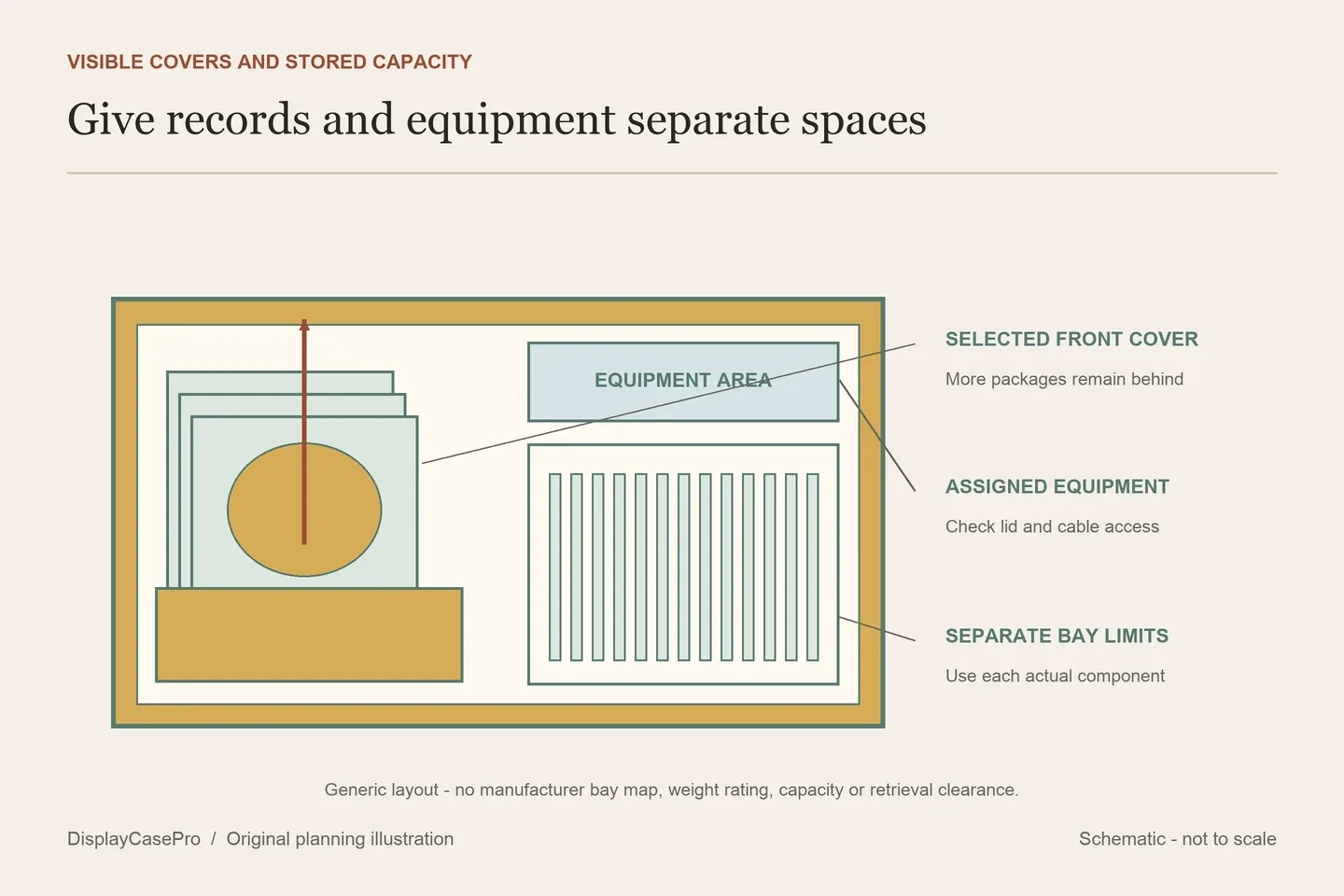
Headliner's top turntable platform is listed as W31½ × D14¼ in. Its upper equipment shelf is W30 × H9 × D13½ in. Keep that equipment area distinct from a full-height LP bay instead of treating every visible shelf as another share of the record capacity.
The Luxe family page contains broad wording about up to 700 records alongside specific 2-, 3- and 4-bay figures of 260, 390 and 520. Use the exact selected product's specification and ask which configuration the broader statement describes. The 2-bay product itself gives up to 260.
A record count and a weight limit must both suit the arrangement
Nora's feature text names several different ratings: 15 lb for each section, 50 lb for the center shelf, 15 lb for each of three adjustable shelves and 100 lb for the top surface. Keep the rating attached to its actual component. The top's rating cannot be transferred to a shelf inside the cabinet.
Ask the maker to map the section and shelf descriptions to a labelled layout before packing. Do not reconstruct the 280-record headline from an assumed number of spaces around four removable dividers, or add unrelated weight limits together as a loading instruction.
The Library of Congress audio-visual guidance calls for upright storage and sturdy shelving suitable for these concentrated loads. It also emphasizes support for sleeved grooved discs. Those principles do not certify a commercial cabinet or make a general weight average the load rating of your shelf.
Follow the actual furniture assembly, loading and installation instructions. Claims such as no sagging, heavy-duty materials or furniture engineered for records are not substitutes for the receiving dimensions and component limits needed for your own arrangement.
Leave room to retrieve jackets and operate the audio equipment
A front-facing bin needs access above its front and beside any divider. A shelf row needs a route for a complete jacket to leave without scraping neighboring packages. For drawers and doors, check the opening in the actual room rather than the closed furniture footprint alone.
Give the turntable a separate equipment record: full base, any cover or lid movement, cable connections and the maker's operating requirements. A top platform's published rectangle does not establish room for every lid position, and an equipment shelf advertised for most receivers still needs the actual unit checked.
Keep heat, light and vibration in the placement decision. The Library of Congress guidance discusses distance from heat and vibration sources and minimal exposure to intense light. A door, a clear cover or a UV claim should not become a promise that every position in the room is suitable.
Use the blank record-cabinet capacity worksheet to keep package groups, occupied row length, actual weight, bay definitions, equipment and unresolved limits together. The collection measurement guide covers the basic outline record, while the display lighting guide covers the separate reflection and access plan.
Common questions
Does a 300-record cabinet show 300 covers?
Its capacity can include albums behind other albums or in spine-facing rows. The cited Headliner states a 70-record flip-bin portion within its approximately 300-single-LP total; that is not 300 continuously visible cover faces.
Will a nominal LP count apply to gatefolds and box sets?
Check the counting basis and your actual packages. A capacity based on single records in cardboard sleeves can change substantially with a different collection.
Can the turntable platform rating be used for the shelves?
Use each component's own rating and the maker's actual layout. A furniture top, center shelf and adjustable shelf can have different limits.
Comments
Share a display tip or ask a question.