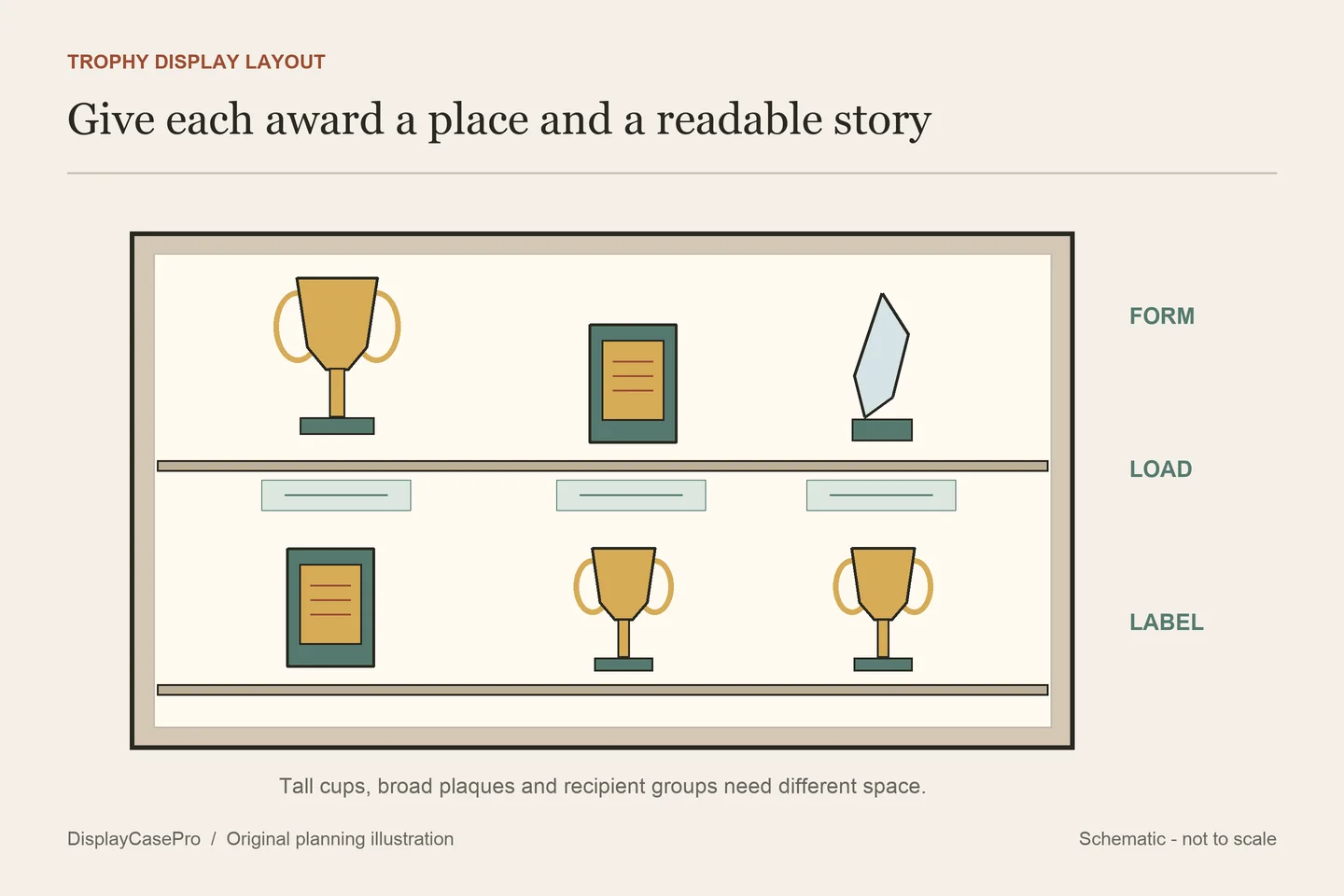
Useful trophy display case ideas start with the awards' shapes: give a tall cup its own clear height, keep smaller awards visible beside it, and group the collection by the person, season or achievement it represents. Choose a layout that lets you read the nameplates and lift each trophy out by a sound, supported part.
A tower cabinet, a wide case and a single covered pedestal solve different problems. Before selecting one, make an inventory of the awards you actually want to show. A shelf full of lightweight participation trophies is a different load and arrangement from a few substantial crystal cups.
Five trophy display case ideas to try
1. One featured trophy in a dedicated space
Give one award a shelf or a suitable individual case, with its identifying information visible beside or below it. This works when the trophy's outline is distinctive or the achievement needs a little explanation. A broad-handled cup can look crowded even when its base fits neatly inside the case.
Mark the full outline, including handles, lid and finial, before choosing the enclosure. Allow for the way its cover lifts off or its door opens. An individual display is a useful composition choice, but the word “pedestal” does not establish its load rating, stability or protection.
2. Tall and short awards on separate levels
Place taller awards where the shelf above does not cut across their tops. Use a different level for compact trophies and small plaques so their inscriptions do not disappear behind the tall row. Arrange the group on paper before moving shelf fittings.
If the back row needs elevation, investigate a properly specified riser. Include the riser's weight, support footprint and height in the plan. Raising a trophy also raises its top and changes its support arrangement; it is not a way to add capacity to a shelf.
3. A separate bay for each person or team
Use one area for each recipient or team, with a small identifying caption. This makes a shared family or club collection easier to follow. Keep the nameplates facing the viewer, and choose a repeatable caption style instead of relying only on trophy color.
The bays do not have to contain equal numbers. One person may have a tall cup and another several smaller awards. Balance the visual space while keeping the physical supports appropriate. Leave a little expansion room if new awards arrive each season.
4. Cups, plaques and sculptural awards in different groups
Group by form when the awards vary too much for a uniform row. A plaque can sit in a suitable stand, a cup needs its entire base supported, and a trophy with projecting figures needs space around those details. Use the groups to reveal differences rather than force every object into the same position.
Keep the groups connected with a common label format or one repeated background color. Avoid leaning a plaque against a cup to make it stand. Each object should remain supported when its neighbor is removed.
5. A current highlight with a rotating history
Choose one part of the case for recent achievements and another for a smaller selection from earlier years. Keep a photographed inventory of awards stored elsewhere. Rotation lets a modest case tell a clear story without treating every available gap as permanent display space.
Write the rotation date and shelf position in the inventory. Check whether a replacement award has a different height, base or weight before putting it in the old position. A space that worked for a small resin trophy may not suit a crystal replacement.
Record actual sizes and weights, not just trophy counts
Measure the widest and deepest projections as well as the height. The base footprint is a separate measurement: cup handles may extend beyond a relatively narrow base. Include any permanent plinth, lid or attached figure. Use our collection measurement guide for the full object, opening and handling-space checks.
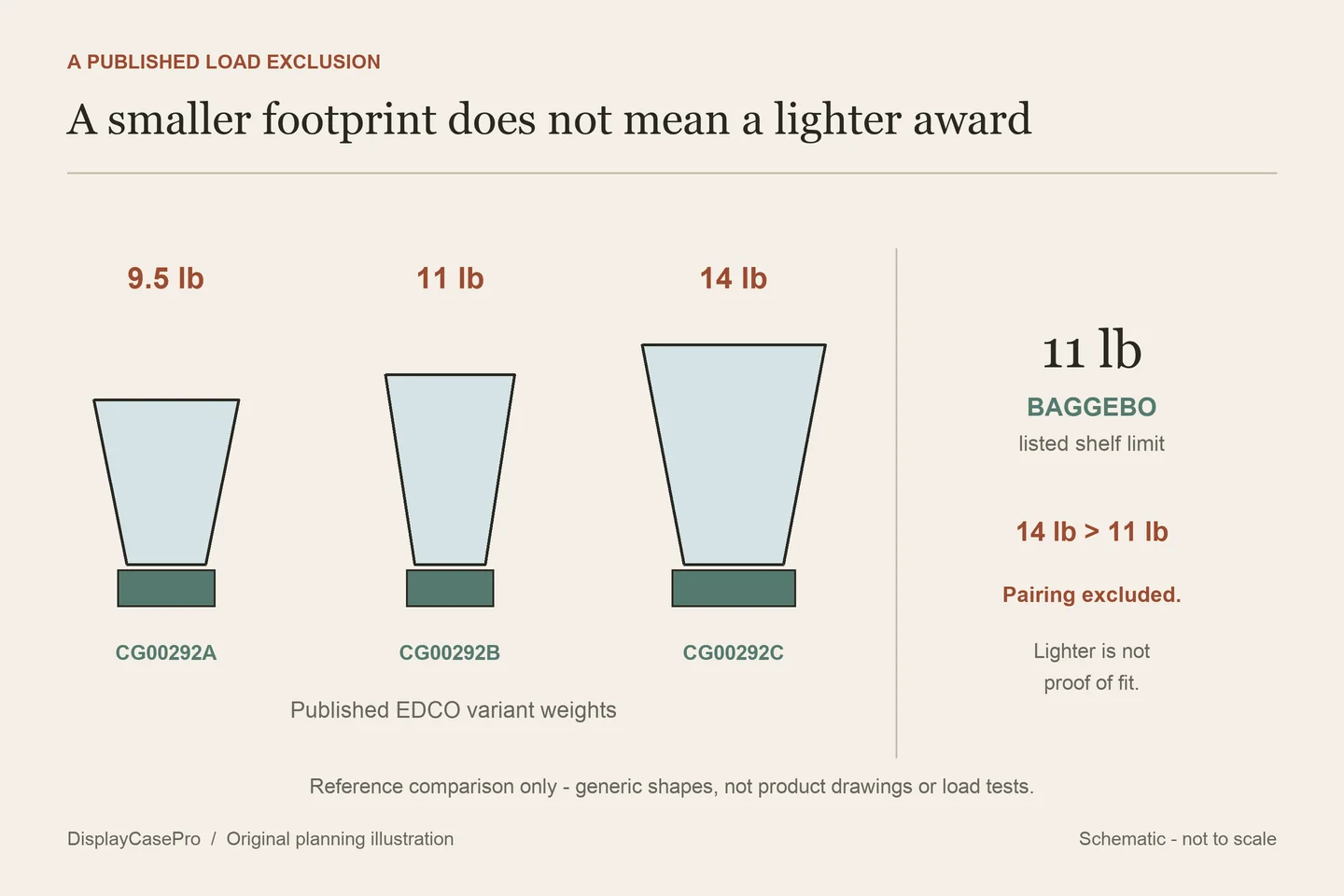
A published example shows why one “trophy shelf” allowance is unreliable. EDCO's Foremost Crystal Trophy Cup listing gives the following specifications for three variants. These are the maker's listed figures, not our measurements, and should be reconfirmed for the item supplied.
| Variant | Listed height × width × depth | Listed weight |
|---|---|---|
| CG00292A | 10.75 × 5.5 × 3 inches | 9.5 lb |
| CG00292B | 12 × 4.5 × 4.5 inches | 11 lb |
| CG00292C | 13.5 × 7.75 × 5 inches | 14 lb |
The variants do not expand equally in every direction. A taller version can also change the required depth, base arrangement and shelf load. Do not select a cabinet by height alone or estimate weight from the number of awards in a photograph.
Check the shelf limit and the complete support arrangement
Read the exact cabinet's documentation, including shelf load, fittings, permitted load placement and required anchoring. Include trophies, stands, risers and other contents in the planned load. A replacement shelf or homemade riser needs its own appropriate specification.
For a concrete comparison, the U.S. IKEA BAGGEBO 805.029.98 listing states an 11 lb maximum load per shelf and required anchoring. The 14 lb EDCO variant above exceeds that shelf figure on its own. This rules out that pairing; it does not establish that a lighter trophy fits, has suitable load placement or can be safely displayed there.
Keep an award's base fully on its intended support. Do not bridge it across an opening or balance it partly on a shelf edge to gain a little extra depth. A riser should have an adequate supporting surface for the actual base, not merely enough height to reveal the nameplate.
Arrange heavy or difficult-to-handle pieces where the cabinet's instructions and a practical lifting route permit. Do not add a floating shelf or wall bracket based on a generic claim that it holds “several trophies.” The wall, fixings, bracket geometry and actual loaded weight form a separate installation decision.
Make the nameplates and the story readable
Look at the case through closed doors from the usual viewing position. Can you read the recipient and event without crouching or moving another award? A wide door rail can obscure a low nameplate even when the cup above it is easy to see.
Use a separate caption when the original inscription is small. Record the verified recipient, event and year; mark any uncertain identification in the private inventory. Do not alter an original plate just to make it match the rest of the display.
A team photograph or copied programme can add context if it has a separate support and does not obscure the awards. Keep longer stories in an album or connected record. If lighting reflections hide the inscription, check the viewing angle before adding more brightness; our cabinet lighting guide covers visibility and reflection planning.
Leave room to handle the award, not only to fit it
Plan a clear removal path for the largest or most awkward trophy. Allow room to support it during lifting, and set up a suitable receiving surface before opening the case. Decorative handles, attached figures and removable lids are not automatically suitable lifting points.
Check the loading opening separately from the interior. A broad cup might fit between the side walls but be difficult to pass through a narrower door. Avoid a layout that requires tipping a fragile object sharply to clear the shelf above.
Choose maintenance according to the award's actual materials and finish. Mixed metal, resin, crystal, wood and applied lettering do not share one polishing method. Follow the appropriate maker's care information and assess damaged or historic pieces separately.
Use the trophy layout and load worksheet to record each award, its base, its weight and its intended position. Keep a photograph of the final arrangement with the inventory so future changes can be checked against a known plan.
Common questions
Should the tallest trophy always go in the middle?
No. A central feature can work, but shelf height, door rails and access may favor another position. Try the complete silhouette on a paper shelf plan and check the view through the doors.
How many trophies can one shelf hold?
A count alone cannot answer that. Compare the actual combined load and its placement with the exact shelf's documented requirements, then check the objects' footprints, height and handling space.
Can I combine trophies and medals?
Yes, with separate suitable supports and clear grouping. Do not drape ribbons where a trophy can trap or pull them. A dedicated medal panel may make a mixed collection easier to understand and maintain.
Comments
Share a display tip or ask a question.