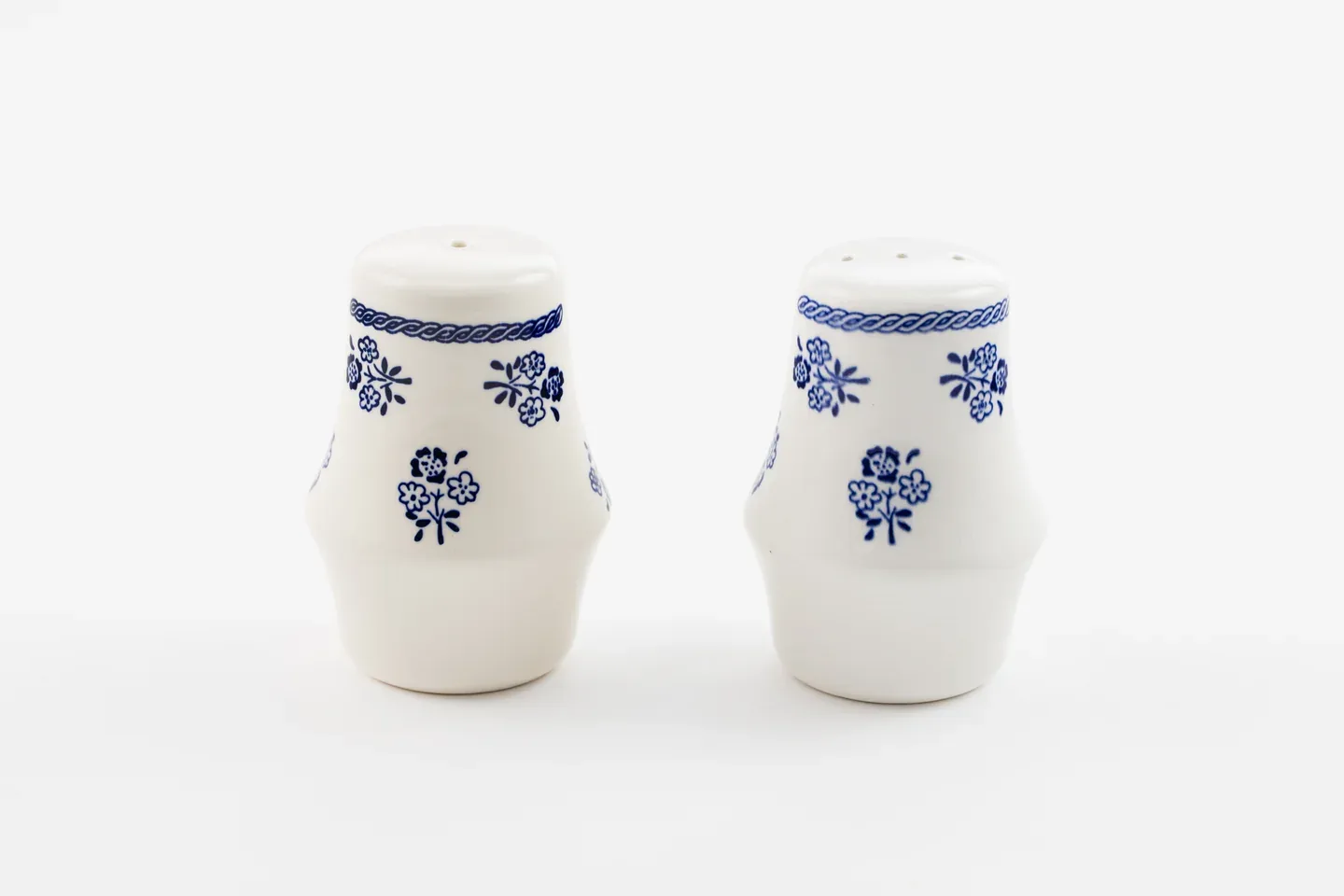
Plan a salt and pepper shaker display case around documented pairs, individual pieces and any retained tray. Give each group a readable position before counting shelves or compartments. An open kitchen shelf, a glazed showcase and a cabinet sold in a Pepper Shaker style need different questions about the actual objects they will receive.
Record the association before making every row symmetrical
Give a documented pair one group identifier and each member a separate identifier. Copy the markings and existing collection information into the record. If a piece is unmarked or its companion is uncertain, preserve that uncertainty instead of creating a matching pair from color alone.
A tray, stand or original package belongs on another line within the same group. Record whether it is normally retained in the display and how the pieces are intended to be supported. A tray’s apparent outline does not establish that it is appropriate to lift the whole group by it.
Cracker Barrel’s shaker category illustrates the distinction between a single miniature shaker card and a product explicitly named as a set. The inspected first page contains fifty cards out of a stated hundred. A card count therefore does not establish the number of matched pairs or the number of case positions needed.
A pair occupies two real outlines, not one repeated diameter
| Group | Record the actual arrangement | Keep available |
|---|---|---|
| Documented pair | Two identified pieces, their intended faces and full projections. | A clear approach to each member. |
| Pair with retained tray | Both pieces plus the complete tray and any separate supports. | The selected handling and return sequence. |
| Unmatched single | Its own identity and documented status. | A readable caption without an invented companion. |
| Changing selection | The groups staying on show and those being rotated. | A record linking every moved member to its group. |
Use paper outlines or existing collection photographs to choose positions. A tall figurative shaker and its shorter companion can occupy different heights and widths. Do not turn one measurement into two identical positions merely because the catalogue treats them as a pair.
Keep groups visually connected without pressing the objects together. Repeated label placement or a shared group caption can establish the relationship. If the intended arrangement hides one member behind another, reduce the row or move the whole group on the paper plan.
Choose the enclosure after choosing the groups
The sources below were read on 18 October 2026. They describe different formats, without a physical collection-fit, mounting or shelf-load test by DisplayCasePro.
| Format | What the source supplies | What to establish |
|---|---|---|
| Existing open shelf | A personal shelf account presents a row on a removable board. | Complete shelf limits, independent supports and access for your own groups. |
| Adjustable glazed showcase | Peter Pepper lists several glass showcase families with adjustable shelves and locking doors. | The exact family, usable shelf, clear opening and selected door system. |
| Individual pair cover | A proposed way to enclose one supported group. | Actual pair-and-tray profile, finished cavity and opening; no fixed universal size. |
The Salt & Pepper Shelf account uses an existing removable pine-board shelf for a personal collection. It provides a composition example, rather than a ready-made enclosing case or a load assessment for another kitchen. Keep the author’s particular installation separate from your furniture instructions.
Peter Pepper’s display-case category separates elliptical, quarter-round, circular and wall-mounted families. Its nine-inch depth statement belongs to the elliptical-profile line and is not labelled as clear usable shelf depth. The wall-series descriptions name sliding doors; do not transfer that opening method to every other family.
Obtain the selected showcase’s own shelf dimensions and loading information. Ask where glass rails, frames or fittings reduce the receiving area and door opening. An adjustable shelf gives a layout choice, without specifying how many irregular pairs fit on it.
There is also a naming trap: Cabinet Giant’s Pepper Shaker collection is a kitchen cabinet style. Its wall-unit dimensions are not specifications for individual salt-and-pepper display bays. Confirm the actual furniture and its display construction before comparing those numbers.
Check the paired view through the closed front
Mark where the selected cabinet’s rails and door edges cross the paper layout. Look from the usual seated or standing position. A small figure’s face or a painted motif can disappear behind a frame while its companion remains visible; adjust the group as a whole where the receiving arrangement permits.
Choose whether the important view is the pair’s combined scene, separate markings or a retained tray. A photograph of another collection can suggest a composition, but it does not establish the support or spacing for your pieces. Keep the objects’ existing condition and any uncertain repair in the enquiry.
Use a short group caption beside the outlines. Put longer documented history in the catalogue so a crowded label does not force objects into the shelf edge or door route. The display lighting guide covers the separate viewing and reflection task once those positions are resolved.
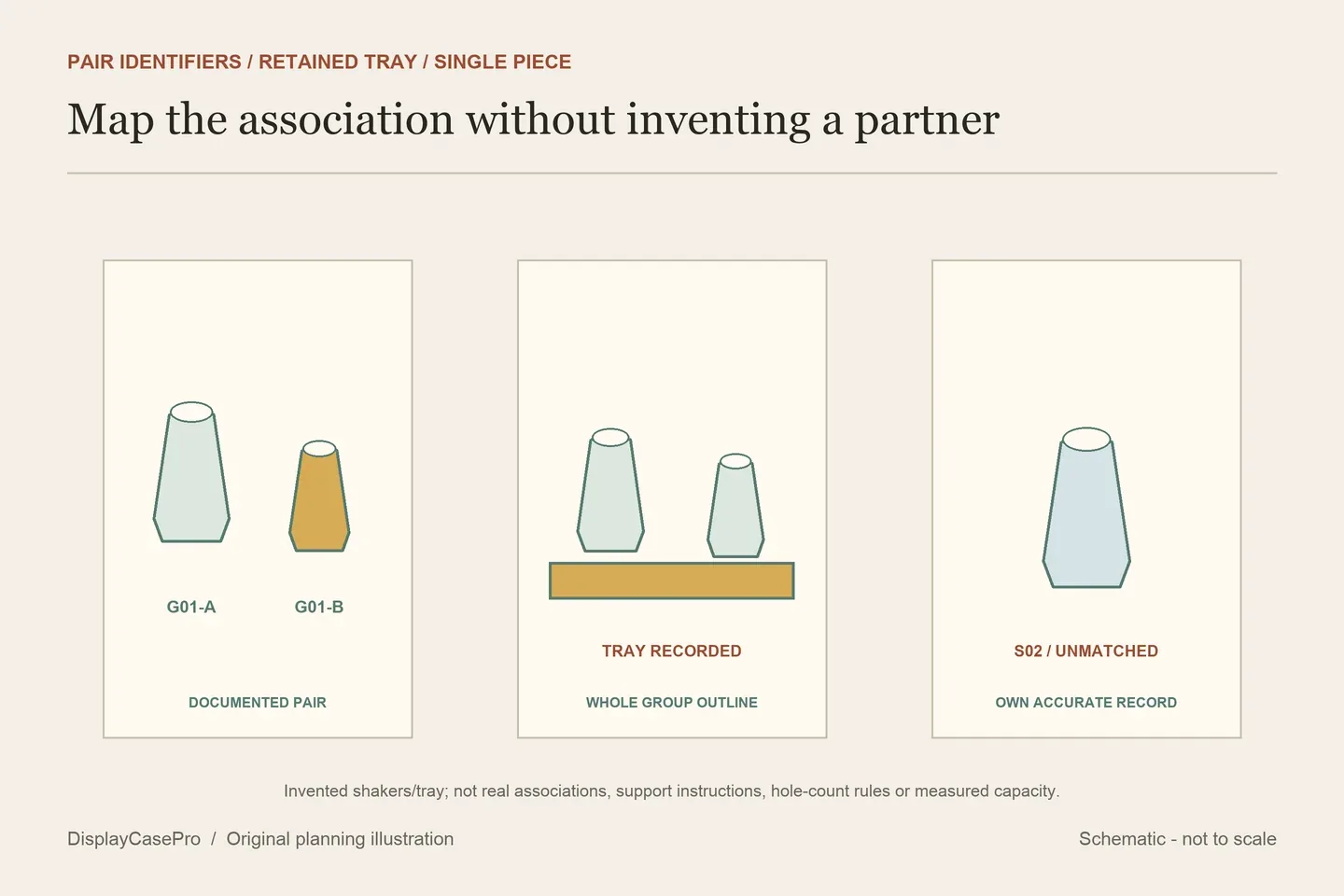
One member needs a route out without losing its group
Plan how each selected piece is approached, supported and returned under its own appropriate handling guidance. If reaching a rear member requires moving several unrelated pairs, change the proposed row before adding another riser. An open door is only one part of access.
Keep regularly used table pieces distinguishable from a display-only selection. Record which member leaves and where it returns, including any separately retained stopper or package already associated with it. This plan does not prescribe opening, cleaning, refilling or restoring old pieces.
Cover photograph: Collection of Auckland Museum Tamaki Paenga Hira, 2014.19.187, CC BY 4.0. Whole composition retained, proportionally resized and compressed to WebP. The two cream-colored, blue-floral objects illustrate a recorded museum group; they do not establish a general hole-count rule, case fit or approval of a display support.

Use the shaker pair, tray and position worksheet with the collection measurement guide to keep member identifiers, complete outlines, the selected enclosure and unresolved opening questions together.
Common questions
Does a case with fifty spaces hold fifty pairs?
Check what one position means and record both members and any retained tray. Nominal spaces do not measure every pair’s supported outline.
Must an unmatched single be given a companion?
Keep its documented status. A clear individual record is more useful than an invented pairing made only to fill a symmetrical row.
Comments
Share a display tip or ask a question.