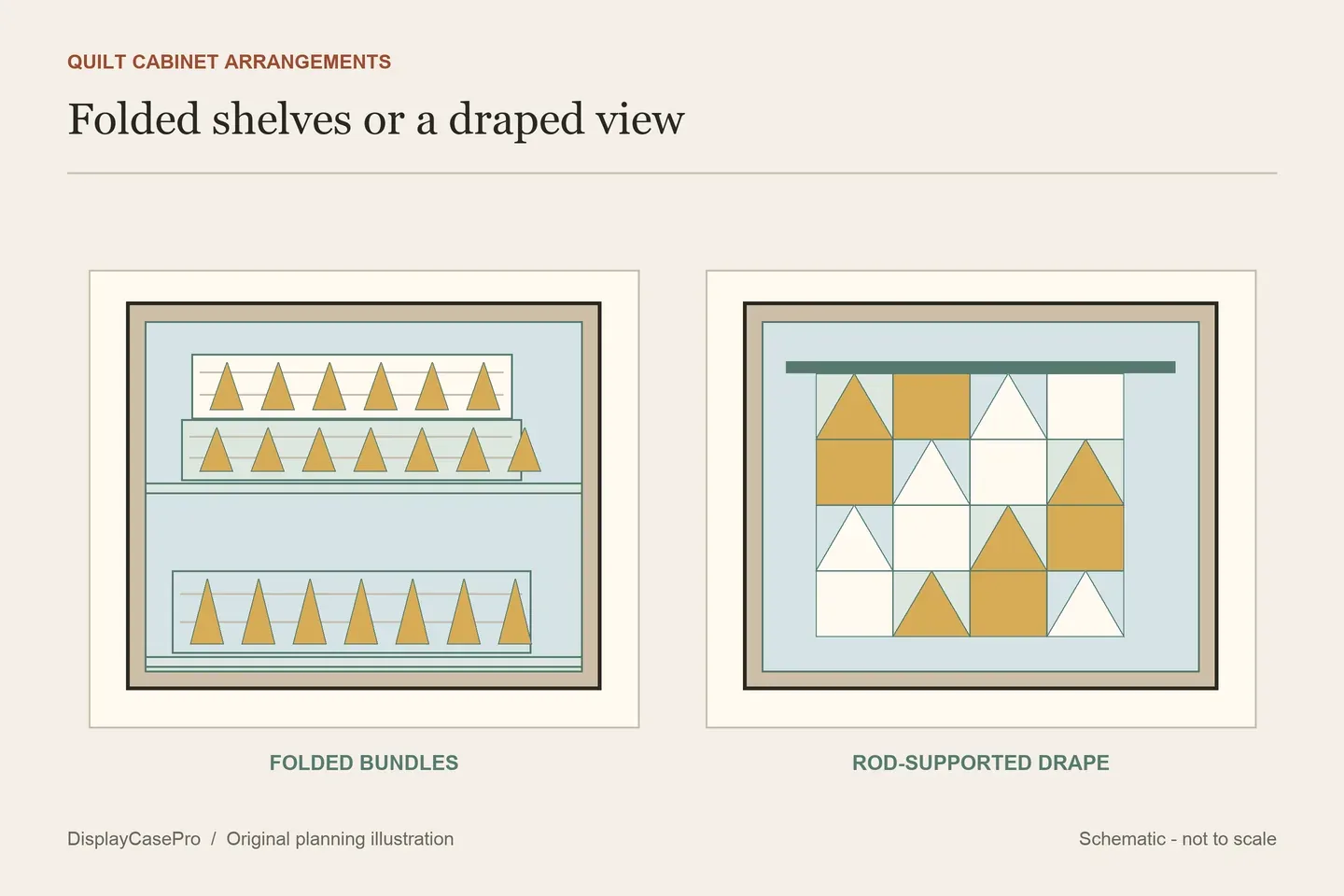
Plan a quilt display cabinet around either a complete folded bundle on a shelf or a supported drape over a rod. Measure that actual arrangement, including cushioned folds, rather than choosing from the quilt's bed-size name. Shelf space, rod spacing, hanging drop and the way the cabinet opens are separate checks.
Decide what the cabinet should make visible
A working collection of quilts used on beds needs convenient retrieval. A special family quilt may instead need a carefully limited display and a separate storage arrangement. Make that distinction before deciding how many bundles to pack behind glass.
Choose the detail you want to see: a broad section of the pattern, several coordinating folded edges, an appliquéd center or a documented label. A narrow fold can be attractive yet hide the very design that makes a quilt meaningful. Use existing photographs to compare presentations before handling a delicate piece.
Record the quilt's documented materials and condition, including raised embellishments or fragile areas. A newly made everyday quilt and an old silk quilt should not inherit the same folding or hanging plan simply because their dimensions are similar. For a fragile or historically important piece, discuss the display with a textile conservator.
| Arrangement | What it shows well | What needs checking |
|---|---|---|
| Folded bundles on shelves | A readable selection of patterns or edges, with quilts kept individually identifiable. | Actual folded width, depth and thickness; contact lining; shelf spacing and retrieval. |
| Draped quilts on rods | A broader hanging section of selected quilts. | Rod direction, usable length, spacing, supported fold and clear drop beneath it. |
| Glass-front display table or top-opening cabinet | A low display that can reveal different faces of the arrangement. | Usable interior and how the top is opened and kept clear during access. |
Build the shelf plan from the folded bundle
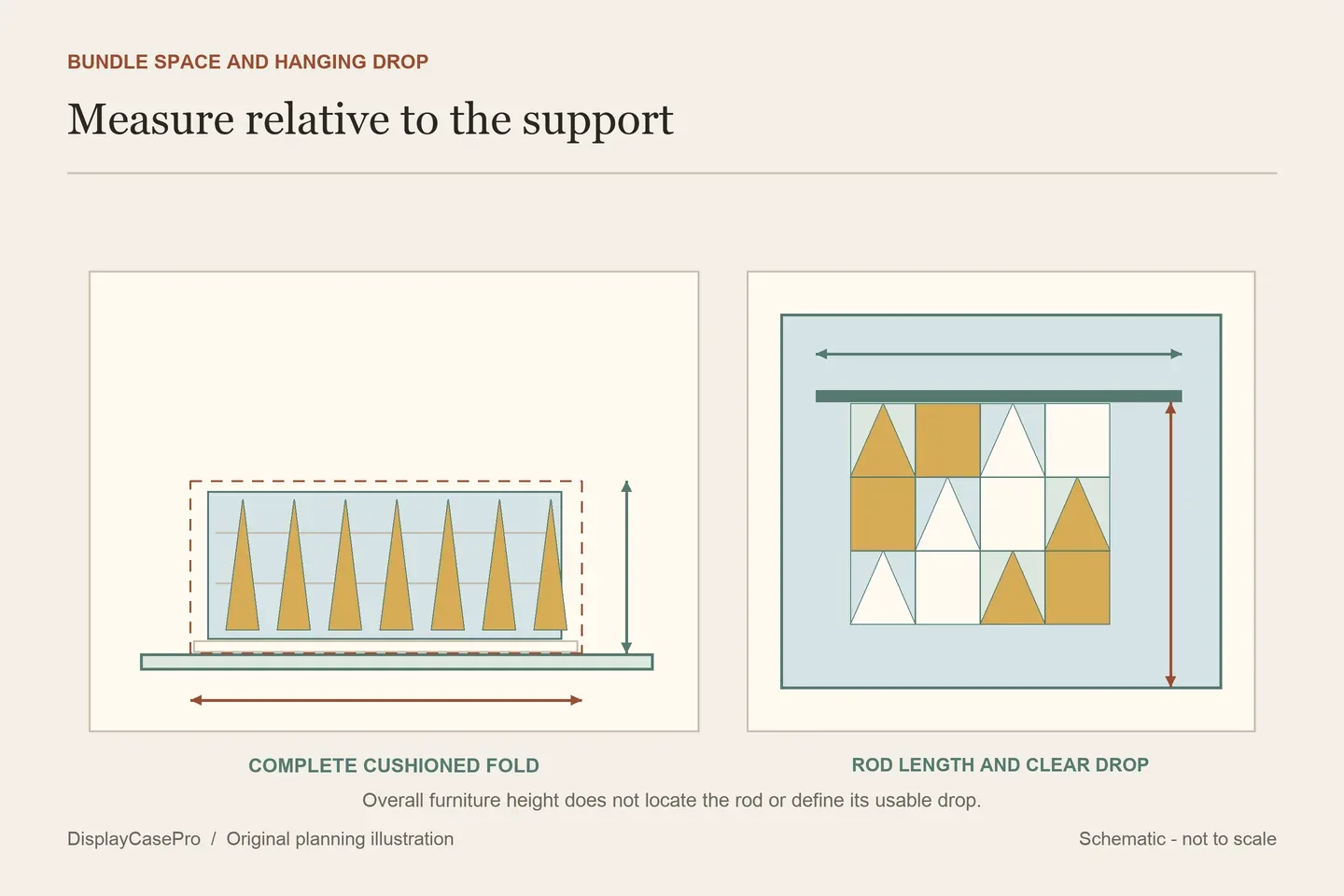
For a quilt suitable for folding, record the dimensions of its intended supported fold. Include the cushioning and any thickness from seams, binding or embellishment. Do not compress the bundle against a shelf above it merely to satisfy a furniture dimension.
A simple paper footprint helps allocate shelf positions without repeatedly rearranging the quilts. Give each bundle its own location and check the shelf's usable depth behind the closed door. A projecting fold can conflict with the door even when the shelf board itself looks deep enough.
The International Quilt Museum's at-home guidance recommends flat storage where possible. When folding is necessary, it advises cushioning folds with acid-free tissue or muslin and refolding periodically. It also recommends a suitable barrier between textiles and wood. Include that contact arrangement in the bundle measurement rather than treating it as a later decorative layer.
Keep frequently used quilts reachable without lifting a tightly packed stack above them. A single low stack may work differently from several separate shelves; assess the actual quilt weights and the furniture maker's load instructions. A total cabinet capacity does not automatically describe what one adjustable shelf can carry.
If a planned position requires a tighter fold than is appropriate for the quilt, reconsider the shelf arrangement or the furniture. An unused quilt can remain separately housed while a smaller selection is displayed. Filling every visible space is not a requirement.
Check rod direction, spacing and the drop below it
A rod parallel to the front and a rod running from front to back present different parts of a folded quilt. Draw the direction on a plan view. Then identify the face of the pattern you want toward the viewer and how neighboring quilts will overlap.
Ask for the rod's usable length between supports, spacing to other rods and panels, and the clear distance beneath the intended resting point. The quilt's folded thickness occupies space around the rod, so a count of two or three bars is not a reliable quilt capacity.
Overall furniture height includes the base, top and sometimes legs. Even a published interior height does not locate the rod. A maker's drawing showing the rod positions is more useful than assuming that the full interior height is available below one.
Compare what the cabinet's figures actually describe
Two DutchCrafters quilt cabinets illustrate why a taller name or silhouette does not resolve all of the useful space. These are published maker specifications, not our measurements or tests with quilts.
| Quilt cabinet | Published dimensions and bars | Still ask for |
|---|---|---|
| Medium Quilt Curio, product 53139 | Outside 27 W × 14½ D × 32½ H in; inside 24 W × 13 D × 24 H in. Two quilt bars, with an optional extra bar. | Rod locations, clear drop beneath them, spacing, loading and access instructions. |
| Large Queen Anne Quilt Case, product 3105 | Outside width 27½ in; inside width 24 in; listed depth 15 in and overall height 56 in. Two bars, with an optional extra bar. | Full inside depth and height, rod-relative clearances and the usable opening. |
Both specify a 24-inch inside width. The taller model should therefore not be assumed wider inside because its title says “Large.” Its 56-inch height is not a 56-inch hanging drop. Nor does adding another bar establish another suitable quilt position without checking bulk and spacing.
Keep the selected options attached to the enquiry. Different glazing or an additional bar can change what is included; confirm the exact configuration and its instructions. Product photographs may show wood, finish or options other than those selected.
Choose a cabinet you can actually open in place
Front access for shelf retrieval
Check the clear doorway as well as the interior. A folded quilt may fit on the shelf but be awkward to support through a narrow opening. Make room to receive the bundle without resting it on a door edge or dragging it past its neighbors.
Leave the shelves and their intended supports in the arrangement approved by the furniture maker. A photograph of a heavily modified cabinet is not permission to remove structural parts or add shelves to another model.
Top access for a lower display
In Treeline Quilting's personal cabinet project, Nicole describes an approximately 72 W × 42 H × 25 D-inch cabinet with five lengthwise rods and a top-opening work surface. She explains changing rod direction to reveal more quilt pattern. This is a useful example of making visibility and access part of the design.
It does not supply a tested capacity for your quilts. The article also discusses changes to the heavy lid's hinge arrangement; those construction details are not a universal cabinet-building instruction. For a top-opening design, obtain the maker's operation and support requirements and keep the top clear for access.
Exposure and the display location
The International Quilt Museum notes that light damage is cumulative and irreversible. A glass cabinet or an added light does not remove that exposure. Choose the location and display routine accordingly, and follow individual conservation advice where needed. Its institutional schedules are not a fixed timetable for every home quilt.
Use the cabinet lighting guide for the practical view and reflections, while retaining the textile's exposure needs as a separate decision. An attractive lit pattern does not establish a suitable long-term display.
The blank quilt cabinet worksheet records folds, contact lining, rod direction, drop and opening. Include those details in a complete collection measurement enquiry rather than sending only a bed-size label.
Common questions
How many quilts fit in a two-bar cabinet?
The bar count alone cannot answer. Confirm the actual folded bulk, bar spacing, supported arrangement, drop and maker's load limits.
Can a glass-door bookcase work?
Evaluate its actual shelf space, doorway, load instructions and suitable contact barrier for your quilts. A furniture category or photograph does not resolve those details.
Should I choose shelves or rods?
Shelves organize folded bundles; rods show a draped section with different support and clearance needs. Choose the view and retrieval routine that suit the particular quilts, then verify the furniture.
Comments
Share a display tip or ask a question.