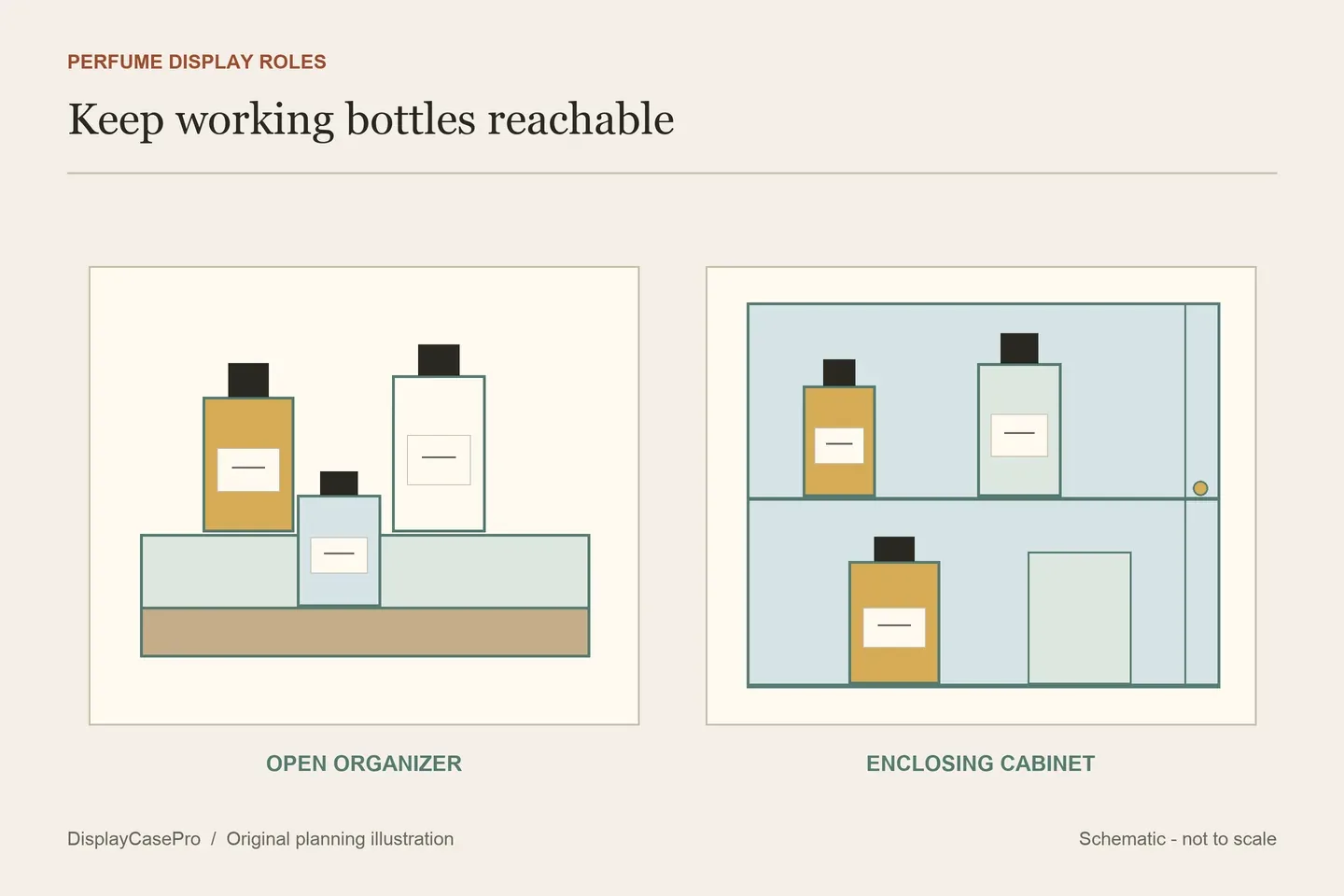
A useful perfume display lets you take out a bottle, use it and return it without disturbing the collection. Start by separating fragrances you wear from empty flacons and presentation boxes. Those groups can share a visual theme, but they do not need the same storage conditions or access.
Decide what will actually be on show
A filled bottle is both a designed object and a product you may still use. An empty bottle can be displayed for its shape, label or collection history. A box can provide a visual connection while the matching fragrance stays elsewhere. Record which role each item serves before assigning cabinet positions.
For filled fragrances, start with the maker's advice. Diptyque recommends keeping perfume tightly closed in a cool, dry place, away from direct light and temperature fluctuations. A transparent enclosure does not establish those conditions. If an attractive location conflicts with the advice for a bottle, choose a different location or display an empty flacon there.
Keep an empty bottle identified as empty in your collection record. Retain its cap and associated packaging where available, without inventing a date or provenance from the design alone. A beautiful vintage bottle is not evidence that its contents, stopper or label can tolerate a particular cleaning or refilling process.
Four perfume display case ideas with different jobs
A small working row behind a cabinet door
Give the fragrances you currently reach for a clear, accessible row. A closed front allows a deliberate display without making every bottle part of a dense arrangement. Position labels toward the normal viewing point and leave a route for the complete capped bottle to come forward.
Keep less-used bottles elsewhere in the cabinet or in appropriate separate storage. The working row can change as your preferences change; it does not need to contain one bottle from every fragrance family. Put the collection record where it helps you find the others rather than adding more bottles to the front.
Open risers inside a suitable enclosing cabinet
A rear step can reveal a short bottle otherwise hidden behind a taller one. Treat the riser as furniture inside the cabinet: it occupies shelf area, adds weight and raises the bottle toward the shelf above. Check the whole arrangement through the closed door before buying a second tier.
Use a riser only where its stated dimensions, support and capacity suit the intended bottles. A narrow decorative shelf is not automatically a good platform for a broad, heavy flacon. A separate bay may be more useful than raising a rear bottle until it becomes difficult to retrieve.
An empty-flacon feature display
Choose one bottle shape, a documented design series or a few related labels as the visual focus. An open organizer or separate clear cover can frame that group while working fragrances remain in their appropriate storage location. Keep the distinction clear in captions if you photograph the collection.
Arrange the empties at their natural resting positions. A tall sculpted stopper, tassel or projecting atomizer bulb belongs in the complete profile. The fact that a bottle contains no perfume does not make a loose stopper a lifting handle or a fragile label suitable for adhesive mounting.
A divided display-and-storage cabinet
Use a visible section for selected flacons and a separate section for boxed bottles or packaging records. Match each section to its purpose: a glass door provides a view, while a solid door hides the contents. Neither description establishes temperature control or a preservation guarantee.
A box-and-bottle location list makes this arrangement practical. Record that a displayed flacon belongs to a particular box elsewhere, rather than squeezing the box behind it and blocking removal. Leave room for the collection you actually own, not an assumed future bottle count.
Read the cabinet specification before counting bottles
Organizer size, furniture footprint and usable shelf space answer different questions. These examples show what a published listing supplies and what still needs checking. They are not a tested pairing or a ranking of products.
| Example | Published information | What it does not establish |
|---|---|---|
| Boho Home Finds Acrylic Desktop Organizer Shelf | 30 cm and 40 cm size options; several shapes; two or three removable layers. | The size labels do not provide a complete width, depth, shelf-spacing and load specification. It is an open organizer, not an enclosing case. |
| IKEA US BLÅLIDEN, black, 005.205.19 | Overall width 13¾ in, depth 12⅝ in and height 59½ in; three movable shelves; maximum load per shelf 7 lb. | Overall dimensions are not the usable shelf footprint or door opening. The listing does not prescribe a perfume-bottle count or fragrance-storage environment. |
For the BLÅLIDEN example, include the weight of any riser or tray along with the bottles when assessing the shelf load. Follow its anchoring and assembly instructions. Movable shelves do not mean that additional shelves, modified brackets or a different loading arrangement have been approved.
For an open organizer, obtain the missing dimensions for the exact shape and layer configuration. Removing a layer may change the arrangement, but it does not supply a new load rating. Keep the maker's original unit and dimension labels with your notes.
Measure the bottle you will remove, not its volume label
A 50 ml or 100 ml marking describes contents, not the enclosing rectangle. Measure the actual bottle with its normal closure fitted. Include the widest cap, a projecting sprayer or bulb, and the height of a decorative stopper. Record the base footprint separately when it differs from the bottle's widest part.
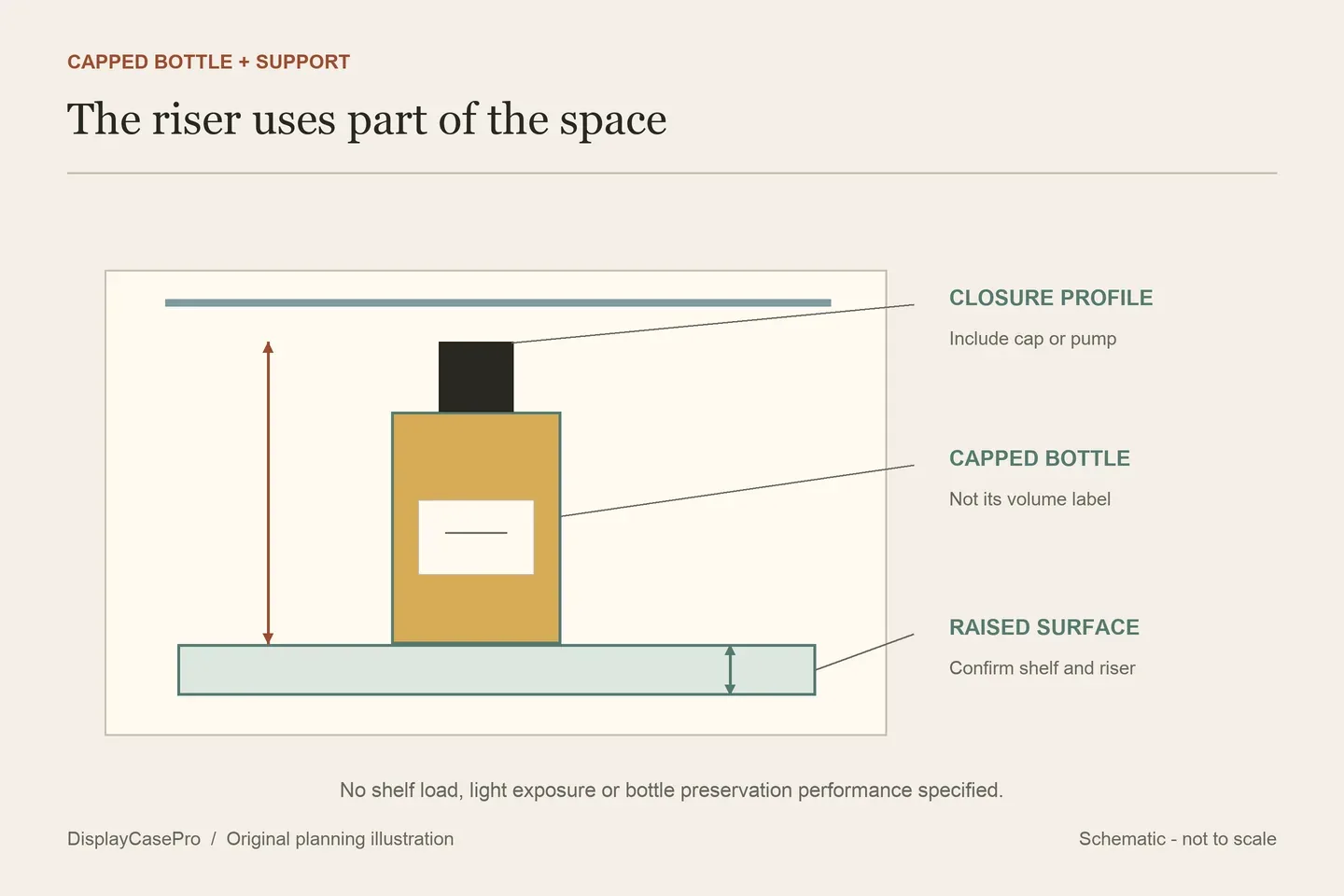
Plan to take a working bottle onto a clear adjacent surface before uncapping or spraying. A door opening that reveals the label does not prove there is room to operate the atomizer inside. Check that the bottle can return to its position without catching a cap on the shelf above or reaching through another bottle's decoration.
Use the blank perfume display and access worksheet to record bottle role, capped profile, shelf limits and box location. The general collection measurement guide explains the distinction between an object's outline, usable interior and furniture footprint.
Choose the location before adding display lights
Assess the proposed position across the day, including light through nearby windows and heat sources beside the cabinet. Use the actual perfume maker's storage advice as the reference. Showing a clear bottle behind glass is not a substitute for selecting a suitable location.
If lighting matters, plan its fittings, cables and operating routine with the cabinet. The cabinet lighting guide covers the view and reflections. A lamp's LED label alone does not certify its effect on a particular fragrance, and a cabinet prepared for cable management is not necessarily supplied with a light.
Common questions
Can filled bottles and empty flacons share a cabinet?
They can share an arrangement where the location and supports suit both. Keep filled-bottle care requirements and the empty-bottle record distinct, and preserve access to the fragrances you use.
Does a closed clear case protect perfume from light?
A clear front describes visibility, not the light conditions at the bottle or a tested protection level. Follow the fragrance maker's advice and assess the actual display location.
How many bottles fit on one shelf?
Count only after checking their complete profiles, access routes, support footprints and the shelf's stated loading requirements. Equal volume labels do not mean equal bottle shapes or weights.
About this guide: Furniture figures are attributed listing examples. No fragrance ageing, light exposure, shelf loading or physical bottle fit has been tested for this article.
Comments
Share a display tip or ask a question.