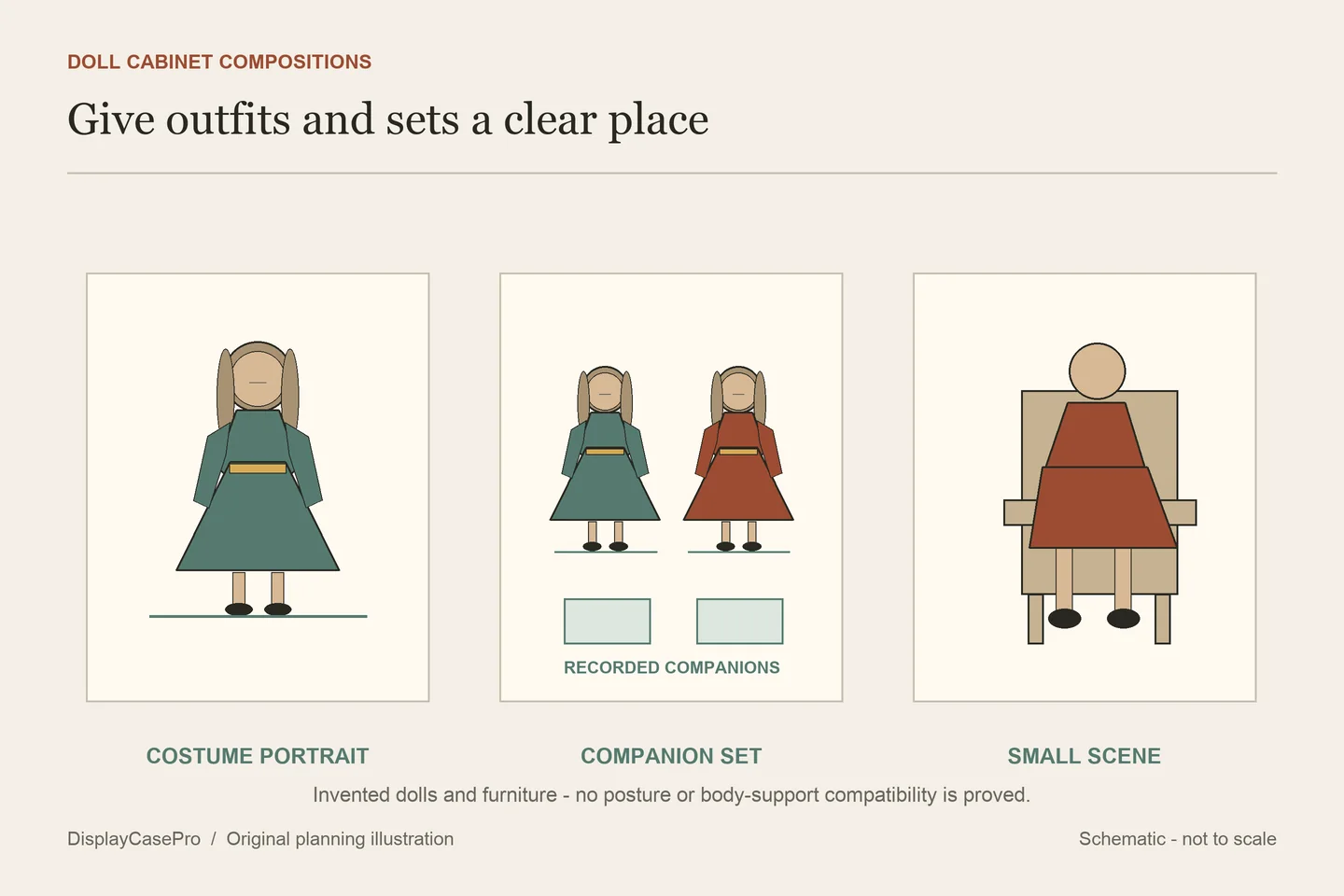
Plan a doll display cabinet around complete dressed figures and the relationships you want to show. A costume row, a documented companion set and a small seated scene need different space and support. Keep each doll connected to its outfit and accessories, then choose the cabinet layout that lets those details be seen and reached.
Four doll display cabinet ideas
Choose one main purpose for a shelf or bay. It may show a garment’s shape, the members of a set, a small scene or a changing selection. That purpose should explain the grouping without making a viewer guess which accessories belong to which doll.
| Composition | What the viewer should see | What belongs in the plan |
|---|---|---|
| Costume portrait | One complete outfit, its silhouette and selected details. | Hair, headwear, skirt/cape spread, body support and a separate caption. |
| Documented companion set | The relationship between named or numbered members. | A record for each doll and associated piece, with a shared group reference. |
| Small seated scene | A chosen interaction or arrangement with furniture. | Permitted posture, suitable support, furniture footprint and a removal order. |
| Rotating outfit selection | A clearly identified current selection from a larger wardrobe or collection. | Which doll wears each outfit, what has moved and where the other components are housed. |
Give a costume its own portrait
A focused bay can reveal a wide skirt, long coat, headpiece or elaborate hairstyle that disappears in a tight row. Start from the actual dressed silhouette in the permitted display position. Leave the label outside that silhouette so it does not conceal the hem, shoes or another chosen detail.
Choose the viewing angle before centering the support base. An asymmetric garment or hat may put the main feature to one side. If the back of the outfit matters, record that view separately or discuss a presentation designed to reveal it. Turning a dressed figure frequently is a different access task from a static portrait.
Keep a companion set legible
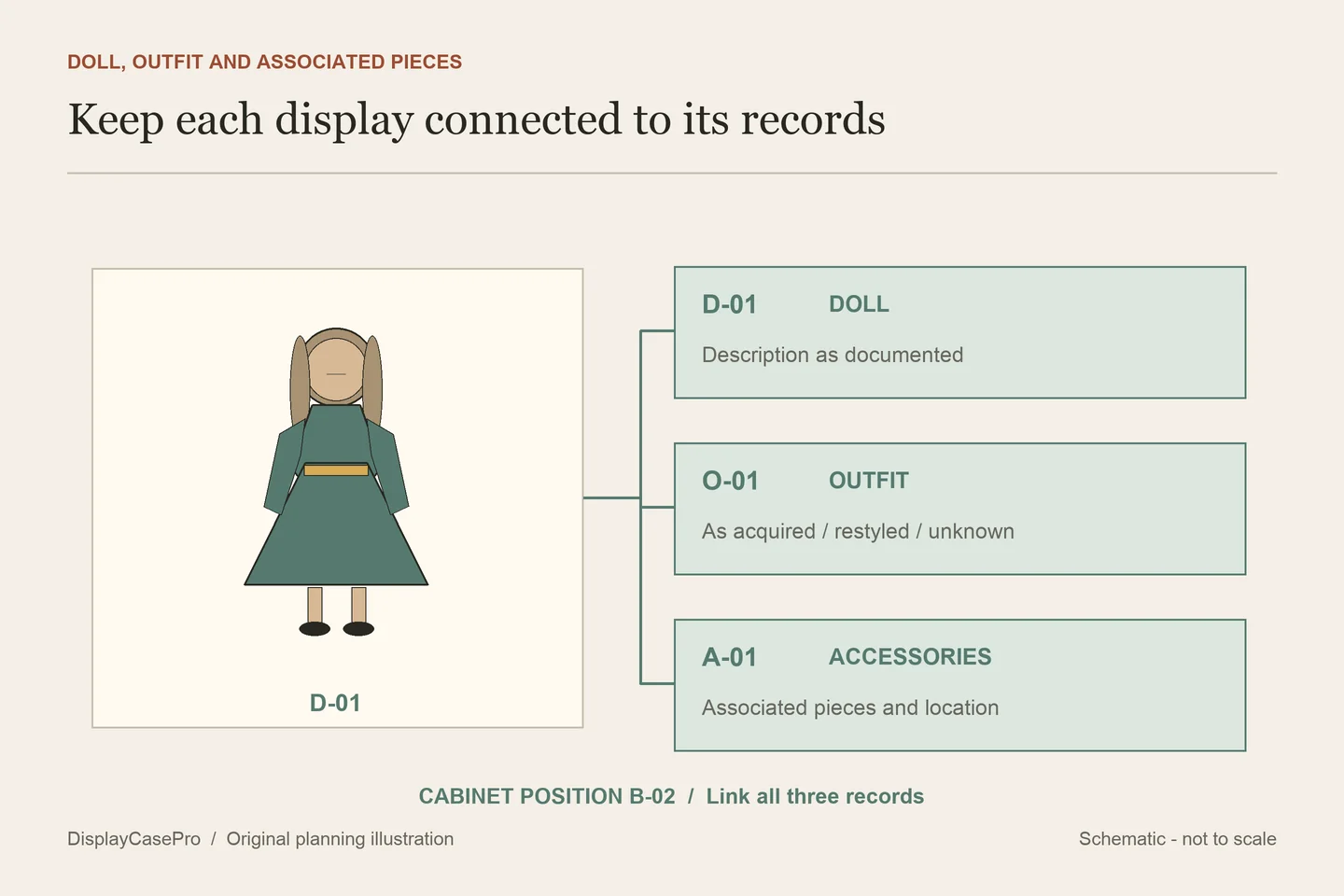
Place the documented members together while retaining their individual identities. A group heading can explain the relationship, with smaller position codes linking each figure and accessory to the record. Preserve uncertainty where a companion piece or outfit association is unconfirmed.
Related dolls do not need to touch to read as a set. Give their garments and supports separate places so that one can be reached without disturbing another. An accessory can sit in its own identified area rather than being pressed into a hand or against clothing to complete the composition.
Build a small scene around suitable support
For a seated or narrative arrangement, first establish whether the doll’s construction and instructions permit the proposed posture. Then resolve the actual support. Miniature furniture is a visual prop until its suitability for that particular doll is established; a matching scale label alone does not answer the question.
Lay out the empty furniture and paper outlines before loading the dolls. Check where the support can be reached and which scene elements must leave first. Keep scenery from concealing the components needed for retrieval. A compact, readable scene can be more useful than filling every shelf corner.
Rotate a selection without losing its associations
For a modern collection intended to be restyled, give each outfit and accessory group its own identifier. Record the current doll and display position. When a change occurs, update the destination of the previous clothing and parts, not just the cabinet photograph.
For an older or uncertain assembly, establish what changes are appropriate before planning regular redressing. A seasonal theme is not a reason to dismantle a fragile or historically associated outfit. A fixed presentation can retain its story while a different, suitable group supplies the changing display.
Measure the costume, support and visible details together
The doll’s advertised height describes only one part of the task. Include the hair or headwear, projecting sleeves, garment spread, fitted support and any separate base in the outline. Keep a body-only dimension distinct from the dressed display profile.
Use the collection measurement guide for the general method. Add notes identifying which details must remain visible from the cabinet’s normal viewing position. A lower door rail or a neighboring costume can hide shoes or a hem even where the figure physically fits.
Resolve the stand or support with the doll and support makers, or an appropriate specialist for an older object. Do not assume that a waist loop, elastic restraint or clear figure stand is compatible with every body and garment. The support is part of the display, not spare space behind it.
Individual boxes can organize a cabinet, but compare their complete profiles
An individual clear box can give a dressed figure its own position within a larger cabinet. It also adds an exterior footprint, an opening task and another set of dimensions. Check both the figure-to-box relationship and the box-to-cabinet relationship.
Two DollSafe listings illustrate why a doll-height range is insufficient:
| Named product | Listed size, W × D × H in | Construction described |
|---|---|---|
| DSDB3x2x12.5, thin-doll box | 3 × 2 × 12.5 | Clear, flexible folding plastic. |
| DSDDC95x5x13, deluxe case | 9.5 × 5 × 13 | Clear flexible sides, with acrylic top and base named in the product. |
The size lines are not labeled clear interior measurements. Confirm usable space, the fitted support and the opening method for the actual outfit. Neither the pictured figure nor a shared advertised height range demonstrates that your dressed doll fits. The wider format is a different physical package, not a guaranteed upgrade for every collection.
If individual boxes share a cabinet shelf, include their complete footprints and combined loading in the cabinet plan. Follow the cabinet’s documented loading and installation requirements. Keep the box’s own opening or removal route accessible rather than placing it behind a permanent scene.
Treat body and costume as separate planning questions
A museum example shows why appearance alone cannot settle care. In its 2022 account of the Possum Trot dolls, the Smithsonian American Art Museum describes painted wooden components in comparatively good condition while clothing needed textile specialists. The team sought to retain evidence of the dolls’ history and tested treatments individually. That specific case supports asking about body, costume and associated materials separately; it is not a home cleaning or restoration recipe.
Record existing condition questions before committing to a support or a changing wardrobe display. For an uncertain or fragile assembly, resolve the proposed contact and posture with an appropriate specialist. Avoid treating a new cloth liner, an elastic loop or a cabinet’s premium description as blanket approval.
Once the physical arrangement is resolved, use the display lighting planning guide for the viewing and access task. Keep material-care requirements as separate inputs; decorative brightness does not establish suitability for a particular garment or painted surface.
Keep the displayed outfit’s status clear
Use descriptions such as “as acquired,” “restyled for this display” or “association unconfirmed” where accurate. A photograph of a pleasing combination does not prove that its clothing and accessories were originally supplied together. Preserve existing labels and maker information in the fuller record.
The blank doll display worksheet links the doll, outfit, accessory IDs, position and rotation destination. Add a photograph of the settled arrangement where appropriate and note the removal order. This makes later changes easier to reconstruct without inventing a family history or product identity.
Common doll-display questions
Should dolls share one shelf height?
Only where their complete dressed groups and access needs suit it. Match the planned profiles to the cabinet’s permitted shelf positions rather than choosing one decorative gap.
Can dollhouse furniture support a display doll?
Confirm its intended use and the doll’s support needs. Miniature furniture sold for a scene does not automatically provide a suitable mount for another doll.
Should every outfit remain on a doll?
Choose according to the collection’s meaning and appropriate care. A documented outfit can be associated through its record even when it is separately housed.
About this guide: These are reference-led compositions and record tools. Named box figures are supplier specifications; no doll, stand, cabinet or conservation treatment was tested for this article.
Comments
Share a display tip or ask a question.