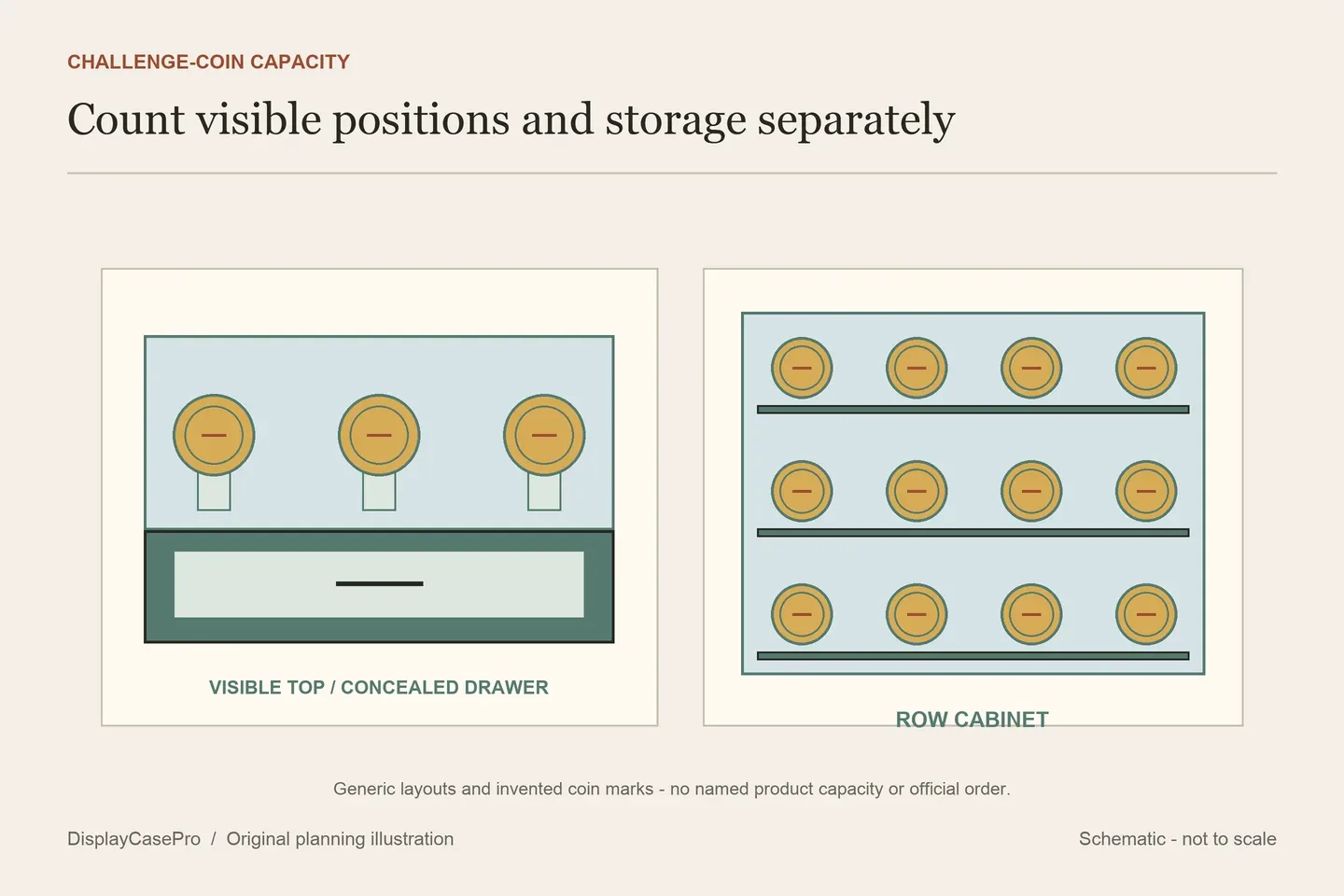
Choose a challenge coin display case by separating the coins you want continuously visible from those kept in a drawer or closed tray. Then compare the actual coin or capsule with the positions provided. “Holds 30” can describe a very different display from 30 visible faces behind a door.
Count visible positions separately from total storage
Start with three numbers: how many pieces you own, how many you want to see at once and how many fit the maker's intended positions. A storage drawer can increase the case's total capacity without adding any visible faces to its upper display.
For example, Holme & Hadfield's Coin Deck describes five top pillars for five coins and a drawer for another 20–25. Its approximately 25–30 total is a display-and-storage figure. It is not a claim that the cover shows 30 individually presented coins.
Decide whether that split suits your collection. A small rotating selection can use a few visible positions with identified backstock. A series whose faces need to be seen together instead requires enough suitable display positions, regardless of how much fits underneath.
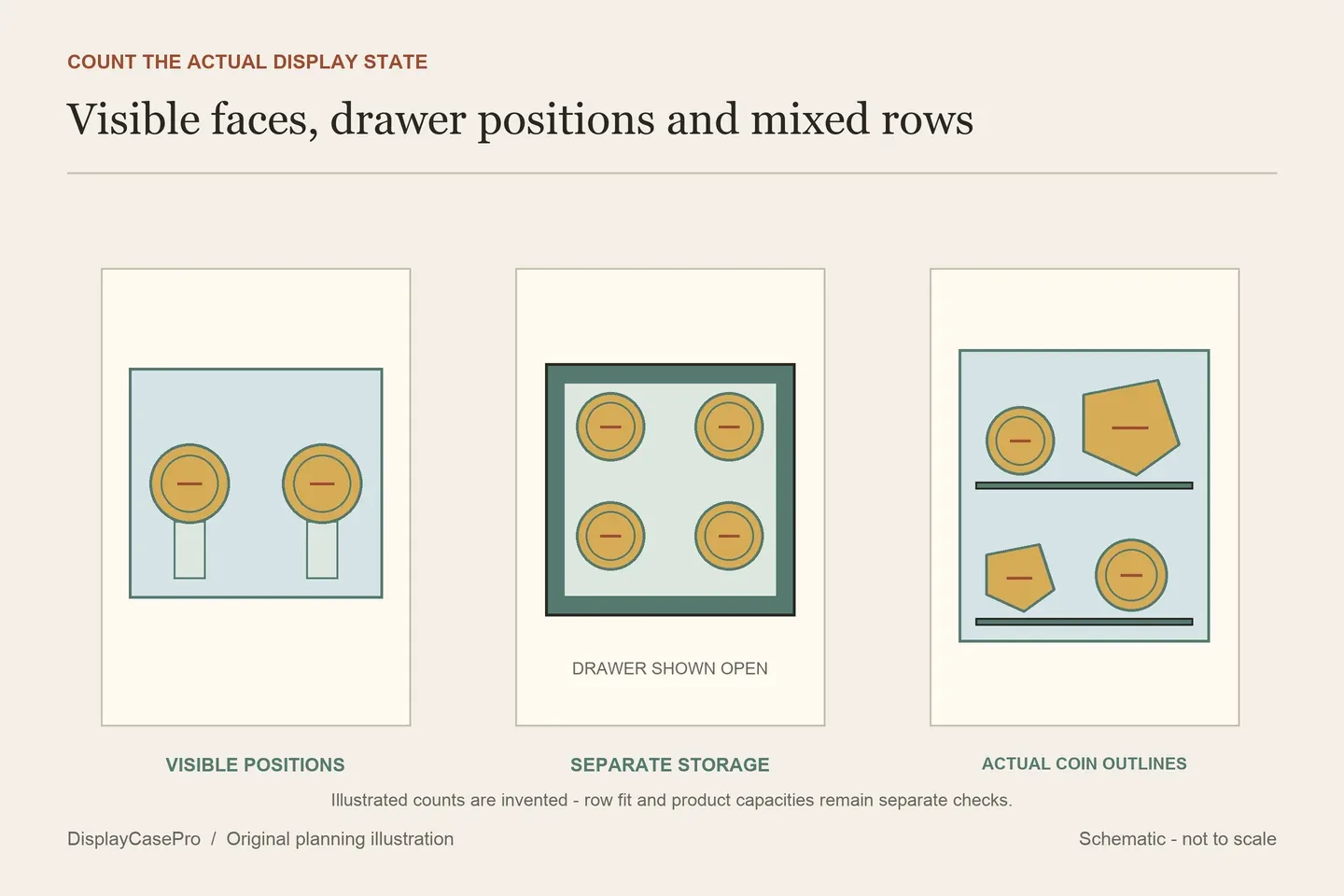
Keep packaging in the count too. A bare challenge coin and the same coin inside a capsule have different outside profiles. Large, thick or irregular pieces can use a different amount of row space from the standard pieces used for a nominal catalogue capacity.
Choose between pillars, rows, open holders and fitted boxes
| Format | Useful purpose | Check before counting positions |
|---|---|---|
| Desk case with pillars and drawer | Feature a small selection while keeping more pieces nearby. | Visible pillar count, groove fit, covered height and what the drawer capacity includes. |
| Wall cabinet with rows | Show a group of faces together behind a closing door. | Actual row arrangement, shelf spacing, depth and the size of each assigned piece. |
| Open flag or row holder | Use a themed backdrop with accessible coins. | Whether there is an enclosing front at all, and the exact groove and supporting geometry. |
| Fitted presentation box or tray | Keep specified bare coins or capsules in individual positions. | The intended insert format, visible opening and whether the collection is visible with the lid closed. |
The Military Gift Store coin category mixes closed cabinets and open multi-row stands, including casino-chip crossovers. Read the individual format rather than treating every “coin case” as a cabinet with the same closing front or retention.
A wooden flag with a surrounding frame can still be an open holder. “Framed” describes a border unless the product also specifies an enclosing front and opening method. Choose continuous enclosure deliberately rather than inferring it from the outline of a wall display.
Keep the maker's capacity definitions attached to its dimensions
These examples compare published descriptions. They are not physical tests, security assessments or a ranking. The unanswered fields matter when your collection differs from the maker's intended arrangement.
| Display | Published description | Unresolved fit question |
|---|---|---|
| Holme & Hadfield Coin Deck | Five visible top positions plus 20–25 drawer coins; hinged acrylic cover and no lock. Size sequence 12.1 × 3.1 × 7.0 in. | The sequence has no axis labels or inside/outside definition. Obtain groove dimensions, usable covered height and drawer arrangement for your pieces. |
| sfDisplay Large Cabinet, dc5175b | Outside H28 × W16 × D1.75 in; inside depth 1 in; shelf spacing 2 1/8 in. Description advertises up to 88 standard-sized coins. | One section says ten grooved shelves, another eleven rows of up to eight. Request the actual numbered position map and the definition of a row. |
| Flags of Valor American Flag Wall Holder | Framed W29 × H18 or W41 × H25 in; unframed W24 × H13 or W36 × H19 in. | No numeric groove, row-clearance or depth specification is supplied in the description read. The framed dimensions are not a clear coin capacity. |
The sfDisplay shelf and row wording should not be silently reconciled by assuming an extra position on the cabinet floor. Obtain the maker's explanation for the selected version. Even with the intended map, 88 remains a nominal standard-piece arrangement, not proof that 88 mixed capsules or large medallions fit.
For a cabinet, compare the actual supported coin height with its assigned row and front clearance. An upright or leaning coin occupies a different profile from one lying flat. Keep the intended support and the complete coin or capsule in the same measurement record.
For an open holder, a large outer flag does not guarantee more usable coin positions. Decorative parts and the actual rows determine the available arrangement. Ask for the selected holder's receiving geometry instead of estimating it from the full width.
Distinguish the coin's diameter from a capsule's outside size
Coin Supply Express's challenge-coin box category distinguishes its Large and Extra Large insert routes. Two listed tray examples illustrate why the receiving format must stay explicit: a Large tray is described for up to 16 positions and specified 1 3/4 in bare challenge coins, while an Extra Large tray is described for up to 12 positions and specified 2 in bare coins. Each also names particular capsule formats.
Those catalogue names do not define a universal challenge-coin standard. A capsule that receives a given coin has its own outside size, and a tray intended for one capsule family need not accept another. Keep the exact insert, holder format and complete thickness with the specification.
A solid-lid box can suit storage or presentation when opened, while a glass-top box offers a different closed view. Neither the material label nor a nominal coin count establishes which faces remain visible. Confirm the insert and viewing arrangement of the actual box.
For an irregular edge, raised decoration or a thick capsule, leave the position unconfirmed until its receiving limits are resolved. Do not force the piece into a groove or alter the coin or holder to preserve an advertised count.
Keep the visible face and collection record connected
Choose which face each position will present and record that choice. A row of fronts can show one side of a series; if the reverse matters, plan a separate labelled reference image or a suitable retrieval routine. A mirror behind the group does not guarantee a readable reverse.
Use documented relationships for grouping: a known event, organization, recipient or acquisition sequence. A flag-themed holder does not establish that its owner served in a particular role, and an attractive row order does not create an official military hierarchy. Keep uncertain identification marked as uncertain.
For a rotating desk selection, record the drawer location of each displayed coin's replacement. For a wall cabinet, allow room for its actual door and for access to the row being changed. A key lock's presence is a feature description, not a certified security rating or a tarnish-prevention claim.
The blank challenge-coin capacity worksheet separates visible positions, concealed storage and the actual coin or capsule. Use the collection measurement guide for the complete supported profile, and the wall layout guide for the finished outside case footprint.
Common questions
Does total capacity mean every coin is visible?
Check the split. A case with five pillars and a storage drawer has five intended visible top positions even when its combined capacity is much larger.
Will a cabinet's coin count apply to capsules?
Confirm that exact protected format. Capsule outside dimensions, thickness and support can differ from the bare standard coins used in the nominal layout.
Is a framed coin flag an enclosed cabinet?
Look for an expressly supplied closing front and opening method. A frame border and an open coin holder do not by themselves provide enclosure.
Comments
Share a display tip or ask a question.