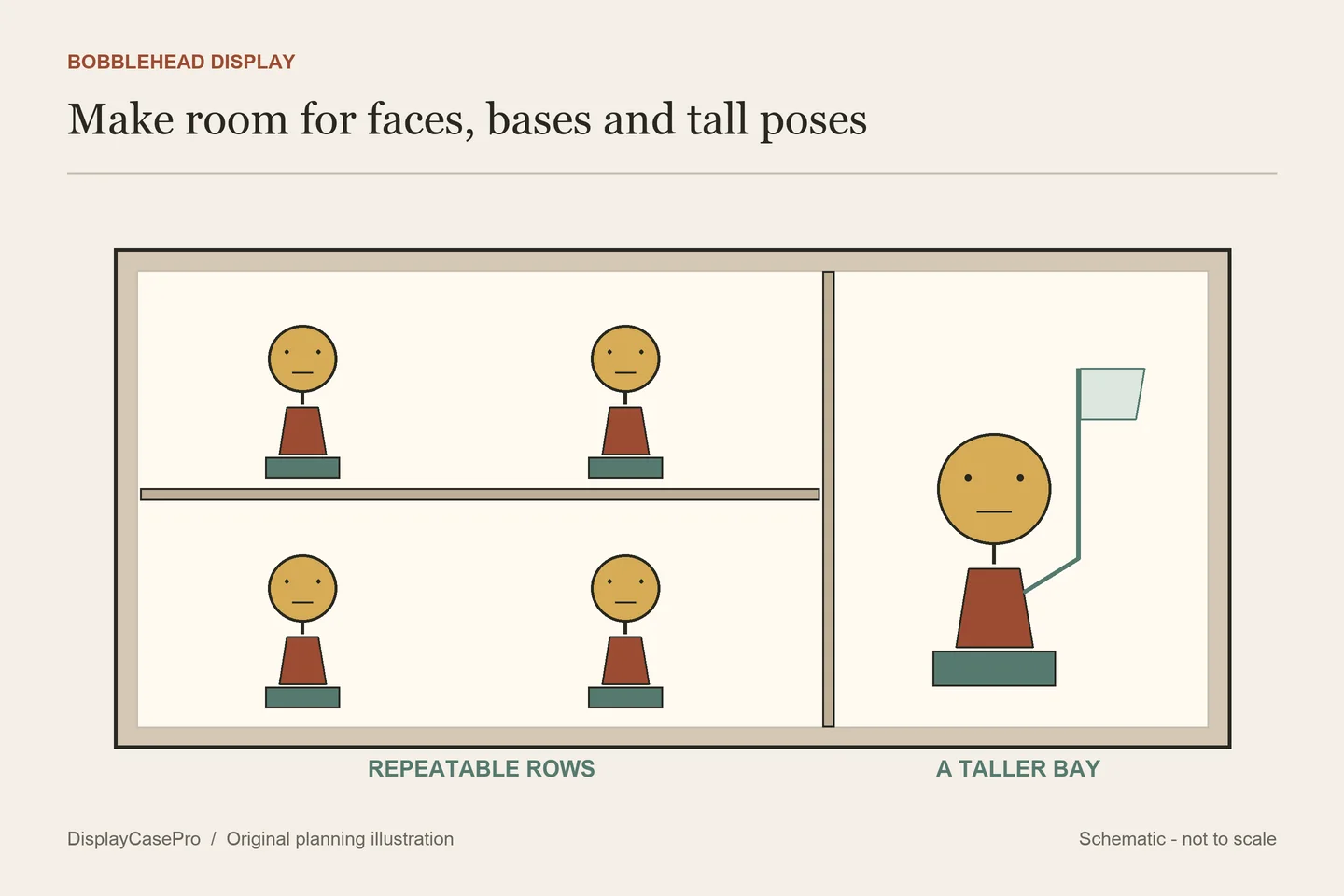
A bobblehead display needs room for more than the figure's stated height. Its head, spring, base and any bat, flag or raised arm can all affect the fit. Choose between individual covers, an enclosed cabinet, open themed shelves and shallow rows by checking the actual figures and the view of their faces and nameplates.
Four bobblehead display case ideas
1. One cover for one featured figure
A separate cover gives a favorite figure a defined space on a desk or shelf. This works well when the pose deserves to be seen from the side or when a projecting accessory makes a shared row awkward. Choose the base and cover as one system; a large enough transparent shell is only part of the fit.
Check how the cover comes off. A lift-off cover must clear the tallest feature throughout the movement, and you need somewhere to place it. A hinged opening needs its own swing space. Keep the figure supported by its base as directed by its maker, rather than pulling on the head to remove it.
2. An enclosed cabinet for a growing team or character collection
A cabinet groups related figures and reduces casual contact. Adjustable shelf positions are useful when the collection mixes upright figures, large scenic bases and raised accessories. Plan a tall bay for the exceptions instead of assuming every figure belongs on identical shelves.
Use a team, series or release theme to organize the collection, but let the actual silhouettes decide the spacing. A pose with a bat extending sideways may need a wider position even if its total height matches the figure beside it. View the cabinet with its doors closed: frames and hinges can hide faces or base lettering at the edges.
3. Open themed shelves or a stadium-style scene
Open shelves can create a group scene, such as a baseball bench or a lineup. They suit collectors who want easy access and accept the extra exposure to dust and accidental contact. Make the scene around the figures, rather than forcing a figure to lean so it fits the set.
A themed display's stated length is not a figure count. Base shapes, overhanging heads and props determine how many pieces can stand in the available space. Keep decorative scenery independent of the figures and leave a straightforward removal route for the widest pose.
4. Shallow rows with carefully chosen risers
Rows can show a larger collection without using a separate box for every figure. Start with one row, then add a rear level only if it reveals faces and nameplates that would otherwise be hidden. Use risers intended to carry the planned bases and loads. An upturned lid or spare packaging component is not a rated display support.
Look from the normal seated or standing position. The rear faces may be visible while their base names remain hidden. Decide which details matter most, and reduce the row count if raising the rear figures leaves insufficient room above them.
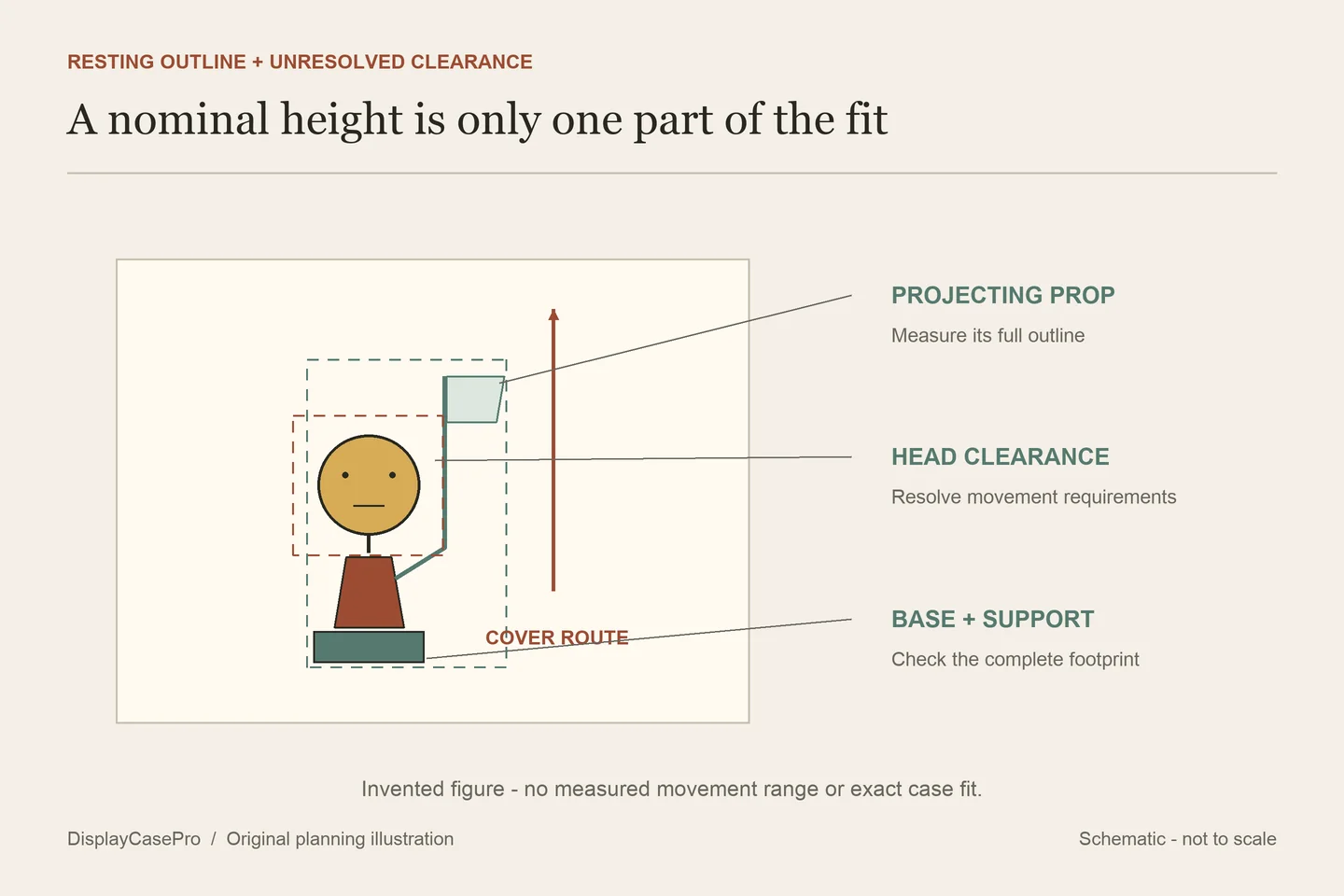
Check the figure's complete profile, including movement
Keep a simple inventory before choosing a case. Record the exact figure or edition, base footprint, widest projection, deepest projection and overall height. Note accessories separately: a removable item should not be bent or omitted merely to make a display dimension work.
The head adds another question. It may sit at an angle or move beyond its resting outline. Observe its natural position without deliberately shaking, bending or stretching the spring. Seek the maker's guidance when the movement range or handling method is unclear. A resting head that almost touches a panel is not evidence of adequate operating space.
| Check | Record | Why it matters |
|---|---|---|
| Base | Full footprint, uneven edges and intended support surface | The base must rest securely; the figure should not balance on an accessory. |
| Head | Resting outline and any unresolved movement clearance | Walls, an upper shelf or neighboring heads may interfere. |
| Pose and props | Farthest projections in each direction | A height-only listing omits a sideways bat or flag. |
| Riser | Support footprint, height and documented capacity | It changes both the occupied space and the load arrangement. |
| Opening | Clear entry dimensions and cover or door route | A figure may fit inside but be difficult to insert without contact. |
Use published dimensions to ask better questions
Pioneer Plastics lists its 048C tall box with internal dimensions of 3¾ × 3¾ × 8¼ inches. That is useful information about one enclosure, but it is not a promise that any figure advertised as eight inches tall will fit.
For comparison, FOCO's Bo Nix Climb Higher listing, style BHNF26CLIMBHDBBN, describes an approximately 8-inch height including the base and a flag-bearing pose. The listing also says its image is a digital representation subject to approval. It does not publish the full width, depth or head-movement envelope there. Treat those figures as planning information, not measurements of a delivered item.
The difference between 8¼ inches and an approximate 8 inches is only a nominal quarter inch along the box's long dimension. That arithmetic cannot establish compatibility: the dimension axes, usable opening, actual figure and its required clearances still need checking. This is an example of an incomplete comparison, not a recommended pairing.
When ordering a display, send the maker the complete measured profile of your actual figure and ask which internal surfaces or fittings reduce usable space. Confirm the exact model and revision. For recording measurements consistently, use our collection measurement guide.
Arrange the faces and the base details as two separate rows
Make paper footprints for the bases and mark the front of each figure. Arrange those footprints on an empty shelf before loading it. Include overhanging props in a different outline so a narrow base does not disguise a wide pose. Leave gaps where one figure's accessory would cross the outline of another.
Then check two sightlines. The upper one should show the faces without placing neighboring heads in contact. The lower one should show the details you care about on the bases: names, numbers, event wording or scenic elements. A riser that solves the first sightline may still hide the second.
Use short series labels in front of the group, where they do not cover the figures' own lettering. Keep the catalogue record more detailed: figure name, edition or identifying code, acquisition information, known condition and the location of its original packaging. If the display mixes originals, custom figures and reproductions, label those distinctions accurately.
Reserve positions for the exceptions, such as an unusually broad base or a high prop. Do not place a tall figure at the back automatically; check that its removal does not require reaching through several moving heads. For a dense group, fewer figures on display may be more practical than another raised row.
Download the blank bobblehead profile and shelf worksheet. It separates nominal height, actual measured profile, head-clearance questions, riser details and visible base text.
Load the display with the base and access route in mind
- Set up the empty display. Follow its installation instructions and establish the documented shelf limits. Include risers and other contents in the load.
- Check each support. Its surface must accommodate the planned base without rocking or overhanging an unsupported edge.
- Place figures according to their handling guidance. Keep hands and nearby objects away from heads, springs and projecting accessories.
- Close the case slowly. Stop if a door, hinge, cover edge or neighboring figure approaches an accessory or head.
- Recheck the view. Look from the normal viewing position before adding more figures.
Keep the collection away from direct sunlight and from places where doors, bags or everyday cleaning will knock the display. An enclosure does not establish a tested UV rating or make every finish suitable for every environment. Follow the figure and case makers' care guidance rather than using a single cleaning recipe for the whole collection.
If you use lighting, plan it around the figures' faces and the reflections on the closed glazing. Keep fittings and cables out of removal routes. Our cabinet lighting guide covers that separate layout decision.
Common questions
Will an eight-inch case fit an eight-inch bobblehead?
The two labels are insufficient. One may describe an outside dimension, and the figure's height may be approximate. Compare usable internal space, opening, full figure profile and clearances, then verify the actual item.
Should I make the heads bobble inside the case?
Do not use the enclosure as a stop for head movement or repeatedly activate a delicate figure to test a tight space. Establish the maker's handling guidance and leave unresolved movement requirements explicit when choosing the display.
Can individual cases be stacked inside a cabinet?
Only use an arrangement supported by the case makers' instructions and the cabinet's limits. A flat lid does not establish stackability. Check total height, access, stability and the combined load before planning a stack.
Comments
Share a display tip or ask a question.