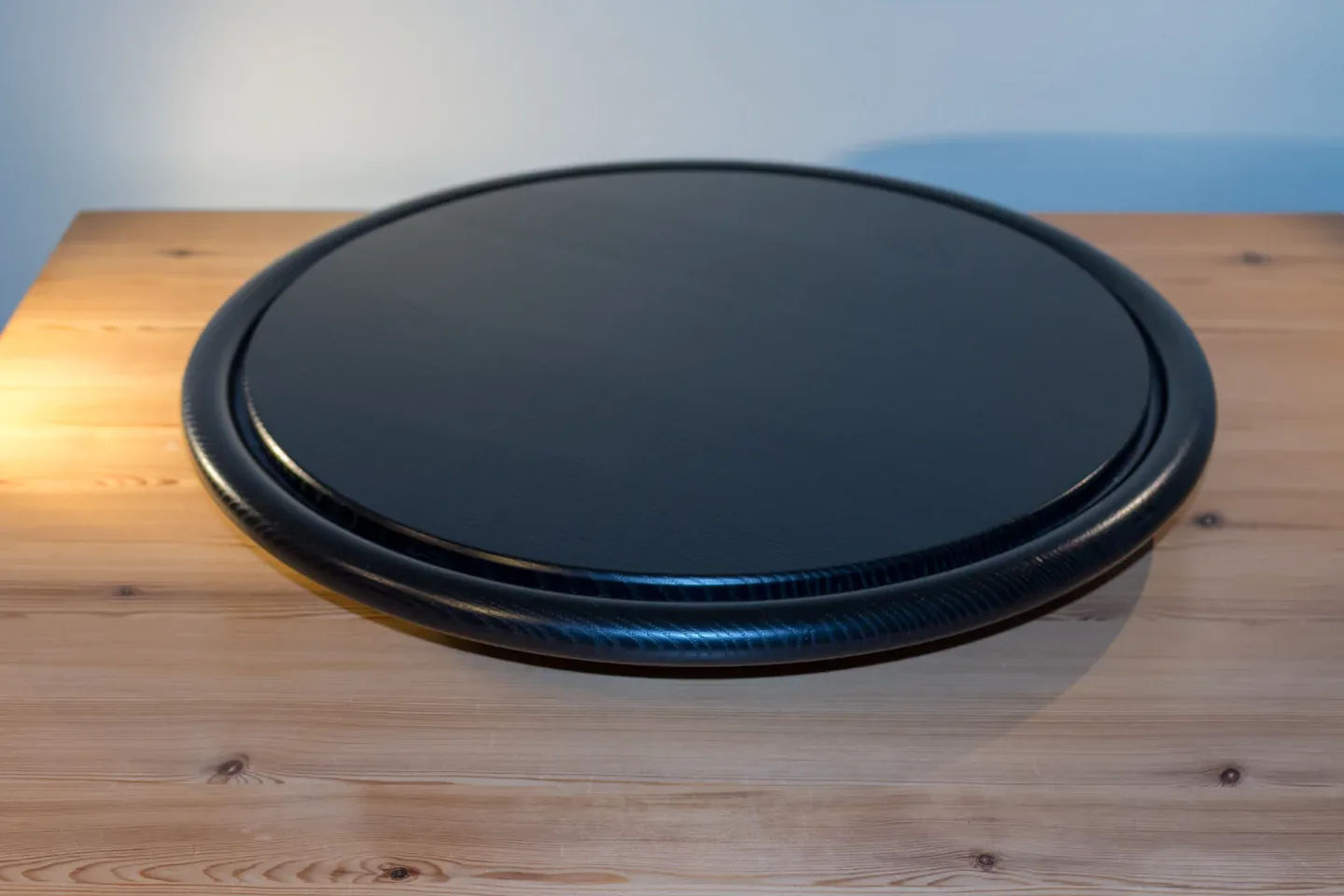
A turntable display case may be a complete rotating cabinet, a manual bearing base or a motorized platform that needs its own cover. Choose the format first. Then compare the complete turning outline and the selected unit’s loading conditions; a circular top’s diameter does not describe the space swept by an overhanging collectible.
Start with the mechanism and the enclosure you actually receive
For collectible display, three receiving questions recur: what supports the object, what makes it rotate and what closes around it. One product may answer all three; another supplies only the bearing or motor. Record the components included in the selected order.
| Format | What the source describes | What remains to check |
|---|---|---|
| Complete rotating cabinet | Carney TableTopSpinner: clear cabinet, door and four shelves. | Mechanism, actual shelf receiving area and loaded conditions. |
| Manual bearing base | TAP revolving acrylic discs turned manually. | Exact top, complete turning outline and any separately selected cover. |
| Motorized platform | Eds category and XYZ models with powered rotation. | Exact motor unit, supplied top, rated conditions and operating instructions. |
| Broad rotating-stand search | Retail results mix collectible turntables with phone, TV and other stands. | The actual object and intended format, rather than the search label. |
Carney’s TableTopSpinner gives an overall W15½ × H15⅞ × D15⅞ inches, four shelves and 3¾ inches between them, with a mirrored base and hinged acrylic door. Those figures describe a complete cabinet. The inspected description did not establish a motor or electrical supply, so the title alone is not evidence of powered rotation.
TAP’s revolving bases describe manual stainless-ball-bearing operation in either direction, with 4.25, 5.5 and 8.5-inch acrylic disc diameters. These are bases, without an included surrounding cabinet in that description. No numerical load limit was stated there.
Eds Box’s motorized-base category shows four cards, including mirrored-base versions. Its settings belong to the identified products rather than every rotating display. Obtain the chosen unit’s complete specification instead of transferring one category excerpt to another model.
The widest point can turn toward a previously clear panel
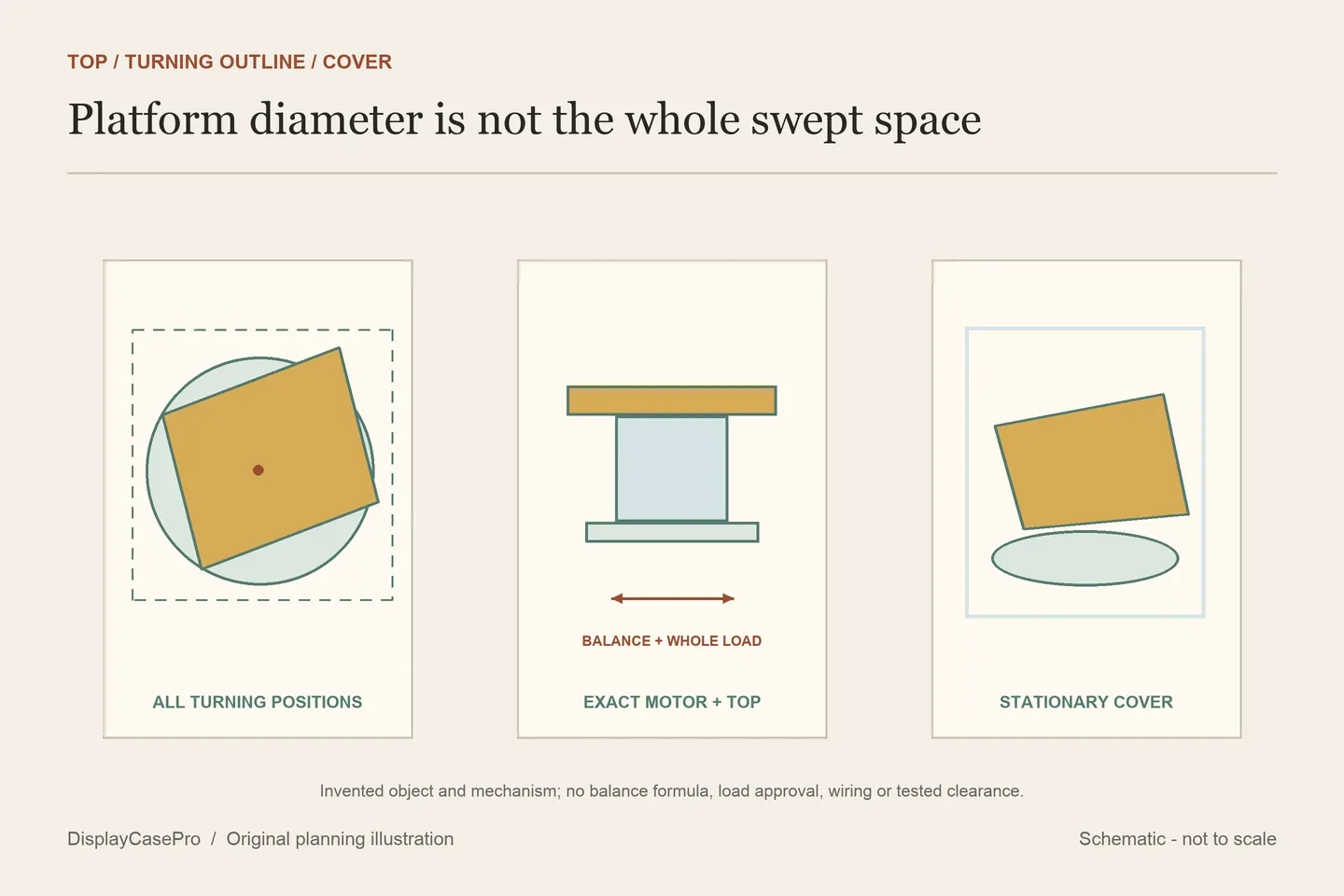
Record the entire supported assembly around its intended rotation axis. Include the collectible, its own stand, projecting props, labels and anything fixed to the rotating top. A long object can sit over a small circular platform while sweeping a much larger outline.
Check front, side and intermediate turning positions in the layout. A rectangular object’s corners need consideration as well as its front width and side depth. Do not infer the required cavity from the disc diameter or one face-on photograph.
Keep any independently movable parts in their intended display state. An unsecured hanging accessory, a delicate antenna or a spring-mounted head adds a separate compatibility question. Do not use an actual fragile collectible as an experimental probe against a cover.
For a multi-shelf cabinet, repeat the receiving question at each shelf. Carney’s shelf gap is not an opening width or a whole-object height allowance above every support. Obtain the actual shelf boundaries, door aperture and intended loading arrangement.
A headline capacity can depend on balance and the selected top
XYZ Displays’ motorized-turntable category lists different units. The specific MB105 / VM201 product page gives a 25-pound capacity and standard three-rpm clockwise rotation, explicitly conditioned on a balanced load and appropriate display size. Those are attributed product details read on 18 October 2026, not our performance test.
| Field | Published detail | Decision it does not settle |
|---|---|---|
| Capacity | 25 lb, based on a balanced load and appropriate display size. | Compatibility with any object weighing less than 25 lb. |
| Rotation | Standard 3 rpm clockwise. | Suitability for every fragile or independently moving collectible. |
| Top selection | Default No Top Selected; optional 6, 8 or 12-in Masonite tops. | A platform top automatically included with every motor order. |
Count the complete rotating assembly when asking the supplier about load: top, stand, collectible and retained accessories. Keep the exact configuration and weight units attached. Do not treat the object’s weight alone as the specified complete load, or assume a larger top increases the motor’s rating.
Some repeated template sentences on the page leave speed and capacity blank, while the product-details block supplies them. Keep the explicit model-specific block and its conditions together. This guide does not fill missing fields for other units or design a motor, wiring arrangement or structural platform.
A stationary cover must stay outside the entire turning path
Identify whether only the object and platform rotate, or whether the complete display structure moves as an intended assembly. With a separate stationary cover, its inner panels, fittings and rear treatment must remain outside the complete turning outline.
Include the turntable’s height and the supported object in the vertical record. A case selected for the object resting directly on a base can lose usable height when a motor unit and top are added. Ask where the clear cavity begins above the finished support.
The broad Best Buy rotating-stand results included a small turntable for 1/64 cars among phone, television, shoe and monitor products. The visible sample was sixteen cards out of sixty-two, rather than a complete review of every item. Choose the exact collectible format; the shared word “stand” supplies no universal enclosure or loading compatibility.
Keep the intended controls and removal sequence reachable
Use the selected unit’s operating instructions to establish stopping, access and removal. Reserve the intended route for its power cord and controls where applicable. Do not trap a cord in a closing panel or assume an ordinary platform includes a rotating electrical connection.
The cover photograph shows a black wooden Lazy Susan, rather than any compared product or verified collectible support. Photo: CC-BY-SA 2.0+ Matti Blume, 1 April 2018; CC BY-SA 4.0 selected. Whole composition retained, proportionally resized and compressed to WebP; derivatives retain that license.

Use the turntable format, load and turning-outline worksheet with the collection measurement guide to keep the stationary enclosure, rotating assembly and original source conditions separate.
Common questions
Does a turntable display case always include a motor?
Identify the exact mechanism. The sampled results include manual bases, motor units and a complete cabinet whose inspected text did not establish powered operation.
Can a smaller object exceed the useful display space?
Check the entire turning outline, supported height, balance conditions and opening. Platform diameter and object weight alone do not establish receiving compatibility.
Comments
Share a display tip or ask a question.