Choose a tennis ball display case around the ball you actually kept and the face you want to see. A small acrylic cube, a twist-opening dome and a glass case with a separate ring provide different presentations. An oversized autograph ball or a ball accompanying a racket needs its own brief.
Identify ordinary balls and oversized souvenirs separately
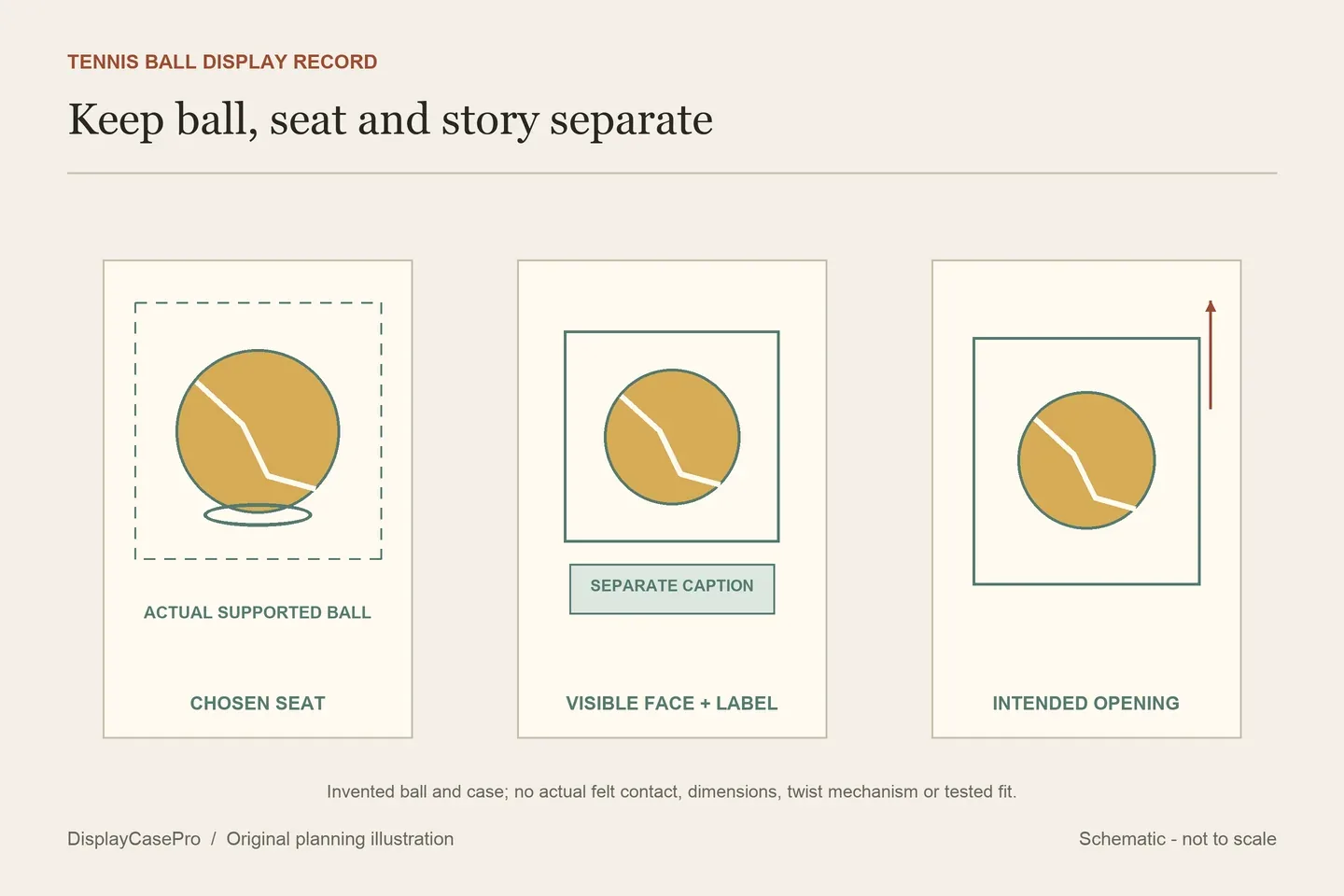
Record the ball's actual width, depth and intended seated height, with units. Include an existing holder if you want it to remain. “Tennis ball” identifies a collecting category; it does not establish that every practice ball, event souvenir or large autograph-collecting ball shares the same dimensions.
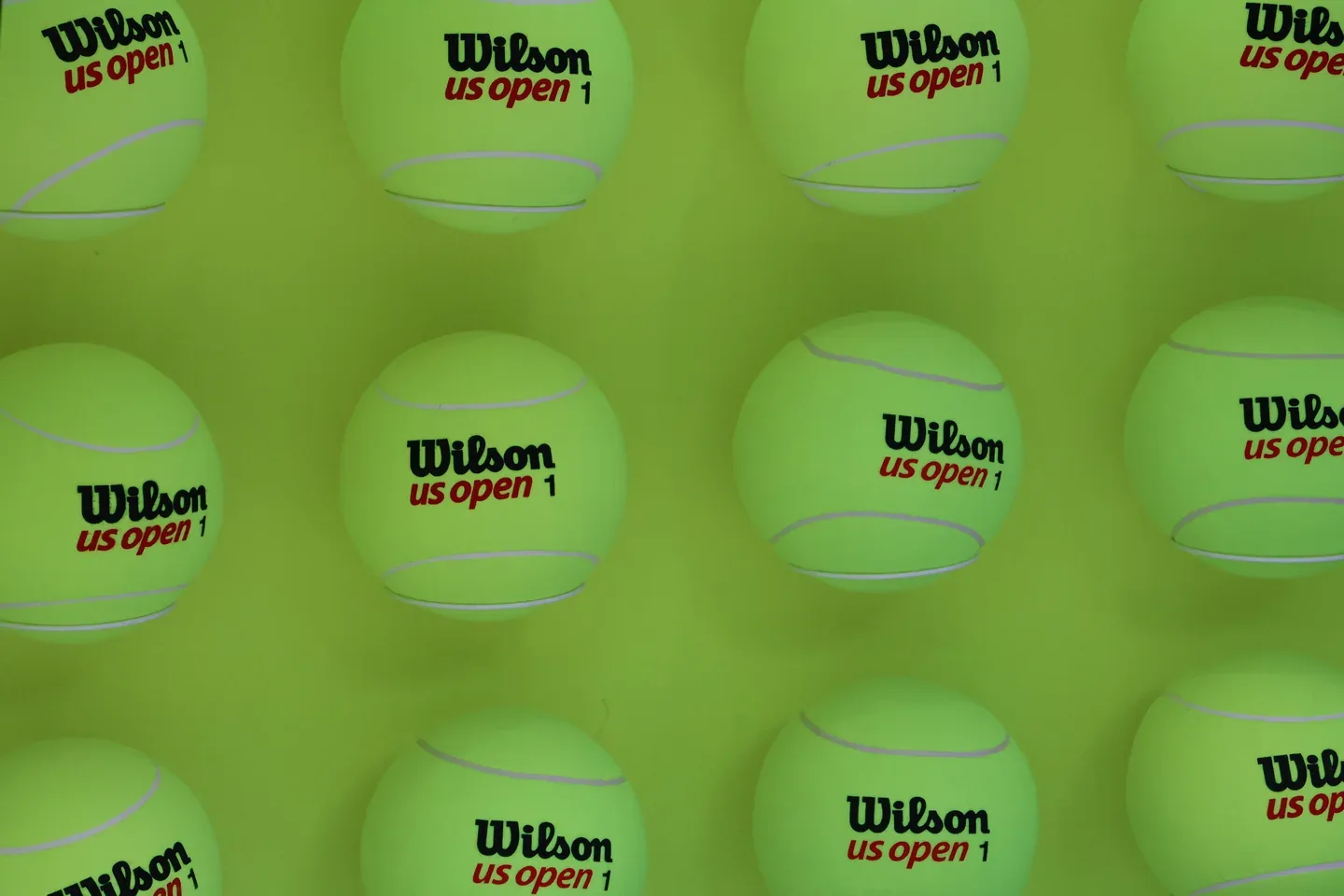
The cover photograph shows oversized balls offered for autograph collecting at the 2023 US Open. It is useful context for that distinction, not a scale reference for a normal ball. A case described for one standard-size ball needs separate confirmation before it receives a larger souvenir.
Keep a match association separate from appearance. Record whether your connection is a documented game, a tournament purchase, a signature or your own club memory. A grass- or clay-inspired base supplies a visual setting; it does not establish where the ball was played.
Choose the presentation before choosing a finish
| Format | Display purpose | Question to resolve |
|---|---|---|
| Acrylic cube | One ball with a front-facing inscription and engraving. | Actual seat, clear cavity and opening. |
| Dome and base | One ball viewed through a curved shell. | The supported ball outline and twist-release method. |
| Glass case with mirror | One ball with a reflected second view. | Ring position, useful reflected view and clear interior. |
| Racket-and-ball cabinet | A ball shown as part of a racket keepsake. | Separate ball stand, racket support and complete layout. |
Perfect Cases’ Tennis Display Case describes a glass enclosure with mirrored bottom and back, wood moulding and a clear acrylic ring. The ring matters independently of the cover: confirm where it holds your ball and which marked areas it leaves visible.
Balldome’s TBALL product instead describes a polystyrene dome and base, with four tabs and a bayonet-style twist closure. Polystyrene is the stated material, so this should not be described as an acrylic dome. Its wraparound label and closure also differ from a cube's engraved presentation.
Keep overall size separate from the receiving cavity
These supplier descriptions were read on 18 October 2026. They are published specifications, not measurements or fitting trials performed by DisplayCasePro. Missing dimensions remain questions for the selected supplier.
| Product | Published figures | Still needed |
|---|---|---|
| FantasyJocks cube | 4 × 4 × 4 in; boundary unlabelled. | Usable interior, actual support and opening. |
| Balldome TBALL | W3.5 × L3.5 × H3.5 in; boundary unlabelled. | Receiving outline within the curved dome. |
| POP Acrylic grass-court case | Overall 3.74 × 3.94 × 3.94 in / 9.5 × 10 × 10 cm; axes unlabelled. | Axis-labelled interior above the supplied stand. |
FantasyJocks supplies the cube sequence and offers up to three engraved lines. Those figures do not identify a four-inch clear cavity or explain the ball seat. Ask for the usable interior with the selected support, rather than estimating it from the photograph.
POP Acrylic’s grass-court product explicitly calls its size overall. Its description identifies a wooden base and a clear central ball stand for one standard-size ball. Obtain the inside dimensions and the supported-ball position; the overall height is not height available above that stand.
A dome's length, width and height cannot be treated as an equally large rectangular interior. The shell curves around the ball. Likewise, the Perfect Cases description read here supplies a ring and mirrors but no numeric receiving cavity. Keep that missing size in the enquiry rather than borrowing a number from another glass case.
Place the felt markings, signature and caption together
Choose the front view from the place where the display will normally be seen. Record any other significant face before it becomes hidden by the seat or rear view. A mirror may show another area, but it does not demonstrate that every curved inscription will be readable.
Keep the caption outside the marked ball. A base label or engraving can carry a date, player name or personal explanation without becoming a new mark on the felt. Check the proposed text against your record before commissioning it; a personalised case cannot authenticate a signature or match-use claim.
Choose an opening routine and a separate racket position
Ask which part releases during normal access and where the ball remains supported. Follow the exact case instructions rather than assuming that every cube lifts off or every dome should be handled while populated. Leave somewhere to rest the removed part without disturbing the ball or its caption.
For a combined keepsake, sfDisplay’s racket-and-ball cabinet specifies one racket hook, one ball stand and a front-opening door. Its stated inside is W44 × H17 × D3.25 inches, while outside is W45 × H18 × D4 inches. Retain those published axes and plan both objects in the actual orientation.
The ball stand does not resolve the racket's mounting or permit the ball to rest against the strings. Give each object its own receiving position. The catalogue's one cabinet product is a different format from a one-ball cube, and included mounting hardware does not settle every wall's installation requirements.
Use the tennis ball case worksheet for the exact ball, support, view and caption. The collection measurement guide covers the complete enclosure's furniture footprint. Material names and broad UV wording are separate from verified performance for a particular ball or ink.
Cover credit: Wilson display (2023 US Open) 01 by Hameltion, CC BY-SA 4.0. Whole composition retained, proportionally resized and compressed to WebP; the photo derivatives use the same licence. No watermark was removed.

Common questions
Will a one-ball case hold a large autograph souvenir?
Obtain confirmation using that actual ball and support. A standard-size compatibility description does not establish the larger receiving outline.
Does a court-themed base identify where the ball was used?
It is a decorative setting. Keep the ball's documented history in a separate record.
Comments
Share a display tip or ask a question.