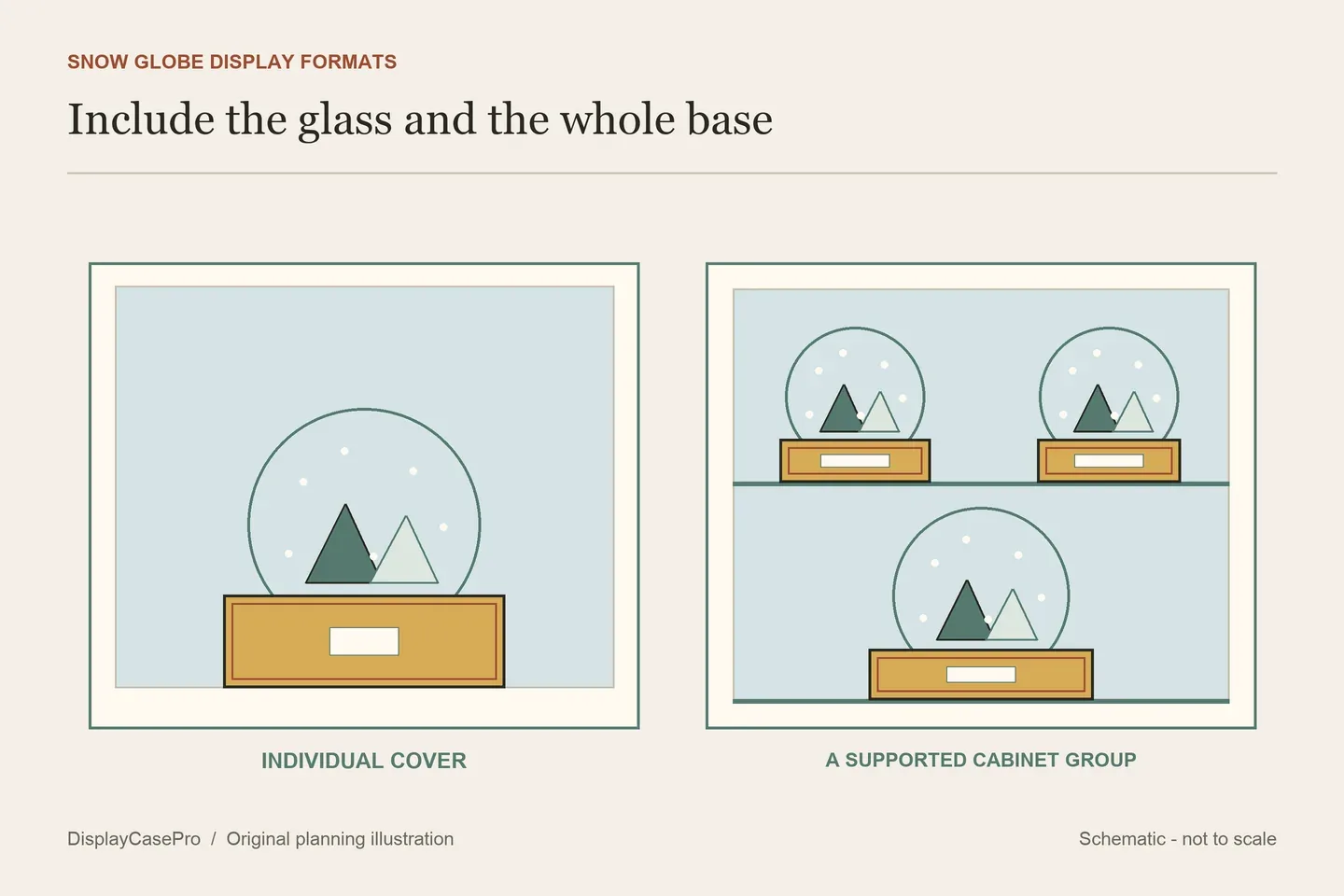
For a finished snow globe, choose a display case that accepts the complete globe and base, supports its actual weight and allows the access you want. Check the glass diameter, widest base, total height and opening route separately. A nominal “100 mm globe” label describes less than the whole object you need to display.
Check that the product is an enclosure for your finished globe
Several different products use the words “snow globe” and “case.” Read the actual contents and function before comparing dimensions.
| Listing type | What it contains | What it means for a collection |
|---|---|---|
| Outer display enclosure | An empty cover or cabinet intended to receive complete objects. | Check its usable interior, support and opening against your finished globe. |
| Factory Direct Craft BUB2096CASE | A bulk pack of 20 plastic DIY globe jars; the description gives a screw cap and seal insert. | These are components for creating globes, rather than protective outer cases for an existing collection. |
| Entertainment Earth FU50814AA | A display case containing 12 randomly selected, individually blind-packaged character snow globes. | The quantity describes merchandise in a retail assortment. Packaging dimensions do not specify an empty home cabinet. |
| Skyline Valley game display | A storage object in Fallout 76. | This belongs to a game. It supplies no physical holder specification for your shelf. |
This guide concerns an outer display for finished physical globes. Keep that task separate from making a new liquid-filled globe or buying a carton of collectibles.
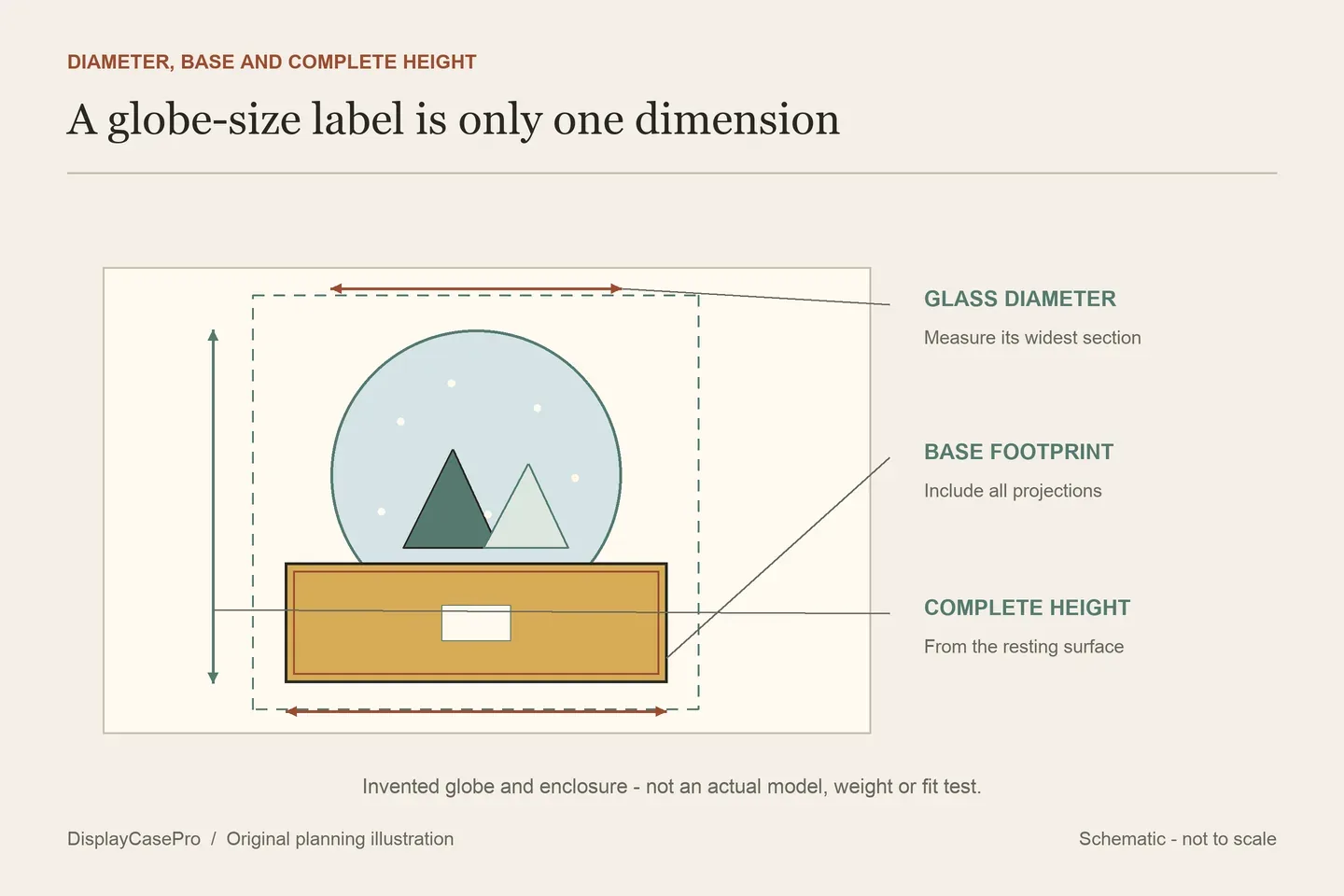
Measure the complete object in its intended resting position
Record the globe's maker and product identity where known, then measure its actual full outline. A decorative base can be wider than the glass. A musical mechanism, switch, nameplate or projecting figure can change the footprint or the access you need.
| Measurement | Use | Limit of the number |
|---|---|---|
| Glass globe diameter | Check its widest glass section. | Does not include the base's width or total height. |
| Base width and depth | Check the supported footprint and projections. | Does not establish the height or suitability of a separate riser. |
| Total height | Check the completed object above its resting surface. | Does not describe the clearance needed to lift a cover or retrieve the globe. |
| Complete weight | Plan against documented shelf and support limits. | Does not prove that a narrow base or local contact point suits that shelf. |
Snow Globe Central's FAQ gives a useful maker-specific example: its glass globe is described as 4 in round, while a finished custom globe on its base is 5.5 in high and approximately 2 lb. The walnut-base version is described as 5 in high and approximately 1.75 lb. Keep each base version's height and weight together. These figures are product descriptions, not our measurements or a standard for all snow globes.
Do not separate a permanently attached base to make a favorite case fit. Snow Globe Central states that its completed globe and base are glued together. Choose a suitable outer enclosure around the intact object.
Choose the display format from the view and access
An individual clear cover
A single cover can give one globe its own visual space. Check every usable interior axis and the admission route. A tall narrow cover may provide plenty of height but insufficient width for the glass or base.
For example, Pioneer Plastics' 048C box states an inner size of 3 3/4 × 3 3/4 × 8 1/4 in. Its height does not make it a suitable published-size match for the 4 in glass globe example above: the clear cross-section is narrower than that stated diameter. This is a rejection of that numerical match, not a physical test or a recommendation to try forcing the object through.
A cabinet group with independently supported globes
Place the widest and tallest complete pieces on a paper plan first. Keep their bases fully accommodated by the intended shelf or support. Shorter globes can have separate rows; a riser can be considered only when its own dimensions, contact and load conditions suit the object.
Arrange the viewing order around documented places, seasons, makers or another clear theme. Leave the important scene and base inscription visible. A higher back row should not require viewers to overlook a front base or reach over several glass globes to remove one.
A rotating featured selection
If the whole collection crowds the cabinet, display a selected group and retain the rest in their identified storage. A place code in the record can connect a displayed globe to its original presentation box. Replacing one seasonal group need not involve repacking every other piece.
Choose the location before adding decorative accents
Keep the display out of direct sunlight. CoolSnowGlobes' care FAQ warns that a globe can concentrate sunlight as a lens and cause a fire, as well as discoloration. A clear outer cabinet or dome does not remove the reason for that placement decision.
Follow the actual globe maker's conditions rather than a universal storage temperature or a claim that placing globes sideways prevents bubbles. This selection guide does not prescribe liquid, seal or bubble repairs. A leaking or unstable object needs attention separately from arranging the display.
Obtain the documented load limit and installation requirements for each shelf. Use the actual complete object weights and include supports and companion items. Do not treat pressing or shaking a shelf as a load rating. If the shelf's specification or condition is uncertain, resolve that before putting glass objects on it.
Use added captions or seasonal details sparingly and independently. Keep the globe's intended support stable and its controls reachable; a loose fabric layer, garland or improvised block should not become an unidentified support underneath a heavy base.
Plan access for the actual functions
Decide whether the collection is mainly viewed, occasionally handled or regularly used for a maker-specified music or light function. Some globes have no such functions: CoolSnowGlobes explicitly says its own globes do not play music, light up or move themselves. Identify your piece instead of adding a control-access requirement that it does not have.
Where controls are present, record where they are and how the maker intends them to be reached. Include any required cable route or removal access in the case plan. Do not dismantle a base or rest the glass against a support to expose an underside control.
Use the blank snow-globe display worksheet to separate glass size, complete base, height, weight and function access. For the finished supported profile, refer to the collection measuring guide.
Common questions
Does a “100 mm” globe need a 100 mm tall case?
Measure the complete piece. A globe-size label does not establish total height with its base, base footprint or clearance for entry and removal.
Is a retail display case of 12 an empty showcase?
Read the contents. The cited character-globe assortment contains individually packaged products; it does not specify a separate cabinet for your existing collection.
Can I put a clear cabinet beside a sunny window?
Choose a location where direct sunlight does not reach the globes, including as the sun moves. The maker's lens warning still applies through a transparent surrounding display.
Comments
Share a display tip or ask a question.