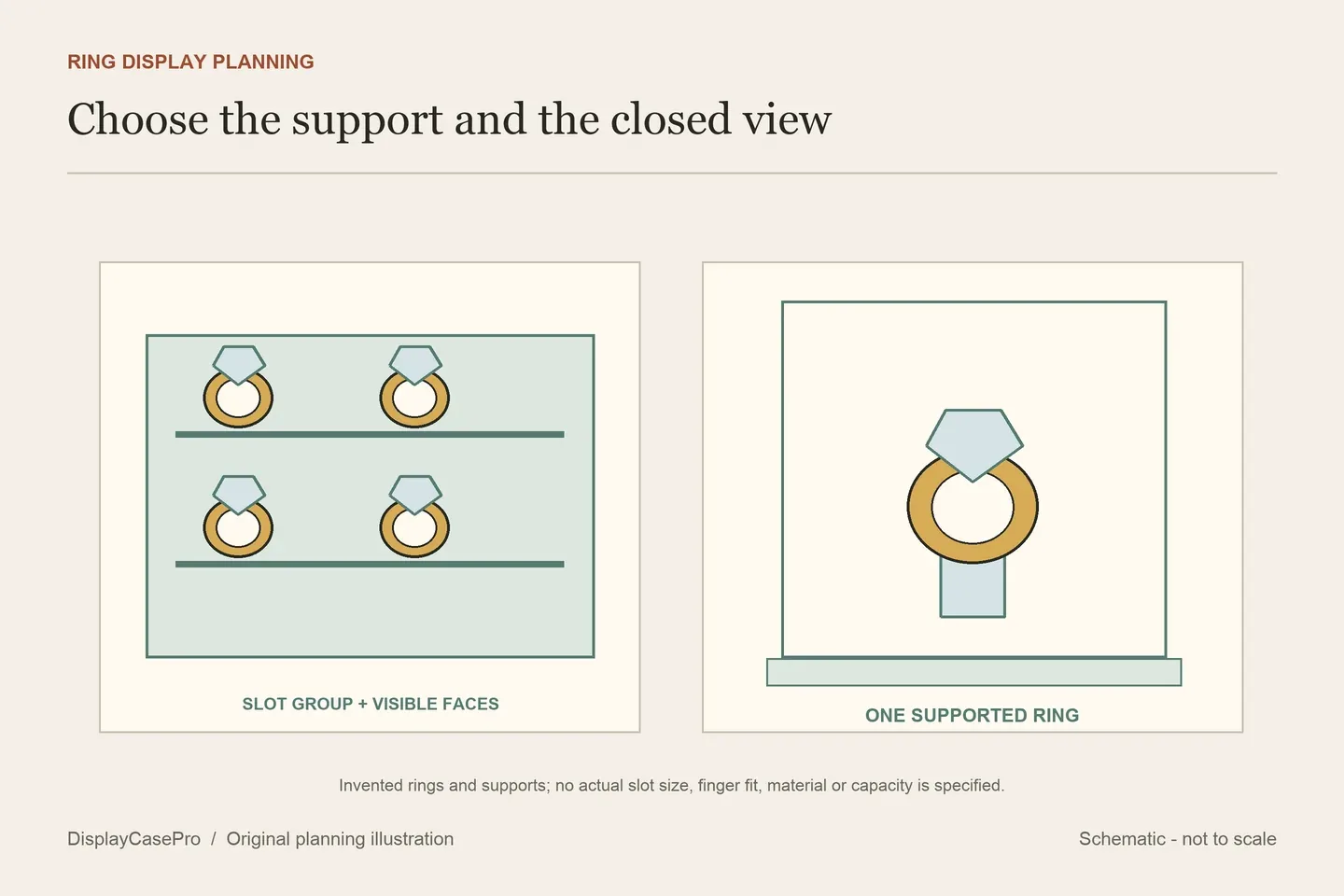
Choose a ring display case by matching the ring to its support, then the supported ring to the enclosure. A thin band, a raised stone setting and a large replica championship ring can need different receiving shapes. Decide which rings must remain visible with the lid closed before comparing advertised capacities.
A ring stand and a ring case are separate choices
Start with the display routine. One meaningful ring can have an individual window case. A collection worn regularly may suit assigned positions in a tray. A retailer's travel case can organize many rings while providing a different closed appearance from a transparent enclosure.
The Jewelry Display ring category mixes foam inserts, finger forms, clips, slots and open trays. Ed's Box also separates finger, slot and clip displays. Those are useful support choices, but a product described as a display does not necessarily include a cover.
| Format | Useful presentation | Check before choosing |
|---|---|---|
| Individual supported ring under a cover | One ring with its face clearly directed toward the viewer. | Actual support fit, complete head projection and clear space inside the cover. |
| Slotted tray or case | Identifiable positions for a changing collection. | Band width, slot construction, neighbouring heads and the closed lid above them. |
| Clip or finger group inside a separate case | Several rings at deliberately chosen heights. | Each support's intended ring fit and the combined group, including its base. |
| Window presentation box | One award or keepsake ring viewed without opening the box. | Ring orientation, visible window, supplied insert and the actual receiving cavity. |
Keep the purpose attached to the chosen product. A window helps viewing; a front clasp provides a closure. Neither fact, by itself, establishes a tested security rating, anti-tarnish environment or suitable travel restraint for your ring.
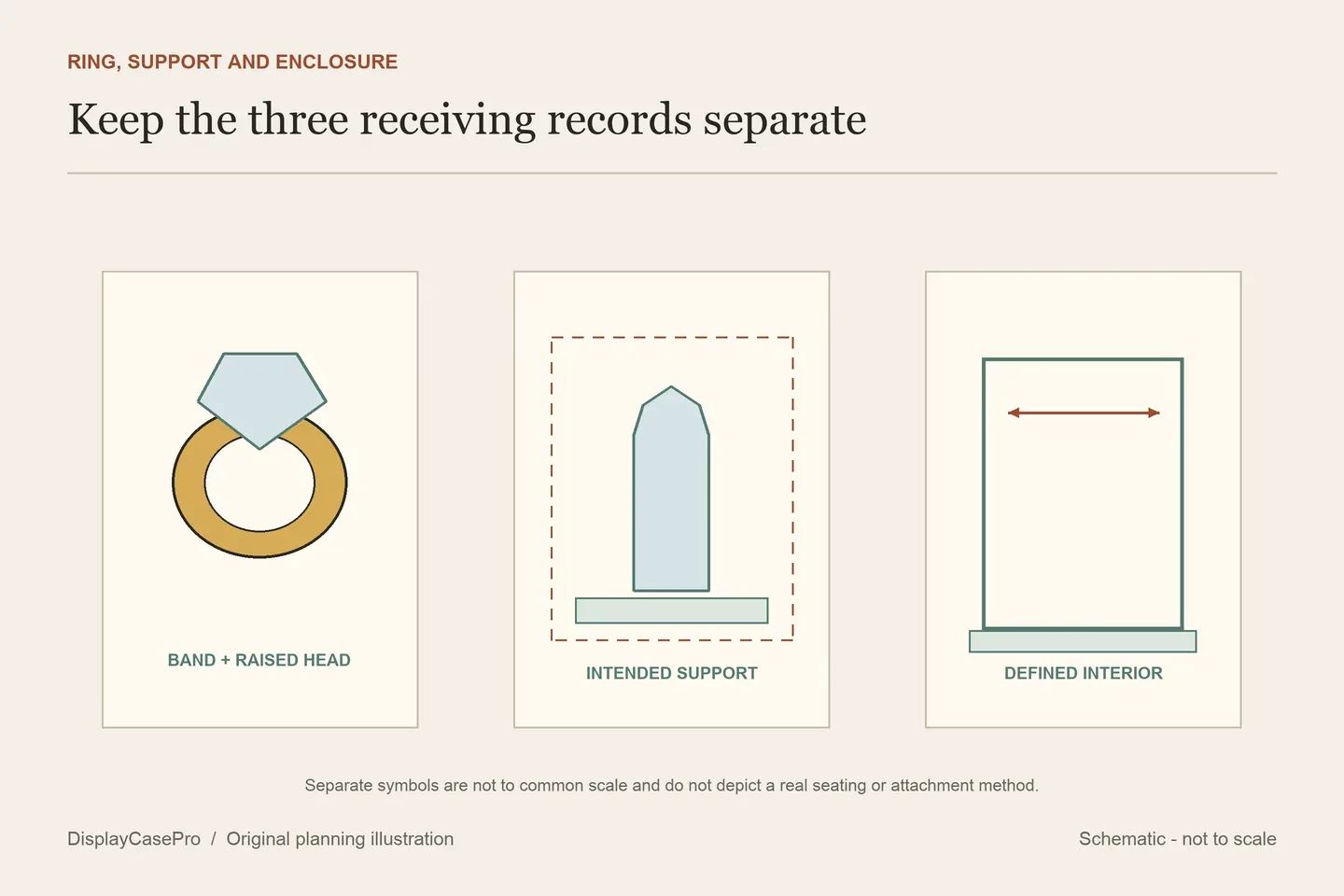
Record the band opening and raised head separately
Identify each ring before laying out the group. Record its band width, opening, highest setting and any broad shoulders or decoration. Keep a left or right projection in the outline if the design is asymmetric. The ring's nominal size alone does not describe that complete profile.
For a slot, ask how the band is intended to enter, rest and release. A broad band can need a different receiving arrangement from a thin band even when their openings are similar. Do not force a setting down to the tray surface to make the lid close.
For a finger form, establish the maker's actual fit instructions. The ring must reach its intended position without being forced over an unsuitable support. Then record the supported height and the head's projection toward the enclosure, rather than treating the empty form's height as the height of the finished display.
A replica or championship ring can have a particularly prominent face. Keep it in the same planning method while checking its own outline. A case sold alongside sports rings has not demonstrated compatibility with every oversized head, band or insert.
Compare an interior, a whole case and a base footprint correctly
The descriptions below were read on 17 October 2026. They are published catalogue specifications, not our measurements or hands-on fit tests. Missing slot dimensions and material conflicts remain questions for the supplier.
| Example | Published information | Question to retain |
|---|---|---|
| Pioneer 020C at Collecting Warehouse | Inside W2.125 × D2.125 × H2.125 in; outside W2.25 × D2.25 × H2.5 in. Seller lists ring sizes 5–15. | Actual ring and finger fit, including the raised head. Resolve the material description. |
| Gems On Display 83-R | 72 wide slots; W15 × D8 1/4 × H1 5/8 in. Leatherette-wrapped wood, foam insert and front clasp. | No numerical slot width or clear height above seated rings is supplied in the description read. |
| Discount Sports Rings single-ring case | Wooden box with black lining and a display window; base 3.75 × 4.25 in and height 4.5 in. | The base and height are not labelled as a complete clear interior. Obtain the actual insert and window arrangement. |
The 020C description gives a complete internal cube, but that cube is not all empty space above the ring support. Its ring-size range also does not establish clearance for every raised face. The numbering system is not identified in the description read, so retain the supplier's fit definition rather than converting it into a universal ring-opening limit.
There is a material inconsistency to resolve: the 020C title says acrylic, while the detailed material line says polystyrene. Do not silently choose one label when material is important to your decision. Ask which material belongs to the exact current SKU and variant.
Count usable positions and visible rings separately
For the 83-R, “72 wide slots” is a nominal arrangement. It does not give the width of a particular slot or the separation between large neighbouring heads. Ask for those receiving details and compare them with your actual rings; dividing the case width by a guessed average ring width does not verify capacity.
Map the intended group with separate ring identifiers. Leave each decorated face visible and give frequently worn rings a practical release route. Two heads can compete for space above adjacent slots even when both bands enter their intended positions.
Record what can be seen with the lid closed. The 83-R description does not specify a viewing window, while the sports single-ring box explicitly describes one. A high-count storage layout and a one-ring window presentation therefore answer different questions. Confirm the chosen case's actual closed view instead of equating stored capacity with visible capacity.
Give worn rings an identifiable return position
Choose the visible selection first, then assign positions. A daily ring, a coordinated group and an infrequently handled keepsake need not share the same access routine. Keep any ring box or associated documentation connected to its record even when it stays outside the display.
Establish how the actual cover opens and how the ring releases from its support. A narrow gap above the setting is not a useful removal route. Follow the selected support's instructions and provide a suitable place for a lifted lid or removable tray.
Use the ring support and visible-capacity worksheet to retain the unresolved dimensions and material label. The collection measurement guide covers placement of the finished display. Resolve contact materials with the actual jewelry and display makers where needed; a soft-looking insert is not a universal compatibility specification.
Common questions
Does a ring-size range establish case fit?
It describes one receiving limit. Check the supported ring's raised head, band width and complete profile as well.
Does a 72-slot box display 72 rings through its lid?
Check the exact closed view and actual ring arrangement. Nominal slots and a transparent viewing window are separate specifications.
Should I use the acrylic title or polystyrene detail for 020C?
Keep the conflict visible and obtain the material of the exact supplied variant from the seller.
Comments
Share a display tip or ask a question.