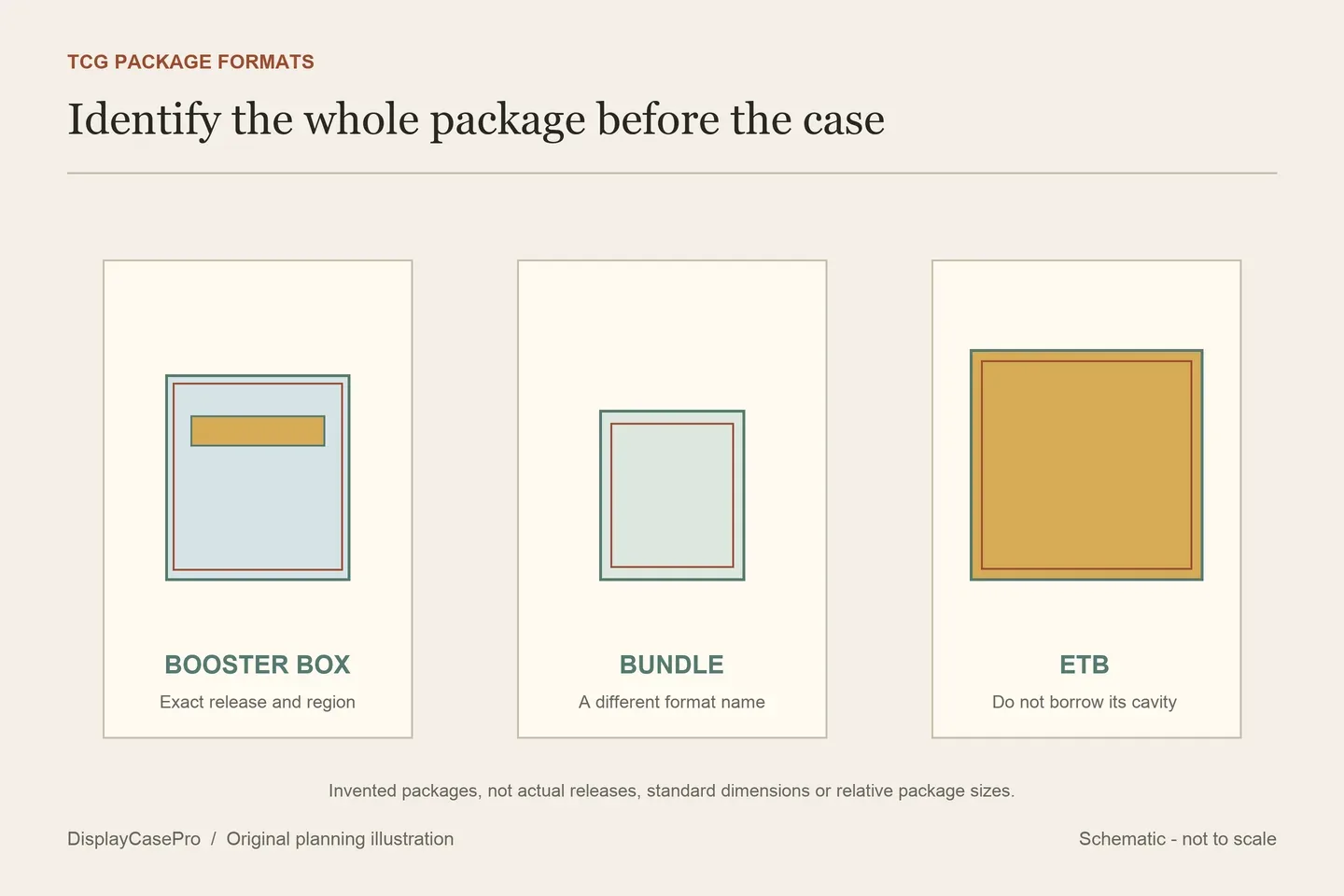
Choose a Pokémon booster box display case for the complete package you intend to keep intact. Record the release, package region and product format before comparing interiors. A booster box, booster bundle, Elite Trainer Box and separately protected card are different physical receiving tasks.
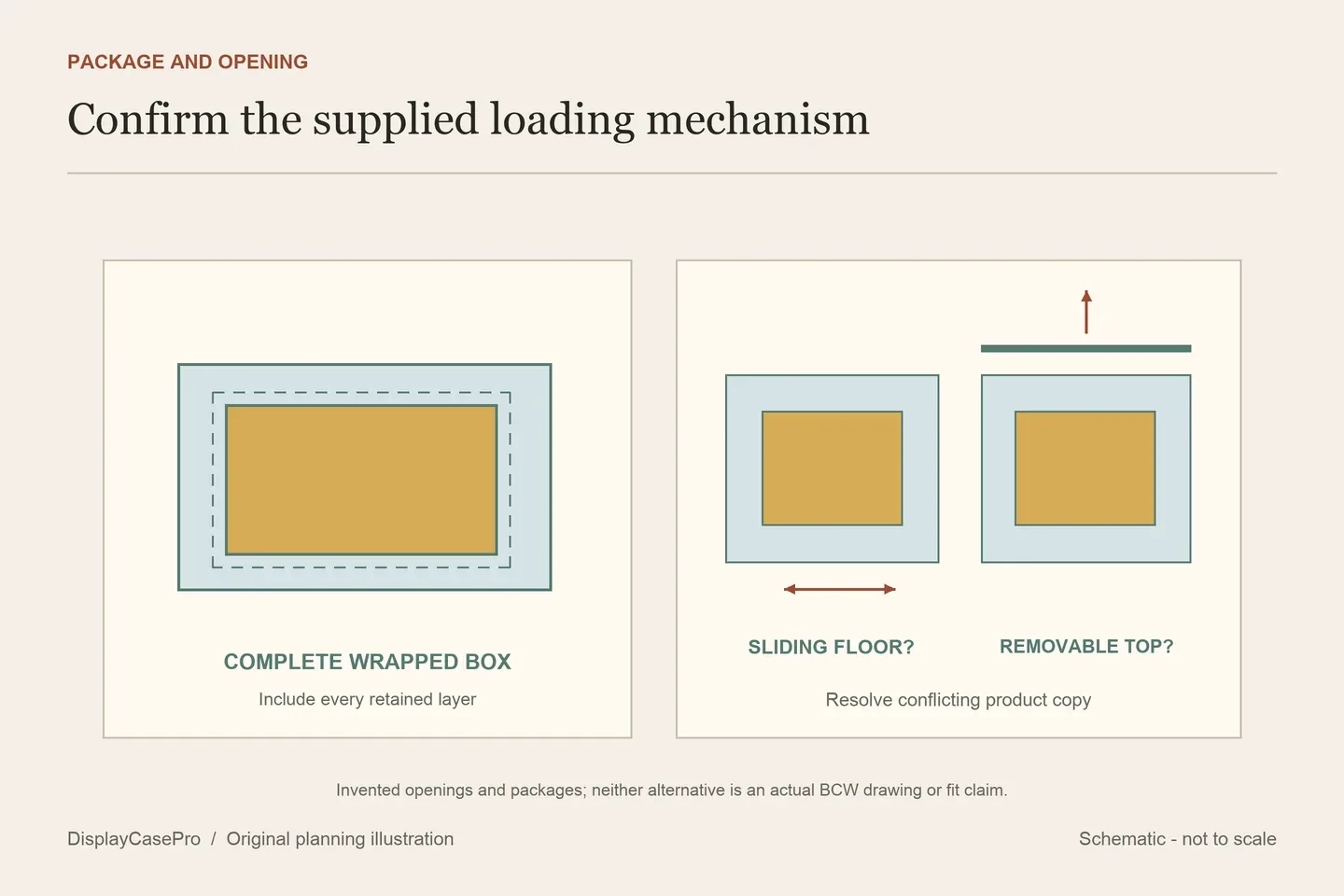
Then check how that exact case opens. An apparently suitable interior does not resolve a sliding floor, removable magnetic top or assembly requirement. One sampled product describes its opening differently in the main text and FAQ, so the loading method needs confirmation alongside the dimensions.
Use the sealed outer box as the receiving object
Write down the product's full name, release and region as documented on the package or purchase record. Note whether it retains its seal, an outer sleeve or another protector. Include all retained layers in the outline rather than using the size of the cardboard alone.
A wrapper fold or projecting package edge belongs in the fit question. Do not smooth, remove or compress it to match a case selected in advance. If you cannot obtain the complete profile without inappropriate handling, keep that dimension unconfirmed and ask for suitable product-specific assistance.
Choose the front you want visible while keeping the package in its intended state. A shop counter box opened for pack sales is a different presentation from an intact sealed box. A display plan should not quietly change between those states because a supplier photograph shows one of them.
“Booster box” is a format name, not one universal size
The Gemloader acrylic catalogue separates booster boxes, Japanese Regular and Special formats, ETBs, booster bundles and new-size bundle products. It also includes packs and graded-card holders. Those cards identify different product families; they do not establish a single receiving standard for everything carrying Pokémon branding.
The TAB homepage similarly separates TCG case families through its retailer and distributor catalogue. Its homepage does not provide a labelled clear booster-box cavity. Request the exact product specification instead of borrowing a dimension from an ETB or graded-card holder elsewhere in a catalogue.
Keep merchant format names verbatim in the enquiry. “Japanese Special” is the name of a selected case here, not proof that every Japanese release has that shape. A later package revision or a retained secondary protector needs its own comparison.
Compare the labelled axes before rotating the numbers
These supplier pages were read in October 2026. The figures are attributed specifications, not our measurements or a compatibility ranking. Where axes are unlabelled, the sequence is preserved as published.
| Case | Inner size as published | Definition and opening question |
|---|---|---|
| Gemloader booster box | 13.5 × 12 × 7.5 cm | Tuple axes unlabelled; magnetic lid. Confirm the orientation and complete package. |
| Gemloader Japanese Regular | 14 × 14 × 4 cm | Tuple axes unlabelled; a separately named magnetic-lid format. |
| Gemloader Japanese Special | 7.4 × 4.7 × 14 cm | Tuple axes unlabelled; do not rotate into another format without the actual loading orientation. |
| BCW 1-BBDC-SM | W5½ × H4⅞ × D3⅛ in | Axis labels explicit; main description and FAQ conflict over the opening. |
| Luna Fabrication booster-box case | 5.5 × 3 × 5 in | Tuple axes unlabelled; assembly required and booster box excluded. |
| Platinum Protectors 6MM case | 5.39 × 3.1 × 4.88 in | Tuple axes unlabelled; magnetic top. Confirm the exact package and intended orientation. |
Do not sort these tuples from largest to smallest and declare equivalence. That loses orientation, access and the location of the opening. Retain each maker's units and labels, then compare the actual box in the confirmed loading and display positions.
Construction thickness is another field. Platinum Protectors describes 6 mm sides, top and bottom, with 4 mm front and back, despite the 6MM product title. Luna specifies 3/16-inch acrylic. Neither material statement is a substitute for clear receiving dimensions or a reason to calculate a missing cavity from an overall size.
Resolve BCW's floor-versus-lid description before ordering
The BCW main description identifies a raised base and slide-out floor. Its FAQ instead describes a magnetic lid and lifting off a lid. Those are different access routes. The read page does not resolve which construction belongs to the current 1-BBDC-SM, so this guide does not choose one on the supplier's behalf.
A useful enquiry is: “For SKU 1-BBDC-SM in the version you will supply, does the package enter through a sliding floor or a removable magnetic lid? Please provide the current assembly instructions, the unobstructed opening and the required removal space.” Keep the reply with the product record.
BCW labels the exterior W5⅞ × H5⅞ × D3½ inches, separately from its interior above. Those outside figures help plan the shelf after the loading mechanism is confirmed. The listing's six-each order configuration is not a six-booster-box capacity for one enclosure.
Confirm fit, contents and shelf use as separate decisions
Record the exact case name and revision, the intended package orientation and the full wrapped outline. Ask for any missing axis labels and the usable opening rather than relying on a photograph of a similar release. Include an existing outer protector if it will stay in place.
Next, establish what must be assembled and what the purchase includes. Luna explicitly excludes the booster box and requires assembly. For any supplier, keep the case, any base, supplied hardware and collectible as separate contents fields. A product photograph should not become an assumed bundle.
Finally, plan where the removed lid, floor or supported case will rest during access. A close row can leave no room for the prescribed opening sequence. A magnetic closure is not a carrying handle, a rated stacking system or evidence that the case may be moved while loaded; obtain the selected maker's actual handling instructions.
The sealed booster-box fit worksheet keeps package format, retained layers, size definitions and conflicting copy together. Use the collection measurement guide for the complete exterior profile. Both illustrations here use invented packages to explain the format and opening questions.
Common questions
Will one case fit every English or Japanese booster box?
Do not infer that from a language or region label. Check the exact release, product format, retained protection and case specification.
Can I use an ETB or booster-bundle case instead?
Only an exact receiving comparison can establish suitability. The catalogue family names refer to different package formats, not interchangeable empty volumes.
Does a thicker acrylic title tell me how much space is inside?
No. Obtain the labelled interior and opening for the selected product. Wall thickness describes construction, and different panels can have different stated thicknesses.
Comments
Share a display tip or ask a question.