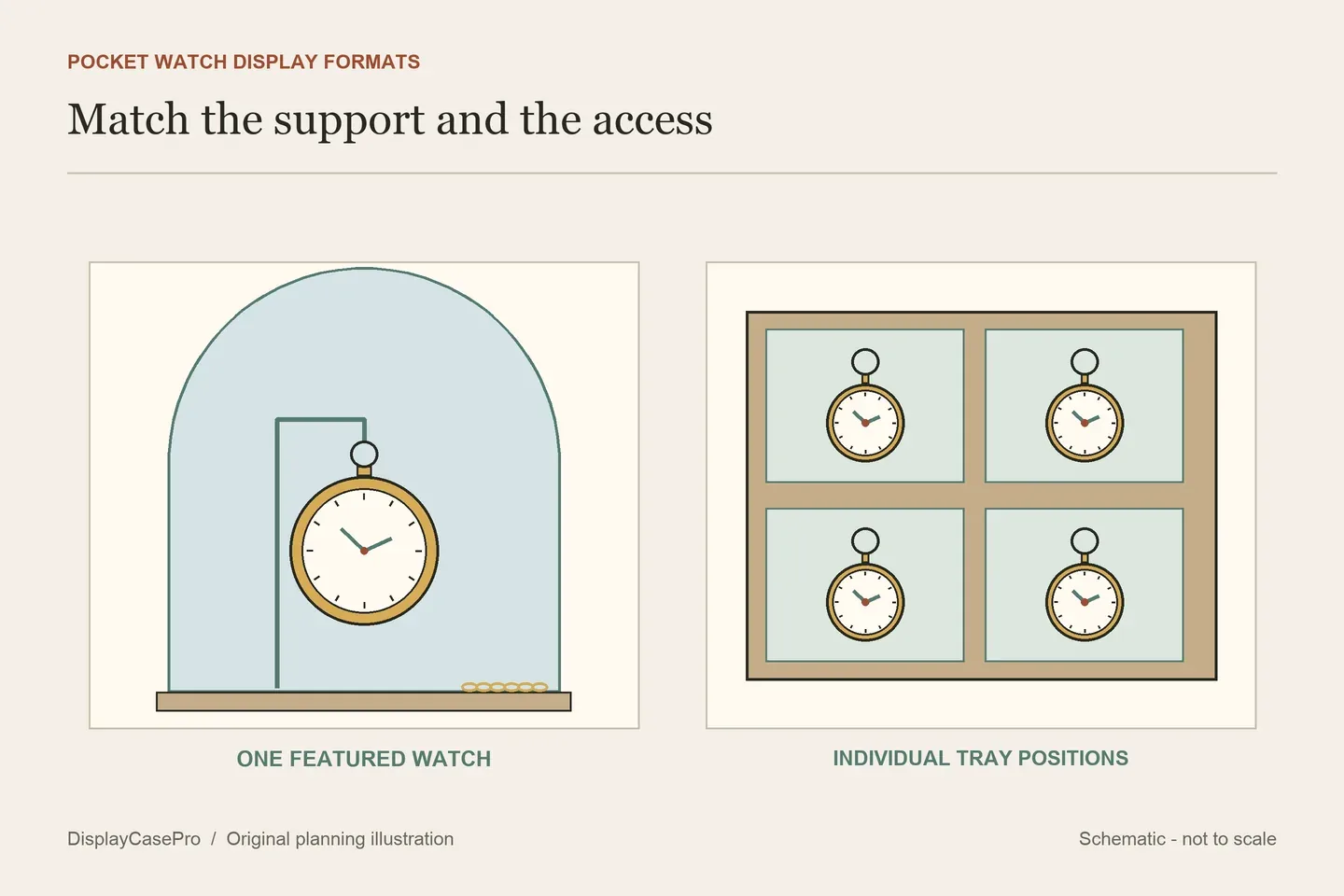
Choose a pocket watch display case around the watch's complete presentation: dial forward, supported by a suitable stand or hanger, with room for its bow, crown, any open cover and the chain you intend to include. A dome, a compartment tray and an open stand provide different access. The watch's case diameter alone cannot choose between them.
Decide what will be visible before measuring
Record the watch's documented maker or identity, case type and condition without opening it solely to fill an inventory. An open-face watch presents its dial differently from a watch with a front cover. If a cover will remain open for display, include its actual intended position in the outline; do not force a hinge wider to suit a holder.
| Presentation | Include in the complete outline | Resolve first |
|---|---|---|
| Dial forward on a stand or hanger | Body, bow, crown, intended attachment and any projecting cover. | Where the support carries the watch and how the dial stays in the chosen view. |
| Watch resting in an individual tray position | Body thickness, cushion or mount, crown and neighboring compartment boundaries. | Whether the arrangement is intended for horizontal use, wall use or both. |
| Watch with a chain, fob or related record | The supported watch plus the separately arranged chain and companion objects. | Space and support for every component, including release without snagging. |
A worn bow, loose cover or uncertain attachment needs assessment before selecting a hanging presentation. A decorative hanger's shape does not establish the condition of the watch's fittings. An alternative supported position can preserve the desired view while the suitability of suspension is resolved.
Choose the access pattern you will actually use
A dome for one featured watch
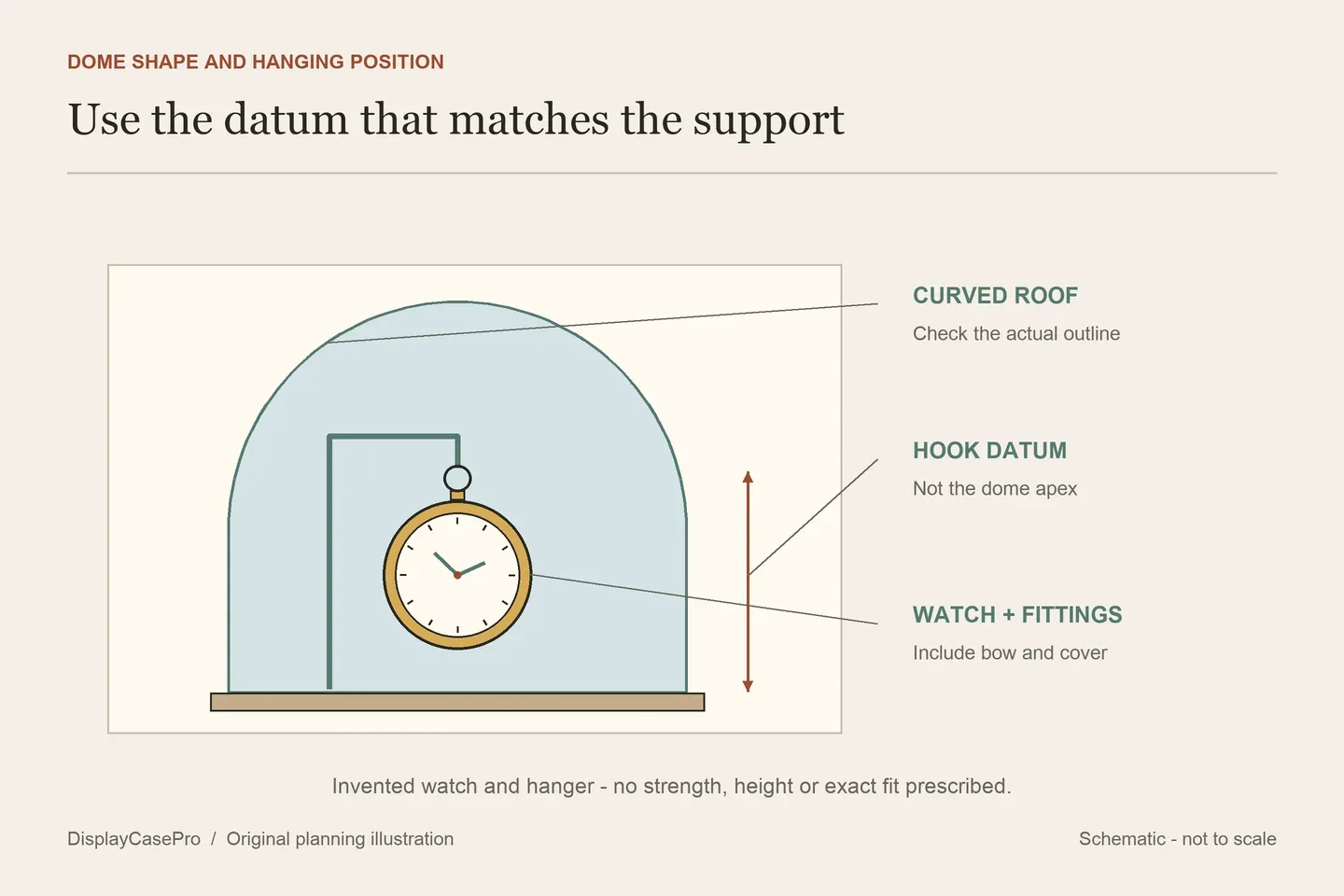
A glass dome can enclose a watch on a hanger or a small stand. Check the complete supported height and width, the curved roof and how the cover lifts away. The listed interior height is not all available below a fixed hook, and the widest interior section may be below the arch.
A divided case for several watches
A compartment tray can keep watches individually positioned and identified. Measure a watch with its cushion or fitting inside the compartment, then check the front closure. A tray's compartment depth and the space over a finished cushion are different references.
If a supplier offers both flat and wall placement, ask how each watch is retained in the selected orientation. A layout that rests satisfactorily on a table should not be turned upright on the strength of a photograph alone.
An open stand for regular access
An open stand avoids lifting an outer dome whenever you take out the watch. It also leaves the watch exposed to contact, so choose its location and any surrounding cabinet deliberately. A stand remains a support; it does not become an enclosed case because it appears in a glass-fronted room display.
Four descriptions show why the dimensions need labels
These examples compare published information. They are not measurements taken by us, a best-product ranking or a tested compatibility list.
| Display | What the source states | What to check for your watch |
|---|---|---|
| Plymor walnut-veneer dome, Dome3x4-PWB+WireG | Exterior 3 in wide × 4 in high; interior 2.75 in wide × 3.875 in high, each with stated ±0.1 in variation. The arch begins at about 2.5 in; about 3 in remains from the base to the bottom of the hook. | The watch's hanging position and full outline relative to the hook and arch, plus the complete base footprint. |
| Pocket Watch Site oak-base dome with clear stand | A nominal 3 × 4 in glass dome, approximately 70 mm internal width and about 4.5 in total height. The text identifies a clear Lucite stand and a pictured watch about 51 mm in diameter. | Supported watch height, stand contact and the cover route. The photographed watch is an example, not a maximum accepted diameter. |
| SAFE eight-watch case, SKU 5907 | Overall 15 × 10 1/4 × 1 1/2 in deep; compartments 3 × 4 1/8 × 1/2 in deep, with removable padded cushions and flat/wall placement described. | The cushion-to-cover clearance, mounting orientation and retention of the complete watch. |
| Clockworks open-face stand, WT28 | The main description discusses hanging an open-face watch on a stand and placing it in a glass cabinet. An additional-information line lists 3 × 3 × 5 in. | Accepted watch and attachment limits are not supplied. The page also has hunter-case subheadings, so confirm the intended model instead of inferring covered-watch compatibility. |
The SAFE page's metric equivalents also need clarification: it pairs the 15 in overall dimension with 375 mm and the 3 in compartment dimension with 78 mm. Keep those printed figures visible when asking the supplier to reconcile them. Do not choose whichever unit gives the more favorable fit.
For the two domes, a similar nominal “3 × 4” label does not establish identical supported space. One description names a hook height and arch; the other gives a total assembly height and a stand. Ask for the dimension that matches the arrangement you intend to use.
Keep the support and chain decisions separate
Identify what the fitting is intended to contact. A hanger, a clear resting stand and a padded tray receive a watch differently. Obtain the supplier's loading and release instructions, and have uncertain historic fittings assessed rather than experimenting with the watch's crown or cover as an attachment.
Decide whether the chain belongs in the visible composition. If it does, plan a separate supported route and enough room for its clasp and any fob. It should not lie across the dial or become an improvised tether that tensions the watch against the stand.
When a chain is stored separately, connect its location to the watch record. A short caption can explain that relationship without forcing both objects into a small dome. Keep documents and photographs on their own supports in a larger arrangement.
Check the removal sequence before completing the group
- Prepare the intended receiving surface. Have a suitable place for the watch and the lifted cover before opening the display.
- Check the case opening. Establish whether the dome lifts vertically, a door swings or the tray comes out.
- Release the watch as directed. Ensure the fitting can be reached without catching the crown, cover or neighboring chain.
- Check the return position. The dial should return to its intended view without pressing against the glazing.
- Review repeated positions individually. A larger bow, thicker case or different cover can make one watch unlike the rest of a nominal eight-watch group.
Use the blank pocket-watch display worksheet to record presentation, fittings, chain, arch and access. The general collection measuring guide helps with the finished supported outline.
Keep operation and servicing questions with the watch's own instructions or an appropriate watchmaker. A general display article's suggestion to keep every watch wound is not a substitute for advice about an individual mechanism or its condition.
Common questions
Will a 3 × 4 inch dome fit my pocket watch?
Check the internal shape and actual fitting. The arch, hook height, stand, crown and intended cover position can matter more than the nominal outer label.
Can I display the front cover open?
Plan around the actual cover position only when the watch and its support are suitable for that presentation. Do not use the dome or frame to hold a reluctant hinge open.
Should the chain hang from the watch?
Resolve its support separately. Include it only when the intended arrangement accommodates the complete chain and fob without snagging or tensioning the watch.
Comments
Share a display tip or ask a question.