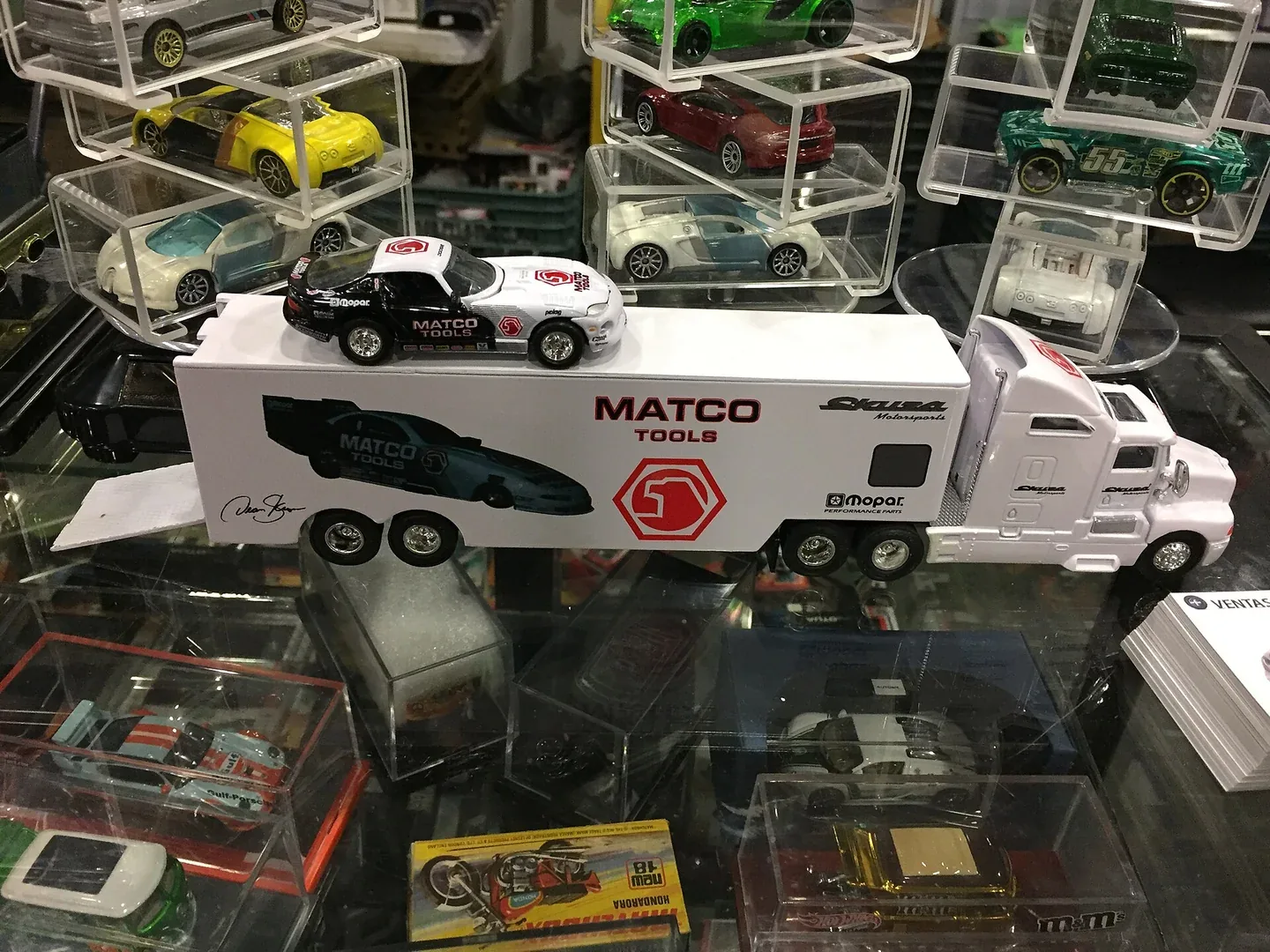
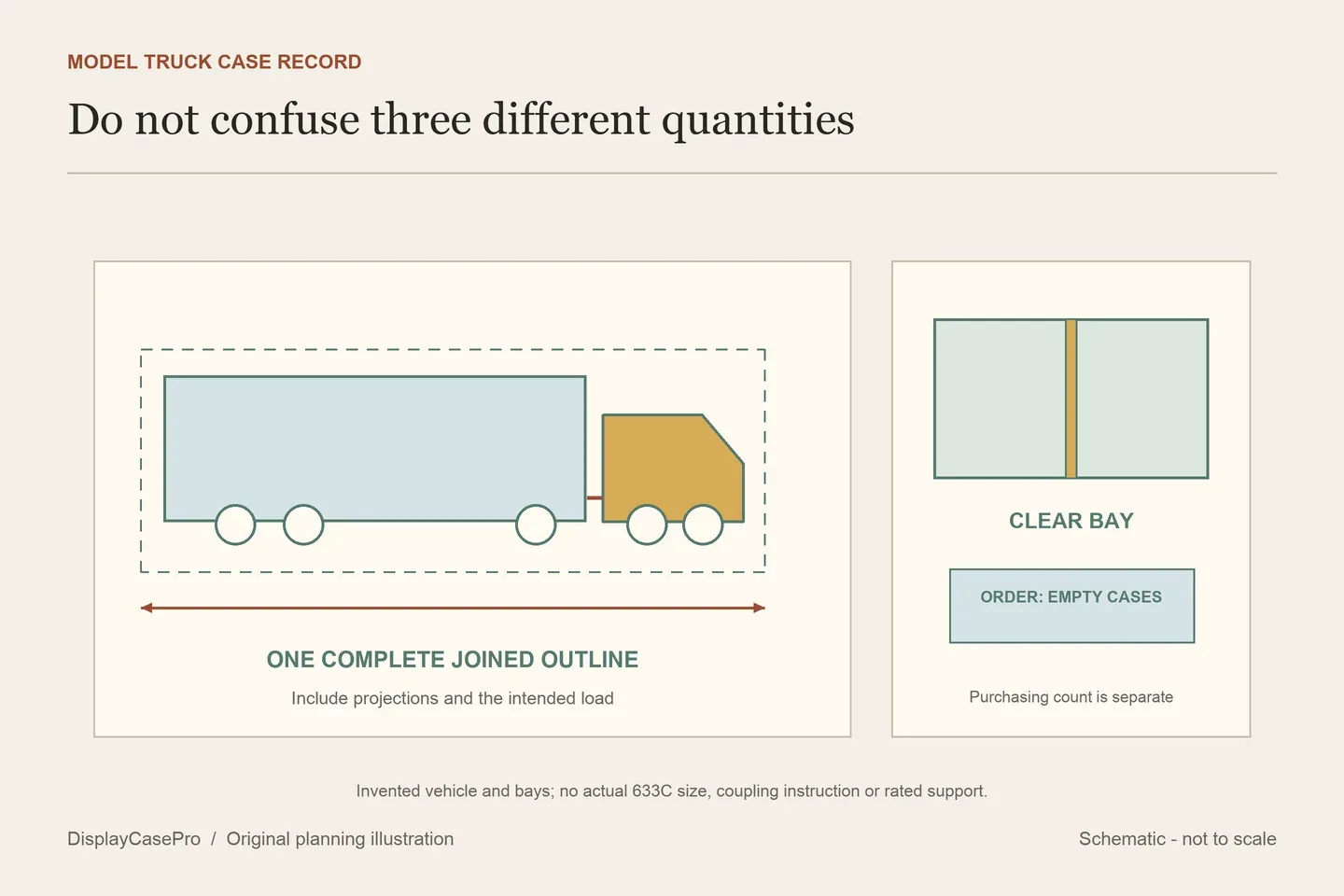
Choose a model truck display case around the complete vehicle arrangement: a rigid truck, a tractor joined to its trailer, or a hauler with its displayed load. Then compare that outline with a single cover or an actual cabinet bay. A 1:64 label does not tell you the complete length or the clear compartment size.
Keep three counts separate: models you want to display, positions that receive those models, and empty cases supplied in an order. “Case of 12” can describe a shipping quantity rather than a twelve-truck display.
Keep tractor, trailer and load in one display record
Identify the truck maker, release and stated scale, then record the trailer or other associated unit. Decide whether the vehicle stays joined, whether its wheels are in the intended display position and whether a load remains on it. Use the model’s instructions for handling and configuration.
Measure the complete chosen arrangement rather than adding body lengths from separate catalogue entries. A coupling gap and projecting equipment belong to the final outline. Include mirrors, an exhaust, a cab accessory or a load wherever it extends beyond the main body.
Choose the view deliberately. A straight side view can keep a trailer’s livery visible along a narrow row. An angled arrangement changes the occupied width and depth, even when the truck itself is unchanged. Record that angle as your chosen layout, not as a reduction in the manufacturer’s required receiving space.
For a car-carrying hauler, decide which models are actually part of the scene. The carrier and its load need their own support and handling requirements. A photograph of several vehicles together does not establish how they are secured or the load accepted by another model.
633C has two different published internal size lines
These source descriptions were read in October 2026. They are not physical measurements by DisplayCasePro. The table preserves the original definitions, including a disagreement that should be resolved before ordering.
| Exact source | Published dimensions | Meaning and limit |
|---|---|---|
| Pioneer Plastics 633C | Inner: 15⅝ × 3⅝ × 3 in. | Axes are not separately labelled in this tuple. Keep the exact SKU and ask for a labelled receiving drawing. |
| Collecting Warehouse 633C | Inside W15.625 × D3.5 × H3 in; outside W15.75 × D3.75 × H3.5 in. | The internal second figure differs from the manufacturer’s tuple. Do not silently substitute one for the other. |
| Carney 64-14 Hauler | Overall W30 × H23⅞ × D3 in; divided compartment W14¾ × H3¼ × D2¾ in. | The compartment line applies when ordered with dividers. It is not the same receiving shape as the single 633C cover. |
Ask the supplier to confirm which specification applies to the exact item they will ship. Do not average the two 633C tuples or turn the smaller figure into a tested minimum. A model near the disputed boundary needs a resolved drawing and complete profile, not a guess about which page is newer.
For a base-mounted model, include the actual base as part of the receiving task. For the location on your furniture, use the complete exterior of the chosen case. Neither the truck’s length nor an interior tuple supplies the total outside footprint.
Acrylic wording and polystyrene detail are not the same claim
The Collecting Warehouse page uses “acrylic” in its title, while its detailed material line says polystyrene and notes a visible mould mark. Retain that conflict in your enquiry. Transparent appearance does not resolve the material, and the article does not silently rename the supplied item.
The same page explains that “Mailer Box” refers to brown shipping packaging instead of a retail box. It does not mean that the displayed enclosure is cardboard. Keep the enclosure, base and delivery packaging in separate fields.
Pioneer’s 633C page distinguishes premium retail packaging with background images from economical shrink-wrap packaging. Confirm the selected package if a background matters to your scene. Do not assume every retailer’s mailer version includes the same presentation inserts.
Compare a divided bay with an undivided shelf
Carney’s truck category offers several nominal capacities, but the exact 64-14 page supplies the more useful distinction: divided or undivided shelves. Its stated divided compartment is shorter than the full cabinet width. Removing that divider option does not automatically establish a new clear shelf length; obtain that figure separately.
Assign complete haulers to the actual bays. A long tractor-trailer combination may need a different position from a short rigid truck at the same scale. Do not count a divider as a suitable break in the model unless you intentionally plan two separately supported, identified units.
The 64-14 listing also describes an optional free-standing arrangement requiring its specified 1/43-scale case stand. Keep that option with the exact cabinet; do not mistake the HESS stand listed elsewhere in the category for an included universal support.
For a wall installation, use the selected cabinet’s instructions for the actual location and loading. A door, transparent panel or nominal truck count does not establish a loaded wall rating. This guide has not tested fixings or prescribed an installation method.
Check what “case” means in the order
The Diecast Direct Pioneer catalogue includes single truck-case formats and a 633C “Case of 12” entry. Pioneer also labels its own carton quantity. Those are purchasing distinctions, separate from the number of complete trucks a display receives.
Keep the selected SKU, mirrored or plain configuration, packaging option and units ordered together. A twelve-case carton is not a cabinet with twelve suitable hauler bays. Likewise, a vehicle or model trailer appearing in a mixed catalogue is not necessarily an enclosure at all.
Before loading, check the prescribed door or cover route with the empty display. Establish whether the complete hauler can enter and leave without using a mirror, coupling or projecting accessory as a handle. Plan where the removed cover rests and how neighbouring models remain undisturbed.
Use the blank truck-case comparison record for the joined arrangement, disputed specification, exact bay and quantity ordered. The collection measurement guide covers the general envelope method.
Common questions
Will any 1:64 car case fit a 1:64 truck?
Compare the actual complete truck and the exact clear receiving space. A small car cover and a long-hauler cover serve different outlines despite a shared scale label.
Does “14 trucks” guarantee my fourteen haulers fit?
It is the maker’s nominal capacity. Assign your actual joined vehicles to the selected divided or undivided layout before accepting that count.
Which 633C internal figure should I use?
Retain both cited descriptions and obtain clarification for the exact supplied item. The disagreement has not been resolved by a physical measurement in this guide.
Cover photo: Kenyirotsuru, Diecast Convention, Mexico 2017, CC BY-SA 4.0. Proportionally resized and compressed to WebP under the same license, with full framing retained. The photographed truck, carrier and car do not establish scale, measured fit or an approved support/load arrangement.

Comments
Share a display tip or ask a question.