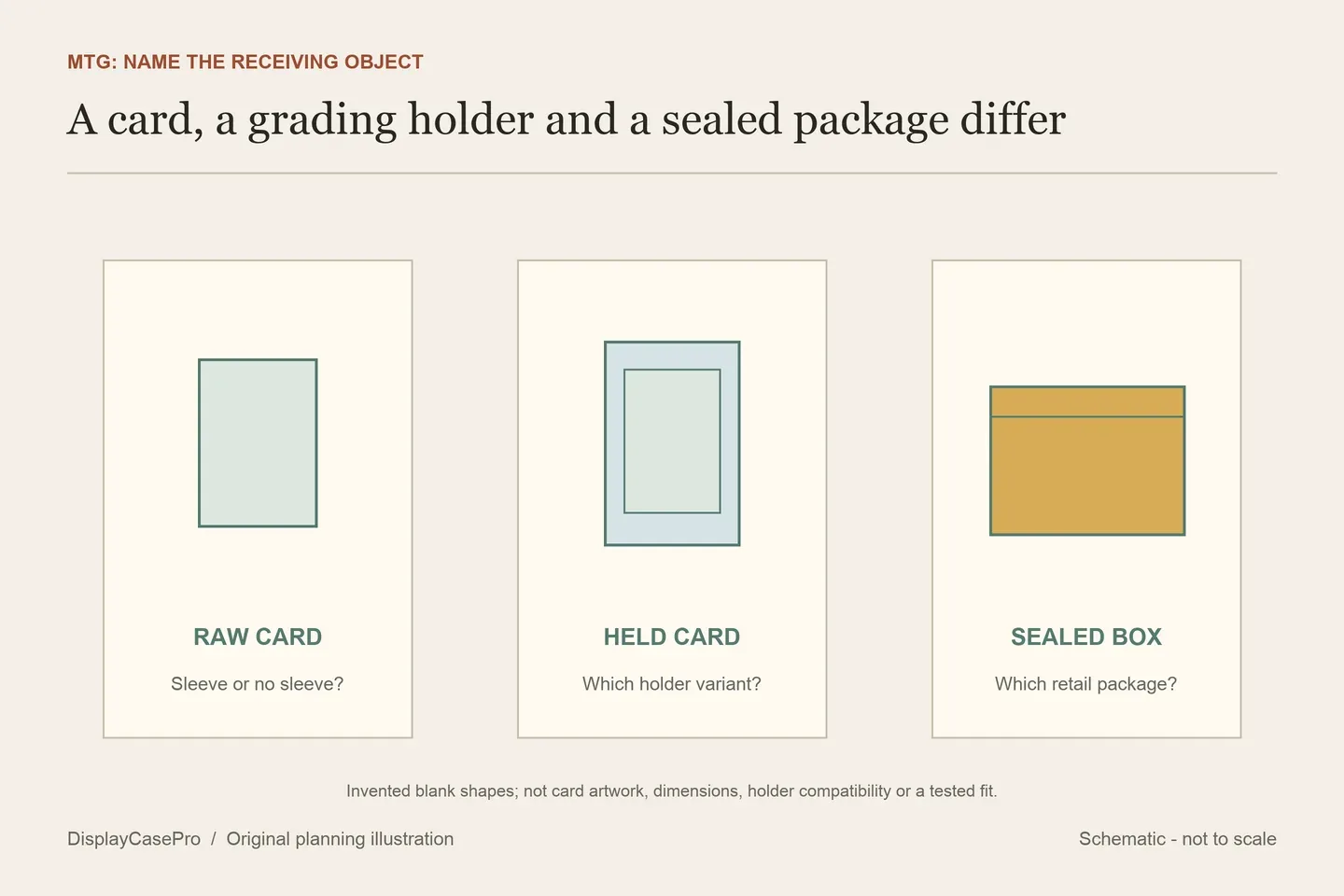
An MTG display case might receive one loose card, a grading holder, an extended-art surround or an unopened retail box. Start by naming the object that enters the case. A product made for a Booster box answers a different question from a slab made for an individual card.
Which part of the collection are you displaying?
Write one of four descriptions before shopping: a raw card without a sleeve; a sleeved card; a card already enclosed in a named grading holder; or an exact sealed retail package. Add the edition, any retained packaging and the orientation you want to see. “Magic: The Gathering” identifies the game, not the thickness or receiving profile.
Then name the next layer. A rigid card slab may itself sit in a frame or podium. An extended-art display may surround a grading holder rather than replace it. A box cover receives the retail package as a whole. Keeping these layers separate helps you read descriptions that use “case,” “slab” and “display” for different objects.
What the available formats actually tell you
| Source and format | Published detail | Confirm before ordering |
|---|---|---|
| Wicked Brick Card displays | Frames, individual slabs, podiums and frame/bracket options appear in the range. | The receiving layer and exact compatible card holder for the selected product. |
| Luna Fabrication MTG Bundle cover | Inside 7.5 × 5.5 × 3.5 in; press-fit construction. Box excluded. | Which dimension is length, width and height; exact Bundle package. |
| TCG Protectors Collector Booster covers | 8 mm acrylic and magnetic-lid products; no cavity dimensions in the category text read. | Exact edition, box profile, internal space and opening method. |
| GeeksStop Extended-art displays | Ungraded and named grading-holder options, including Traveling Chocobo designs. | Exact grading-company variant and whether card or slab is supplied. |
| Star City Games Booster box display | Designed for a box measuring H5 × W8 × D2.75 in. | The case’s usable cavity; those figures describe the receiving box. |
These are source-specific descriptions, not a tested ranking. Some category labels are inconsistent: the TCG Protectors main text includes a Pokémon heading, and the Star City product has a Pokémon category label alongside an MTG title. Use the actual product description and ask for confirmation where labels disagree; a breadcrumb cannot establish compatibility.
Check raw cards, grading holders and outer art separately
Wicked Brick’s five-slab pack is a useful example of a precise receiving limit. The maker describes five individual slabs, each for an unsleeved card up to 35 pt, with an internal area of 64.5 × 90 mm. The pack count is five separate holders; 35 pt is a thickness rating, not a card count.
The stated limit is for an unsleeved card. It does not confirm that a sleeved card, a thicker special card or a grading holder fits. Do not squeeze another layer into the stated space or treat the two planar dimensions as a complete thickness specification. If you intend to keep a sleeve, ask about that exact sleeve-and-card combination before choosing the holder.
GeeksStop’s blue Traveling Chocobo graded display makes a different distinction. Its options name PSA, TAG, CGC and Beckett BGS holders. The card and grading slab are excluded, and an ungraded version is listed separately. Select the actual holder variant rather than assuming “graded” is one universal outer shape.
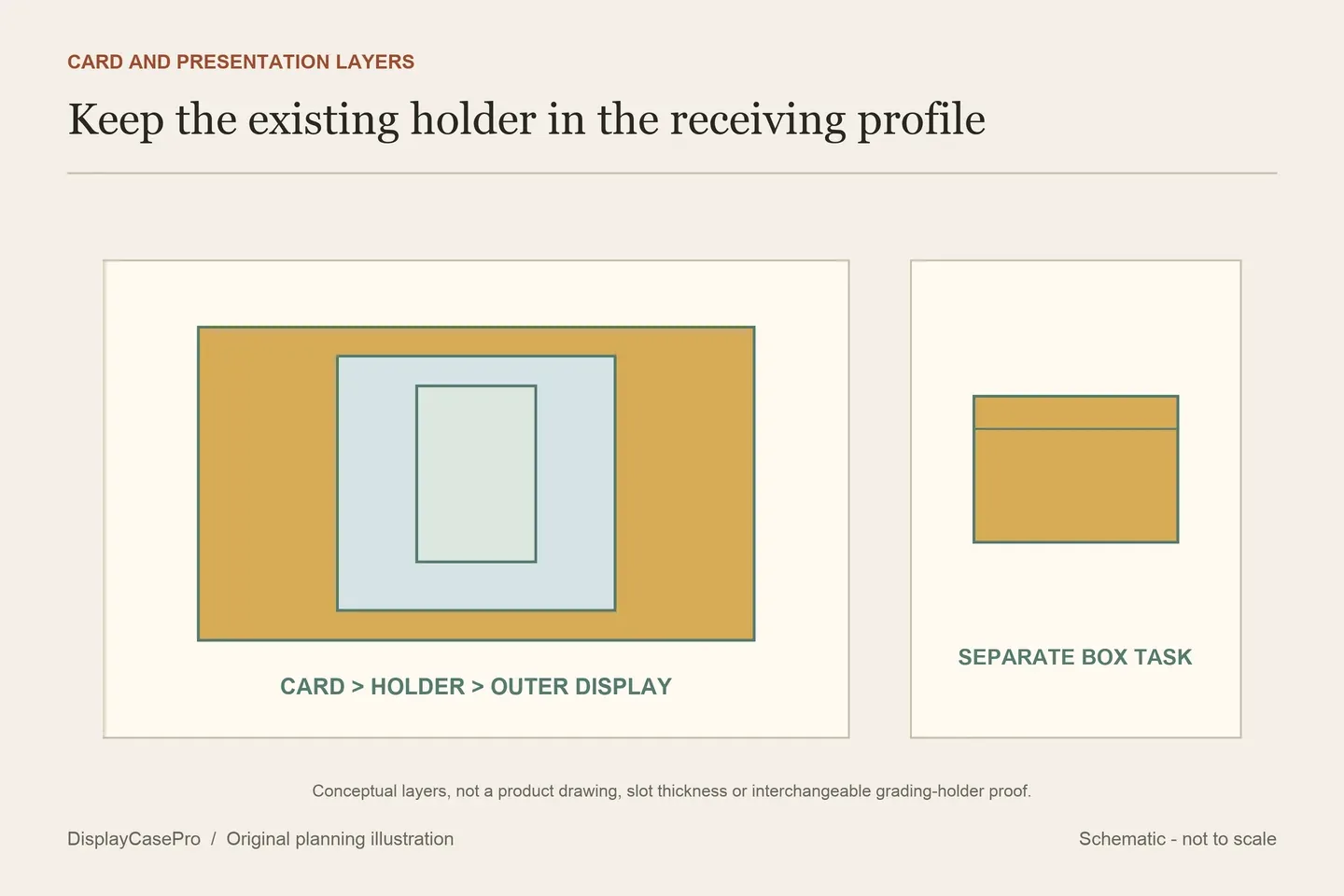
For an art surround, record which card edition and border treatment the design depicts, as well as the grading-holder option. Matching the art does not verify the cavity. Matching the cavity does not mean the card or holder comes with the display. Keep both questions in your order notes.
A Bundle, Booster box and Collector Booster box are different tasks
Copy the full retail package name from the box you own. Include the release and package type rather than using “MTG box” as the specification. A maker’s Bundle case and a Collector Booster cover should remain separate candidates until each is matched to your actual package.
Luna publishes inside dimensions, but without labelled axes in the text read. Star City instead describes the dimensions of the box its product is designed to receive. Those two statements cannot be compared as though both were case interiors. Ask for a dimensioned drawing showing the clear receiving space, lid construction and any base intrusion.
Measure the package in its retained condition, including a protective outer layer if you plan to keep one. Record protruding folds or closures rather than compressing them to reproduce a nominal listing. The existing collection measurement guide provides the general method; the MTG-specific decision is which retail package and layers belong in that measurement.
Keep opening and presentation in the same plan
Decide whether you will regularly exchange individual cards or mainly view a sealed package. Ask how the selected cover opens, where the separated lid rests and whether fingers can reach the holder without dragging it against the display. A magnetic closure describes a connection, not a guarantee of airtightness, conservation performance or loaded stacking strength.
For a row of cards, make labels distinguish the card edition from the display variant. For sealed products, decide which face carries the information you want to read. Check the complete case footprint on the shelf, not just the inner receiving rectangle. Confirm any stacking instructions for the exact product and base; a category photograph is insufficient evidence for a loaded arrangement.
Download the MTG display worksheet to record the card or box, sleeve or grading holder, published thickness limit, selected outer display, labelled cavity, excluded contents and unresolved questions. Leave unconfirmed fields blank rather than treating a marketing claim as a measurement.
Common questions
Does a graded-card art display include the card?
Check the exact listing. The GeeksStop example above explicitly excludes both card and grading slab. A display shown around a valuable card does not by itself establish either item as included.
Can I use one sealed-box case for every MTG release?
Only an exact package match or a confirmed dimensional comparison can support that decision. The package type, release, retained wrapping, receiving cavity and opening route all matter; the game name alone does not.
Comments
Share a display tip or ask a question.