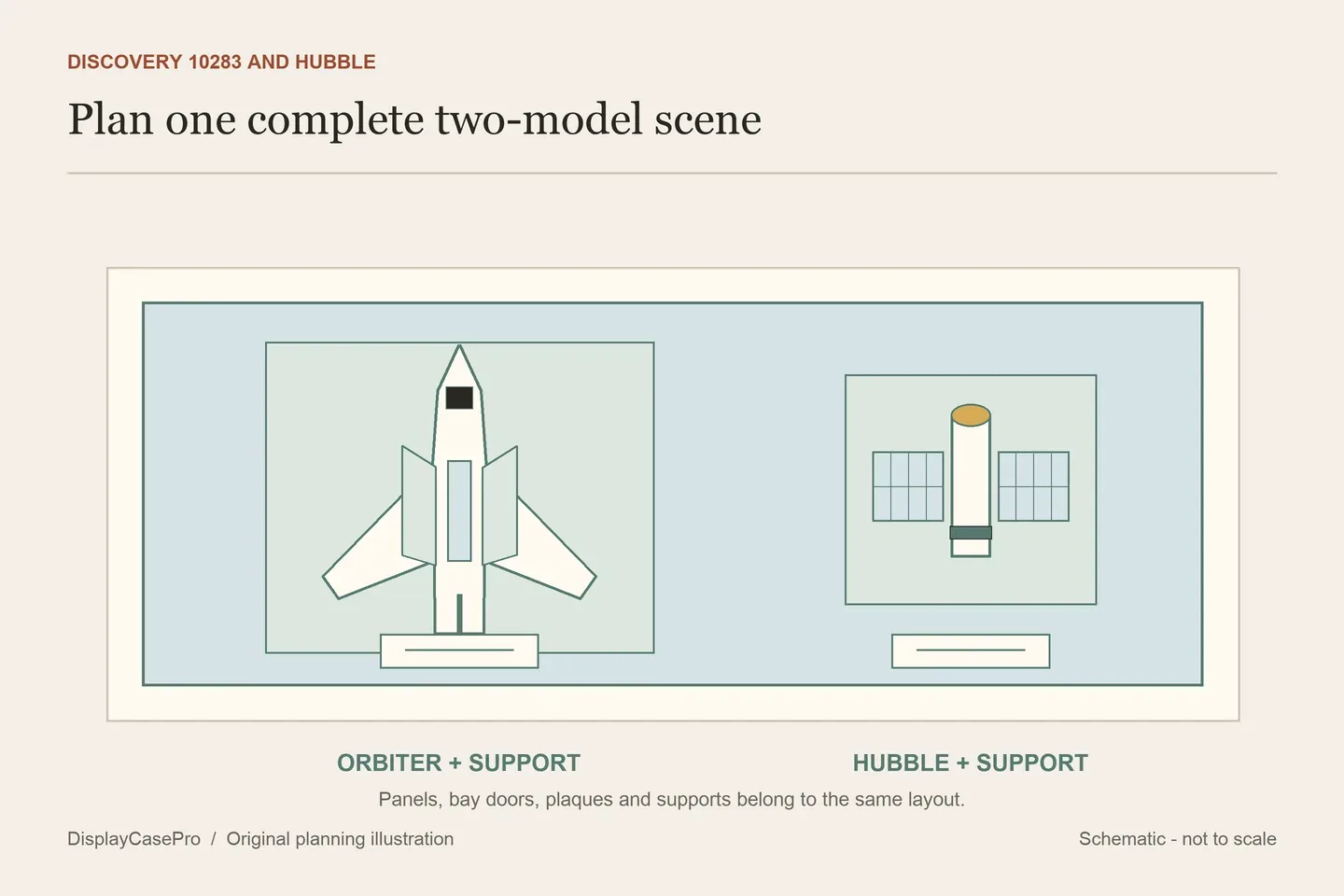
A LEGO Space Shuttle display case for Discovery 10283 needs to accommodate the scene you choose for both the orbiter and Hubble. Decide whether the telescope is stowed, presented above the payload bay or displayed separately, then check the supports, solar panels, plaques and full outline together. The shuttle's published dimensions alone do not describe that complete arrangement.
Use 10283 rather than the general Space Shuttle name
LEGO's official Discovery 10283 description includes the shuttle, Hubble and multiple stands for displaying them individually or together. The shuttle has opening payload-bay doors, a robotic arm, landing gear and movable surfaces; Hubble has movable solar panels and an aperture door.
The descriptive model reference is over 21 cm high, 54 cm long and 34 cm wide for the shuttle. It is not a dimensioned drawing of the entire telescope-and-orbiter scene on every available stand. Keep that distinction when reading a case advertised as compatible with the set.
NASA display categories can contain Saturn V, Lunar Lander, Space Shuttle Discovery and Shuttle Carrier Aircraft products together. A frame for 10360 is not a fit specification for 10283. Begin the enquiry with the exact set and the components you intend to enclose, rather than sending only a “Space Shuttle” product name.
Choose how Hubble will relate to the orbiter
The position of the telescope affects more than the height. Its solar panels can occupy space beside the shuttle, and the robotic arm and open bay doors can extend the combined profile. Record the model in the supported state you want to leave on display, following the actual set and support instructions.
| Intended scene | Include in the outline | Ask the case maker |
|---|---|---|
| Hubble stowed | The chosen bay-door, solar-panel and shuttle-support state. | Which closed or open model configuration does the supplied layout assume? |
| Hubble above the bay | Telescope, panels, arm and the support that actually holds the telescope. | Is that support included, and is the illustrated deployment specifically accommodated? |
| Hubble displayed separately | Both models, both complete supports, all plaques and the space between them. | Where do the support bases and plaque positions sit on the usable floor? |
Do not assume the model's arm is the load-bearing support in a supplier photograph. An enclosure can provide a separate stem for that presentation. Ask which component carries Hubble and which parts merely form the visible scene.
Also decide whether you want the plaques side by side at the front or located in prescribed cutouts. A plaque placed outside its intended position can compete with a support base or extend the overall depth. Mark it on the same plan as the two models.
Compare the cavity and the complete outside separately
The following specifications were read in October 2026. They illustrate differences in the information supplied, rather than a tested ranking. No amount of apparent spare height proves that every telescope and panel position is supported.
| Exact listing | Published size | Definition and unresolved check |
|---|---|---|
| Wicked Brick | External W59 × D39 × H34.3 cm. | Clear interior is not given here. The product describes two Hubble stems and cutouts for both LEGO plaques. |
| iDisplayit | Inside L65 × W39 × H36 cm; outside L67 × W41 × H37 cm. | The cavity and furniture footprint are distinct. Confirm the intended supports and exact two-model arrangement. |
| Kingdom Brick Supply | Approximate inside L64.8 × W39.2 × H32.8 cm; outside L66.3 × W40.7 × H33.7 cm. | Keep the approximate figures and axes. The separate 80 × 48-stud statement is not a profile for the complete posed scene. |
| FantasMall | 60 × 40 × 40 cm. | The FAQ calls the labelled dimensions internal. Confirm the selected support arrangement and exact finished exterior. |
The two labelled interiors with lengths around 65 cm have different heights. That is a reason to check the actual layout and support datum, rather than declare the taller one a necessary minimum or the shorter one unsuitable. The correct comparison uses the same supported pose and the usable space above the floor where it rests.
Likewise, Wicked Brick's 34.3 cm external height cannot be compared directly with another brand's inside height. Do not subtract a base thickness and call the result a verified cavity; the tiered base, cover seating and fittings need their own dimensioned specification.
The FantasMall FAQ also describes a nonremovable painted background. Consider whether that suits the side from which you want to see Hubble and the payload bay. Treat the metric figures as one published set; do not mix the rounded inch equivalents into a precise clearance calculation.
A supplied Hubble stem is part of a particular layout
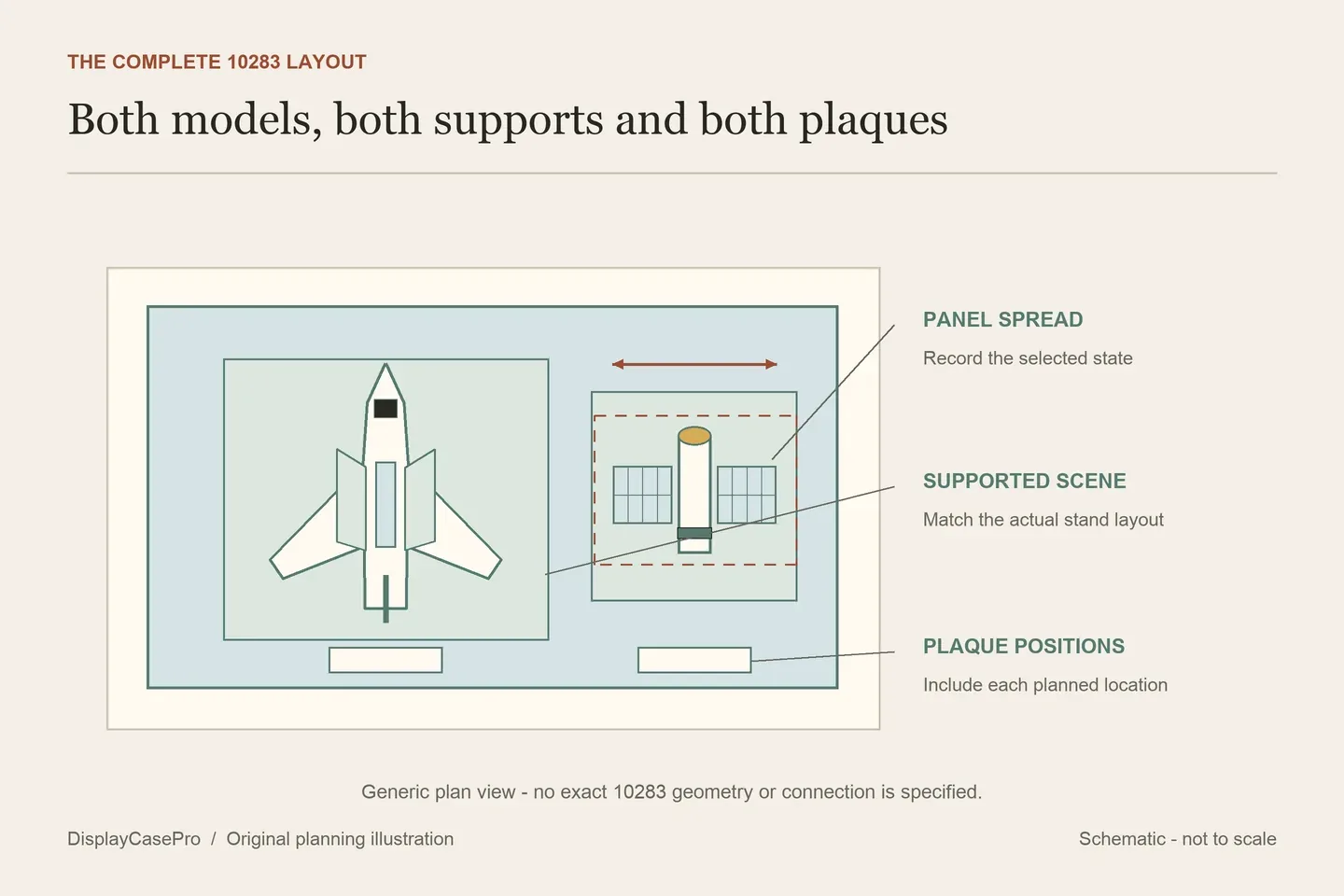
Wicked Brick explicitly describes two additional clear stems for Hubble in a floating position, along with two cutout areas for the set's plaques. Those features help identify the intended composition. They do not show that the original LEGO stands remain in every position or that Hubble can be placed anywhere in the enclosure.
Request a view of the finished supported arrangement for the exact case option. The drawing should show which stand or stem belongs under each model, the panel orientation and the plaque locations. Keep the quoted supports with the order record so a base-only photograph is not mistaken for the full package.
For another maker's case, ask the same questions without assigning it Wicked Brick's features. A general statement about displaying the shuttle in various positions does not specify the full set of permitted arm, panel and support combinations.
Decide whether you will change the scene inside or outside
A case that receives the completed display may not leave working room for opening bay doors, moving Hubble or changing stands while enclosed. Decide which operation you expect to perform. Ask whether it requires the cover to be removed and whether the model should then be handled outside the enclosure.
The Wicked Brick product describes a lift-off clear surround. Check its path past the shuttle tail, open doors and solar panels, along with a place to rest it. For another case, obtain that product's intended opening method instead of assuming the same movement.
Plan the final furniture location before filling the enclosure. Kingdom Brick Supply states that its case is not designed to be relocated with the LEGO set inside. Do not use the display box as a loaded carrying container because the two models appear secure in their normal display positions.
Use the blank Discovery and Hubble worksheet to record the support system, bay and panel states, complete outline and remaining supplier questions. The collection measurement guide provides the general method; the important extra step here is measuring one coherent two-model configuration.
Common questions
Is the 54 cm model length enough to choose a case?
No. It describes the shuttle reference, while the selected scene can include a separately supported Hubble, panels, plaques and space between components.
Can a wall frame use the same layout?
Obtain its own support and enclosure specification. A NASA frame category does not establish that the shelf scene or Hubble stands transfer to a wall-mounted product.
Does a case labelled 10283 allow every pose?
Ask which supported arrangement and movable-feature states the maker has designed for. The set number identifies the model, not all possible configurations.
Comments
Share a display tip or ask a question.