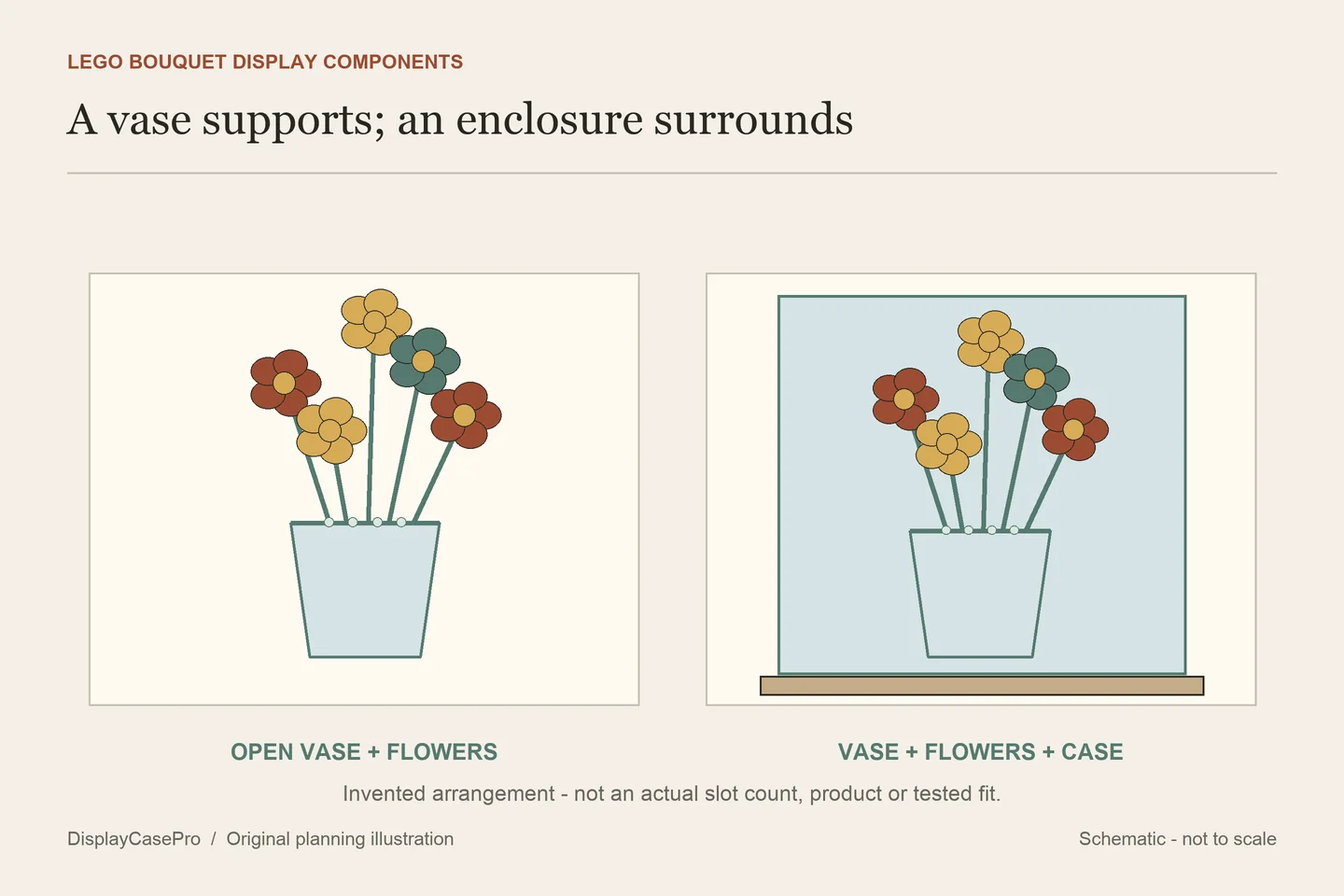
A LEGO flower bouquet display case and a LEGO flower vase solve different problems. The vase holds or arranges the stems. An enclosure surrounds the completed arrangement. You may want either one, or both, but an open vase is not a closed cover for the petals and leaves.
Choose your exact bouquet, vase and stem arrangement before ordering an enclosure. Unlike a model with one fixed base, a bouquet can change height and width as you adjust the stems, spread the flowers or combine sets. A case matched to a set number does not automatically cover every arrangement you can make from it.
Start with the bouquet, not a generic Botanicals label
LEGO’s official Flower Bouquet 10280 page says a vase is not included. It describes adjustable stem lengths and positionable petals and leaves. Its reference to one straight snapdragon measuring over 36 cm is a stem example, not the overall height of every finished bouquet.
That distinction changes the shopping list. Record the set number or the sets being mixed, the stems you intend to display, the chosen vase and any separate support insert. Then ask what the display product includes. A photograph of flowers in a vase inside a case may show several components sold separately.
The broad Botanical name also covers arrangements with very different forms. An orchid, a bonsai, a garden scene and a loose-stem bouquet should not be treated as interchangeable case tasks. The iDisplayit Botanical category, for example, lists dedicated cases for several named sets, including Flower Arrangement 10345. That category is a starting point for finding the right set, not evidence that every listed enclosure fits your chosen vase.
Read the exact vase version, including stem capacity
One category can contain several sizes of vase and other open supports. The Wicked Brick Botanicals category includes open vases and wall-mounted stands. Its category FAQ describes capacity for up to twelve stems, while the exact large clear vase product gives a different capacity.
| Specific item | Published detail | What remains separate |
|---|---|---|
| Wicked Brick Large Clear Vase, LDS498.1.1 | Up to 24 stems in individual slots; W12 × D12 × H18 cm. | The flower spread and completed height above/around the vase; any enclosure. |
| Official Pick a Brick vase article | A separate vase bundle with a 7 cm neck width and 21 cm height. | The chosen bouquet and customization; a vase neck is not case width. |
| BrickShell Roses 10328 enclosure | H13 × W13 × D13 in; vase and LEGO set excluded. | The size line does not say inside or outside. Confirm the exact vase and arrangement. |
The exact large-vase page, read directly in October 2026, lists 10280, 10313 and 10328 among its compatible sets. That supports checking it for those sets; it does not turn the twenty-four-slot capacity into a guarantee that every flower head can occupy every neighboring position.
Count the stems you plan to use and consider the arrangement as well as the available slots. Closely grouped large flowers and a spread-out mixed bouquet can look very different in the same support. If one vase is too crowded for the composition you want, consider a different intended support or separate arrangements before choosing a larger enclosure.
The category’s twelve-stem statement and the large leaf’s twenty-four-stem statement should not be averaged or silently applied to all versions. Keep the item name, size and source together. The same applies to a clear-versus-black option or a seasonal design: confirm whether the selected version changes only the appearance or also the physical configuration.
Measure the vase and flowers together
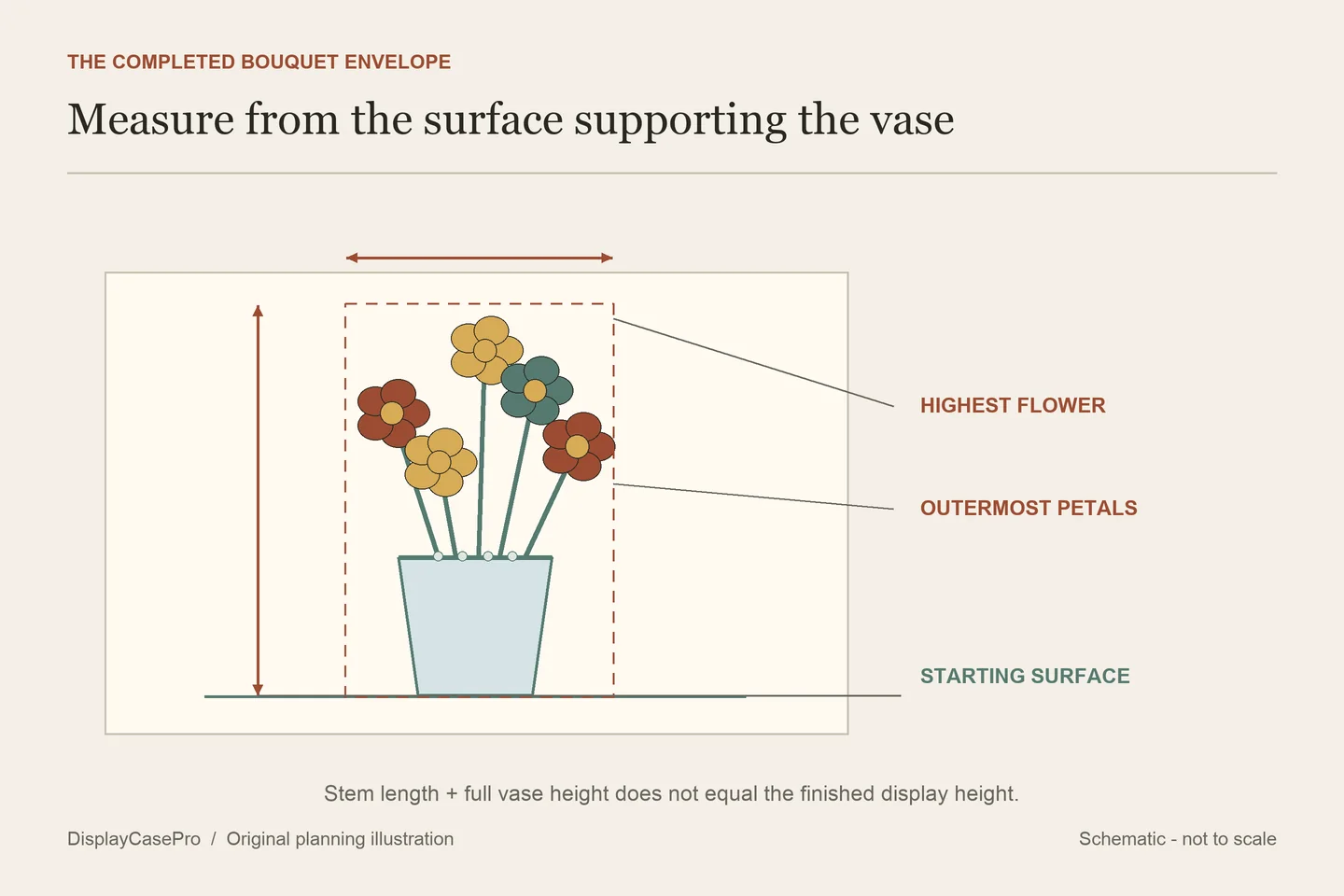
Finish the intended arrangement first. Check the outermost petals and leaves from the front and side, the highest flower, and the complete vase footprint. Preserve the arrangement while measuring it; pressing a leaf inward to clear a ruler does not record its normal display profile.
Measure height from the surface on which the vase will stand. Do not add the full stem length to the full vase height: part of a stem may sit within the support, and different stems may be positioned differently. Conversely, measuring only the visible flowers above the vase omits the lower part of the display.
For a case, request usable inside width, depth and height measured from its actual display floor. Ask whether connectors, the cover seating or a raised plinth reduce that space. The BrickShell 10328 example’s thirteen-inch size line is not labeled as an interior, so it should not be used as thirteen inches of guaranteed clear space for your vase.
Check the outside footprint separately against the surface where the complete case will sit. A vase that fits neatly on a narrow shelf can require a much wider enclosure once the flowers spread. Furniture must suit the complete loaded arrangement, not only the empty vase.
Allow for the opening method without guessing a universal gap
If the cover lifts off, check how it passes the widest flowers and where it can be set down. If a panel opens, check the admission route for the vase and the intended arrangement. A bouquet can fit within the closed interior while being awkward to place through a smaller opening.
Ask the maker how the specific enclosure is intended to be assembled and accessed around a flower display. Do not use the petals or stems to push panels into alignment. Any repositioning should follow the model and support instructions, with the final arrangement checked again afterward.
Choose for your rearranging routine
Choose an open vase when the visible, accessible bouquet is the main goal. It can suit frequent changes to color, height or grouping, provided the selected support is appropriate for the arrangement. Accept that the flowers remain exposed; an open slotted vase does not provide an enclosure around their upper surfaces.
Consider a complete case when reducing exposure is part of the goal. Verify how enclosed it is and how you will reach the bouquet. A maker’s “dust-free” description is not an independent test of every joint or installation, and the case does not establish light protection merely by being clear.
Use a vase inside a case when you want both functions. Confirm the two products together, including the cover’s route. A listing that excludes the vase requires you to identify a suitable separate one; the photographed arrangement is not a bill of materials.
A fixed envelope can also set a practical boundary for later rearrangements. If you extend stems or add flowers, recheck the completed height and spread before returning the cover. Keep the original arrangement record so you can see what changed rather than relying on the original set’s compatibility label.
This guide does not prescribe fillers, adhesives, water or gel for holding the stems. Those are additional material and support choices, not consequences of buying a vase. Ask the relevant maker about compatibility instead of adopting a decorative suggestion as a tested support method.
Prepare a useful bouquet display enquiry
The bouquet, vase and case worksheet has separate fields for stem count, exact vase version, completed envelope and dimension definitions. Use it for one arrangement at a time.
A focused question is: “I plan to display [set numbers] with [vase model], arranged to [measured W/D/H and units]. Does this exact case provide sufficient clear internal space and an appropriate opening route? Is the vase included, and what changes if I select the other base or backdrop?” Include a simple front and side sketch if the arrangement is asymmetric.
Our collection measurement guide explains the underlying envelope method. For bouquets, the extra decision is to finish the vase-and-stem composition before treating any catalog size as a case requirement.
Does a LEGO flower case include a vase?
Check the exact package. The 10280 model excludes one, and the BrickShell 10328 case example also excludes the vase and set. A separately described vase bundle or slotted support is a different purchase component.
Can one Botanical case fit all my flowers?
A shared collection name does not establish that. Identify the exact sets, vase and completed arrangement, then compare a confirmed usable interior and opening route. Recheck when the stems or flower spread change.
Comments
Share a display tip or ask a question.