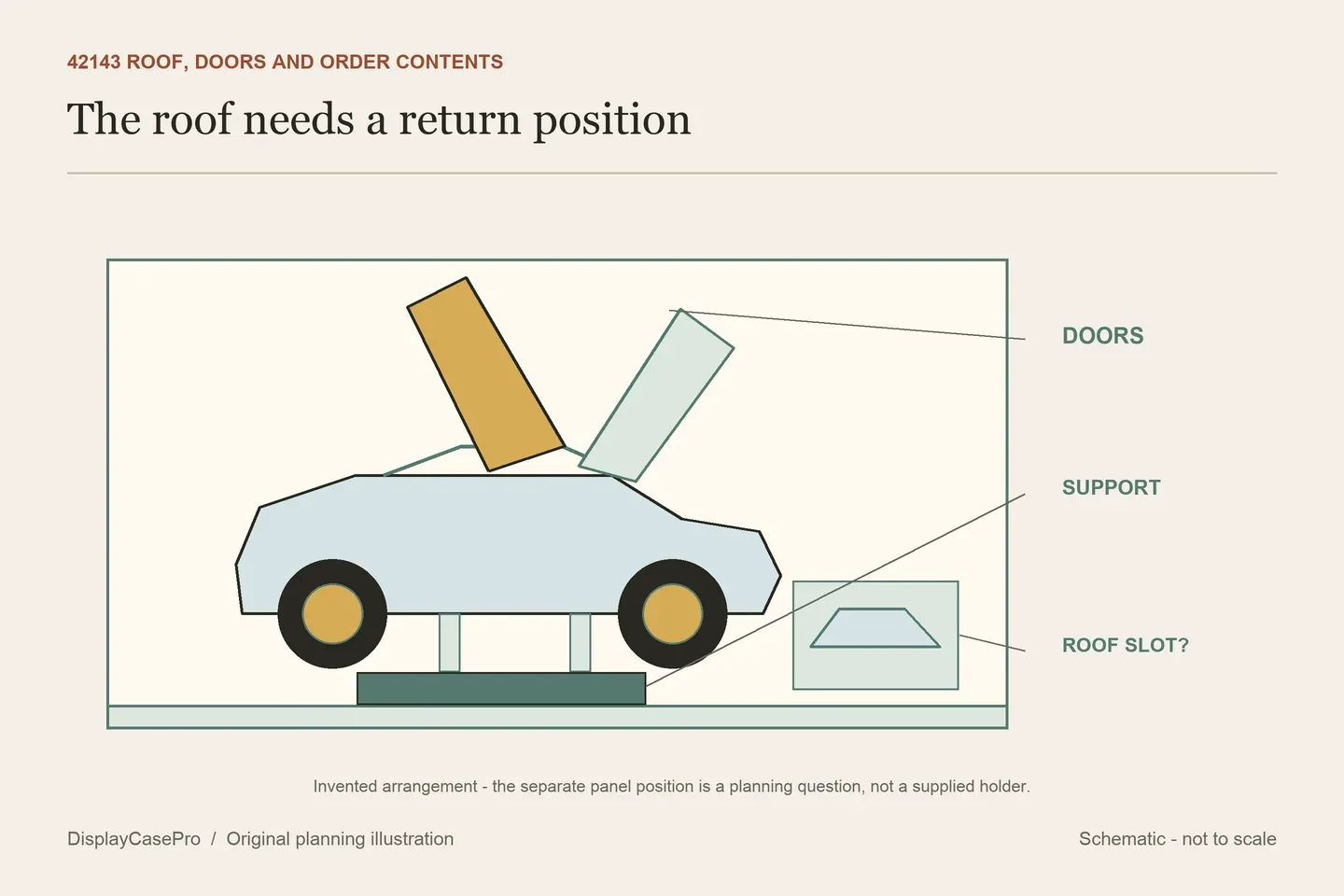
Choose a LEGO Ferrari Daytona SP3 display case around set 42143's roof, butterfly doors, support and display plate. Decide where a removed roof will go and whether the doors form a settled scene or will be opened only after removing the cover. Then compare the exact case and stand option with that whole arrangement.
The 42143 reference is a starting point, not an open-door envelope
The official Ferrari Daytona SP3 specification describes a 1:8 model over H14 × L59 × W25 cm. Its features include opening butterfly doors, a removable roof, an opening hood and a decorated display plate. Those parts create several display decisions beyond the car's everyday body outline.
Record 42143 before comparing enclosures. A case or wall board for another Ferrari is not documented compatibility simply because it uses red artwork or the Ferrari name. The model's reference height also does not establish clearance above an aftermarket support.
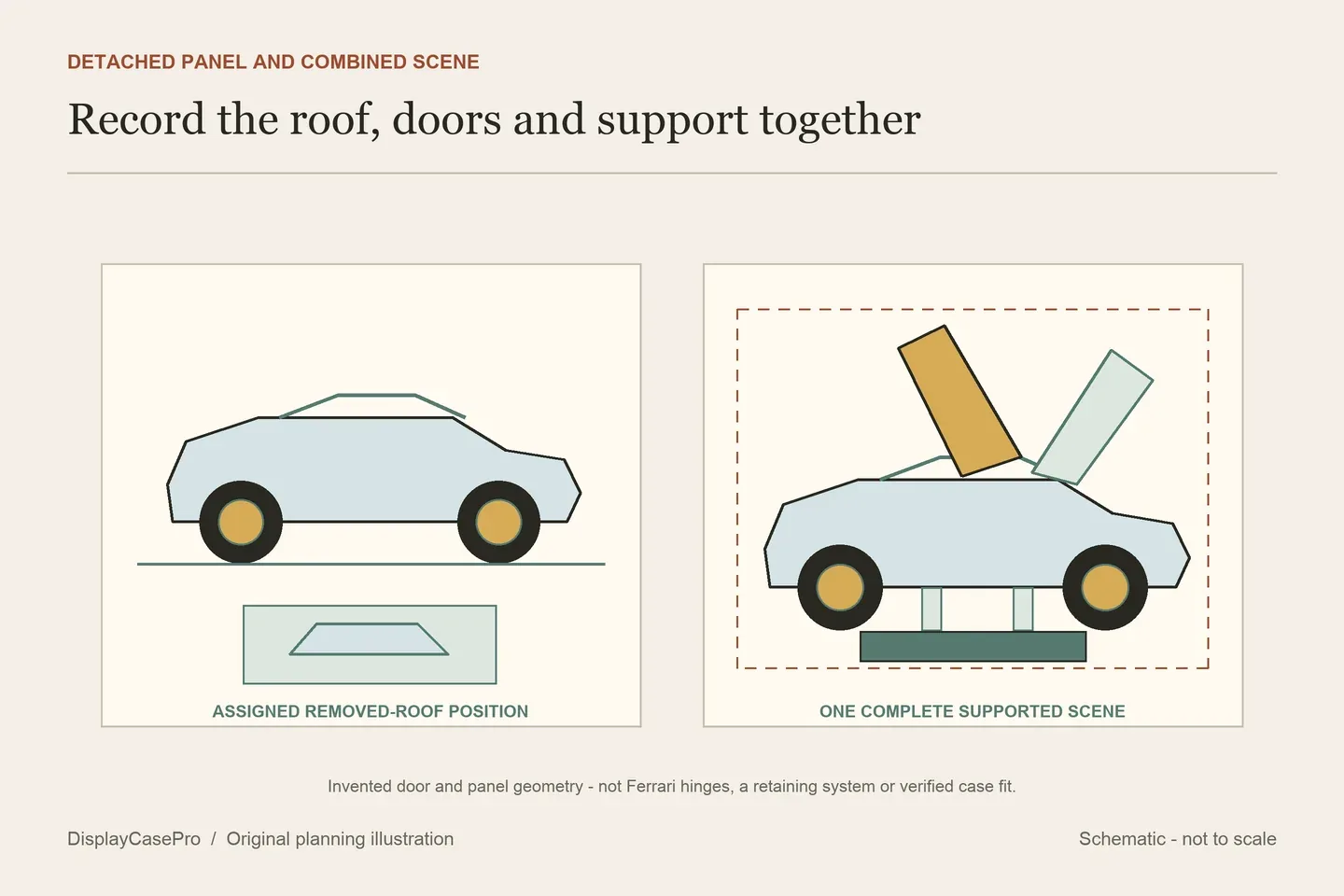
Choose the arrangement you want to see from the room. A closed-roof car emphasizes the body line. Removing the roof exposes a different view of the cockpit. Raised doors add another upper outline. These choices should appear together in one fit record rather than as unrelated assurances that individual parts can open.
Give the detached roof an actual destination
| Scene | Record | Do not assume |
|---|---|---|
| Roof fitted, doors closed | Complete car on its selected support, with the display plate. | The same enclosure accommodates every open-panel pose. |
| Roof removed, doors in a chosen position | Both doors, the exposed cockpit view and the roof's separate storage location. | Removing a roof creates a supplied compartment for that loose part. |
| Roof displayed beside the car | A defined resting position for the detached panel, separate from the plaque and support. | Unused-looking floor in a photograph is confirmed accessory space. |
If the roof remains outside the enclosure, give it an identified storage location in your collection record. If it stays inside, include its supported outline in the scene. Avoid choosing an enclosure that depends on the panel resting against a closing wall or covering the information plate.
For the doors, decide between a permanent raised pose and occasional demonstration. The first needs the complete static outline of both doors on the actual support. The second needs practical access after opening the enclosure. Neither proves that the full butterfly-door movement works with the cover fitted.
The hood adds a separate front-end question. Showing it raised to reveal the serial-number area is different from keeping the car closed. Do not combine the smallest quoted car height with an open hood, detached roof and raised doors without a drawing or record of that complete arrangement.
Keep each case's size definition and receiving system
These examples were read on 17 October 2026. They are catalogue descriptions, not measured fit tests or rankings. Unlabelled dimensions remain unlabelled; clear height has not been reconstructed from acrylic thickness.
| Case | Published information | Question to settle |
|---|---|---|
| Wicked Brick 42143 tabletop | W64 × D36.2 × H16 cm; inside/outside not specified. The description explicitly includes a display stand. | The actual support, clear receiving space and combined roof/door state assumed by the product. |
| Brickcessories 42143 | Assembled 660 × 330 × 180 mm; black base, clear or black rear and corner brackets. | Axes, interior/exterior boundary and the intended car arrangement. |
| iDisplayit 42143 XL | Inside L65 × W39 × H24 cm; outside L67 × W41 × H25 cm. | The exact stand order option, selected roof and doors, and cover route. |
| Blacked Brick 42143 | External W72 × D40 × H16.2 cm; set-specific base cut-out and information plaque. | The clear cavity and the model state received by that base cut-out. An added stand is a different arrangement. |
A 24 cm labelled interior and a 16.2 cm external height are different measurements. They cannot be ranked as spare room without the supported scene and reference surfaces. A lower external case might be intended for a different presentation rather than being a smaller version of an angled display.
For the unlabelled Wicked Brick height, do not subtract the model's H14 reference to manufacture a support allowance. Its stand is part of the described product, but the height line does not independently identify free air above the finished base.
A separately listed stand does not settle what the case contains
The Wicked Brick collection contains a tabletop case, open stand, wall-mounted case and wall-mounted stand. They are distinct formats. Its linked tabletop case nevertheless explicitly says it includes a stand to lift the Ferrari. Use that exact product description instead of assuming the separately sold stand makes every case stand-free.
iDisplayit's XL page presents the opposite order-selection question. Its text calls the photographed stand separately sold, and the selector offers Acrylic Stand for LEGO Technic and None/Already Purchased. Record the chosen line and contents. The XL title alone does not say which stand option has been ordered.
A supplied support still needs its own intended contact arrangement and complete posed dimensions. Do not add another stand, change the mounting angle or use an unconfirmed base cut-out merely to reproduce an open-door photograph.
Check the current rear panel and product-specific stacking restriction
Wicked Brick's page notes that photographs show a vinyl background sticker while the current display comes with an upgraded UV-printed rear panel of the same design. Keep that change with the chosen option. A photograph's surface treatment is not necessarily the component currently supplied, and UV printing is not a UV-filtering specification.
The same page explicitly says this case does not stack with the other Technic Ultimate Car Concept cases. Do not transfer another model's stacking description to it. iDisplayit's Clear (Stackable) base is separately named; that label does not approve mixed-brand stacks or arbitrary loads.
The Elevenmark promotional article discusses door movement, lighting and protection in broad terms. It does not supply the receiving drawing needed to verify your combined scene. Treat those promises as questions for an exact product rather than independent evidence of door clearance or fade prevention.
Identify how the selected clear section opens and where it will rest during a roof or door change. iDisplayit says its case is not designed to be relocated with the LEGO set inside. Keep the display at a workable location instead of relying on moving a filled enclosure for routine access.
Use the Daytona roof, doors and support worksheet. The collection measurement guide covers the receiving location and full occupied outline. This comparison does not verify mounting strength, dust isolation or material protection.
Common questions
Does every Daytona case need a separately purchased stand?
No single rule covers the examples. One cited case explicitly includes a stand, while another asks you to choose an added stand or a case-only option.
Does a removable roof reduce all the required space?
It changes the scene. If the panel remains inside, it needs its own position; raised doors and the support still need their full outlines.
Does a case that fits raised doors allow them to move inside?
A fixed pose does not prove the movement range. Establish access before changing features unless the complete in-case operation is documented.
Comments
Share a display tip or ask a question.