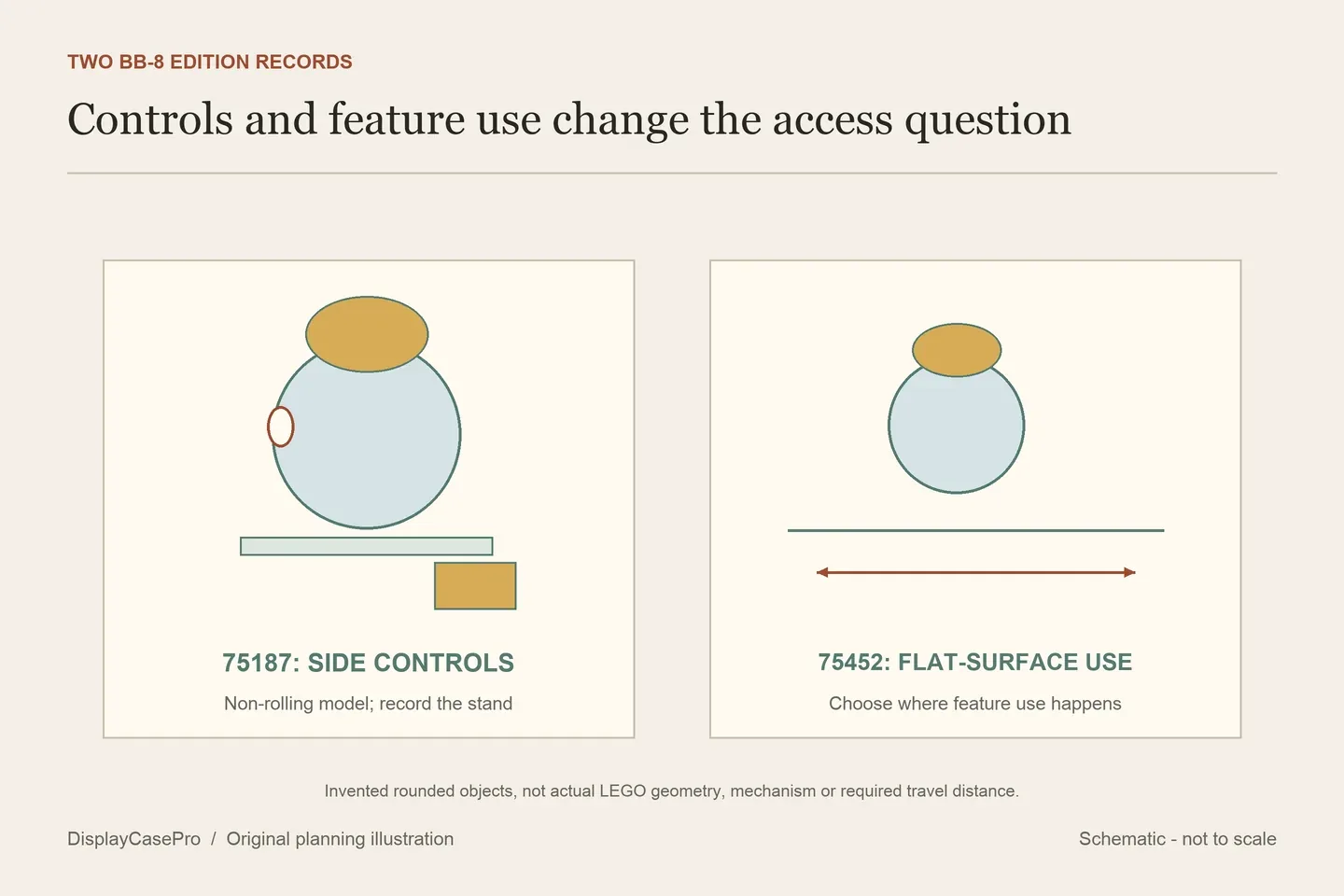
Before choosing a LEGO BB-8 display case, identify whether you have 75187 or 75452. The earlier build uses side controls and does not roll. The newer build moves across a flat surface to make its head spin. Their display arrangements and access needs cannot be reduced to two sizes of the same orange-and-white sphere.
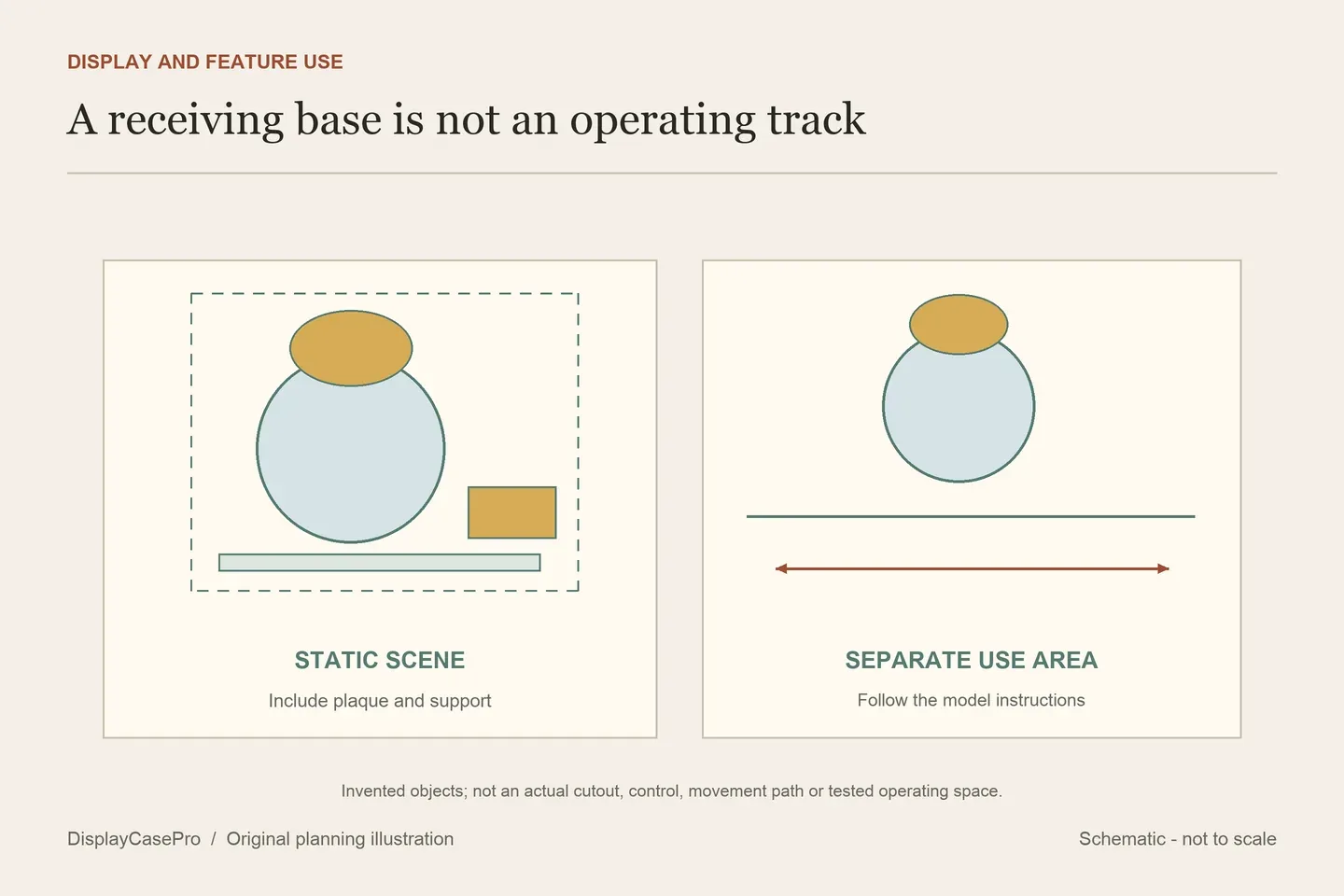
Choose a closed display state first: model, support where applicable, plaque, small figure and hatch position. Then decide where you will use the features. A locating cutout or a nominal stud area can organize a static scene without providing room to operate the model there.
Identify the controls as well as the set number
LEGO's 75187 specifications describe side wheels for head rotation and the hatch with its non-working torch. They explicitly say the model does not roll. The model without its stand is over 25 cm high and 15 cm wide; the stand has a separate published length of over 26 cm.
Those references describe different components. Do not add them into a finished display dimension, treat the bare-model height as the supported scene height, or assume that every case keeps the original stand and plaque in the same arrangement.
For 75452, LEGO describes moving BB-8 across a flat surface to activate the head-spinning feature, together with a body hatch and burner arm. Its figure stands over 9 cm tall. The plaque and standard-size BB-8 figure still need their own positions; that height is not the whole scene's size.
Compare sizes without losing the axis labels
These exact descriptions were read in October 2026. The Blacked Brick main was accessible through an ordinary primary-domain indexed result with a two-month crawl age; it is not a live stock check. “Unlabelled” below identifies missing definitions, not a measurement made by this site.
| Listing and edition | Published dimension line | Keep with the specification |
|---|---|---|
| Wicked Brick 75187 | External W28 × D23 × H26.3 cm. | Two-tier magnetic base; front positions for the small figure and LEGO plaque. Clear cavity is not given here. |
| Blacked Brick 75452 | External W21 × D23 × H21 cm. | Locating cutout for the set and plaque; supplied information plaque. No usable travel area is established. |
| iDisplayit 75452 | Inside L18 × W18 × H20 cm; outside L20 × W20 × H21 cm. | Loose lid and surround locating on a base; nominal 22 × 22 stud area. |
| Brickcessories 75452 | Inside 194 × 204 × 220 mm; outside 206 × 216 × 227.5 mm. | Tuple axes are unlabelled. Confirm which direction faces the intended view. |
| Songlection 75187 | Inside W32 × D21 × H30 cm. | 10 mm black WPC base and 3 mm acrylic panels; outside footprint still needed. |
Do not use the 75452 rows to select an enclosure for 75187, even if a store photograph looks similar. Within one edition, preserve inside versus outside, axis order and base construction. A 20 cm external width is not a 20 cm clear cavity, and the Songlection inner width does not give the furniture footprint.
The base can change what the numbers describe
Wicked Brick's 75187 description discusses a two-tier 10 mm base and also contains a separate 5 mm baseplate material line. That is not enough information to calculate clear interior height by subtraction. Ask for the actual receiving dimensions and intended support scene instead of choosing which thickness to deduct.
The Blacked Brick cutout and iDisplayit stud-area description answer different layout questions. A cutout may define a supplied resting position; a stud count describes a nominal base area. Neither proves that the newer BB-8 can be moved around inside without contacting a panel, plaque or another component.
Keep the Songlection WPC base identified as such rather than describing the complete product as an acrylic base-and-cover system. Material names do not establish handling limits or care equivalence. Follow the exact case instructions for assembly, opening and any proposed relocation.
Separate the static scene from using the features
For 75187, record whether the hatch will be closed or shown open and whether the torch is extended. Confirm the static outline for that choice. If you want to use its side controls, check that your hands and the permitted movement have access; the clear panel being transparent does not make the control reachable.
For 75452, decide where you will perform the flat-surface movement described by LEGO. Do not treat the case floor as an operating track simply because it looks flat in a photograph. The source product descriptions do not establish a suitable movement distance inside their enclosures.
If feature use will happen outside, plan a clear place for the model and a separate resting place for the cover. Follow the actual model instructions when moving it and returning it to the display position. Preserve the intended plaque and small-figure locations so you do not need to improvise a crowded layout each time.
iDisplayit describes a top lid followed by a clear surround that locates on the base, and explicitly says the case is not designed to be relocated with the LEGO inside. Moving a loaded enclosure is therefore not the access method proposed here. Other cases require their own instructions rather than this sequence by analogy.
Make the feature-use decision part of the enquiry
Use the BB-8 edition and access worksheet to keep exact set, hatch state, controls, base, plaques, cavity and exterior together. Leave unknown axis labels and operating clearances as questions; do not fill them from a product photograph.
A useful enquiry is: “I have [75187 / 75452], displayed with [support and plaque arrangement], and want the hatch [state]. Please confirm this static configuration, labelled clear dimensions and complete outer footprint. What opening and removal sequence is intended if I use the model's features outside the case?”
The collection measurement guide covers the whole arrangement and furniture checks. Keep the edition-specific feature record alongside it: another droid's published measurements or a generic spherical outline cannot replace that configuration.
Common questions
Can I use the old BB-8 as a rolling display?
LEGO explicitly states that 75187 does not roll. Use its documented controls and instructions.
Does 75452's 9 cm reference describe the case I need?
No. It describes the figure's published height, excluding the complete scene, desired hatch state and handling space.
Can I roll the newer model inside a case with a stud-area specification?
The cited stud-area figure does not establish that use. Confirm the intended display and use a suitable location for the feature according to the model instructions.
About this guide: Reference-led edition and access comparison with original schematics. No mechanism, movement path, base, material performance or case fit was physically tested.
Comments
Share a display tip or ask a question.